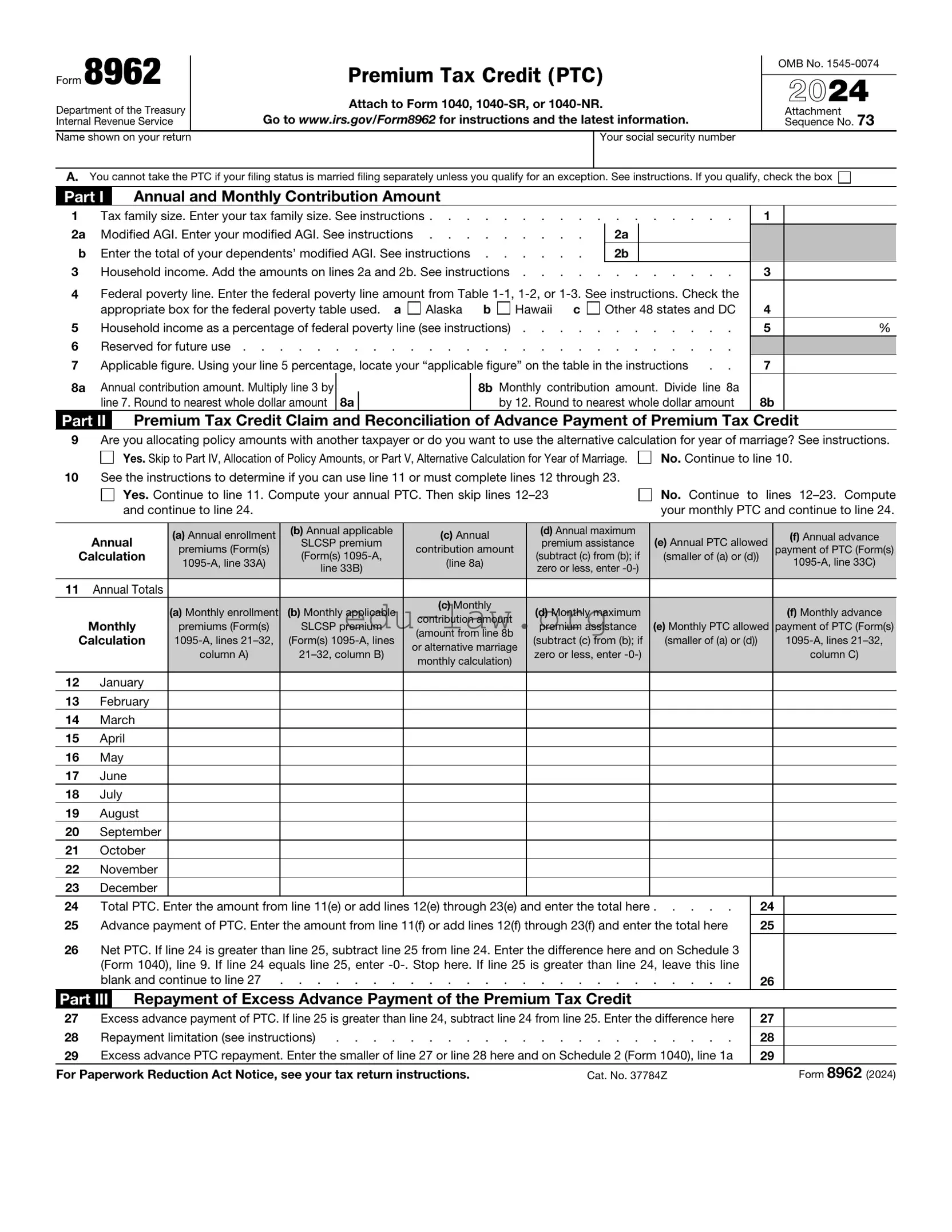
The IRS 8962 form plays a crucial role for individuals who received premium tax credits to help pay for their health insurance under the Affordable Care Act (ACA). This form is essential for reconciling the amount of premium tax credit you received with what you were actually eligible for based on your annual income. If you received financial assistance to lower your monthly health insurance premiums, completing this form accurately is vital to ensure compliance with tax regulations. The form requires you to provide information about your household income, the number of individuals in your household, and the health insurance coverage you had during the year. Additionally, it helps determine if you need to repay any excess premium credits or if you are eligible for additional credits. Understanding how to fill out the IRS 8962 form can help you avoid unexpected tax liabilities and ensure you receive the correct benefits for your health coverage.
Form 8962
Department of the Treasury Internal Revenue Service
Name shown on your return
Premium Tax Credit (PTC)
Attach to Form 1040,
Go to www.irs.gov/Form8962 for instructions and the latest information.
Your social security number
OMB No.
2024
Attachment Sequence No. 73
A.You cannot take the PTC if your filing status is married filing separately unless you qualify for an exception. See instructions. If you qualify, check the box
Part I Annual and Monthly Contribution Amount
1 |
Tax family size. Enter your tax family size. See instructions |
. . . . . . . . |
|
1 |
|
||
2a |
Modified AGI. Enter your modified AGI. See instructions |
|
2a |
|
|
|
|
b |
Enter the total of your dependents’ modified AGI. See instructions |
|
2b |
|
|
|
|
3 |
Household income. Add the amounts on lines 2a and 2b. See instructions . . . . |
. . . . . . . . |
|
3 |
|
||
4Federal poverty line. Enter the federal poverty line amount from Table
|
appropriate box for the federal poverty table used. a |
Alaska |
b |
Hawaii |
c |
Other 48 states and DC |
4 |
|
|
5 |
Household income as a percentage of federal poverty line (see instructions) |
5 |
% |
||||||
6 |
Reserved for future use |
|
|
||||||
7 |
Applicable figure. Using your line 5 percentage, locate your “applicable figure” on the table in the instructions |
. . |
7 |
|
|||||
8a |
Annual contribution amount. Multiply line 3 by |
|
8b Monthly contribution amount. Divide line 8a |
|
|
||||
|
line 7. Round to nearest whole dollar amount 8a |
|
|
by 12. Round to nearest whole dollar amount |
8b |
|
|||
Part II Premium Tax Credit Claim and Reconciliation of Advance Payment of Premium Tax Credit
9Are you allocating policy amounts with another taxpayer or do you want to use the alternative calculation for year of marriage? See instructions.
Yes. Skip to Part IV, Allocation of Policy Amounts, or Part V, Alternative Calculation for Year of Marriage. |
No. Continue to line 10. |
10See the instructions to determine if you can use line 11 or must complete lines 12 through 23.
Yes. Continue to line 11. Compute your annual PTC. Then skip lines
No. Continue to lines
Annual |
(a) Annual enrollment |
(b) Annual applicable |
(c) Annual |
(d) Annual maximum |
(e) Annual PTC allowed |
(f) Annual advance |
|
SLCSP premium |
premium assistance |
||||||
premiums (Form(s) |
contribution amount |
payment of PTC (Form(s) |
|||||
Calculation |
(Form(s) |
(line 8a) |
(subtract (c) from (b); if |
(smaller of (a) or (d)) |
|||
|
line 33B) |
zero or less, enter |
|
||||
|
|
|
|
|
|||
|
|
|
|
|
|
|
11Annual Totals
|
(a) Monthly enrollment |
(b) Monthly applicable |
(c) Monthly |
(d) Monthly maximum |
|
(f) Monthly advance |
|
|
contribution amount |
|
|||||
Monthly |
premiums (Form(s) |
SLCSP premium |
premium assistance |
(e) Monthly PTC allowed |
payment of PTC (Form(s) |
||
(amount from line 8b |
|||||||
Calculation |
(Form(s) |
(subtract (c) from (b); if |
(smaller of (a) or (d)) |
||||
or alternative marriage |
|||||||
|
column A) |
zero or less, enter |
|
column C) |
|||
|
monthly calculation) |
|
|||||
|
|
|
|
|
|
||
|
|
|
|
|
|
|
12January
13February
14March
15April
16May
17June
18July
19August
20September
21October
22November
23December
24 |
Total PTC. Enter the amount from line 11(e) or add lines 12(e) through 23(e) and enter the total here |
24 |
25 |
Advance payment of PTC. Enter the amount from line 11(f) or add lines 12(f) through 23(f) and enter the total here |
25 |
26Net PTC. If line 24 is greater than line 25, subtract line 25 from line 24. Enter the difference here and on Schedule 3 (Form 1040), line 9. If line 24 equals line 25, enter
|
blank and continue to line 27 |
26 |
|
||
Part III |
Repayment of Excess Advance Payment of the Premium Tax Credit |
|
|
||
27 |
Excess advance payment of PTC. If line 25 is greater than line 24, subtract line 24 from line 25. Enter the difference here |
27 |
|
||
28 |
Repayment limitation (see instructions) |
28 |
|
||
29 |
Excess advance PTC repayment. Enter the smaller of line 27 or line 28 here and on Schedule 2 (Form 1040), line 1a |
29 |
|
||
For Paperwork Reduction Act Notice, see your tax return instructions. |
Cat. No. 37784Z |
|
Form 8962 (2024) |
||
Form 8962 (2024) |
Page 2 |
|
Part IV |
Allocation of Policy Amounts |
|
Complete the following information for up to four policy amount allocations. See instructions for allocation details.
Allocation 1
30(a) Policy Number (Form
(b)SSN of other taxpayer
(c)Allocation start month
(d)Allocation stop month
Allocation percentage applied to monthly amounts
(e)Premium Percentage
(f)SLCSP Percentage
(g)Advance Payment of the PTC Percentage
Allocation 2
31(a) Policy Number (Form
(b)SSN of other taxpayer
(c)Allocation start month
(d)Allocation stop month
Allocation percentage applied to monthly amounts
(e)Premium Percentage
(f)SLCSP Percentage
(g)Advance Payment of the PTC Percentage
Allocation 3
32(a) Policy Number (Form
(b)SSN of other taxpayer
(c)Allocation start month
(d)Allocation stop month
Allocation percentage applied to monthly amounts
(e)Premium Percentage
(f)SLCSP Percentage
(g)Advance Payment of the PTC Percentage
Allocation 4
33(a) Policy Number (Form
(b)SSN of other taxpayer
(c)Allocation start month
(d)Allocation stop month
Allocation percentage applied to monthly amounts
(e)Premium Percentage
(f)SLCSP Percentage
(g)Advance Payment of the PTC Percentage
34Have you completed all policy amount allocations?
Yes. Multiply the amounts on Form
No. See the instructions to report additional policy amount allocations.
Part V Alternative Calculation for Year of Marriage
Complete line(s) 35 and/or 36 to elect the alternative calculation for year of marriage. For eligibility to make the election, see the instructions for line 9. To complete line(s) 35 and/or 36 and compute the amounts for lines
35 |
Alternative entries |
(a) |
Alternative family size |
(b) Alternative monthly |
(c) |
Alternative start month |
(d) |
Alternative stop month |
|
|
contribution amount |
|
|
|
|
||
|
for your SSN |
|
|
|
|
|
|
|
|
|
|
|
|
|
|
|
|
|
|
|
|
|
|
|
|
|
36 |
Alternative entries |
(a) |
Alternative family size |
(b) Alternative monthly |
(c) |
Alternative start month |
(d) |
Alternative stop month |
|
|
contribution amount |
|
|
|
|
||
|
for your spouse’s |
|
|
|
|
|
|
|
|
|
|
|
|
|
|
|
|
|
SSN |
|
|
|
|
|
|
|
|
|
|
|
|
|
|
|
Form 8962 (2024) |
| Fact Name | Description |
|---|---|
| Purpose | The IRS Form 8962 is used to calculate the Premium Tax Credit, which helps eligible individuals and families pay for health insurance coverage obtained through the Health Insurance Marketplace. |
| Eligibility | To qualify for the Premium Tax Credit, taxpayers must meet certain income requirements and cannot be eligible for other types of affordable health coverage. |
| Filing Requirement | Taxpayers who received advance payments of the Premium Tax Credit must file Form 8962 with their federal tax return to reconcile the amount received with the actual credit amount. |
| State-Specific Forms | Some states may have their own versions of this form or additional requirements. For instance, California requires Form 3849 for state-level reconciliation of the Premium Tax Credit. |
| Deadline | The form must be submitted by the tax return deadline, which is typically April 15th of the following year, unless an extension has been filed. |
After you gather the necessary information and documents, you can begin filling out the IRS Form 8962. This form is essential for calculating your premium tax credit and reconciling it with the amount you received throughout the year. Follow these steps to complete the form accurately.
Once you have completed the form, you will need to submit it along with your tax return. Make sure to keep a copy for your records, as it may be required for future reference or audits.
What is IRS Form 8962?
IRS Form 8962 is used to calculate the Premium Tax Credit (PTC) for individuals and families who have purchased health insurance through the Health Insurance Marketplace. This form helps determine if you qualify for the credit, which can lower your monthly health insurance premiums. If you received advance payments of the premium tax credit, you must file this form to reconcile those payments with your actual income for the year.
Who needs to file Form 8962?
If you or any member of your household enrolled in a health plan through the Health Insurance Marketplace and received advance premium tax credits, you must file Form 8962 with your tax return. Even if you did not receive advance payments, you may still want to file the form to claim the premium tax credit based on your actual income.
How do I fill out Form 8962?
To fill out Form 8962, start by gathering your Form 1095-A, which provides information about your health insurance coverage. The form has several sections. You'll need to enter your household income, the number of people in your household, and the premium amounts you paid. Follow the instructions carefully to ensure accuracy. If you have questions while completing the form, the IRS website offers guidance and resources.
What if I did not receive Form 1095-A?
If you did not receive Form 1095-A, contact the Health Insurance Marketplace where you enrolled. They can provide you with a copy of the form or help you resolve any issues. It's essential to have this form to accurately complete Form 8962, as it contains critical information about your coverage and premium amounts.
What happens if I make a mistake on Form 8962?
If you realize you made a mistake after submitting Form 8962, you can correct it by filing an amended tax return using Form 1040-X. Be sure to include the corrected Form 8962 with your amended return. It's important to address any errors promptly, as they can affect your tax refund or liability.
Can I get help with Form 8962?
Yes, you can seek help with Form 8962 from various sources. The IRS provides resources on its website, including instructions for the form. Additionally, you may want to consult a tax professional or a certified public accountant (CPA) for personalized assistance. Community organizations may also offer free tax help, especially during tax season.
Filling out the IRS Form 8962 can be a daunting task, especially if you're not familiar with the ins and outs of tax forms. Many people make common mistakes that can lead to delays or even penalties. Here’s a list of four frequent errors to watch out for:
Incorrect Calculation of Premium Tax Credit: One of the most significant mistakes is miscalculating the premium tax credit. This credit helps reduce your monthly health insurance premiums. Ensure you accurately input your household income and family size to determine the correct amount.
Failure to Use Correct Marketplace Information: When filling out the form, it’s essential to use the correct information from your health insurance marketplace. Double-check the Form 1095-A you receive, as errors here can lead to incorrect entries on Form 8962.
Not Reporting All Income: Some individuals forget to report all sources of income. This can affect your eligibility for the premium tax credit. Include all taxable income, such as wages, self-employment income, and any other earnings.
Neglecting to Sign and Date the Form: A simple yet critical oversight is forgetting to sign and date the form. Without your signature, the IRS may not process your return. Always remember to sign before submitting!
By being mindful of these common pitfalls, you can navigate the Form 8962 process more smoothly and ensure your tax return is accurate. Take your time, double-check your entries, and don’t hesitate to seek assistance if needed.
The IRS Form 8962, also known as the Premium Tax Credit form, is essential for individuals who wish to claim the premium tax credit for health insurance purchased through the Health Insurance Marketplace. However, several other forms and documents often accompany it to ensure a complete and accurate filing. Below are four commonly used forms and documents that you may need.
Understanding these forms can simplify the process of filing your taxes and claiming the appropriate credits. Make sure to gather all necessary documents to ensure a smooth filing experience.
The IRS Form 1095-A is similar to Form 8962 because both documents relate to health insurance coverage obtained through the Health Insurance Marketplace. Form 1095-A provides information about the coverage, including the months you were covered and the premium amounts. This form is essential for completing Form 8962, as it helps taxpayers calculate their premium tax credit. Without the details from Form 1095-A, it would be challenging to accurately fill out Form 8962.
Form 1040, the individual income tax return, shares similarities with Form 8962 in that both are used by taxpayers to report their income and claim credits. While Form 1040 encompasses all income sources and deductions, Form 8962 specifically focuses on the premium tax credit. Taxpayers must include the information from Form 8962 on their Form 1040 to ensure they receive the correct tax benefits related to their health insurance coverage.
Form 8862 is another document that has a connection to Form 8962. This form is used to claim the Earned Income Tax Credit (EITC) after it has been denied in a previous year. Like Form 8962, Form 8862 requires taxpayers to provide specific information to validate their eligibility for a tax credit. Both forms help taxpayers navigate the complexities of claiming credits, ensuring they meet the necessary criteria to receive benefits.
Form 8888, which allows taxpayers to allocate their tax refund to multiple accounts, is also similar to Form 8962 in that both deal with financial benefits. While Form 8962 calculates the premium tax credit, Form 8888 helps taxpayers manage their refunds more effectively. Both forms require careful attention to detail to ensure that the financial benefits are accurately processed and received.
Lastly, Form 8863 is relevant as it pertains to education credits. Like Form 8962, it is used to claim a tax benefit, specifically for qualified education expenses. Both forms require taxpayers to provide detailed information to substantiate their claims. They serve as tools to maximize tax benefits, helping individuals reduce their overall tax liability through credits that support health insurance and education.
When filling out the IRS 8962 form, it's important to be thorough and accurate. Here’s a list of things you should and shouldn’t do:
Following these guidelines can help ensure that your IRS 8962 form is filled out correctly and efficiently.
The IRS Form 8962, also known as the Premium Tax Credit form, is essential for those who received health coverage through the Health Insurance Marketplace. However, several misconceptions surround this form. Here are seven common misunderstandings:
Understanding these misconceptions can help you navigate the complexities of the IRS Form 8962. Being informed will ensure you fulfill your tax obligations accurately and efficiently.
The IRS Form 8962 is essential for individuals who wish to claim the Premium Tax Credit. This form helps determine eligibility for the credit based on household income and family size. Below are key takeaways regarding the completion and use of this form.
Understanding these key points can facilitate a smoother filing process and ensure that individuals maximize their benefits under the Affordable Care Act.