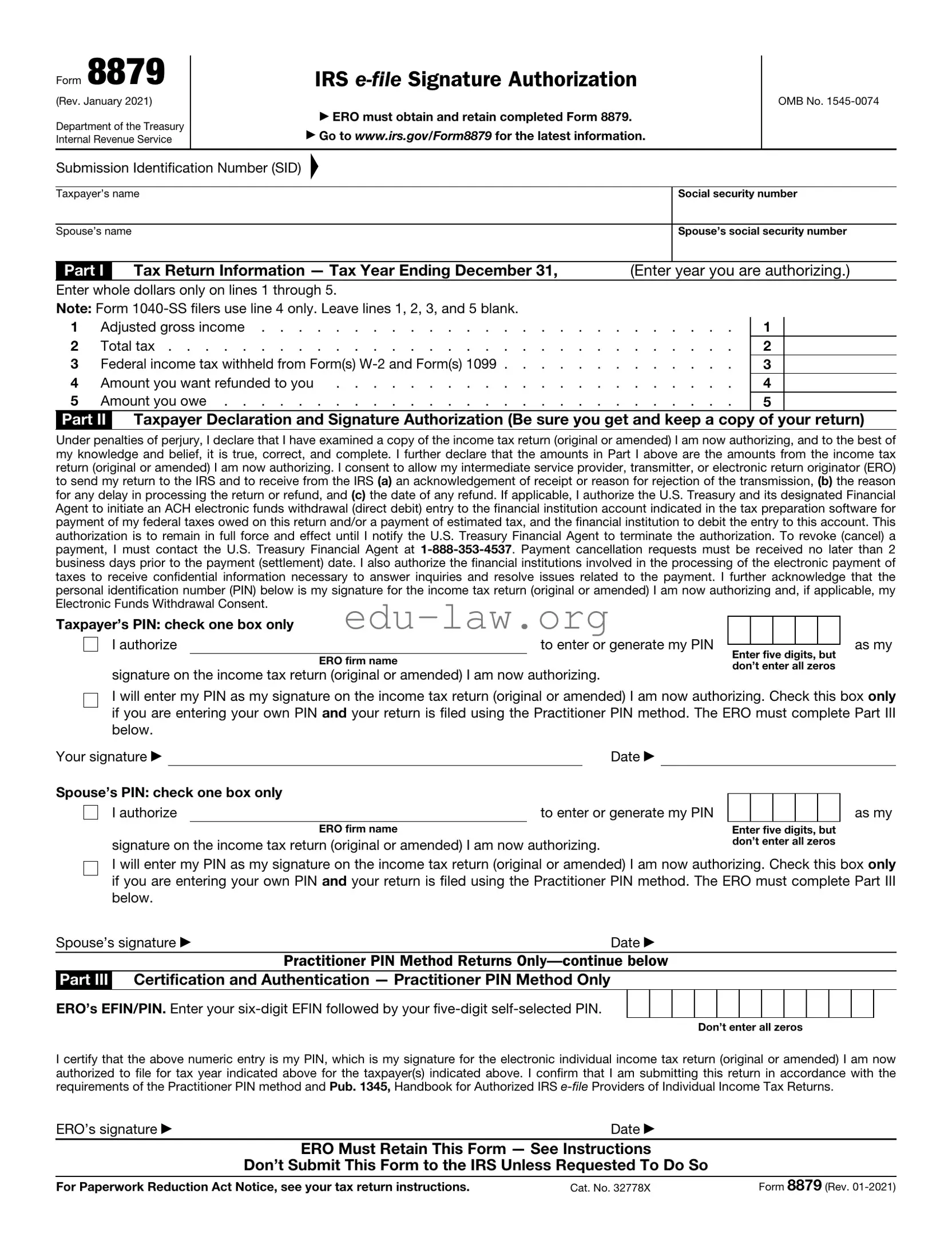
The IRS 8879 form plays a crucial role in the tax filing process for many individuals and businesses. This form serves as an electronic signature authorization for e-filed tax returns, allowing taxpayers to confirm their agreement with the information reported on their return. By signing the IRS 8879, taxpayers provide consent for their tax preparers to submit their returns electronically. This not only streamlines the filing process but also helps ensure that returns are processed more quickly by the IRS. Additionally, the form includes important details such as the taxpayer's name, Social Security number, and the tax year for which the return is being filed. Understanding the significance of the IRS 8879 form can help taxpayers navigate the complexities of electronic filing and ensure compliance with IRS regulations.

Form 8879
(Rev. January 2021)
Department of the Treasury Internal Revenue Service
IRS
▶ ERO must obtain and retain completed Form 8879.
▶Go to www.irs.gov/Form8879 for the latest information.
OMB No.
Submission Identification Number (SID)
▲
Taxpayer’s name |
|
|
|
Social security number |
||||
|
|
|
|
|
|
|
||
Spouse’s name |
|
|
|
|
Spouse’s social security number |
|||
|
|
|
|
|
|
|||
Part I |
|
Tax Return Information — Tax Year Ending December 31, |
|
(Enter |
year you are authorizing.) |
|||
Enter whole dollars only on lines 1 through 5. |
|
|
|
|
|
|||
Note: Form |
|
|
|
|
|
|||
1 |
Adjusted gross income |
. |
. . |
. |
. . . |
1 |
||
2 |
Total tax |
. |
. . |
. |
. . . |
2 |
||
3 |
Federal income tax withheld from Form(s) |
. |
. . |
. |
. . . |
3 |
||
4 |
Amount you want refunded to you |
. |
. . |
. |
. . . |
4 |
||
5 |
Amount you owe |
. |
. . |
. |
. . . |
5 |
||
Part II Taxpayer Declaration and Signature Authorization (Be sure you get and keep a copy of your return)
Under penalties of perjury, I declare that I have examined a copy of the income tax return (original or amended) I am now authorizing, and to the best of my knowledge and belief, it is true, correct, and complete. I further declare that the amounts in Part I above are the amounts from the income tax return (original or amended) I am now authorizing. I consent to allow my intermediate service provider, transmitter, or electronic return originator (ERO) to send my return to the IRS and to receive from the IRS (a) an acknowledgement of receipt or reason for rejection of the transmission, (b) the reason for any delay in processing the return or refund, and (c) the date of any refund. If applicable, I authorize the U.S. Treasury and its designated Financial Agent to initiate an ACH electronic funds withdrawal (direct debit) entry to the financial institution account indicated in the tax preparation software for payment of my federal taxes owed on this return and/or a payment of estimated tax, and the financial institution to debit the entry to this account. This authorization is to remain in full force and effect until I notify the U.S. Treasury Financial Agent to terminate the authorization. To revoke (cancel) a payment, I must contact the U.S. Treasury Financial Agent at
Taxpayer’s PIN: check one box only |
|
|
|
|
|
|
|
||
I authorize |
|
|
to enter or generate my PIN |
|
|
|
|
|
|
|
Enter five digits, but |
||||||||
|
|
ERO firm name |
|||||||
|
|
don’t enter all zeros |
|||||||
signature on the income tax return (original or amended) I am now authorizing. |
|||||||||
|
|
|
|
|
|||||
as my
I will enter my PIN as my signature on the income tax return (original or amended) I am now authorizing. Check this box only if you are entering your own PIN and your return is filed using the Practitioner PIN method. The ERO must complete Part III below.
Your signature ▶ |
|
|
Date ▶ |
|
|
|
|
|
|
Spouse’s PIN: check one box only |
|
|
|
|
|
|
|
||
|
|
|
|
|
|
|
|||
I authorize |
to enter or generate my PIN |
|
|
|
|
|
|||
|
|
ERO firm name |
|
|
Enter five digits, but |
||||
signature on the income tax return (original or amended) I am now authorizing. |
don’t enter all zeros |
||||||||
as my
I will enter my PIN as my signature on the income tax return (original or amended) I am now authorizing. Check this box only if you are entering your own PIN and your return is filed using the Practitioner PIN method. The ERO must complete Part III below.
Spouse’s signature ▶ |
Date ▶ |
|
Practitioner PIN Method Returns |
Part III Certification and Authentication — Practitioner PIN Method Only
ERO’s EFIN/PIN. Enter your
Don’t enter all zeros
I certify that the above numeric entry is my PIN, which is my signature for the electronic individual income tax return (original or amended) I am now authorized to file for tax year indicated above for the taxpayer(s) indicated above. I confirm that I am submitting this return in accordance with the requirements of the Practitioner PIN method and Pub. 1345, Handbook for Authorized IRS
ERO’s signature ▶ |
Date ▶ |
|
ERO Must Retain This Form — See Instructions |
|
|
Don’t Submit This Form to the IRS Unless Requested To Do So |
|
|
For Paperwork Reduction Act Notice, see your tax return instructions. |
Cat. No. 32778X |
Form 8879 (Rev. |
Form 8879 (Rev. |
Page 2 |
General Instructions
Section references are to the Internal Revenue Code unless otherwise noted.
Future developments. For the latest information about developments related to Form 8879 and its instructions, such as legislation enacted after they were published, go to www.irs.gov/Form8879.
What's New. Form 8879 is used to authorize the electronic filing
Purpose of Form
Form 8879 is the declaration document and signature authorization for an
|
|
▲ |
|
! |
Don’t send this form to the IRS. |
The ERO must retain Form 8879. |
|
CAUTION |
|
When and How To Complete
Use this chart to determine when and how to complete Form 8879.
IF the ERO is . . . |
THEN . . . |
|
|
|
|
Not using the Practitioner |
Don’t complete |
|
PIN method and the |
Form 8879. |
|
taxpayer enters his or her |
|
|
own PIN |
|
|
|
|
|
Not using the Practitioner |
Complete Form |
|
PIN method and is |
8879, Parts I and II. |
|
authorized to enter or |
|
|
generate the taxpayer’s |
|
|
PIN |
|
|
|
|
|
Using the Practitioner PIN |
Complete Form 8879, |
|
method and is authorized |
Parts I, II, and III. |
|
to enter or generate the |
|
|
taxpayer’s PIN |
|
|
|
|
|
Using the Practitioner PIN |
Complete Form 8879, |
|
Parts I, II, and III. |
||
method and the taxpayer |
||
|
||
enters his or her own PIN |
|
|
|
|
ERO Responsibilities
The ERO must:
1.Enter the name(s) and social security number(s) of the taxpayer(s) at the top of the form.
2.Complete Part I using the amounts (zeros may be entered when appropriate) from the taxpayer’s tax return. Form
3.Enter or generate, if authorized by the taxpayer, the taxpayer’s PIN and enter it in the boxes provided in Part II.
4.Enter on the authorization line in Part II the ERO firm name (not the name of the individual preparing the return) if the ERO is authorized to enter the taxpayer’s PIN.
5.Provide the taxpayer(s) Form 8879 by hand delivery, U.S. mail, private delivery service, email, Internet website, or fax.
6.Enter the
You must receive the completed ▲! and signed Form 8879 from the
taxpayer before the electronic CAUTION return is transmitted (or released
for transmission).
For additional information, see Pub. 1345.
Taxpayer Responsibilities
Taxpayers must:
1.Verify the accuracy of the prepared income tax return, including direct deposit information.
2.Check the appropriate box in Part II to authorize the ERO to enter or generate your PIN or to do it yourself.
3.Indicate or verify your PIN when authorizing the ERO to enter or generate it (the PIN must be five digits other than all zeros).
4.Sign and date Form 8879. Taxpayers must sign Form 8879 by handwritten signature, or electronic signature if supported by computer software.
5.Return the completed Form 8879 to the ERO by hand delivery, U.S. mail, private delivery service, email, Internet website, or fax.
Your return won’t be transmitted to the IRS until the ERO receives your signed Form 8879.
Refund information. You can check on the status of your refund if it has been at least 72 hours since the IRS acknowledged receipt of your
•Go to www.irs.gov/Refunds.
•Call
•Call
Important Notes for EROs
•Don’t send Form 8879 to the IRS unless requested to do so. Retain the completed Form 8879 for 3 years from the return due date or IRS received date, whichever is later. Form 8879 may be retained electronically in accordance with the recordkeeping guidelines in Rev. Proc.
•Confirm the identity of the taxpayer(s).
•Complete Part III only if you are filing the return using the Practitioner PIN method. You aren’t required to enter the taxpayer’s date of birth, prior year adjusted gross income, or PIN in the Authentication Record of the electronically filed return.
•If you aren’t using the Practitioner PIN method, enter the taxpayer(s) date of birth and either the adjusted gross income or the PIN, or both, from the taxpayer’s prior year originally filed return in the Authentication Record of the taxpayer’s electronically filed return. Don’t use an amount from an amended return or a math error correction made by the IRS.
•Enter the taxpayer’s PIN(s) on the input screen only if the taxpayer has authorized you to do so. If married filing jointly, it is acceptable for one spouse to authorize you to enter his or her PIN, and for the other spouse to enter his or her own PIN. It isn’t acceptable for a taxpayer to select or enter the PIN of an absent spouse.
•Taxpayers must use a PIN to sign their
•Provide the taxpayer with a copy of the signed Form 8879 for his or her records upon request.
•Provide the taxpayer with a corrected copy of Form 8879 if changes are made to the return (for example, based on taxpayer review).
•EROs can sign the form using a rubber stamp, mechanical device (such as a signature pen), or computer software program. See Notice
•Go to www.irs.gov/Efile for the latest information.
| Fact Name | Details |
|---|---|
| Purpose | The IRS Form 8879 is used to authorize an electronic return originator to file a taxpayer's federal income tax return electronically. |
| Eligibility | Taxpayers must have a valid Social Security Number (SSN) or Individual Taxpayer Identification Number (ITIN) to use this form. |
| Signature Requirement | Taxpayers must sign and date the form to provide consent for electronic filing. |
| Filing Deadline | The form must be signed and submitted by the tax return filing deadline, typically April 15, unless an extension is granted. |
| State-Specific Forms | Some states have their own versions of Form 8879, such as California's Form 8879 and New York's Form IT-201. Each state governs its own form under state tax law. |
| Retention Period | Taxpayers should retain a copy of Form 8879 for at least three years from the date the return is filed. |
| Electronic Signature | The form allows for electronic signatures, which simplifies the process of filing returns electronically. |
| Form Access | Form 8879 can be obtained from the IRS website or through tax preparation software that supports electronic filing. |
| Amendments | If a return needs to be amended, a new Form 8879 must be completed and signed for the amended return. |
| Importance of Accuracy | Providing accurate information on Form 8879 is crucial, as it ensures the proper filing of the tax return and avoids potential issues with the IRS. |
After completing the IRS 8879 form, you will need to submit it to your tax preparer. This form allows your tax preparer to electronically file your tax return on your behalf. It's essential to ensure that all information is accurate before moving forward with the submission process.
What is IRS Form 8879?
IRS Form 8879 is known as the "IRS e-file Signature Authorization." This form allows taxpayers to authorize an electronic return originator (ERO) to file their tax returns electronically on their behalf. It acts as a signature for the taxpayer, confirming that they approve the return and the information contained within it. By using this form, you can ensure a smoother e-filing process.
Who needs to use Form 8879?
If you are filing your taxes electronically through a tax professional or an ERO, you will likely need to use Form 8879. This includes individuals, businesses, and anyone else who is having their tax return submitted electronically. It's important to remember that if you are filing on your own using tax software, you may not need this form, as the software usually has built-in methods for authorization.
How do I complete Form 8879?
Completing Form 8879 is straightforward. First, make sure all your tax information is accurate and ready. Your ERO will provide you with the form after preparing your tax return. Fill in your personal information, including your name, address, and Social Security number. After reviewing your return, you will sign the form to authorize the ERO to e-file on your behalf. Make sure to keep a copy for your records.
What should I do if I need to amend my return after filing with Form 8879?
If you need to amend your return after it has been filed, you cannot use Form 8879 for that purpose. Instead, you will need to file Form 1040-X, which is the Amended U.S. Individual Income Tax Return. This form allows you to make corrections to your original return. Be sure to follow the instructions carefully and consult with your ERO or tax advisor if you have questions about the amendment process.
Not signing the form. The IRS 8879 requires the taxpayer's signature. Without it, the form is considered incomplete.
Incorrect Social Security Number (SSN). Entering an incorrect SSN can lead to delays in processing and potential issues with tax returns.
Missing the date. Failing to date the form can result in questions about when the form was completed, which may affect the validity of the submission.
Providing inaccurate income information. It's crucial to ensure that all reported income matches the documentation. Inconsistencies can trigger audits.
Not reviewing the form before submission. A thorough review can catch errors that may have been overlooked, such as typos or missing information.
Forgetting to provide the preparer's information. If a tax professional prepares the return, their details must be included on the form.
The IRS 8879 form, also known as the "IRS e-file Signature Authorization," is an essential document for taxpayers who e-file their tax returns. It allows taxpayers to authorize an electronic return originator (ERO) to file their tax returns on their behalf. Alongside this form, several other documents are commonly used to ensure a smooth filing process. Below is a list of these documents, each serving a specific purpose in the tax preparation and filing process.
Each of these forms plays a vital role in the tax filing process, ensuring that taxpayers meet their obligations while maximizing their potential benefits. Understanding these documents can lead to a more efficient and accurate tax preparation experience.
The IRS Form 8879, known as the e-file Signature Authorization, allows taxpayers to authorize an electronic return to be filed on their behalf. This form is similar to Form 1040, which is the standard individual income tax return form. While Form 1040 is used to report income, deductions, and credits, Form 8879 specifically serves as a signature authorization for electronic filing. Both documents are crucial in the tax preparation process, but they serve different purposes: one captures the details of a taxpayer's financial situation, while the other provides the necessary consent for e-filing.
Another document that shares similarities with Form 8879 is Form 4868, the Application for Automatic Extension of Time to File U.S. Individual Income Tax Return. Like Form 8879, Form 4868 is a straightforward document that facilitates a specific aspect of tax filing. While Form 8879 allows for the electronic submission of a tax return, Form 4868 provides taxpayers with additional time to prepare their returns. Both forms are essential for ensuring compliance with tax obligations, but they focus on different phases of the filing process.
Form 8822, which is used to notify the IRS of a change of address, also bears resemblance to Form 8879 in that it requires the taxpayer's signature to validate the information provided. Both forms are designed to streamline communication with the IRS. Form 8822 ensures that the IRS has up-to-date contact information, while Form 8879 authorizes the electronic submission of tax returns. Each form serves to facilitate efficient interactions between taxpayers and the IRS.
Form 2848, the Power of Attorney and Declaration of Representative, is another document similar to Form 8879. Both forms involve authorization, but they serve different functions. While Form 8879 authorizes the e-filing of a tax return, Form 2848 allows a designated individual to represent a taxpayer before the IRS. Both forms require signatures and serve as official documentation to ensure that the IRS recognizes the authority granted by the taxpayer.
Form 4506-T, Request for Transcript of Tax Return, is also akin to Form 8879 in that it is a request for information from the IRS. While Form 8879 authorizes e-filing, Form 4506-T allows taxpayers or their representatives to obtain a transcript of past tax returns. Both forms facilitate communication with the IRS, but they do so in different contexts: one for filing and the other for obtaining information.
Form 1065, U.S. Return of Partnership Income, shares some similarities with Form 8879, particularly when it comes to the electronic filing process. Just as Form 8879 is used to authorize the e-filing of individual tax returns, Form 1065 can also be filed electronically, and it requires the signatures of partners to validate the return. Both forms play a role in ensuring that the IRS receives accurate and timely information, but they apply to different types of taxpayers.
Form 941, Employer's Quarterly Federal Tax Return, is another document that parallels Form 8879. While Form 8879 pertains to individual taxpayers, Form 941 is used by employers to report payroll taxes. Both forms require signatures for validation and are essential for compliance with tax regulations. They are submitted to the IRS to ensure that the appropriate tax obligations are met, albeit for different taxpayer categories.
Lastly, Form W-9, Request for Taxpayer Identification Number and Certification, is similar to Form 8879 in that it involves the provision of taxpayer information. While Form W-9 is used to request the taxpayer's identification number for reporting income, Form 8879 is focused on authorizing the electronic filing of tax returns. Both forms require the taxpayer's signature and serve to confirm the identity and intent of the individual in their dealings with the IRS.
When filling out the IRS 8879 form, it's important to get it right. Here are five things you should and shouldn't do:
The IRS 8879 form, also known as the "IRS e-file Signature Authorization," is often misunderstood. Here are six common misconceptions about this form, along with clarifications to help you understand its purpose and use.
This form is not a tax return itself. Instead, it serves as an authorization for electronic filing of your tax return. It confirms that you have reviewed your return and agree to its contents.
The 8879 form does not need to be submitted to the IRS. It is kept by the tax preparer as proof of your consent to file electronically.
Any taxpayer who is filing their return electronically through a tax preparer will need to complete this form. It applies to individuals, families, and businesses alike.
While both forms involve authorizations, the 8879 is specifically for e-filing. A power of attorney grants broader rights to someone else to act on your behalf in various tax matters.
Signing this form does not imply that you are agreeing to pay any specific amount. It simply indicates your consent to the filing of your return as prepared.
This form must be signed before the tax return is submitted electronically. Once the return is filed, the authorization is no longer valid.
Understanding these misconceptions can help you navigate the e-filing process with confidence. Always consult with a tax professional if you have questions or need assistance.
When it comes to filing your taxes, understanding the IRS 8879 form is essential. This form plays a crucial role in the electronic filing process. Here are some key takeaways to help you navigate this important document:
By keeping these points in mind, you can ensure a smoother experience when using the IRS 8879 form. Understanding its purpose and requirements will help you stay organized and compliant during tax season.