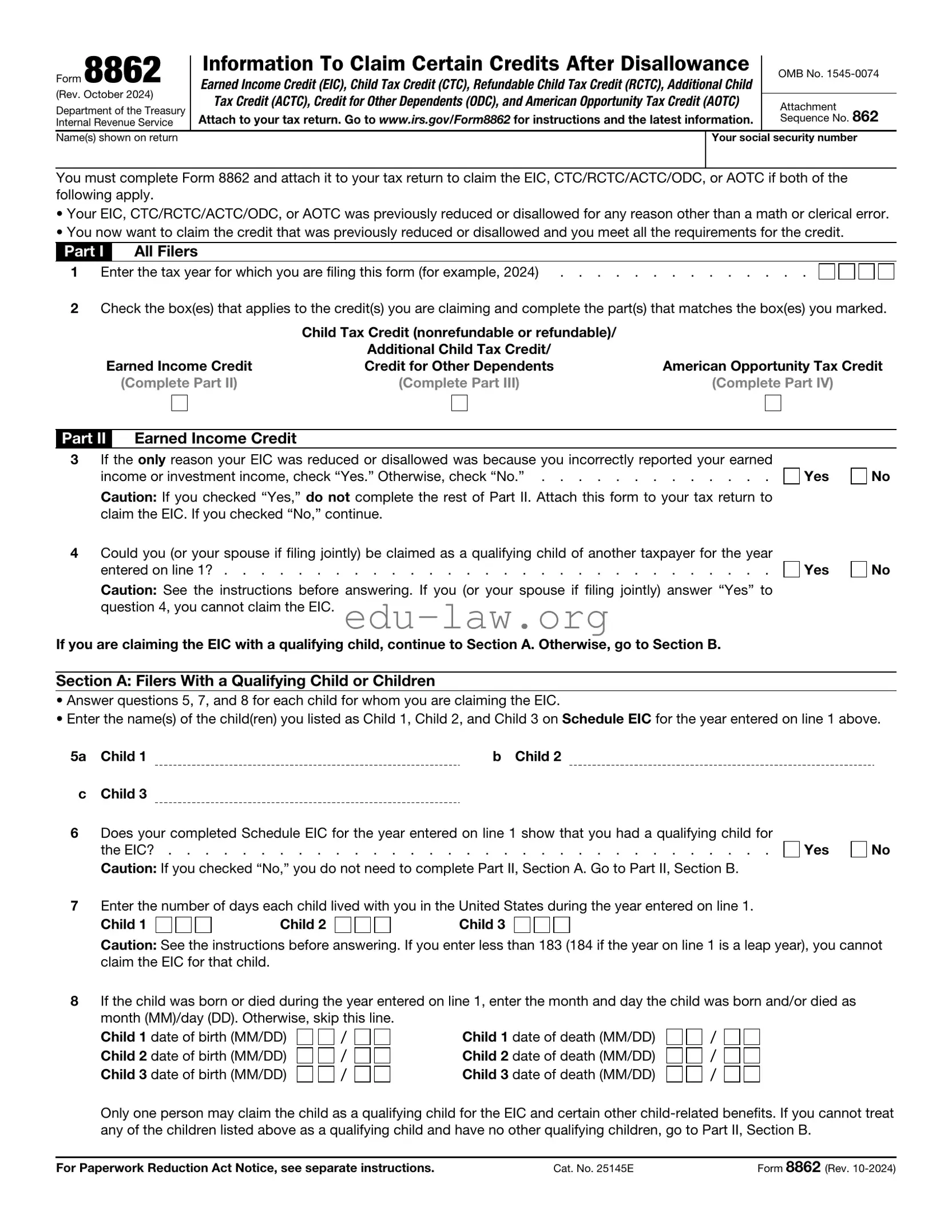
The IRS 8862 form plays a crucial role for taxpayers who have previously claimed the Earned Income Tax Credit (EITC) but faced disallowance in prior years. This form is necessary for those looking to reclaim the credit after a denial, ensuring they meet the eligibility requirements. By completing the 8862, individuals can demonstrate their qualification for the EITC once again. The form requires taxpayers to provide information about their prior claims, the reasons for disallowance, and any changes in circumstances that now make them eligible. Additionally, it is essential to submit the form along with your tax return for the year you are seeking the credit. Understanding the requirements and implications of the IRS 8862 form can help taxpayers navigate the process more effectively and avoid potential pitfalls. This article will guide you through the key elements of the form, its purpose, and the steps necessary for successful completion.

Form 8862 |
|
Information To Claim Certain Credits After Disallowance |
|
OMB No. |
|
|
|
||||
|
Earned Income Credit (EIC), Child Tax Credit (CTC), Refundable Child Tax Credit (RCTC), Additional Child |
|
|||
|
|
|
|||
(Rev. October 2024) |
|
Tax Credit (ACTC), Credit for Other Dependents (ODC), and American Opportunity Tax Credit (AOTC) |
|
|
|
|
|
Attachment |
|||
Department of the Treasury |
|
|
|||
|
Attach to your tax return. Go to www.irs.gov/Form8862 for instructions and the latest information. |
|
Sequence No. 862 |
||
Internal Revenue Service |
|
|
|||
Name(s) shown on return |
|
|
Your social security number |
||
|
|
|
|
|
|
You must complete Form 8862 and attach it to your tax return to claim the EIC, CTC/RCTC/ACTC/ODC, or AOTC if both of the following apply.
•Your EIC, CTC/RCTC/ACTC/ODC, or AOTC was previously reduced or disallowed for any reason other than a math or clerical error.
•You now want to claim the credit that was previously reduced or disallowed and you meet all the requirements for the credit.
Part I |
All Filers |
|
1 |
Enter the tax year for which you are filing this form (for example, 2024) |
|
2Check the box(es) that applies to the credit(s) you are claiming and complete the part(s) that matches the box(es) you marked.
|
Child Tax Credit (nonrefundable or refundable)/ |
|
|
Additional Child Tax Credit/ |
|
Earned Income Credit |
Credit for Other Dependents |
American Opportunity Tax Credit |
(Complete Part II) |
(Complete Part III) |
(Complete Part IV) |
Part II Earned Income Credit
3If the only reason your EIC was reduced or disallowed was because you incorrectly reported your earned
income or investment income, check “Yes.” Otherwise, check “No.” |
Yes |
No |
Caution: If you checked “Yes,” do not complete the rest of Part II. Attach this form to your tax return to |
|
|
claim the EIC. If you checked “No,” continue. |
|
|
4Could you (or your spouse if filing jointly) be claimed as a qualifying child of another taxpayer for the year
entered on line 1? |
Yes |
No |
Caution: See the instructions before answering. If you (or your spouse if filing jointly) answer “Yes” to |
|
|
question 4, you cannot claim the EIC. |
|
|
If you are claiming the EIC with a qualifying child, continue to Section A. Otherwise, go to Section B. |
|
|
Section A: Filers With a Qualifying Child or Children
•Answer questions 5, 7, and 8 for each child for whom you are claiming the EIC.
•Enter the name(s) of the child(ren) you listed as Child 1, Child 2, and Child 3 on Schedule EIC for the year entered on line 1 above.
5a Child 1 |
b Child 2 |
c Child 3
6Does your completed Schedule EIC for the year entered on line 1 show that you had a qualifying child for
the EIC? |
Yes |
No |
Caution: If you checked “No,” you do not need to complete Part II, Section A. Go to Part II, Section B. |
|
|
7Enter the number of days each child lived with you in the United States during the year entered on line 1.
Child 1 |
Child 2 |
Child 3 |
Caution: See the instructions before answering. If you enter less than 183 (184 if the year on line 1 is a leap year), you cannot claim the EIC for that child.
8If the child was born or died during the year entered on line 1, enter the month and day the child was born and/or died as month (MM)/day (DD). Otherwise, skip this line.
Child 1 date of birth (MM/DD) /
Child 2 date of birth (MM/DD) /
Child 3 date of birth (MM/DD) /
Child 1 date of death (MM/DD) /
Child 2 date of death (MM/DD) /
Child 3 date of death (MM/DD) /
Only one person may claim the child as a qualifying child for the EIC and certain other
For Paperwork Reduction Act Notice, see separate instructions. |
Cat. No. 25145E |
Form 8862 (Rev. |

Form 8862 (Rev.
Section B: Filers Without a Qualifying Child or Children
9a Enter the number of days during the year entered on line 1 that your main home was in the United States . . .
bIf married filing jointly, enter the number of days during the year entered on line 1 that your spouse’s main home
|
was in the United States |
|
||
|
Caution: Members of the military stationed outside the United States during the year entered on line 1, see the |
|
||
|
instructions before answering. If you enter less than 183 (184 if the year on line 1 is a leap year) on either line 9a or |
|
||
|
9b (if filing jointly), you cannot claim the EIC. |
|
|
|
10a |
Enter your age at the end of the year on line 1 |
|
|
|
b |
Enter your spouse’s age at the end of the year on line 1 |
|
|
|
|
Caution: If your spouse died during the year entered on line 1 or you are preparing a return for someone who died |
|
||
|
during the year entered on line 1, see the instructions before answering. If neither you (nor your spouse if filing |
|
||
|
jointly) were at least age 25 but under age 65 at the end of the year entered on line 1, unless that year is 2021, you |
|
||
|
cannot claim the EIC. See the Instructions for Form 8862 for more information. |
|
|
|
11a |
Can you be claimed as a dependent on another taxpayer’s return? |
Yes |
No |
|
b |
Can your spouse (if filing jointly) be claimed as a dependent on another taxpayer’s return? |
Yes |
No |
|
|
Caution: If either you (or your spouse if filing jointly) answer “Yes” to question 11, you cannot claim the EIC. |
|
|
|
Part III Child Tax Credit (nonrefundable or refundable)/Additional Child Tax Credit/Credit for Other Dependents
12Enter the name(s) of each child for whom you are claiming the child tax credit/refundable child tax credit/additional child tax credit (CTC/RCTC/ACTC). If you are claiming the CTC/RCTC/ACTC for more than four qualifying children, attach a statement also answering questions 12 and
a |
Child 1 |
b |
Child 2 |
c |
Child 3 |
d |
Child 4 |
13Enter the name(s) of each person for whom you are claiming the credit for other dependents (ODC). If you are claiming the credit for more than four dependents, attach a statement answering questions 13, 16, and 17 for those dependents.
a |
Other dependent 1 |
b |
Other dependent 2 |
c |
Other dependent 3 |
d |
Other dependent 4 |
14For each child listed in response to question 12, did the child live with you for more than half of the year or meet an exception described in the instructions?
Child 1 |
Yes |
No |
Child 2 |
Yes |
No |
Child 3 |
Yes |
No |
Child 4 |
Yes |
No |
15For each child listed in response to question 12, did the child meet the requirements to be a qualifying child for the CTC/RCTC/ ACTC?
Child 1 |
Yes |
No |
Child 2 |
Yes |
No |
Child 3 |
Yes |
No |
Child 4 |
Yes |
No |
16For each person claimed as a qualifying child or other dependent for the CTC/RCTC/ACTC/ODC, is that person your dependent?
Child 1 |
Yes |
No |
Child 2 |
Yes |
No |
Child 3 |
Yes |
No |
Child 4 |
Yes |
No |
|
Other dependent 1 |
|
Yes |
No |
Other dependent 2 |
Yes |
No |
|
|
|
|||
Other dependent 3 |
|
Yes |
No |
Other dependent 4 |
Yes |
No |
|
|
|
|||
17For each person claimed as a qualifying child or other dependent for the CTC/RCTC/ACTC/ODC, is that person a citizen, national, or resident of the United States? See Pub. 519 for more information on when a person is a resident of the United States or is treated as a resident of the United States.
Child 1 |
Yes |
No |
Child 2 |
Yes |
No |
Child 3 |
Yes |
No |
Child 4 |
Yes |
No |
|
Other dependent 1 |
|
Yes |
No |
Other dependent 2 |
Yes |
No |
|
|
|
|||
Other dependent 3 |
|
Yes |
No |
Other dependent 4 |
Yes |
No |
|
|
|
|||
Caution: If the answer is “No” for question 14, 15, 16, or 17, you cannot claim the CTC/RCTC/ACTC/ODC for that child or other dependent.
Only one person can claim the child as a qualifying child for the CTC/RCTC/ACTC/ODC. If you cannot treat any of the children listed above as a qualifying child and have no other qualifying children, you cannot claim the CTC/RCTC/ACTC or the ODC based on having a qualifying child.
Form 8862 (Rev.

Form 8862 (Rev. |
Page 3 |
|
Part IV |
American Opportunity Tax Credit |
|
•Answer the following questions for each student for whom you are claiming the AOTC. If you have more than three students, attach a statement also answering questions 18 and 19 for those students.
•Enter the name(s) of the student(s) as listed on Form 8863.
18a |
Student 1 |
|
|
|
b |
Student 2 |
|
|
|
c |
Student 3 |
|
|
|
|
|
|
|
|
19a |
Did the student meet the requirements to be an eligible student for purposes of the AOTC for the year entered on line 1? See |
||||||||
|
Pub. 970 for more information. |
|
|
|
|
|
|
||
|
Student 1 |
Yes |
No |
Student 2 |
Yes |
No |
Student 3 |
Yes |
No |
bHas the Hope Scholarship Credit or AOTC been claimed for the student for any 4 tax years before the year entered on line 1?
Student 1 |
Yes |
No |
Student 2 |
Yes |
No |
Student 3 |
Yes |
No |
Caution: If you answered “No” to question 19a or “Yes” to question 19b, you cannot claim the credit for that student.
Form 8862 (Rev.
| Fact Name | Description |
|---|---|
| Purpose | The IRS Form 8862 is used to claim the Earned Income Tax Credit (EITC) after a prior disallowance. |
| Eligibility | Taxpayers who had their EITC denied or reduced in previous years must file this form to claim the credit again. |
| Filing Requirement | Form 8862 must be attached to the tax return when claiming the EITC after a disallowance. |
| Information Needed | Taxpayers need to provide information about their qualifying children and income to complete the form. |
| Previous Years | The form must be filed for each year the EITC was disallowed, not just the most recent year. |
| Impact on Refund | Filing Form 8862 correctly can lead to the reinstatement of the EITC, potentially increasing tax refunds. |
| Deadline | Form 8862 must be submitted by the tax return deadline, which is typically April 15 of the following year. |
| State-Specific Forms | Some states may have their own forms for claiming credits similar to the EITC; check local tax laws for details. |
After gathering your necessary documents, you are ready to fill out the IRS Form 8862. This form is essential for certain tax situations, and completing it accurately will help ensure that your tax return is processed smoothly. Follow these steps to complete the form correctly.
What is IRS Form 8862?
IRS Form 8862 is a document used to claim the Earned Income Credit (EIC) after it has been denied in a previous year. If you had your EIC revoked or disallowed, you must file this form to re-establish your eligibility for the credit in future tax years.
Who needs to file Form 8862?
You need to file Form 8862 if you are claiming the Earned Income Credit and you were denied the credit in a previous year. This applies to situations where the IRS disallowed your EIC due to issues like incorrect filing or failure to meet eligibility requirements.
What information is required on Form 8862?
Form 8862 requires you to provide personal information, including your name, Social Security number, and details about your qualifying children, if applicable. You will also need to answer questions regarding your eligibility and the reasons for the previous denial of the credit.
How do I know if I qualify for the Earned Income Credit?
To qualify for the Earned Income Credit, you must meet specific income limits, filing status requirements, and residency criteria. Additionally, you must have a valid Social Security number and meet age and relationship tests for any qualifying children.
Where do I submit Form 8862?
You can submit Form 8862 along with your federal tax return. If you are filing electronically, the software will guide you through the process. If you are filing a paper return, include Form 8862 with your completed tax return and mail it to the address specified in the instructions.
What happens after I submit Form 8862?
After you submit Form 8862, the IRS will review your information to determine your eligibility for the Earned Income Credit. If approved, you will receive the credit on your tax return. If not, the IRS will notify you of the decision and provide reasons for any further denial.
Can I appeal if my Form 8862 is denied?
If your Form 8862 is denied, you have the right to appeal the decision. The IRS will provide instructions on how to contest the denial. You may need to provide additional documentation or clarification to support your claim for the Earned Income Credit.
Failing to check eligibility: Many individuals do not confirm if they are eligible to claim the Earned Income Tax Credit (EITC) before filling out the form. It’s important to understand the requirements.
Incorrect personal information: Some taxpayers make mistakes when entering their name, Social Security number, or filing status. These errors can delay processing.
Not providing prior year information: The form requires details about previous tax years. Omitting this information can lead to rejection.
Missing signatures: A common oversight is forgetting to sign the form. A signature is necessary for the form to be valid.
Inaccurate income reporting: Some filers report incorrect income amounts. This can affect eligibility for credits and lead to further complications.
Not attaching supporting documents: Failing to include necessary documentation can result in delays or denials. It’s essential to provide proof of income and other relevant information.
Submitting late: Some individuals submit the form after the deadline. Timeliness is crucial for ensuring eligibility for the EITC.
The IRS 8862 form, known as the "Information to Claim Certain Refundable Credits After Disallowance," is essential for taxpayers who have previously had their claims for certain credits denied. When filing this form, there are several other documents that may be required or beneficial to include. These documents help provide additional context, support claims, or fulfill other tax obligations. Below is a list of forms and documents that are often used in conjunction with the IRS 8862 form.
Including the appropriate forms and documents alongside the IRS 8862 can streamline the tax filing process and enhance the chances of a successful claim. Each of these forms serves a specific purpose and can provide critical support for your tax situation. Always ensure that all information is accurate and complete to avoid complications with the IRS.
The IRS Form 8862, titled "Information to Claim Certain Refundable Credits After Disallowance," is similar to Form 1040-X, which is used to amend a previously filed tax return. Both forms serve as avenues for taxpayers to correct errors or omissions in their tax filings. While Form 8862 specifically addresses the need to re-establish eligibility for certain tax credits after they have been denied, Form 1040-X allows taxpayers to adjust their overall tax return, including income, deductions, and credits. This means that both forms aim to rectify past mistakes, but they focus on different aspects of the tax filing process.
Another document that shares similarities with Form 8862 is the IRS Form 8863, which is used to claim education credits. Like Form 8862, Form 8863 requires specific information to validate eligibility for tax benefits. Both forms necessitate that taxpayers provide detailed information about their circumstances to ensure compliance with IRS regulations. While Form 8862 is concerned with refundable credits like the Earned Income Tax Credit, Form 8863 focuses on credits related to educational expenses, highlighting how both forms facilitate the claiming of benefits while ensuring that eligibility criteria are met.
Form 8880, known as the "Credit for Qualified Retirement Savings Contributions," is another document that parallels Form 8862. Both forms require taxpayers to demonstrate their eligibility for certain credits, emphasizing the importance of providing accurate and complete information. Form 8880 is specifically aimed at those who contribute to retirement accounts, while Form 8862 deals with refundable credits. The common thread between them is the need for taxpayers to prove their qualifications for financial benefits, reinforcing the IRS's commitment to preventing fraudulent claims.
Lastly, Form 8865, which is used for reporting foreign partnerships, shares some characteristics with Form 8862 in terms of information disclosure. While Form 8862 is focused on claiming tax credits, both forms require detailed information about the taxpayer's situation. Form 8865 ensures compliance with reporting requirements for those involved in foreign partnerships, while Form 8862 is about re-establishing eligibility for credits. Both documents reflect the IRS's emphasis on transparency and accountability in tax filings, ensuring that taxpayers provide the necessary information to support their claims.
When filling out the IRS 8862 form, it is essential to follow specific guidelines to ensure accuracy and compliance. Below are four key do's and don'ts to consider.
The IRS 8862 form is often misunderstood. Here are four common misconceptions about this form:
This is not entirely accurate. While the form is required for individuals who have previously been denied the EITC and want to claim it again, it is also necessary for those who have been denied other tax credits, such as the Child Tax Credit.
Submitting the form does not automatically ensure approval. The IRS will review your eligibility based on various factors, including your income and filing status. The form simply allows you to demonstrate your eligibility again.
Individuals can file the form multiple times if they continue to experience issues with their tax credits. Each time they are denied a credit, they may need to submit the form again to prove their eligibility.
This is misleading. While the form is important, taxpayers must also meet other criteria and provide necessary documentation to support their claims. The form alone does not fulfill all requirements for tax credits.
When it comes to filing your taxes, understanding the IRS Form 8862 is crucial for those who have previously been denied the Earned Income Tax Credit (EITC). Here are some key takeaways to help you navigate this form effectively:
By understanding these points, you can approach the IRS Form 8862 with confidence and clarity, ensuring you maximize your tax benefits.