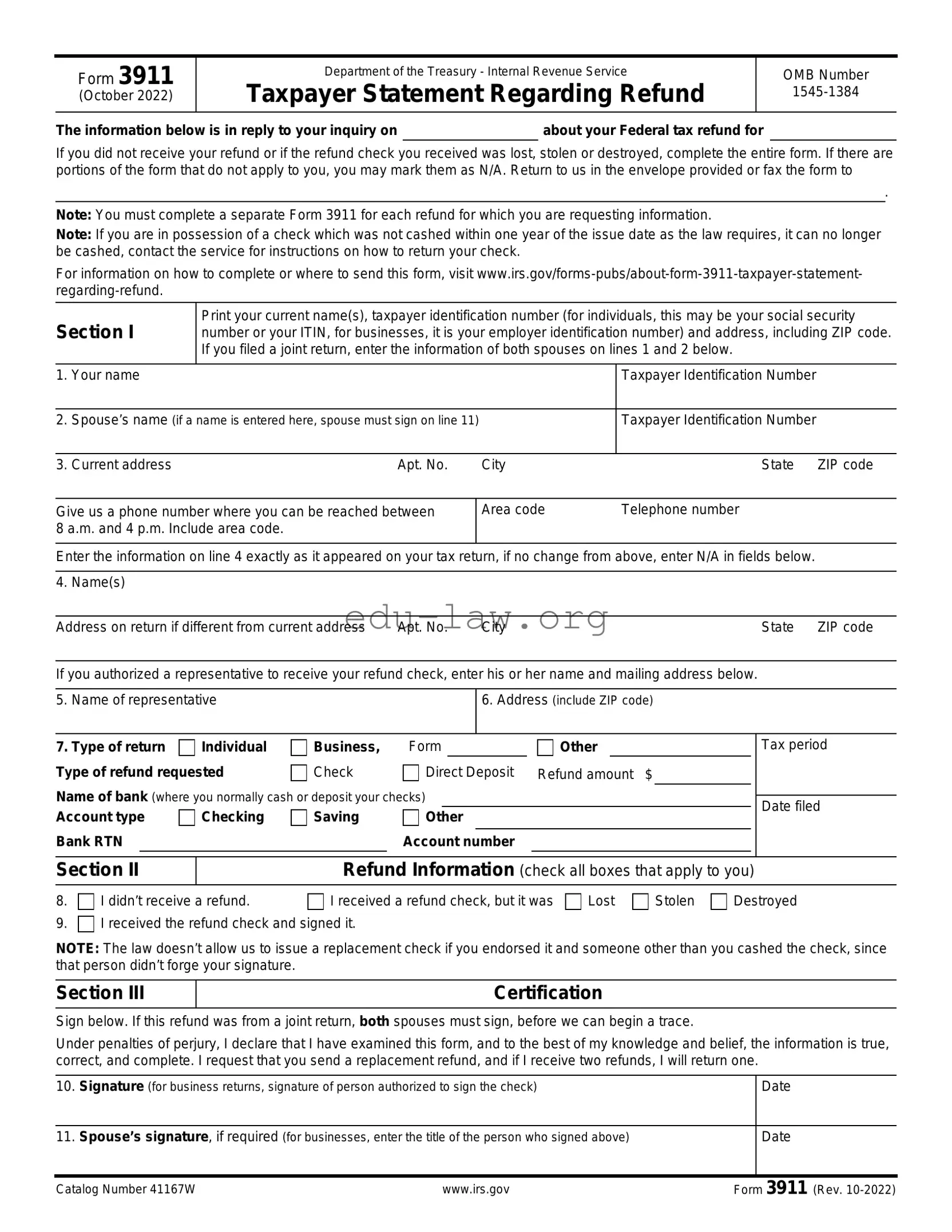
The IRS 3911 form plays a crucial role for taxpayers who find themselves in a situation where their tax refund is missing or delayed. This form serves as a request for the IRS to initiate a trace on a refund that has not been received, allowing individuals to track down their funds. It is essential for those who have waited longer than the typical processing time or have concerns about the status of their refund. Completing the IRS 3911 form requires personal information, including the taxpayer’s name, Social Security number, and details about the tax return in question. Additionally, it is important to provide information about the expected refund amount and the method by which the refund was supposed to be received, whether by check or direct deposit. By submitting this form, taxpayers can take proactive steps to resolve issues surrounding their refunds, ensuring they receive the money they are entitled to. Understanding the nuances of this form can help alleviate the stress that often accompanies tax season and missing refunds.
Form 3911
(October 2022)
Department of the Treasury - Internal Revenue Service
Taxpayer Statement Regarding Refund
OMB Number
The information below is in reply to your inquiry on |
about your Federal tax refund for |
If you did not receive your refund or if the refund check you received was lost, stolen or destroyed, complete the entire form. If there are portions of the form that do not apply to you, you may mark them as N/A. Return to us in the envelope provided or fax the form to
.
Note: You must complete a separate Form 3911 for each refund for which you are requesting information.
Note: If you are in possession of a check which was not cashed within one year of the issue date as the law requires, it can no longer be cashed, contact the service for instructions on how to return your check.
For information on how to complete or where to send this form, visit
Section I
Print your current name(s), taxpayer identification number (for individuals, this may be your social security number or your ITIN, for businesses, it is your employer identification number) and address, including ZIP code. If you filed a joint return, enter the information of both spouses on lines 1 and 2 below.
1. Your name
Taxpayer Identification Number
2.Spouse’s name (if a name is entered here, spouse must sign on line 11)
Taxpayer Identification Number
3. Current address |
Apt. No. |
City |
State |
ZIP code |
Give us a phone number where you can be reached between 8 a.m. and 4 p.m. Include area code.
Area code |
Telephone number |
Enter the information on line 4 exactly as it appeared on your tax return, if no change from above, enter N/A in fields below.
4. Name(s)
Address on return if different from current address |
Apt. No. |
City |
|
|
|
|
|
|
|
|
State ZIP code |
|||||||
|
|
|
|
|
|
|
|
|
|
|
|
|||||||
If you authorized a representative to receive your refund check, enter his or her name and mailing address below. |
||||||||||||||||||
|
|
|
|
|
|
|
|
|
|
|
|
|
|
|
|
|||
5. |
Name of representative |
|
|
|
|
6. Address (include ZIP code) |
|
|
|
|
||||||||
|
|
|
|
|
|
|
|
|
|
|
|
|
|
|
|
|
|
|
7. |
Type of return |
Individual |
Business, |
Form |
|
|
|
|
Other |
|
|
|
|
|
Tax period |
|||
Type of refund requested |
Check |
Direct Deposit |
|
Refund amount |
$ |
|
|
|
|
|
||||||||
Name of bank (where you normally cash or deposit your checks) |
|
|
|
|
|
|
|
|
|
|
|
|
||||||
|
|
|
|
|
|
|
|
|
Date filed |
|||||||||
Account type |
Checking |
Saving |
Other |
|
|
|
|
|
|
|
|
|
||||||
|
|
|
|
|
|
|
|
|
|
|
||||||||
Bank RTN |
|
|
|
Account number |
|
|
|
|
|
|
|
|
|
|
||||
|
|
|
|
|
||||||||||||||
Section II |
|
Refund Information (check all boxes that apply to you) |
|
|
||||||||||||||
8. |
I didn’t receive a refund. |
I received a refund check, but it was |
Lost |
|
Stolen |
Destroyed |
||||||||||||
9. |
I received the refund check and signed it. |
|
|
|
|
|
|
|
|
|
|
|
|
|
|
|||
NOTE: The law doesn’t allow us to issue a replacement check if you endorsed it and someone other than you cashed the check, since that person didn’t forge your signature.
Section III
Certification
Sign below. If this refund was from a joint return, both spouses must sign, before we can begin a trace.
Under penalties of perjury, I declare that I have examined this form, and to the best of my knowledge and belief, the information is true, correct, and complete. I request that you send a replacement refund, and if I receive two refunds, I will return one.
10. |
Signature (for business returns, signature of person authorized to sign the check) |
|
Date |
|
|
|
|
|
|
11. |
Spouse’s signature, if required (for businesses, enter the title of the person who signed above) |
|
Date |
|
|
|
|
|
|
Catalog Number 41167W |
www.irs.gov |
Form 3911 (Rev. |
||

Privacy Act and Paperwork Reduction Act Notice
We ask for the information on this form to carry out the Internal Revenue laws of the United States.
You aren’t required to give us the information since the refund you claimed has already been issued. However, without the information we won’t be able to trace your refund, and may be unable to replace it. You may give us the information we need in a letter.
We need the information to ensure that you are complying with these laws and to allow us to determine the correctness of your refund or the right amount of payment. Your Social Security Number and the other information are being requested in order that the Department of the Treasury can process your refund. The authority of requesting your social security number is 26 United States Code, section 6109. If you cannot or will not furnish the information, the tracing of your refund may be delayed.
You are not required to provide the information requested on a form that is subject to the Paperwork Reduction Act unless the form displays a valid OMB control number. Books or record relating to a form or its instructions must be retained as long as their contents may become material in the administration of any Internal Revenue law. Generally, tax returns and return information are confidential, as required by Internal Revenue Code section 6103. The time needed to compete and file this form will vary depending on individual circumstances. The estimated average time is less than 5 minutes.
If you have comments concerning the accuracy of this time estimate or suggestions for making this form simpler, we would be happy to hear from you. You can write to the Internal Revenue Service, Attention: Tax Products Coordinating Committee, Western Area Distribution Center, Rancho Cordova, CA
Do not send this form to this office. Instead, please use the envelope provided or mail the form to the Internal Revenue Service center where you would normally file a paper tax return.
Catalog Number 41167W |
www.irs.gov |
Form 3911 (Rev. |
| Fact Name | Description |
|---|---|
| Purpose | The IRS Form 3911 is used to initiate a trace for a lost, stolen, or destroyed refund check. |
| Eligibility | Taxpayers who have not received their refund after 28 days from the date the IRS accepted their return may file this form. |
| Submission Method | The form can be submitted via mail or by fax, depending on the instructions provided by the IRS. |
| Processing Time | Generally, it takes about six weeks to process a Form 3911, but this can vary based on the IRS workload. |
| State-Specific Forms | Some states have their own forms for tracing lost checks, such as California's Form 3500. |
| Governing Law | For California, the governing law is California Revenue and Taxation Code Section 18670. |
| Refund Types | This form can be used for various types of refunds, including those from individual income tax and corporate tax returns. |
| Additional Information | Taxpayers may need to provide personal identification information, such as Social Security numbers, when filing the form. |
After gathering your information, you can begin filling out the IRS 3911 form. This form is important for addressing specific issues related to your tax situation. Follow these steps to complete the form accurately.
What is the IRS Form 3911?
The IRS Form 3911, also known as the "Taxpayer Statement Regarding Refund," is a document used by taxpayers to inquire about the status of their tax refund. If a taxpayer has not received their expected refund within the typical processing time, this form helps initiate a search for the refund and provides the IRS with necessary information to locate it.
Who should use Form 3911?
Taxpayers who have filed their tax returns and have not received their refunds can use Form 3911. This form is especially useful for individuals who believe their refund has been lost or misplaced. It is important to wait at least 21 days after filing electronically or six weeks after mailing a paper return before submitting this form.
How do I complete Form 3911?
To complete Form 3911, you will need to provide personal information such as your name, address, Social Security number, and details about your tax return. Additionally, you will need to indicate the tax year for which you are inquiring about the refund. Follow the instructions carefully to ensure all required fields are filled out accurately.
Where do I send Form 3911?
Once you have completed Form 3911, you should send it to the address provided in the instructions on the form. The mailing address may vary depending on your location and whether you are filing for a specific tax year. Ensure you check the latest IRS guidelines for the correct address.
How long does it take to get a response after submitting Form 3911?
The response time can vary. Generally, the IRS aims to respond within 30 days of receiving Form 3911. However, during peak tax seasons or due to other circumstances, it may take longer. Patience is advised while waiting for a resolution.
Can I track the status of my refund without using Form 3911?
Yes, taxpayers can track the status of their refunds using the IRS "Where's My Refund?" tool available on the IRS website. This online tool provides updates on the status of your refund without the need to submit Form 3911. It is recommended to check this tool first before submitting a formal inquiry.
What should I do if my refund is lost?
If you suspect your refund is lost, first confirm that it was issued by checking your bank account or the IRS tracking tool. If you still cannot locate it, completing and submitting Form 3911 is the next step. The IRS will then initiate a trace to determine the status of your refund.
Is there a fee to file Form 3911?
No, there is no fee associated with filing Form 3911. It is a free service provided by the IRS to assist taxpayers in resolving issues related to their tax refunds. Make sure to keep a copy of the form for your records after submission.
Incorrect Personal Information: Many individuals fail to provide accurate personal details, such as their name, address, or Social Security number. This can lead to delays in processing the form.
Not Signing the Form: A common oversight is neglecting to sign the form. Without a signature, the IRS cannot process the request.
Missing Required Documentation: Some individuals forget to include necessary supporting documents. These may include tax returns or previous correspondence with the IRS.
Submitting Multiple Forms: Submitting more than one IRS 3911 form for the same issue can create confusion and slow down the resolution process.
Failure to Follow Instructions: Each section of the form has specific instructions. Ignoring these can lead to incomplete or incorrect submissions.
Providing Incomplete Information: Some individuals leave sections blank or provide vague answers. This can hinder the IRS's ability to assist effectively.
Not Keeping Copies: Failing to retain a copy of the completed form for personal records can be problematic. It is essential to have a reference in case follow-up is needed.
The IRS Form 3911 is used to request a trace of a tax refund. When filing this form, individuals may also need to consider other documents that can support their request or provide additional context. Below is a list of forms and documents that are often used alongside the IRS 3911 form.
Having these documents ready can facilitate the process of tracing a tax refund and ensure that the IRS has all the necessary information to assist in your request. Proper documentation can significantly streamline communication with the IRS and help resolve issues more efficiently.
The IRS Form 4506-T is similar to Form 3911 in that both are used to request information from the IRS. Form 4506-T allows taxpayers to request a transcript of their tax return, which can be helpful for verifying income or tax filing status. Like Form 3911, which is used to inquire about the status of a refund, Form 4506-T provides a way for individuals to obtain important tax-related information directly from the IRS.
Another document that shares similarities with Form 3911 is Form 8821, the Tax Information Authorization. This form allows taxpayers to authorize someone else to receive their tax information. While Form 3911 is focused on tracking down a specific refund, Form 8821 facilitates communication between the IRS and a designated representative, ensuring that the taxpayer’s information is handled appropriately.
Form 1040-X, the Amended U.S. Individual Income Tax Return, also has a connection to Form 3911. When taxpayers realize they made an error on their original tax return, they can use Form 1040-X to correct it. If a refund was missed due to that error, Form 3911 can help track the status of the corrected refund after the amendment is filed.
Form 9465, the Installment Agreement Request, is another document that relates to taxpayer needs. While Form 3911 is about tracking refunds, Form 9465 is used when taxpayers cannot pay their tax bill in full. It allows them to set up a payment plan with the IRS. Both forms address taxpayer concerns, but they serve different purposes within the tax process.
Form 843, the Claim for Refund and Request for Abatement, is also comparable to Form 3911. Taxpayers use Form 843 to request a refund for various reasons, such as overpayment or penalties. While Form 3911 helps track the status of a refund request, Form 843 initiates the process of claiming a refund directly with the IRS.
Form 8862, the Information to Claim Certain Refundable Credits After Disallowance, shares a relationship with Form 3911 as well. This form is used by taxpayers who have previously had their eligibility for certain credits denied and wish to claim them again. If a refund related to these credits is delayed, Form 3911 can be used to check on its status, linking the two forms through the refund process.
Lastly, Form 1040, the U.S. Individual Income Tax Return, is the foundational document for individual taxpayers. While Form 3911 is specifically for tracking refunds, it stems from the information provided on Form 1040. If there are issues with the refund claimed on a 1040, taxpayers may need to use Form 3911 to resolve those issues, making the connection between these two forms significant in the tax filing process.
When filling out the IRS Form 3911, it’s important to approach the process with care. This form is used to request a refund trace for a tax refund that has not been received. Here are some key dos and don’ts to keep in mind:
The IRS Form 3911, also known as the "Taxpayer Statement Regarding Refund," is often misunderstood. Here are seven common misconceptions about this form, along with clarifications to help demystify its purpose and use.
This is not entirely accurate. While the form is primarily used to inquire about a refund status, it can also be used in cases of incorrect amounts or when a refund has been lost.
Unfortunately, there is no guarantee of a swift reply. The IRS processes many requests, and response times can vary based on their workload and the complexity of the inquiry.
This form is specifically designed for refund inquiries. For other tax issues, different forms or processes may be required.
While mailing is a common method, taxpayers can also submit this form in person at certain IRS offices. Additionally, some inquiries can be made via phone.
The form is relatively straightforward. Most taxpayers can complete it without assistance, as it asks for basic information regarding the taxpayer's identity and the refund in question.
While it is advisable to wait at least 21 days after filing your return before submitting the form, there is no strict rule that mandates a waiting period. If you believe your refund is significantly delayed, you can file it sooner.
While the form helps initiate an inquiry, it does not resolve the issue on its own. The IRS will investigate and communicate with you regarding the outcome, which may take time.
Understanding these misconceptions can help taxpayers navigate the refund inquiry process more effectively and set realistic expectations when dealing with the IRS.
The IRS 3911 form is used to request a refund trace. Here are some key takeaways to keep in mind when filling it out and using it: