The IRS Form 2553 plays a crucial role for small businesses seeking to elect S Corporation status. By filing this form, eligible corporations can potentially enjoy significant tax benefits, including the ability to avoid double taxation on corporate income. This election allows profits and losses to be passed directly to shareholders, who report them on their personal tax returns. The form must be filed within a specific timeframe, typically within 75 days of the corporation's formation or the beginning of the tax year. Understanding the eligibility requirements is essential, as not all corporations qualify for S Corporation status. Additionally, the form requires detailed information about the corporation, including its name, address, and the number of shares issued. Completing Form 2553 accurately is vital, as any errors or omissions can lead to delays or rejection of the election, potentially impacting the business's tax obligations. Overall, the IRS Form 2553 serves as a critical tool for business owners aiming to optimize their tax strategy while complying with federal regulations.
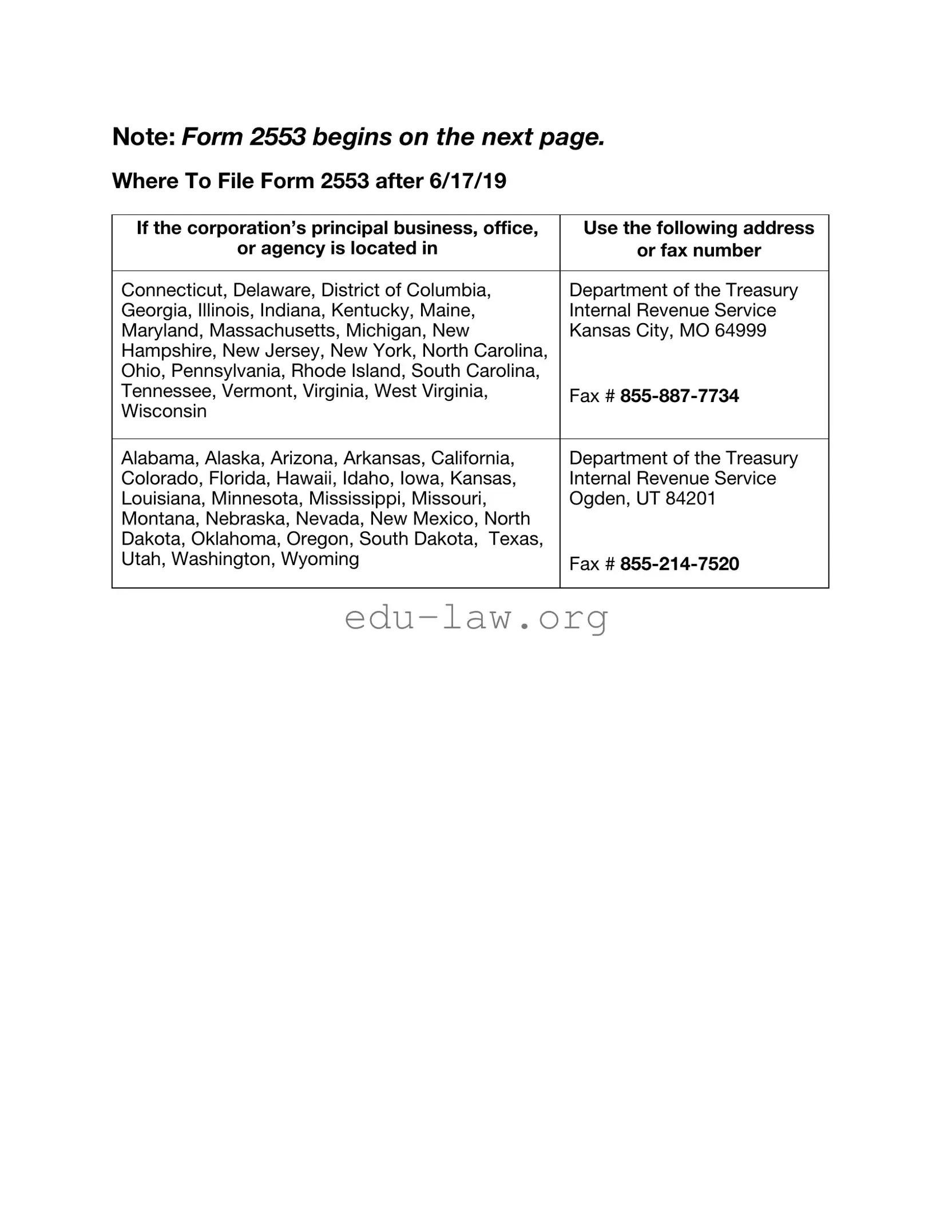
Note: Form 2553 begins on the next page.
Where To File Form 2553 after 6/17/19
If the corporation’s principal business, office, |
Use the following address |
or agency is located in |
or fax number |
|
|
Connecticut, Delaware, District of Columbia, |
Department of the Treasury |
Georgia, Illinois, Indiana, Kentucky, Maine, |
Internal Revenue Service |
Maryland, Massachusetts, Michigan, New |
Kansas City, MO 64999 |
Hampshire, New Jersey, New York, North Carolina, |
|
Ohio, Pennsylvania, Rhode Island, South Carolina, |
|
Tennessee, Vermont, Virginia, West Virginia, |
Fax # |
Wisconsin |
|
|
|
Alabama, Alaska, Arizona, Arkansas, California, |
Department of the Treasury |
Colorado, Florida, Hawaii, Idaho, Iowa, Kansas, |
Internal Revenue Service |
Louisiana, Minnesota, Mississippi, Missouri, |
Ogden, UT 84201 |
Montana, Nebraska, Nevada, New Mexico, North |
|
Dakota, Oklahoma, Oregon, South Dakota, Texas, |
|
Utah, Washington, Wyoming |
Fax # |
|
|

Form 2553
(Rev. December 2017)
Department of the Treasury Internal Revenue Service
Election by a Small Business Corporation
(Under section 1362 of the Internal Revenue Code)
(Including a late election filed pursuant to Rev. Proc.
▶You can fax this form to the IRS. See separate instructions.
▶Go to www.irs.gov/Form2553 for instructions and the latest information.
OMB No.
Note: This election to be an S corporation can be accepted only if all the tests are met under Who May Elect in the instructions, all shareholders have signed the consent statement, an officer has signed below, and the exact name and address of the corporation (entity) and other required form information have been provided.
Part I |
|
Election Information |
|
|
|
|
|
|
|
Name (see instructions) |
A Employer identification number |
||
Type |
|
|
|
|
|
|
|
Number, street, and room or suite no. If a P.O. box, see instructions. |
B Date incorporated |
|
|||
or |
|
|
|
|||
|
|
|
|
|
|
|
|
|
|
|
|
||
|
City or town, state or province, country, and ZIP or foreign postal code |
C State of incorporation |
|
|||
|
|
|
|
|||
|
|
|
|
|
|
|
D |
Check |
the applicable box(es) if the corporation (entity), after applying for the EIN shown in A above, changed its |
name or |
address |
||
EElection is to be effective for tax year beginning (month, day, year) (see instructions) . . . . . . ▶
Caution: A corporation (entity) making the election for its first tax year in existence will usually enter the beginning date of a short tax year that begins on a date other than January 1.
FSelected tax year:
(1) Calendar year
(2) Fiscal year ending (month and day) ▶
(3)
(4)
If box (2) or (4) is checked, complete Part II.
GIf more than 100 shareholders are listed for item J (see page 2), check this box if treating members of a family as one shareholder results in no more than 100 shareholders (see test 2 under Who May Elect in the instructions) ▶
HName and title of officer or legal representative whom the IRS may call for more information
Telephone number of officer or legal representative
IIf this S corporation election is being filed late, I declare I had reasonable cause for not filing Form 2553 timely. If this late election is being made by an entity eligible to elect to be treated as a corporation, I declare I also had reasonable cause for not filing an entity classification election timely and the representations listed in Part IV are true. See below for my explanation of the reasons the election or elections were not made on time and a description of my diligent actions to correct the mistake upon its discovery. See instructions.
|
Under penalties of perjury, I declare that I have examined this election, including accompanying documents, and, to the best of my |
||
Sign knowledge and belief, the election contains all the relevant facts relating to the election, and such facts are true, correct, and complete. |
|||
Here |
▲Signature of officer |
|
|
|
Title |
Date |
|
For Paperwork Reduction Act Notice, see separate instructions. |
Cat. No. 18629R |
Form 2553 (Rev. |
|

Form 2553 (Rev. |
Page 2 |
Name |
Employer identification number |
Part I Election Information (continued) Note: If you need more rows, use additional copies of page 2.
J
Name and address of each
shareholder or former shareholder required to consent to the election.
(see instructions)
K
Shareholder’s Consent Statement
Under penalties of perjury, I declare that I consent to the election of the
Signature |
Date |
L
Stock owned or
percentage of ownership
(see instructions)
Number of |
|
shares or |
|
percentage |
Date(s) |
of ownership |
acquired |
M |
|
Social security |
|
number or |
N |
employer |
Shareholder’s |
identification |
tax year ends |
number (see |
(month and |
instructions) |
day) |
Form 2553 (Rev.

Form 2553 (Rev. |
Page 3 |
|
Name |
|
Employer identification number |
|
|
|
Part II |
Selection of Fiscal Tax Year (see instructions) |
|
Note: All corporations using this part must complete item O and item P, Q, or R. |
|
|
O Check the applicable box to indicate whether the corporation is: |
|
|
1. |
A new corporation adopting the tax year entered in item F, Part I. |
|
2. |
An existing corporation retaining the tax year entered in item F, Part I. |
|
3. |
An existing corporation changing to the tax year entered in item F, Part I. |
|
PComplete item P if the corporation is using the automatic approval provisions of Rev. Proc.
1. Natural Business Year ▶ |
I represent that the corporation is adopting, retaining, or changing to a tax year that qualifies |
as its natural business year (as defined in section 5.07 of Rev. Proc.
2. Ownership Tax Year ▶ |
I represent that shareholders (as described in section 5.08 of Rev. Proc. |
than half of the shares of the stock (as of the first day of the tax year to which the request relates) of the corporation have the same tax year or are concurrently changing to the tax year that the corporation adopts, retains, or changes to per item F, Part I, and that such tax year satisfies the requirement of section 4.01(3) of Rev. Proc.
Note: If you do not use item P and the corporation wants a fiscal tax year, complete either item Q or R below. Item Q is used to request a fiscal tax year based on a business purpose and to make a
QBusiness
1. Check here ▶ if the fiscal year entered in item F, Part I, is requested under the prior approval provisions of Rev. Proc.
Yes |
No |
2.Check here ▶ to show that the corporation intends to make a
3.Check here ▶ to show that the corporation agrees to adopt or change to a tax year ending December 31 if necessary for the IRS to accept this election for S corporation status in the event (1) the corporation’s business purpose request is not approved and the corporation makes a
RSection 444
1.Check here ▶ to show that the corporation will make, if qualified, a section 444 election to have the fiscal tax year shown in item F, Part I. To make the election, you must complete Form 8716, Election To Have a Tax Year Other Than a Required Tax Year, and either attach it to Form 2553 or file it separately.
2.Check here ▶ to show that the corporation agrees to adopt or change to a tax year ending December 31 if necessary for the IRS to accept this election for S corporation status in the event the corporation is ultimately not qualified to make a section 444 election.
Form 2553 (Rev.
Form 2553 (Rev. |
Page 4 |
Name |
Employer identification number |
Part III Qualified Subchapter S Trust (QSST) Election Under Section 1361(d)(2)* Note: If you are making more than
one QSST election, use additional copies of page 4.
Income beneficiary’s name and address
Social security number
Trust’s name and address
Employer identification number
Date on which stock of the corporation was transferred to the trust (month, day, year) . . . . . . . . ▶
In order for the trust named above to be a QSST and thus a qualifying shareholder of the S corporation for which this Form 2553 is filed, I hereby make the election under section 1361(d)(2). Under penalties of perjury, I certify that the trust meets the definitional requirements of section 1361(d)(3) and that all other information provided in Part III is true, correct, and complete.
Signature of income beneficiary or signature and title of legal representative or other qualified person making the election |
|
Date |
*Use Part III to make the QSST election only if stock of the corporation has been transferred to the trust on or before the date on which the corporation makes its election to be an S corporation. The QSST election must be made and filed separately if stock of the corporation is transferred to the trust after the date on which the corporation makes the S election.
Part IV Late Corporate Classification Election Representations (see instructions)
If a late entity classification election was intended to be effective on the same date that the S corporation election was intended to be effective, relief for a late S corporation election must also include the following representations.
1The requesting entity is an eligible entity as defined in Regulations section
2The requesting entity intended to be classified as a corporation as of the effective date of the S corporation status;
3The requesting entity fails to qualify as a corporation solely because Form 8832, Entity Classification Election, was not timely filed under Regulations section
4The requesting entity fails to qualify as an S corporation on the effective date of the S corporation status solely because the S corporation election was not timely filed pursuant to section 1362(b); and
5a The requesting entity timely filed all required federal tax returns and information returns consistent with its requested classification as an S corporation for all of the years the entity intended to be an S corporation and no inconsistent tax or information returns have been filed by or with respect to the entity during any of the tax years, or
bThe requesting entity has not filed a federal tax or information return for the first year in which the election was intended to be effective because the due date has not passed for that year’s federal tax or information return.
Form 2553 (Rev.
| Fact Name | Description |
|---|---|
| Purpose | The IRS Form 2553 is used by small businesses to elect S Corporation status for tax purposes. |
| Eligibility | Only domestic corporations can file Form 2553 to become an S Corporation. |
| Filing Deadline | The form must be filed within 75 days of the beginning of the tax year in which the election is to take effect. |
| Shareholder Limit | An S Corporation can have a maximum of 100 shareholders. |
| Shareholder Requirements | All shareholders must be U.S. citizens or resident aliens. |
| State-Specific Forms | Some states require additional forms to recognize S Corporation status, such as California Form 100S. |
| Governing Law for California | California Revenue and Taxation Code Section 23802 governs the S Corporation election in California. |
| Tax Benefits | S Corporations can avoid double taxation on corporate income. |
| Form Signatures | All shareholders must sign the form to validate the election. |
| Revocation | Once made, the S Corporation election can be revoked, but there are specific procedures and waiting periods involved. |
Once you have gathered the necessary information, the next step is to carefully fill out the IRS Form 2553. This form is essential for entities wishing to elect to be treated as an S corporation for tax purposes. Ensuring accuracy is crucial, as errors may lead to delays or complications in your tax status.
After submitting the form, you will need to wait for confirmation from the IRS regarding your election. It is advisable to keep a copy of the submitted form and any correspondence for your records. Monitoring your tax status and ensuring compliance with ongoing requirements will be essential moving forward.
What is IRS Form 2553?
IRS Form 2553 is the form used by small businesses to elect to be taxed as an S Corporation. This election allows the business to pass income, losses, deductions, and credits directly to shareholders, avoiding double taxation. It’s an important step for businesses looking to take advantage of the S Corporation tax structure.
Who can file Form 2553?
Any domestic corporation can file Form 2553, provided it meets certain criteria. The corporation must have fewer than 100 shareholders, all of whom must be individuals, certain trusts, or estates. Additionally, the corporation must have only one class of stock and must not be an ineligible corporation, such as certain financial institutions or insurance companies.
When should Form 2553 be filed?
Form 2553 should be filed within 75 days of the beginning of the tax year when you want the S Corporation status to take effect. If you miss this window, you may still be able to file late, but you will need to provide a reasonable cause for the delay. It’s crucial to keep these deadlines in mind to ensure your election is accepted.
What happens after filing Form 2553?
Once Form 2553 is filed, the IRS will review your application. If approved, the corporation will be taxed as an S Corporation from the date specified in the form. You will receive a confirmation from the IRS. It’s important to maintain proper records and comply with all S Corporation requirements to keep this status.
Can Form 2553 be revoked?
Yes, a corporation can revoke its S Corporation election by filing a statement with the IRS. This statement must be signed by shareholders holding more than 50% of the stock. Revocation can happen at any time, but it’s essential to understand the implications, as reverting to a C Corporation can change how the business is taxed.
Incorrect Entity Type Selection: Many applicants fail to accurately identify their business structure. It's crucial to select the correct entity type, whether it's a corporation or a limited liability company (LLC). Misclassification can lead to significant tax implications.
Missing Signatures: A common oversight is neglecting to obtain the necessary signatures. All shareholders must sign the form, and missing a signature can delay processing or even result in rejection.
Filing Deadline Errors: Applicants often overlook the importance of filing within the designated time frame. The IRS requires that the form be submitted within a specific period after the entity's formation or the start of the tax year.
Inaccurate Information: Providing incorrect details, such as the business name, address, or Employer Identification Number (EIN), can cause complications. Double-checking all entries for accuracy is essential to avoid unnecessary issues.
Not Meeting Eligibility Requirements: Some applicants do not fully understand the eligibility criteria for S corporation status. It's vital to ensure that the business meets all requirements, such as the number of shareholders and types of stock issued.
Failure to Attach Required Statements: Certain situations require additional statements to be attached to the form. Not including these can lead to delays in processing and potential disqualification from S corporation status.
Neglecting to Keep Copies: After submission, individuals often forget to retain copies of the completed form and any correspondence with the IRS. Keeping these records is important for future reference and in case of audits.
The IRS 2553 form is essential for businesses electing to be taxed as an S corporation. However, several other forms and documents often accompany it to ensure compliance and proper filing. Below is a list of these documents, along with brief descriptions of each.
These forms and documents work together to ensure that a business complies with federal and state tax regulations. Properly completing and submitting them is crucial for maintaining S corporation status and avoiding potential issues with the IRS.
The IRS Form 2553, which is used by small businesses to elect S corporation status, shares similarities with Form 8832. Form 8832 allows a business entity to choose its classification for federal tax purposes. Both forms require the entity to provide information about its structure and ownership. Just as Form 2553 is essential for businesses wanting to be taxed as an S corporation, Form 8832 is crucial for those looking to opt for a different classification, such as a partnership or a corporation. Both forms must be filed timely to ensure the desired tax treatment is granted, and they involve similar procedures for submission to the IRS.
Another document that resembles Form 2553 is Form 1065, which is used for reporting income, deductions, gains, and losses from partnerships. While Form 2553 is about electing S corporation status, Form 1065 is about reporting the financial activities of a partnership. Both forms require detailed information about the entity and its owners, including Social Security numbers and tax identification numbers. They also share the common goal of ensuring accurate tax reporting and compliance with IRS regulations, although they apply to different business structures.
Form 1120S is closely related to Form 2553 as well. This form is specifically for S corporations to report their income, deductions, and credits. After electing S corporation status with Form 2553, businesses must file Form 1120S annually. Both forms involve similar information regarding the business’s financial activities, ownership structure, and compliance with tax laws. The successful completion of Form 2553 sets the stage for the ongoing reporting requirements outlined in Form 1120S.
Form 941 also has some parallels with Form 2553, particularly in the context of payroll and employment taxes. Form 941 is used by employers to report income taxes, Social Security tax, and Medicare tax withheld from employee wages. While Form 2553 focuses on the classification of the business for tax purposes, both forms require accurate reporting and timely submission to the IRS. They help ensure that businesses comply with federal tax obligations, although they address different aspects of business operations.
Lastly, Form SS-4, the application for an Employer Identification Number (EIN), shares a connection with Form 2553 as both are integral to business formation and tax compliance. Form SS-4 is essential for obtaining an EIN, which is often required when filing Form 2553. Both forms necessitate detailed information about the business entity, including its structure and ownership. Having an EIN is a prerequisite for many tax-related filings, including the election made with Form 2553, linking the two documents in the overall business setup process.
When filling out the IRS Form 2553, which is used to elect S corporation status, it's essential to follow certain guidelines. Here’s a helpful list of things you should and shouldn't do:
The IRS Form 2553 is essential for small businesses electing to be taxed as an S corporation. However, several misconceptions can lead to confusion. Here are four common misunderstandings:
This is not true. While Form 2553 is primarily used by corporations, it can also be filed by certain limited liability companies (LLCs) that choose to be taxed as S corporations.
Many believe that the form can be submitted whenever they choose. In reality, there are deadlines. Generally, it must be filed within two months and 15 days after the beginning of the tax year for which the election is to take effect.
This is misleading. A business can revoke its S corporation status or switch back to a different tax classification. However, there are specific procedures and waiting periods involved.
This is incorrect. S corporations are limited to 100 shareholders. Additionally, all shareholders must be U.S. citizens or residents, which adds another layer of eligibility requirements.
Filling out and using the IRS 2553 form is essential for certain businesses electing to be taxed as an S corporation. Here are key takeaways to consider: