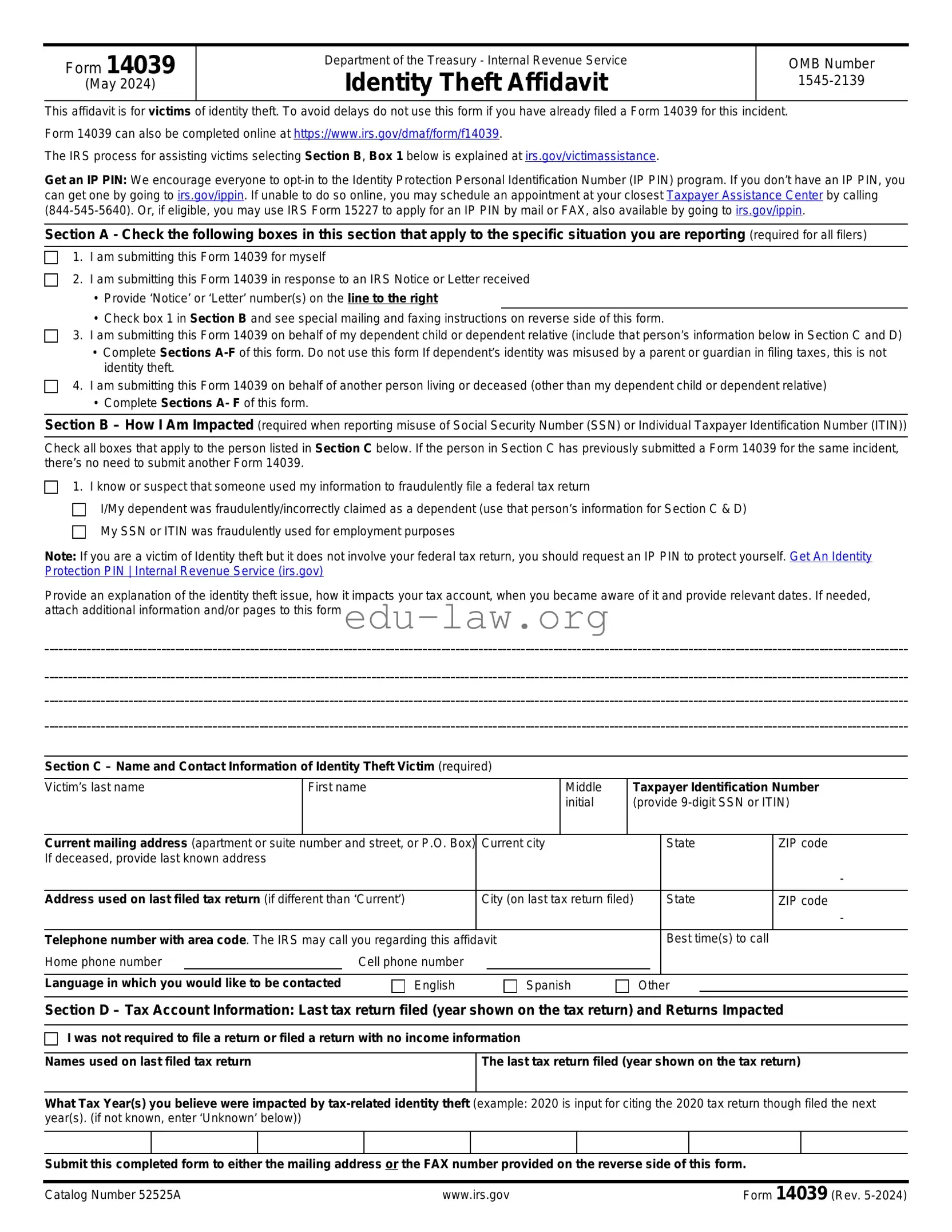
The IRS 14039 form, also known as the Identity Theft Affidavit, serves a crucial role for taxpayers who suspect that their personal information has been compromised. This form is designed to assist individuals in reporting identity theft to the IRS, providing a structured way to communicate the details of the incident. By submitting the form, taxpayers can initiate the process of rectifying any fraudulent activity that may have occurred under their name, including unauthorized tax filings. The form requires essential information, such as the taxpayer's name, Social Security number, and a description of the identity theft incident. Additionally, it allows individuals to assert their claim of identity theft and seek relief from the consequences of fraudulent tax actions. Completing the IRS 14039 form is a vital step in protecting one’s financial and personal well-being, ensuring that the IRS can take appropriate measures to safeguard the taxpayer's identity and resolve any issues stemming from the theft.

Form 14039
(May 2024)
Department of the Treasury - Internal Revenue Service
Identity Theft Affidavit
OMB Number
This affidavit is for victims of identity theft. To avoid delays do not use this form if you have already filed a Form 14039 for this incident.
Form 14039 can also be completed online at https://www.irs.gov/dmaf/form/f14039.
The IRS process for assisting victims selecting Section B, Box 1 below is explained at irs.gov/victimassistance.
Get an IP PIN: We encourage everyone to
Section A - Check the following boxes in this section that apply to the specific situation you are reporting (required for all filers)
1. I am submitting this Form 14039 for myself
2. I am submitting this Form 14039 in response to an IRS Notice or Letter received
•Provide ‘Notice’ or ‘Letter’ number(s) on the line to the right
•Check box 1 in Section B and see special mailing and faxing instructions on reverse side of this form.
3. I am submitting this Form 14039 on behalf of my dependent child or dependent relative (include that person’s information below in Section C and D)
•Complete Sections
4. I am submitting this Form 14039 on behalf of another person living or deceased (other than my dependent child or dependent relative)
• Complete Sections A- F of this form.
Section B – How I Am Impacted (required when reporting misuse of Social Security Number (SSN) or Individual Taxpayer Identification Number (ITIN))
Check all boxes that apply to the person listed in Section C below. If the person in Section C has previously submitted a Form 14039 for the same incident, there’s no need to submit another Form 14039.
1. I know or suspect that someone used my information to fraudulently file a federal tax return
I/My dependent was fraudulently/incorrectly claimed as a dependent (use that person’s information for Section C & D)
My SSN or ITIN was fraudulently used for employment purposes
Note: If you are a victim of Identity theft but it does not involve your federal tax return, you should request an IP PIN to protect yourself. Get An Identity Protection PIN | Internal Revenue Service (irs.gov)
Provide an explanation of the identity theft issue, how it impacts your tax account, when you became aware of it and provide relevant dates. If needed, attach additional information and/or pages to this form
Section C – Name and Contact Information of Identity Theft Victim (required)
Victim’s last name |
First name |
|
|
|
Middle |
Taxpayer Identification Number |
|||||||
|
|
|
|
|
|
|
initial |
(provide |
|||||
|
|
|
|
|
|
|
|
|
|
|
|
|
|
Current mailing address (apartment or suite |
number and street, or P.O. Box) |
Current city |
|
|
|
|
State |
ZIP code |
|||||
If deceased, provide last known address |
|
|
|
|
|
|
|
|
|
|
|
|
|
|
|
|
|
|
|
|
|
|
|
|
|
|
- |
|
|
|
|
|
|
|
|
|
|
|
|||
Address used on last filed tax return (if different than ‘Current’) |
|
City (on last tax return filed) |
|
|
State |
ZIP code |
|||||||
|
|
|
|
|
|
|
|
|
|
|
|
|
- |
|
|
|
|
|
|
|
|
|
|
|
|||
Telephone number with area code. The IRS may call you regarding this affidavit |
|
|
|
Best time(s) to call |
|
||||||||
Home phone number |
|
|
Cell phone number |
|
|
|
|
|
|
|
|
|
|
|
|
|
|
|
|
|
|
|
|||||
Language in which you would like to be contacted |
English |
|
Spanish |
|
Other |
|
|
||||||
|
|||||||||||||
Section D – Tax Account Information: Last tax return filed (year shown on the tax return) and Returns Impacted |
|||||||||||||
|
|
|
|
|
|
|
|||||||
I was not required to file a return or filed a return with no income information |
|
|
|
|
|
|
|||||||
|
|
|
|
|
|||||||||
Names used on last filed tax return |
|
|
|
The last tax return filed (year shown on the tax return) |
|||||||||
|
|
|
|
|
|
|
|
|
|
|
|
|
|
What Tax Year(s) you believe were impacted by
Submit this completed form to either the mailing address or the FAX number provided on the reverse side of this form.
Catalog Number 52525A |
www.irs.gov |
Form 14039 (Rev. |

Section E – Penalty of Perjury Statement and Signature (required)
Under penalty of perjury, I declare that, to the best of my knowledge and belief, the information entered on this Form 14039 is true, correct, complete, and made in good faith.
Signature of taxpayer, or representative, conservator, parent or guardian
Date signed
Section F – Representative, Conservator, Parent or Guardian Information (required if completing Form 14039 on someone else’s behalf)
Check only ONE of the following five boxes next to the reason you are submitting this form
1.The taxpayer is deceased, and I am the surviving spouse
•No attachments are required, including death certificate.
2.The taxpayer is deceased, and I am the
•Attach a copy of the court certificate showing your appointment.
3.The taxpayer is deceased, and a
•Attach copy of death certificate or formal notification from a government office informing next of kin of the decedent’s death.
• Indicate your relationship to decedent:
Child
Parent/Legal Guardian
Other
4. The taxpayer is unable to complete this form and I am the appointed conservator, or I have been authorized to act on behalf of the taxpayer per Form 2848, Power of Attorney and Declaration of Representative
•Attach a copy of documentation showing your appointment as conservator or Power of Attorney authorization.
•If you have an IRS issued Centralized Authorization File (CAF) number, enter the
5. The person listed above is my dependent child or my dependent relative
By checking this box and signing below you are indicating that you are an authorized representative, as parent, guardian or legal guardian, to file a legal document on the dependent’s behalf.
• Indicate your relationship to person |
Parent/Legal Guardian |
Power of Attorney |
|
Fiduciary per IRS Form 56, Notice of Fiduciary Relationship |
Other |
||
|
|
|
|
Parent’s/Representative's name |
|
|
|
Last name |
First name |
|
Middle initial |
Parent’s/Representative’s current mailing address (city, town or post office, state, and ZIP code)
Parent’s/Representative’s telephone number
Instructions for Submitting this Form
Submit this completed and signed form to the IRS via Online, Mail or FAX to specialized IRS processing areas dedicated to assist you. In Section C of this form, be sure to include the Social Security Number in the ‘Taxpayer Identification Number’ field.
Help us avoid delays:
•Do not use this form if you have already filed a Form 14039 for this incident.
•Choose one method of submitting this form either Online (preferred method), by Mail, or by FAX, not all methods.
•Provide clear and readable photocopies/images of any additional information you may choose to provide.
•Submit the original tax return to the IRS location where you normally file your tax return. Do not use the following address or fax number to file an original tax return.
|
Online (Preferred Method) |
|
Submitting by Mail |
|
• https://www.irs.gov/dmaf/form/f14039 |
• |
If you checked Box 2 in Section A in response to a notice or letter |
||
|
|
|
received from the IRS, return this form and if possible, a copy of the |
|
|
Submitting by FAX |
|
||
|
|
notice or letter to the address contained in the notice or letter. |
||
• Always include a cover sheet marked "Confidential”. |
• |
If you checked Box 1 or 2 in Section B of Form 14039 and are unable |
||
• If you checked Box 2 in Section A of Form 14039 and are submitting |
|
to file your tax return electronically because the SSN/ITIN of you, |
||
|
this form in response to a notice or letter received from the IRS. If it |
|
your spouse, or dependent was misused, attach this Form 14039 to |
|
|
provides a FAX number, you should send there. |
|
the back of your paper tax return and submit to the IRS location where |
|
• |
If no FAX number is shown on the notice or letter, follow the mailing |
|
you normally file your tax return. |
|
• |
All others should mail this form to: |
|||
|
instructions on the notice or letter. |
|||
• |
For all others, FAX this form |
|
Department of the Treasury |
|
|
Internal Revenue Service |
|||
|
|
|||
|
|
Fresno, CA |
||
|
|
|
||
|
|
|
||
|
Privacy Act and Paperwork Reduction Notice |
|||
Our legal authority to request the information is 26 U.S.C. 6001. The primary purpose of the form is to provide a method of reporting identity theft issues to the IRS so that the IRS may document situations where individuals are or may be victims of identity theft. Additional purposes include the use in the determination of proper tax liability and to relieve taxpayer burden. The information may be disclosed only as provided by 26 U.S.C. 6103. Providing the information on this form is voluntary. However, if you do not provide the information it may be more difficult to assist you in resolving your identity theft issue. If you are a potential victim of identity theft and do not provide the required substantiation information, we may not be able to place a marker on your account to assist with future protection. If you are a victim of identity theft and do not provide the required information, it may be difficult for IRS to determine your correct tax liability. If you intentionally provide false information, you may be subject to criminal penalties. You are not required to provide the information requested on a form that is subject to the Paperwork Reduction Act unless the form displays a valid OMB control number. Books or records relating to a form or its instructions must be retained as long as their contents may become material in the administration of any Internal Revenue law. Generally, tax returns and return information are confidential, as required by section 6103. Public reporting burden for this collection of information is estimated to average 15 minutes per response, including the time for reviewing instructions, searching existing data sources, gathering and maintaining the data needed, and completing and reviewing the collection of information. If you have comments concerning the accuracy of these time estimates or suggestions for making this form simpler, we would be happy to hear from you. You can write to the Internal Revenue Service, Tax Products Coordinating Committee, SE:W:CAR:MP:T:T:SP, 1111 Constitution Ave. NW,
Catalog Number 52525A |
www.irs.gov |
Form 14039 (Rev. |
| Fact Name | Description |
|---|---|
| Purpose | The IRS Form 14039, also known as the Identity Theft Affidavit, is used by taxpayers to report identity theft related to their tax records. |
| Eligibility | This form is applicable to individuals who believe their personal information has been used fraudulently to file a tax return. |
| Submission Process | Taxpayers must complete the form and submit it to the IRS, either by mail or electronically, depending on the specific circumstances. |
| State-Specific Forms | Some states have their own forms for reporting identity theft, governed by state laws such as the California Identity Theft Law (Cal. Civ. Code § 1798.92) and New York's Identity Theft Prevention Act (N.Y. Gen. Bus. Law § 899-aa). |
After obtaining the IRS Form 14039, you will need to complete it carefully to ensure that your information is accurate. This form is essential for reporting identity theft related to your tax information. Once you fill it out, you will submit it to the IRS, which will take the necessary steps to address your situation.
What is the IRS Form 14039?
The IRS Form 14039, also known as the Identity Theft Affidavit, is a document that individuals use to report identity theft to the Internal Revenue Service (IRS). When someone suspects that their personal information has been used fraudulently to file a tax return or for other financial purposes, this form serves as a formal declaration of that identity theft. Submitting this form helps the IRS take necessary actions to protect the taxpayer's account and prevent further fraudulent activity.
Who should file Form 14039?
Any taxpayer who believes they are a victim of identity theft related to their tax information should file Form 14039. This includes individuals whose Social Security numbers have been compromised, those who have received notices from the IRS about suspicious tax activity, or anyone who has discovered unauthorized accounts opened in their name. Prompt action is crucial to mitigate potential financial damage and resolve any issues with the IRS.
How do I file Form 14039?
To file Form 14039, first, complete the form with accurate personal information and details about the identity theft incident. You can download the form from the IRS website. Once completed, submit the form to the IRS either by mail or electronically, depending on your situation. If you are filing a paper return, include the completed form with your return. If you are filing electronically, follow the instructions provided by your tax software or tax professional for submitting the affidavit.
What happens after I submit Form 14039?
After submitting Form 14039, the IRS will review the information provided. They may contact you for additional details or documentation if necessary. The IRS will take steps to secure your account and prevent further fraudulent activity. You may receive a confirmation letter from the IRS acknowledging your report. It is important to monitor your IRS account and credit reports for any unusual activity while the IRS investigates your claim.
Is there a deadline for filing Form 14039?
There is no specific deadline for filing Form 14039; however, it is advisable to submit it as soon as you suspect identity theft. The sooner the IRS is notified, the quicker they can take action to protect your tax account. Additionally, if you are filing a tax return that may be impacted by identity theft, addressing the issue promptly can help avoid delays in processing your return and receiving any refunds.
Incomplete Information: Failing to fill out all required fields can delay processing. Ensure that every section is complete.
Incorrect Social Security Number: Providing an incorrect or invalid Social Security Number can lead to rejection. Double-check for accuracy.
Not Signing the Form: Forgetting to sign the form is a common oversight. A signature is necessary for validation.
Using Incorrect Tax Year: Submitting the form for the wrong tax year can cause confusion. Verify that the year matches your situation.
Neglecting to Include Supporting Documents: Not attaching necessary documentation can hinder the review process. Include any required proof of identity theft.
Failing to Keep Copies: Not retaining a copy of the submitted form can create issues later. Always keep a record for your files.
Ignoring Submission Instructions: Disregarding the specific submission guidelines can lead to delays. Follow the instructions carefully to ensure proper handling.
The IRS Form 14039, also known as the Identity Theft Affidavit, is a crucial document for individuals who suspect that their personal information has been used fraudulently. When filing this form, several other documents may be necessary to support the claim and ensure a thorough investigation. Below is a list of commonly used forms and documents that accompany the IRS 14039.
Gathering these documents can streamline the process of reporting identity theft and ensure that all necessary information is presented to the IRS. Proper documentation is essential for resolving issues effectively and protecting one's financial identity.
The IRS Form 14039, also known as the Identity Theft Affidavit, serves as a crucial tool for individuals who suspect they have been victims of identity theft in relation to their tax records. Similar to the IRS Form 14039, the IRS Form 4506-T allows taxpayers to request a transcript of their tax return information. While Form 14039 is focused on reporting identity theft, Form 4506-T is utilized to obtain necessary documentation that may be needed for verification or to address tax-related issues. Both forms are essential in managing and rectifying tax matters, albeit for different purposes.
Another document that shares similarities with Form 14039 is the IRS Form 8822, which is used to change a taxpayer's address. While Form 14039 deals with identity theft concerns, Form 8822 helps ensure that the IRS has the correct address for future correspondence. Both forms are vital for maintaining accurate information with the IRS, protecting taxpayers from potential issues arising from outdated or incorrect data.
The IRS Form 9465, known as the Installment Agreement Request, is another document that bears resemblance to Form 14039. While Form 14039 addresses identity theft, Form 9465 allows taxpayers to request a payment plan for their tax liabilities. Both forms serve to assist taxpayers in managing their obligations, whether by addressing identity issues or facilitating payment arrangements.
Form 1040-X, the Amended U.S. Individual Income Tax Return, is also similar to Form 14039 in that both documents are used to correct or address issues related to a taxpayer’s information. While Form 14039 is specifically for reporting identity theft, Form 1040-X allows individuals to amend their tax returns to reflect accurate information, thus ensuring compliance with IRS regulations.
IRS Form 1099 is another relevant document. This form reports various types of income other than wages, salaries, and tips. While it does not directly address identity theft, it is important for taxpayers to monitor their 1099 forms to ensure that no fraudulent income has been reported under their name, similar to how Form 14039 seeks to protect individuals from identity theft-related tax issues.
The IRS Form 1310, which is used to claim a refund on behalf of a deceased taxpayer, also shares some similarities with Form 14039. Both forms require the submission of specific information to address unique circumstances. Form 1310 helps ensure that refunds are properly directed, while Form 14039 aims to protect individuals from the fallout of identity theft, including potential fraudulent claims on their tax records.
Another document that parallels Form 14039 is the IRS Form 2848, the Power of Attorney and Declaration of Representative. This form allows individuals to designate someone to act on their behalf in tax matters. While Form 14039 focuses on identity theft, both forms empower individuals to manage their tax situations effectively, whether by reporting fraud or allowing representation in dealings with the IRS.
Form 8821, Tax Information Authorization, is similar in that it grants permission for someone to receive a taxpayer's confidential information from the IRS. While Form 14039 is aimed at protecting against identity theft, Form 8821 facilitates communication and information sharing with authorized individuals, ensuring that taxpayers can manage their affairs without compromising their security.
Lastly, the IRS Form 1040, the U.S. Individual Income Tax Return, is foundational for all taxpayers. While it is not specifically related to identity theft, it is the primary form used to report income and calculate tax liabilities. Like Form 14039, it is essential for maintaining accurate records with the IRS. Both forms play critical roles in the overall tax process, addressing different aspects of taxpayer responsibility and protection.
When filling out the IRS 14039 form, it is important to follow certain guidelines to ensure the process goes smoothly. Here are four things to keep in mind:
The IRS Form 14039, also known as the Identity Theft Affidavit, is often misunderstood. Here are four common misconceptions about this important form:
This is not entirely accurate. While the form is primarily used to report identity theft, it can also be filed if you suspect that your personal information has been compromised, even if no fraudulent activity has yet taken place.
Filing Form 14039 is a critical step, but it does not guarantee immediate resolution. The IRS will investigate your claim, which may take time. Patience and follow-up may be necessary as they work through the process.
This is incorrect. While the form is often associated with individual taxpayers, businesses can also file Form 14039 if they believe their identity has been stolen. The process for businesses may differ slightly, but the form is available for all entities.
This is a common misunderstanding. Form 14039 should be submitted separately to the IRS, not attached to your tax return. Make sure to follow the instructions provided for proper submission.
When dealing with the IRS 14039 form, it's essential to understand its purpose and how to fill it out correctly. Here are some key takeaways: