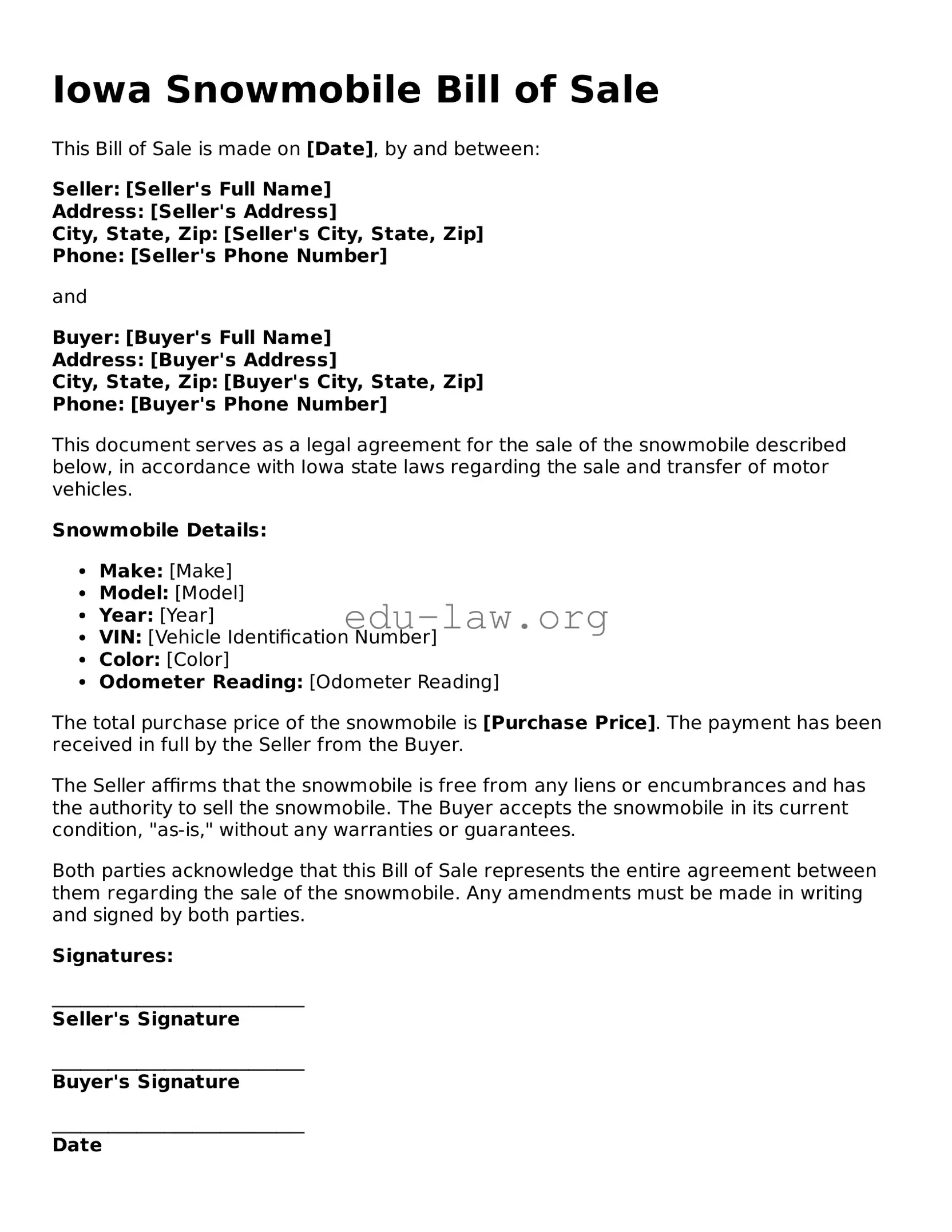
When buying or selling a snowmobile in Iowa, a Snowmobile Bill of Sale form is an essential document that facilitates the transfer of ownership. This form captures critical information, such as the names and addresses of both the buyer and seller, along with the snowmobile's details, including its make, model, year, and Vehicle Identification Number (VIN). It also outlines the sale price and the date of the transaction, ensuring that both parties have a clear record of the agreement. Having this document not only protects the interests of both the buyer and seller but also helps in the registration process with the Iowa Department of Natural Resources. Additionally, it serves as proof of ownership, which can be crucial if any disputes arise in the future. Overall, the Snowmobile Bill of Sale is a straightforward yet vital tool in ensuring a smooth and legal transfer of snowmobile ownership in Iowa.
Iowa Snowmobile Bill of Sale
This Bill of Sale is made on [Date], by and between:
Seller: [Seller's Full Name]
Address: [Seller's Address]
City, State, Zip: [Seller's City, State, Zip]
Phone: [Seller's Phone Number]
and
Buyer: [Buyer's Full Name]
Address: [Buyer's Address]
City, State, Zip: [Buyer's City, State, Zip]
Phone: [Buyer's Phone Number]
This document serves as a legal agreement for the sale of the snowmobile described below, in accordance with Iowa state laws regarding the sale and transfer of motor vehicles.
Snowmobile Details:
The total purchase price of the snowmobile is [Purchase Price]. The payment has been received in full by the Seller from the Buyer.
The Seller affirms that the snowmobile is free from any liens or encumbrances and has the authority to sell the snowmobile. The Buyer accepts the snowmobile in its current condition, "as-is," without any warranties or guarantees.
Both parties acknowledge that this Bill of Sale represents the entire agreement between them regarding the sale of the snowmobile. Any amendments must be made in writing and signed by both parties.
Signatures:
___________________________
Seller's Signature
___________________________
Buyer's Signature
___________________________
Date
| Fact Name | Description |
|---|---|
| Purpose | The Iowa Snowmobile Bill of Sale form is used to document the sale or transfer of ownership of a snowmobile in Iowa. |
| Governing Law | This form is governed by the Iowa Code Chapter 321G, which outlines the regulations for snowmobiles in the state. |
| Parties Involved | The form requires information from both the seller and the buyer, ensuring that both parties are clearly identified. |
| Vehicle Information | Details about the snowmobile, such as make, model, year, and Vehicle Identification Number (VIN), must be included. |
| Sale Price | The form includes a section where the sale price of the snowmobile is documented, providing clarity for both parties. |
| Date of Sale | It is essential to record the date of the sale on the form, as it establishes when the ownership transfer takes place. |
| Signatures Required | Both the seller's and buyer's signatures are required to validate the transaction and confirm the agreement. |
| Record Keeping | Retaining a copy of the completed Bill of Sale is crucial for both parties for future reference and potential legal matters. |
| Notarization | While notarization is not mandatory, having the form notarized can add an extra layer of security and authenticity to the transaction. |
Once you have the Iowa Snowmobile Bill of Sale form, you are ready to fill it out. This document is essential for transferring ownership of a snowmobile. Ensure you have all necessary information at hand before you begin.
After completing the form, ensure that both parties retain their copies. This will serve as proof of the transaction and may be required for registration purposes in the future.
What is an Iowa Snowmobile Bill of Sale?
An Iowa Snowmobile Bill of Sale is a legal document that records the sale of a snowmobile. It includes important details such as the buyer and seller's names, the snowmobile's make, model, year, and Vehicle Identification Number (VIN). This document serves as proof of the transaction and can help protect both parties in case of disputes.
Why do I need a Bill of Sale for my snowmobile?
A Bill of Sale is essential for several reasons. First, it provides a clear record of the sale, which can be useful for registration and insurance purposes. Second, it protects the seller by documenting that they are no longer responsible for the snowmobile once the sale is complete. Lastly, it helps the buyer establish ownership and may be required when registering the snowmobile with the state.
What information should be included in the Bill of Sale?
The Bill of Sale should include the names and addresses of both the buyer and seller, the date of the sale, the snowmobile's details (make, model, year, and VIN), the purchase price, and any terms of the sale. Additionally, both parties should sign the document to make it legally binding.
Do I need to have the Bill of Sale notarized?
No, in Iowa, a Bill of Sale for a snowmobile does not need to be notarized. However, having it notarized can add an extra layer of security and authenticity to the document, which may be beneficial in case of disputes.
Can I use a generic Bill of Sale template?
Yes, you can use a generic Bill of Sale template as long as it includes all necessary information specific to the transaction. Just ensure that it meets Iowa's requirements for a snowmobile sale. Customizing a template to fit your specific needs can help avoid any issues later on.
What if I lose the Bill of Sale after the sale?
If you lose the Bill of Sale after the sale, it can be difficult to prove ownership. It’s a good idea to keep multiple copies in safe places. If you are the seller, you may want to provide a duplicate to the buyer. If necessary, you can create a new Bill of Sale and have both parties sign it again.
Is there a specific form I need to use for the Bill of Sale?
Iowa does not require a specific form for the Bill of Sale. However, it is important that the document includes all the necessary details mentioned earlier. You can find templates online or create your own as long as it contains the required information.
What should I do with the Bill of Sale after the sale?
After the sale, both the buyer and seller should keep their copies of the Bill of Sale for their records. The buyer will need it for registering the snowmobile with the state. It is also wise to keep a copy in case any issues arise in the future regarding ownership or the sale.
Can I cancel the sale after the Bill of Sale is signed?
Once the Bill of Sale is signed and the transaction is complete, it is generally considered a binding agreement. Cancelling the sale can be complicated and may require both parties to agree to the cancellation. If you find yourself in this situation, communication between both parties is key to resolving any issues amicably.
Incomplete Information: One of the most common mistakes is failing to provide all necessary details. Buyers and sellers must fill in names, addresses, and vehicle identification numbers (VINs). Missing any of this information can lead to issues during registration.
Incorrect VIN: Entering an incorrect VIN can create significant problems. This number must match the snowmobile's registration documents. Double-checking this information helps prevent future complications.
Not Signing the Form: Both parties must sign the bill of sale. A missing signature can invalidate the document. Ensure that all required signatures are present before finalizing the sale.
Failure to Date the Document: Forgetting to include the date can lead to confusion about when the sale occurred. Including the date is essential for both parties to establish the timeline of the transaction.
When purchasing or selling a snowmobile in Iowa, several important documents accompany the Snowmobile Bill of Sale form. Each of these documents serves a specific purpose in ensuring a smooth transaction and proper registration of the snowmobile. Below is a list of forms and documents that are commonly used in conjunction with the Snowmobile Bill of Sale.
Having these documents ready can facilitate a smoother transaction when buying or selling a snowmobile in Iowa. Each form plays a vital role in protecting the interests of both the buyer and seller, ensuring compliance with state regulations and fostering trust in the sale process.
The Iowa Snowmobile Bill of Sale form is similar to the Boat Bill of Sale. Both documents serve as proof of transfer of ownership for recreational vehicles. When selling or buying a boat, a Bill of Sale provides essential details, such as the buyer's and seller's information, the boat's description, and the sale price. This document protects both parties by documenting the transaction, ensuring that the seller is no longer liable for the vessel once the sale is completed.
Another document akin to the Snowmobile Bill of Sale is the Motorcycle Bill of Sale. This form is used when a motorcycle is sold or purchased, detailing the same crucial elements as the Snowmobile Bill of Sale. It includes information about the motorcycle's make, model, year, and Vehicle Identification Number (VIN). This ensures clarity and legal protection for both the buyer and seller, confirming that ownership has been transferred.
The Car Bill of Sale is also comparable to the Snowmobile Bill of Sale. When a car is sold, this document outlines the transaction's specifics, including the vehicle's details, sale price, and signatures from both parties. Like the snowmobile form, it serves as a legal record of ownership transfer, which can be vital for registration and future liability issues.
In addition, the ATV Bill of Sale shares similarities with the Snowmobile Bill of Sale. This document is used for the sale of all-terrain vehicles and includes similar information, such as the vehicle's description and the parties involved in the transaction. It ensures that both the buyer and seller have a clear understanding of the sale, protecting their interests.
The Trailer Bill of Sale is another related document. When a trailer is sold, this form captures the essential details of the transaction, including the trailer's identification and the sale price. It functions similarly to the Snowmobile Bill of Sale by providing proof of ownership transfer, which can be important for registration and legal purposes.
The Firearm Bill of Sale is also relevant. While it pertains to the sale of firearms, it shares the same fundamental purpose of documenting a transfer of ownership. This document includes details about the firearm, the buyer, and the seller, ensuring that both parties are protected and that the transaction complies with local laws.
The RV Bill of Sale is similar as well. When a recreational vehicle is sold, this document outlines the transaction details, including the RV's specifics and the involved parties. Like the Snowmobile Bill of Sale, it serves to formalize the sale and protect both the buyer and seller from potential disputes.
The Pet Bill of Sale can also be compared to the Snowmobile Bill of Sale. This document is used when pets are sold or transferred, capturing important details about the animal and the parties involved. It formalizes the transaction and helps to clarify ownership, similar to how the Snowmobile Bill of Sale functions for snowmobiles.
Lastly, the General Bill of Sale serves as a catch-all document for various transactions. It can be used for the sale of personal property, including items not covered by other specific bills of sale. Like the Snowmobile Bill of Sale, it includes details about the item, the buyer, and the seller, ensuring that both parties have a record of the transaction for future reference.
When filling out the Iowa Snowmobile Bill of Sale form, it is important to ensure accuracy and completeness. Here are some guidelines to help you navigate the process effectively:
By following these guidelines, you can help ensure a smooth transaction and avoid potential issues in the future.
When it comes to the Iowa Snowmobile Bill of Sale form, several misconceptions can lead to confusion for buyers and sellers alike. Here are six common misunderstandings about this important document:
Many people believe that a bill of sale is optional when buying or selling a snowmobile. However, having a written record is crucial for proving ownership and protecting both parties in the transaction.
While it may seem that any document can suffice, a proper bill of sale should include specific details such as the buyer's and seller's information, the snowmobile's description, and the sale price. This ensures clarity and legality.
Some individuals think that only the seller's signature is required. In reality, both parties should sign the document to validate the transaction and acknowledge their agreement.
This misconception suggests that only new snowmobiles require a bill of sale. In truth, whether the snowmobile is new or used, a bill of sale is essential for any sale to establish clear ownership.
Some believe that a signed bill of sale is set in stone. However, if both parties agree, they can amend the document to correct any errors or update details, as long as the changes are documented and signed.
While it is true that the bill of sale is necessary for registering the snowmobile, it also serves as a vital record for both parties in case of disputes or issues that may arise later.
Understanding these misconceptions can help ensure that your snowmobile transaction goes smoothly and legally. Always consider using a proper bill of sale to protect your interests.
When filling out and using the Iowa Snowmobile Bill of Sale form, keep the following key takeaways in mind: