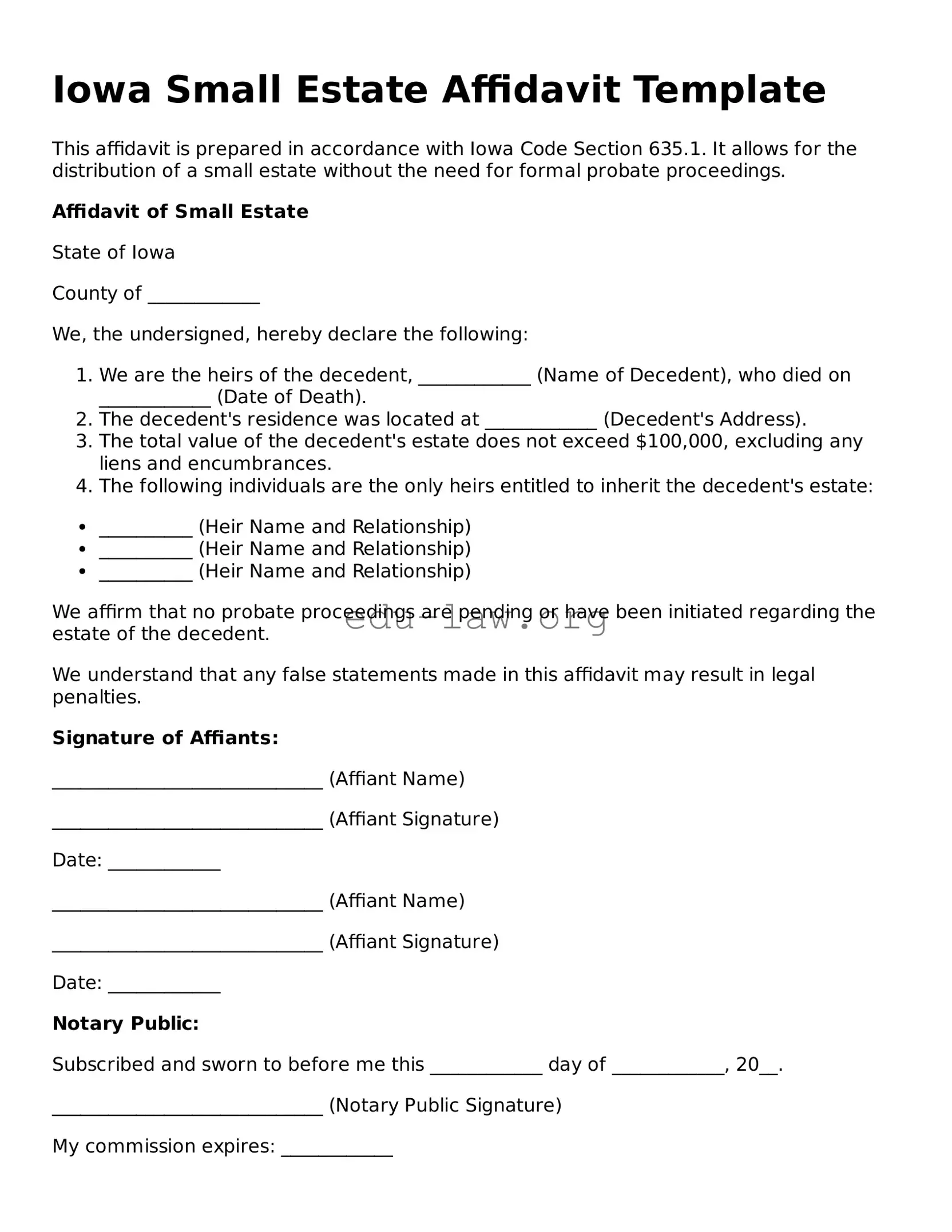
The Iowa Small Estate Affidavit form serves as a crucial tool for individuals managing the estates of loved ones who have passed away, particularly when the estate's total value is below a certain threshold. This form simplifies the probate process, allowing heirs to claim assets without going through lengthy court proceedings. By completing the affidavit, heirs can assert their rights to the deceased's property, which may include bank accounts, personal belongings, and real estate. Importantly, the form requires specific information, such as the decedent's details, a list of assets, and the names of heirs. It also mandates that the heirs affirm they are entitled to the estate's assets, ensuring transparency and accountability. Understanding how to properly fill out and submit this affidavit can save time and reduce stress during a challenging period, making it an essential resource for families navigating the complexities of estate management in Iowa.
Iowa Small Estate Affidavit Template
This affidavit is prepared in accordance with Iowa Code Section 635.1. It allows for the distribution of a small estate without the need for formal probate proceedings.
Affidavit of Small Estate
State of Iowa
County of ____________
We, the undersigned, hereby declare the following:
We affirm that no probate proceedings are pending or have been initiated regarding the estate of the decedent.
We understand that any false statements made in this affidavit may result in legal penalties.
Signature of Affiants:
_____________________________ (Affiant Name)
_____________________________ (Affiant Signature)
Date: ____________
_____________________________ (Affiant Name)
_____________________________ (Affiant Signature)
Date: ____________
Notary Public:
Subscribed and sworn to before me this ____________ day of ____________, 20__.
_____________________________ (Notary Public Signature)
My commission expires: ____________
| Fact Name | Description |
|---|---|
| Purpose | The Iowa Small Estate Affidavit is used to simplify the transfer of a deceased person's assets when the total value is below a certain threshold. |
| Governing Law | The form is governed by Iowa Code Section 635.1. |
| Eligibility | Only estates valued at $100,000 or less in total assets can utilize this affidavit. |
| Filing Requirement | The affidavit must be filed with the appropriate county recorder's office. |
| Timeframe | It can be filed as soon as 30 days after the death of the individual. |
| Signature Requirement | The affidavit must be signed by the person claiming the assets, also known as the affiant. |
| Asset Types | The affidavit can be used for various types of assets, including bank accounts and personal property. |
| Legal Effect | Once filed, it allows the transfer of assets without the need for probate court proceedings. |
After obtaining the Iowa Small Estate Affidavit form, it is important to gather the necessary information before starting to fill it out. This form is used to simplify the process of settling a small estate, allowing heirs or beneficiaries to claim property without going through a lengthy probate process. Follow the steps below to complete the form accurately.
What is the Iowa Small Estate Affidavit?
The Iowa Small Estate Affidavit is a legal document that allows individuals to settle the estate of a deceased person without going through the lengthy and often costly probate process. This form is specifically designed for estates that meet certain criteria, making it easier for heirs to claim their inheritance quickly and efficiently.
Who can use the Small Estate Affidavit in Iowa?
Any individual who is an heir or beneficiary of the deceased can use the Small Estate Affidavit, provided the total value of the estate is under a specified limit. As of the latest guidelines, this limit is $100,000, excluding certain types of property. It’s essential to ensure that the estate qualifies before proceeding with this option.
What assets are included in the Small Estate Affidavit?
The affidavit can include various types of assets such as bank accounts, personal property, and real estate. However, it typically does not cover assets held in a trust or life insurance policies with designated beneficiaries. Understanding which assets are eligible is crucial for a smooth process.
How do I complete the Small Estate Affidavit?
To complete the Small Estate Affidavit, you will need to gather necessary information about the deceased, including their name, date of death, and a list of assets. The form requires you to provide details about the heirs and their relationship to the deceased. Once filled out, the affidavit must be signed in front of a notary public.
Where do I file the Small Estate Affidavit?
The completed Small Estate Affidavit should be filed with the probate court in the county where the deceased lived at the time of their death. It’s important to check with the local court for any specific filing requirements or additional documentation that may be needed.
Is there a fee to file the Small Estate Affidavit?
Yes, there is typically a filing fee associated with submitting the Small Estate Affidavit. The fee can vary by county, so it’s wise to contact the local probate court for the exact amount. Be prepared for this cost as part of the estate settlement process.
How long does it take to process the Small Estate Affidavit?
The processing time for a Small Estate Affidavit can vary depending on the court’s workload and any potential complications. Generally, once filed, it can take a few weeks to receive confirmation. However, many heirs find that the process is much quicker than traditional probate.
Can I use the Small Estate Affidavit if there is a will?
Yes, you can still use the Small Estate Affidavit even if the deceased left a will. However, the will must not require formal probate, and the estate must still meet the small estate criteria. It’s advisable to review the will carefully to ensure it aligns with this process.
What happens if the estate exceeds the small estate limit?
If the total value of the estate exceeds the small estate limit, you will need to go through the formal probate process. This process can be more complex and may require the assistance of an attorney. It’s essential to assess the estate’s value accurately to determine the appropriate path forward.
Failing to provide accurate information about the decedent. It is crucial to ensure that the name, date of death, and other personal details are correct.
Not including all required assets. Individuals often overlook certain assets, such as bank accounts or personal property, which can lead to delays or complications.
Omitting the names of all heirs. Every heir must be listed on the affidavit, and failure to do so can result in legal challenges.
Incorrectly estimating the total value of the estate. The value must not exceed the threshold set by Iowa law, and inaccuracies can invalidate the affidavit.
Neglecting to sign the affidavit. A signature is required for the document to be considered valid, and without it, the affidavit cannot be processed.
Not having the affidavit notarized. Iowa law requires that the affidavit be notarized to ensure its authenticity.
Using outdated forms. It is essential to use the most current version of the Small Estate Affidavit form to avoid any issues with acceptance.
Failing to provide identification. Many people forget to include a copy of their ID, which can be necessary for verification purposes.
Overlooking the importance of accuracy in asset descriptions. Clear and precise descriptions of assets help prevent disputes among heirs.
Not seeking legal advice when necessary. Some individuals might assume they can fill out the form without guidance, but consulting with a legal professional can prevent costly mistakes.
The Iowa Small Estate Affidavit is a useful tool for individuals seeking to settle a deceased person's estate without going through the lengthy probate process. However, several other forms and documents often accompany this affidavit to ensure a smooth transition of assets. Below is a list of commonly used documents that can help facilitate the small estate process in Iowa.
Using these documents in conjunction with the Iowa Small Estate Affidavit can streamline the estate settlement process. Being well-prepared helps ensure that all legal requirements are met, allowing heirs to receive their inheritance more efficiently.
The Iowa Small Estate Affidavit is similar to the Affidavit of Heirship, which is used to establish the heirs of a deceased individual when there is no will. This document is often utilized in situations where the estate is not large enough to warrant formal probate proceedings. Like the Small Estate Affidavit, it allows heirs to claim property directly, simplifying the transfer process without the need for court intervention.
Another document with similarities is the Transfer on Death Deed (TOD). This deed allows individuals to designate beneficiaries for their property upon their death, bypassing probate. Both the TOD and the Small Estate Affidavit facilitate a smoother transition of assets, ensuring that beneficiaries receive their inheritance without lengthy legal processes.
The Affidavit for Collection of Personal Property is also comparable. This document allows individuals to collect personal property from a deceased person’s estate without going through probate. Like the Small Estate Affidavit, it provides a streamlined way to access assets, making it easier for family members to manage the deceased’s belongings.
The Small Estate Affidavit shares characteristics with the Will, particularly in how it designates beneficiaries. While a will outlines the distribution of an estate and requires probate, the Small Estate Affidavit simplifies this process for smaller estates. Both documents aim to ensure that the deceased's wishes are honored, but the Small Estate Affidavit is more straightforward for smaller estates.
The Summary Administration process is another document that bears similarities. Used in some states, this process allows for a simplified probate procedure for smaller estates. Like the Small Estate Affidavit, it minimizes the time and expense involved in settling an estate, making it a practical choice for families dealing with modest assets.
The Small Estate Affidavit can also be compared to a Living Trust. While a living trust is established during a person’s lifetime to manage assets, it can help avoid probate upon death. Both documents aim to facilitate the transfer of assets efficiently, although a living trust requires more planning and maintenance than the Small Estate Affidavit.
Lastly, the Small Estate Affidavit is similar to the Petition for Determination of Heirship. This petition is filed in court to formally establish heirs when there is no will. While the Small Estate Affidavit allows heirs to claim property without court involvement, the Petition for Determination of Heirship provides a legal framework for confirming heirship, making it necessary in more complex situations.
Filling out the Iowa Small Estate Affidavit form can seem daunting, but with careful attention to detail, you can navigate the process smoothly. Here are seven important dos and don'ts to keep in mind.
By following these guidelines, you can help ensure that the process is as straightforward as possible. Remember, attention to detail is key.
When it comes to the Iowa Small Estate Affidavit, many people hold misconceptions that can lead to confusion and unnecessary stress during an already challenging time. Here are six common myths debunked to help clarify the process.
Understanding these misconceptions can help you navigate the Small Estate Affidavit process with confidence. Always consider seeking advice tailored to your specific situation to ensure a smoother experience.
When dealing with the Iowa Small Estate Affidavit form, it is essential to understand the process and requirements to ensure a smooth experience. Here are ten key takeaways to keep in mind:
Understanding these key points will help navigate the Iowa Small Estate Affidavit process effectively.