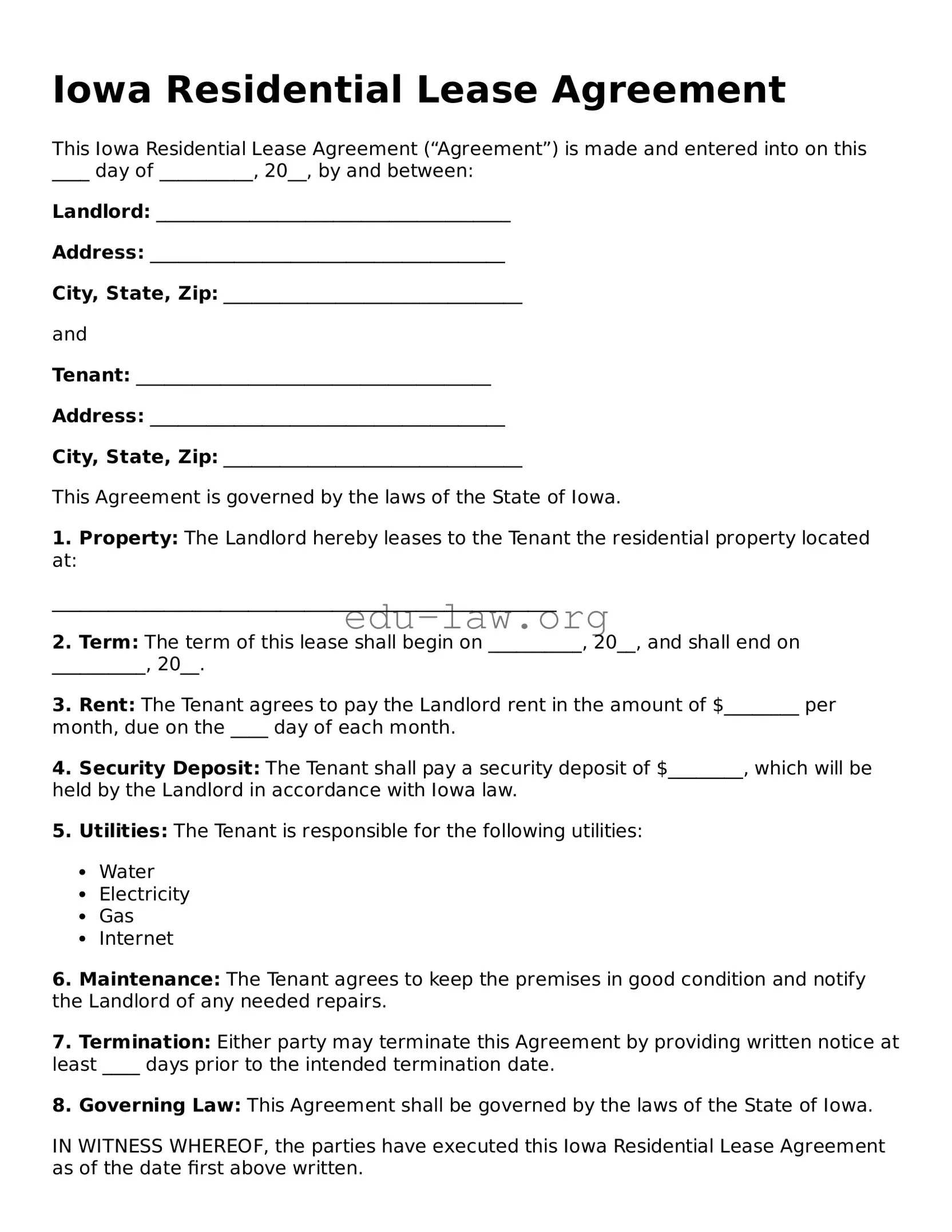
The Iowa Residential Lease Agreement is a crucial document for both landlords and tenants, outlining the terms and conditions of renting a residential property. This form typically includes essential details such as the names of the parties involved, the property address, and the duration of the lease. It addresses rental payment amounts, due dates, and acceptable payment methods, ensuring clarity on financial obligations. Additionally, the agreement covers security deposits, maintenance responsibilities, and rules regarding pets, providing a comprehensive framework for the rental relationship. Furthermore, it outlines the procedures for terminating the lease and addressing disputes, ensuring that both parties understand their rights and responsibilities. By clearly defining these aspects, the Iowa Residential Lease Agreement helps to prevent misunderstandings and fosters a positive rental experience for everyone involved.
Iowa Residential Lease Agreement
This Iowa Residential Lease Agreement (“Agreement”) is made and entered into on this ____ day of __________, 20__, by and between:
Landlord: ______________________________________
Address: ______________________________________
City, State, Zip: ________________________________
and
Tenant: ______________________________________
Address: ______________________________________
City, State, Zip: ________________________________
This Agreement is governed by the laws of the State of Iowa.
1. Property: The Landlord hereby leases to the Tenant the residential property located at:
______________________________________________________
2. Term: The term of this lease shall begin on __________, 20__, and shall end on __________, 20__.
3. Rent: The Tenant agrees to pay the Landlord rent in the amount of $________ per month, due on the ____ day of each month.
4. Security Deposit: The Tenant shall pay a security deposit of $________, which will be held by the Landlord in accordance with Iowa law.
5. Utilities: The Tenant is responsible for the following utilities:
6. Maintenance: The Tenant agrees to keep the premises in good condition and notify the Landlord of any needed repairs.
7. Termination: Either party may terminate this Agreement by providing written notice at least ____ days prior to the intended termination date.
8. Governing Law: This Agreement shall be governed by the laws of the State of Iowa.
IN WITNESS WHEREOF, the parties have executed this Iowa Residential Lease Agreement as of the date first above written.
Landlord Signature: ____________________________
Date: ______________________________________
Tenant Signature: _____________________________
Date: ______________________________________
| Fact Name | Details |
|---|---|
| Governing Law | The Iowa Residential Lease Agreement is governed by Iowa Code Chapter 562A, which outlines the rights and responsibilities of landlords and tenants. |
| Duration of Lease | The lease can be for a fixed term, such as one year, or it can be a month-to-month agreement, depending on the preferences of both parties. |
| Security Deposit | Iowa law limits the security deposit to no more than two months’ rent, ensuring that tenants are not overburdened by upfront costs. |
| Notice Requirements | Landlords must provide a written notice of at least 30 days for lease termination in a month-to-month agreement, while specific terms apply for fixed-term leases. |
| Maintenance Responsibilities | Landlords are required to maintain the property in a habitable condition, which includes ensuring that essential services such as heating and plumbing are functioning properly. |
| Tenant Rights | Tenants have the right to privacy and must be given reasonable notice before a landlord enters the rental unit, typically 24 hours in advance. |
Filling out the Iowa Residential Lease Agreement form requires attention to detail and accuracy. Each section must be completed to ensure clarity between the landlord and tenant regarding the terms of the lease.
After completing the form, ensure that all parties receive a copy for their records. This step is crucial for maintaining clear communication and understanding of the lease terms.
What is an Iowa Residential Lease Agreement?
The Iowa Residential Lease Agreement is a legal document that outlines the terms and conditions under which a landlord rents property to a tenant. This agreement typically includes details such as the rental amount, duration of the lease, security deposit requirements, and the responsibilities of both the landlord and tenant. It serves to protect the rights of both parties and provides a clear framework for the rental relationship.
What should be included in the Iowa Residential Lease Agreement?
A comprehensive Iowa Residential Lease Agreement should include several key components. These typically consist of the names of the landlord and tenant, the address of the rental property, the lease term (whether it's month-to-month or for a fixed period), the rental amount and payment due date, security deposit information, and maintenance responsibilities. Additionally, it may outline rules regarding pets, smoking, and any other specific policies that the landlord wishes to enforce.
How long is a typical lease term in Iowa?
In Iowa, lease terms can vary widely based on the agreement between the landlord and tenant. Many leases are typically one year long, but month-to-month arrangements are also common. The length of the lease should be clearly stated in the agreement. It's important for tenants to understand the duration of their commitment and the process for renewing or terminating the lease.
Can a landlord change the terms of the lease during the rental period?
Generally, a landlord cannot change the terms of the lease agreement during the rental period without the tenant's consent. Any modifications to the lease must be agreed upon by both parties and documented in writing. This ensures that both the landlord and tenant are aware of their rights and obligations. If changes are necessary, it's advisable for both parties to communicate openly and reach a mutual agreement.
Filling out the Iowa Residential Lease Agreement form can be a straightforward process, but there are common mistakes that individuals often make. Here’s a list of nine mistakes to avoid:
Incomplete Information: One of the most frequent errors is not providing all required information. This includes missing names, addresses, or contact details for both the landlord and tenant.
Incorrect Dates: Failing to accurately enter the lease start and end dates can lead to confusion later. Make sure to double-check these dates for accuracy.
Omitting Rent Amount: Not specifying the monthly rent amount is a significant oversight. Clearly state the rent to avoid misunderstandings.
Ignoring Security Deposit Terms: It's important to include details about the security deposit, such as the amount and conditions for its return. Omitting this can lead to disputes.
Not Specifying Utilities: Failing to clarify which utilities are included in the rent can create confusion. Be explicit about what the landlord covers and what the tenant is responsible for.
Missing Signatures: Both parties must sign the lease for it to be legally binding. Forgetting to sign can render the agreement invalid.
Neglecting to Review Local Laws: Not being aware of local rental laws can lead to mistakes. It's beneficial to familiarize oneself with Iowa's specific regulations regarding leases.
Not Including Pet Policies: If pets are allowed or prohibited, this should be clearly stated in the lease. Leaving it out can result in misunderstandings later on.
Failure to Update the Lease: If any changes occur after the lease is drafted, such as changes in rent or terms, these should be updated in the document to reflect the current agreement.
By avoiding these common mistakes, individuals can ensure that their lease agreement is clear, comprehensive, and legally sound.
When entering into a rental agreement in Iowa, several other documents may accompany the Residential Lease Agreement. These forms help clarify responsibilities, outline terms, and protect the interests of both landlords and tenants. Here are some essential documents often used in conjunction with the lease agreement:
Understanding these documents is crucial for both landlords and tenants. They provide clarity and protection throughout the rental process. Always ensure that all forms are filled out accurately and kept on file for reference.
The Iowa Residential Lease Agreement shares similarities with the Standard Lease Agreement, which is a common document used across many states. Both agreements outline the terms and conditions under which a tenant can occupy a rental property. They typically cover essential elements such as the duration of the lease, rental payments, security deposits, and maintenance responsibilities. The Standard Lease Agreement can vary in terms of state-specific laws, but its core purpose remains the same: to protect the rights of both landlords and tenants.
Another document akin to the Iowa Residential Lease Agreement is the Month-to-Month Rental Agreement. This type of agreement provides flexibility for both parties, allowing the lease to renew automatically each month unless either party gives notice to terminate. Like the Iowa Residential Lease Agreement, it includes terms regarding rent payment, property maintenance, and tenant responsibilities. However, it typically has fewer long-term commitments, making it suitable for tenants who may need to move on short notice.
The Lease Renewal Agreement is also similar, as it serves to extend the terms of an existing lease. When a tenant and landlord wish to continue their relationship beyond the original lease period, they can use this document. It often restates the original lease terms while allowing for any necessary updates, such as changes in rent. This document ensures clarity and mutual agreement on the continuation of the tenancy.
Additionally, the Commercial Lease Agreement is comparable, though it is specifically designed for business properties rather than residential spaces. Both types of agreements outline the rights and obligations of the parties involved, including lease duration, payment terms, and maintenance duties. However, commercial leases often contain more complex terms due to the nature of business operations, which can include clauses about use of space and modifications.
The Rental Application form is another document that complements the Iowa Residential Lease Agreement. While it is not a lease itself, it is an essential preliminary step in the leasing process. This form collects information from potential tenants, such as employment history and references. It helps landlords assess the suitability of applicants before entering into a lease agreement, ensuring that they select reliable tenants.
Moreover, the Sublease Agreement is similar in that it allows a tenant to rent out their leased property to another party. This document must align with the original lease terms and requires the landlord's consent. Like the Iowa Residential Lease Agreement, it specifies the rights and responsibilities of all parties involved, ensuring that the primary tenant remains accountable to the landlord while providing a legal framework for the subtenant.
Finally, the Lease Termination Agreement bears resemblance to the Iowa Residential Lease Agreement as it outlines the process for ending a lease. This document clarifies the terms under which a tenant can vacate the property, including notice periods and any final obligations, such as cleaning or repairs. It serves to protect both the landlord's interests and the tenant's rights, ensuring a smooth transition at the end of the rental period.
When filling out the Iowa Residential Lease Agreement form, it's essential to approach the task with care. Here are some important do's and don'ts to keep in mind:
Understanding the Iowa Residential Lease Agreement form is important for both landlords and tenants. However, several misconceptions can lead to confusion. Here are eight common misconceptions explained:
This is not true. Each lease agreement can vary based on the property, the landlord's requirements, and local laws. The Iowa Residential Lease Agreement has specific provisions that may not be found in agreements from other states.
While verbal agreements can be enforceable, they are harder to prove. A written lease agreement provides clear terms and protects both parties in case of disputes.
Breaking a lease can lead to penalties, including financial repercussions. It is essential to understand the terms of the lease before making any decisions.
Landlords must provide proper notice before entering a tenant's home, except in emergencies. This protects the tenant's right to privacy.
Security deposits are often refundable, provided the tenant meets the lease terms and leaves the property in good condition. Landlords must return the deposit within a specified time frame.
Rent increases must follow the terms outlined in the lease agreement. Typically, landlords must provide advance notice before any increase takes effect.
While landlords are responsible for major repairs, tenants may need to handle minor maintenance tasks. The lease should clarify these responsibilities.
Many terms in a lease agreement can be negotiated before signing. Open communication between landlords and tenants can lead to a mutually beneficial agreement.
By understanding these misconceptions, both landlords and tenants can navigate the leasing process more effectively and foster a positive rental experience.
When filling out and using the Iowa Residential Lease Agreement form, keep the following key takeaways in mind: