In the realm of property transactions, the Iowa Quitclaim Deed serves as a vital instrument for transferring ownership rights from one party to another. This form is particularly notable for its simplicity and efficiency, allowing individuals to relinquish their interests in real estate without the complexities often associated with other types of deeds. Unlike warranty deeds, which provide assurances regarding the title, the quitclaim deed offers no guarantees about the property’s title status, making it essential for parties to understand the implications of such a transfer. Typically utilized in situations such as divorce settlements, property transfers between family members, or when clearing up title issues, this document requires careful consideration. The form must include specific information, including the names of the grantor and grantee, a legal description of the property, and the signatures of the involved parties. Additionally, while the quitclaim deed does not necessitate notarization in all cases, having it notarized can enhance its credibility and facilitate smoother transactions. Understanding these key aspects can empower individuals to navigate property transfers with greater confidence.
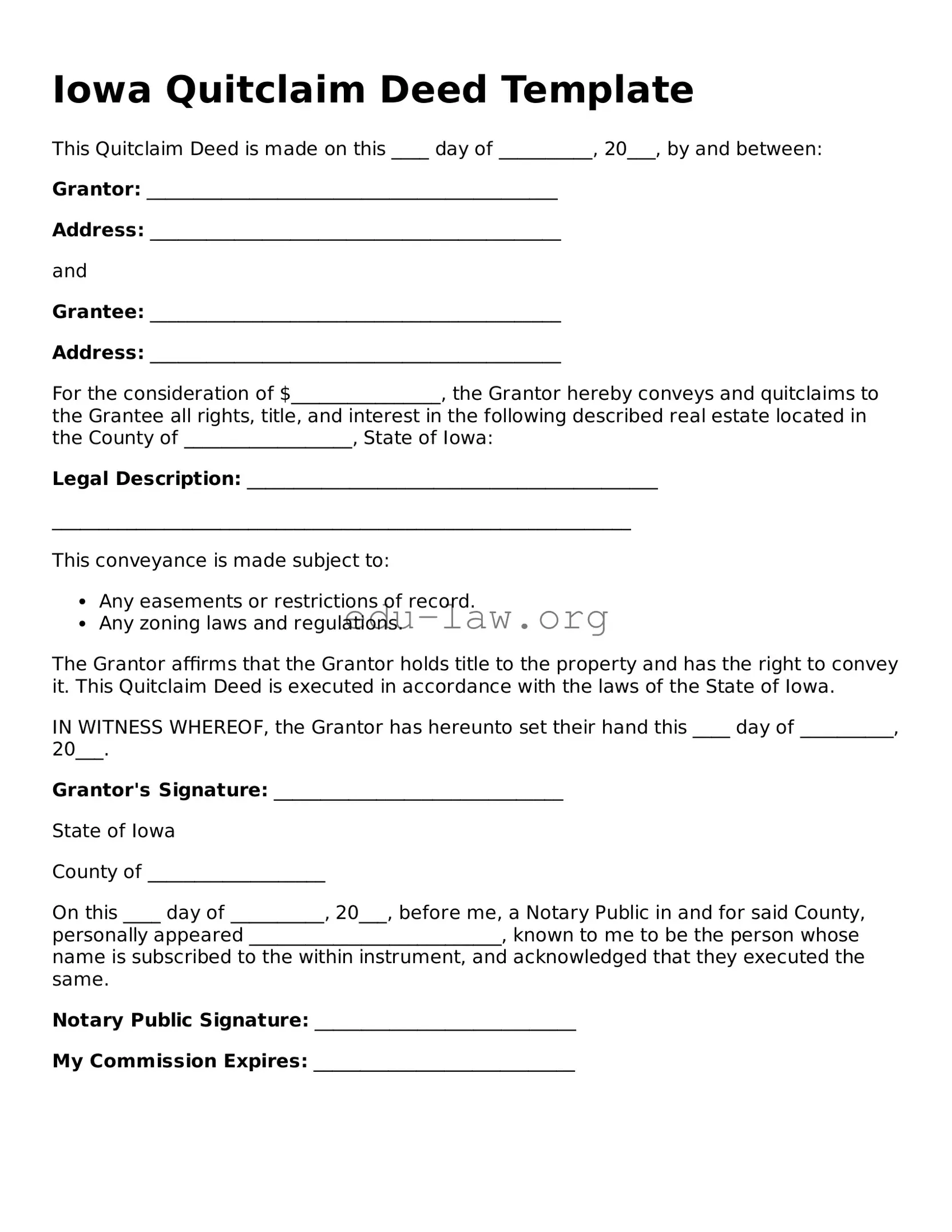
Iowa Quitclaim Deed Template
This Quitclaim Deed is made on this ____ day of __________, 20___, by and between:
Grantor: ____________________________________________
Address: ____________________________________________
and
Grantee: ____________________________________________
Address: ____________________________________________
For the consideration of $________________, the Grantor hereby conveys and quitclaims to the Grantee all rights, title, and interest in the following described real estate located in the County of __________________, State of Iowa:
Legal Description: ____________________________________________
______________________________________________________________
This conveyance is made subject to:
The Grantor affirms that the Grantor holds title to the property and has the right to convey it. This Quitclaim Deed is executed in accordance with the laws of the State of Iowa.
IN WITNESS WHEREOF, the Grantor has hereunto set their hand this ____ day of __________, 20___.
Grantor's Signature: _______________________________
State of Iowa
County of ___________________
On this ____ day of __________, 20___, before me, a Notary Public in and for said County, personally appeared ___________________________, known to me to be the person whose name is subscribed to the within instrument, and acknowledged that they executed the same.
Notary Public Signature: ____________________________
My Commission Expires: ____________________________
| Fact Name | Description |
|---|---|
| Definition | A quitclaim deed is a legal document used to transfer ownership of real estate without any warranties. |
| Governing Law | The Iowa Quitclaim Deed is governed by Iowa Code Chapter 557. |
| Parties Involved | The form involves a grantor (the person transferring the property) and a grantee (the person receiving the property). |
| Consideration | While a monetary amount is typically included, it is not required for the deed to be valid. |
| Recording | The deed should be recorded with the county recorder's office to provide public notice of the transfer. |
| Legal Effect | A quitclaim deed conveys whatever interest the grantor has in the property, if any, but does not guarantee it is free of claims. |
| Use Cases | This type of deed is often used in divorce settlements, transferring property between family members, or clearing up title issues. |
Once you have the Iowa Quitclaim Deed form, you will need to complete it accurately to ensure a smooth transfer of property ownership. After filling out the form, it will need to be signed and notarized before being filed with the appropriate county office.
What is a Quitclaim Deed in Iowa?
A Quitclaim Deed is a legal document used to transfer ownership of real estate from one person to another. In Iowa, this type of deed does not guarantee that the person transferring the property has clear title to it. Instead, it simply conveys whatever interest the grantor has in the property, if any. This can be useful in situations such as divorce settlements, transferring property between family members, or clearing up title issues.
How do I complete a Quitclaim Deed in Iowa?
To complete a Quitclaim Deed in Iowa, you will need to provide specific information. This includes the names of the grantor (the person giving up the property) and the grantee (the person receiving the property), a description of the property being transferred, and the date of the transfer. After filling out the form, the grantor must sign it in the presence of a notary public. It is important to ensure that all information is accurate to avoid future disputes.
Do I need to file the Quitclaim Deed with the county?
Yes, in Iowa, it is necessary to file the Quitclaim Deed with the county recorder's office where the property is located. This step is crucial for making the transfer official and for public record. Filing the deed typically requires a small fee, and it is advisable to keep a copy for personal records as well.
Are there any tax implications when using a Quitclaim Deed?
Using a Quitclaim Deed may have tax implications, though it often depends on the circumstances of the transfer. In some cases, if the property is transferred as a gift or part of a divorce settlement, there may not be any immediate tax consequences. However, it is wise to consult with a tax professional to understand any potential capital gains tax or other tax responsibilities that may arise from the transfer.
Can I use a Quitclaim Deed to transfer property to myself?
Yes, a Quitclaim Deed can be used to transfer property to yourself, although this may seem unnecessary. This action can be beneficial if you want to clarify the title or correct a previous deed. It can also be used in situations where you want to change the way the property is held, such as from sole ownership to joint ownership with another person.
What should I do if I encounter problems after filing a Quitclaim Deed?
If you encounter problems after filing a Quitclaim Deed, it is important to address them promptly. Common issues may include disputes over property ownership or unclear title. Consulting with a real estate attorney can provide guidance on how to resolve these issues. They can help you understand your rights and options, ensuring that your interests are protected.
Failing to include all necessary parties. It is crucial to ensure that both the grantor (the person transferring the property) and the grantee (the person receiving the property) are clearly identified. Missing a name can lead to complications in ownership.
Not providing a complete legal description of the property. A vague or incomplete description can create confusion regarding the exact boundaries of the property being transferred. Always include the full address and any relevant parcel numbers.
Neglecting to sign the form. A quitclaim deed must be signed by the grantor to be valid. Without a signature, the document holds no legal weight, and the property transfer will not occur.
Overlooking the need for notarization. In Iowa, a quitclaim deed must be notarized to be legally effective. Failing to have the document notarized can invalidate the transfer.
Not recording the deed with the county recorder's office. Once the quitclaim deed is completed, it should be filed with the appropriate local government office. This step is essential to protect the new owner's rights and establish public record.
Using outdated forms. Always ensure that you are using the most current version of the quitclaim deed form. Laws and requirements can change, and using an outdated form may lead to errors or legal issues.
Ignoring tax implications. Transferring property can have tax consequences. It is advisable to consult with a tax professional to understand any potential liabilities or benefits associated with the transfer.
The Iowa Quitclaim Deed is a useful document for transferring property ownership. However, several other forms and documents often accompany it to ensure a smooth transaction. Below is a list of these commonly used documents.
Using these documents in conjunction with the Iowa Quitclaim Deed can help clarify the transaction and protect the interests of both parties involved. Ensuring that all necessary paperwork is completed accurately is vital for a successful property transfer.
A warranty deed is similar to a quitclaim deed in that both are used to transfer property ownership. However, a warranty deed provides a guarantee from the seller that they hold clear title to the property and have the right to sell it. This type of deed protects the buyer against future claims to the property, making it a more secure option for those looking to purchase real estate. In contrast, a quitclaim deed offers no such guarantees, which can leave buyers at risk if any issues arise regarding the title.
A special warranty deed also serves the purpose of transferring property ownership but includes limited warranties. The seller guarantees that they have not done anything to impair the title during their ownership. This contrasts with a warranty deed, which covers the entire history of the property. A special warranty deed may be used in commercial transactions or by sellers who want to limit their liability while still providing some assurance to the buyer.
A bargain and sale deed is another document that resembles a quitclaim deed. It conveys property without any warranties regarding the title. This type of deed implies that the seller has the right to sell the property but does not guarantee a clear title. Buyers should exercise caution when dealing with a bargain and sale deed, as they assume the risk of any title issues that may arise after the transaction.
A grant deed is similar to a quitclaim deed in that it transfers ownership of property. However, a grant deed includes certain warranties, such as the assurance that the property has not been sold to anyone else and that the seller has not encumbered the property during their ownership. This added layer of protection makes grant deeds more favorable for buyers compared to quitclaim deeds.
An executor's deed is used to transfer property from a deceased person's estate. This type of deed is similar to a quitclaim deed in that it may not provide warranties regarding the title. Executors typically use this deed to fulfill their duties in administering the estate. Buyers should be aware that they may face title issues when acquiring property through an executor's deed.
A trustee's deed is issued when a property is sold by a trustee, often in a foreclosure situation. Like a quitclaim deed, a trustee's deed may not offer warranties about the title. The trustee acts on behalf of the trust and transfers the property to the buyer. Buyers should be cautious, as they may encounter title defects or claims after the sale.
A deed in lieu of foreclosure is a document that allows a homeowner to transfer their property to the lender to avoid foreclosure. This type of deed is similar to a quitclaim deed because it typically does not provide warranties. The homeowner relinquishes their ownership, and the lender takes possession of the property. This option can be beneficial for both parties, but buyers should be aware of any potential title issues that may arise.
A leasehold deed is used to transfer a leasehold interest in a property rather than ownership. While this document serves a different purpose, it shares similarities with a quitclaim deed in that it may not provide warranties about the title. This type of deed is often used in commercial real estate transactions, allowing businesses to secure a property for a specific period without transferring full ownership.
When filling out the Iowa Quitclaim Deed form, it’s essential to approach the task with care. Here’s a list of ten important dos and don’ts to keep in mind:
Many people have misunderstandings about the Iowa Quitclaim Deed form. Here are four common misconceptions:
Understanding the Iowa Quitclaim Deed form is essential for anyone looking to transfer property rights. Here are some key takeaways to keep in mind:
By keeping these points in mind, you can navigate the process of using the Iowa Quitclaim Deed form with confidence and clarity.