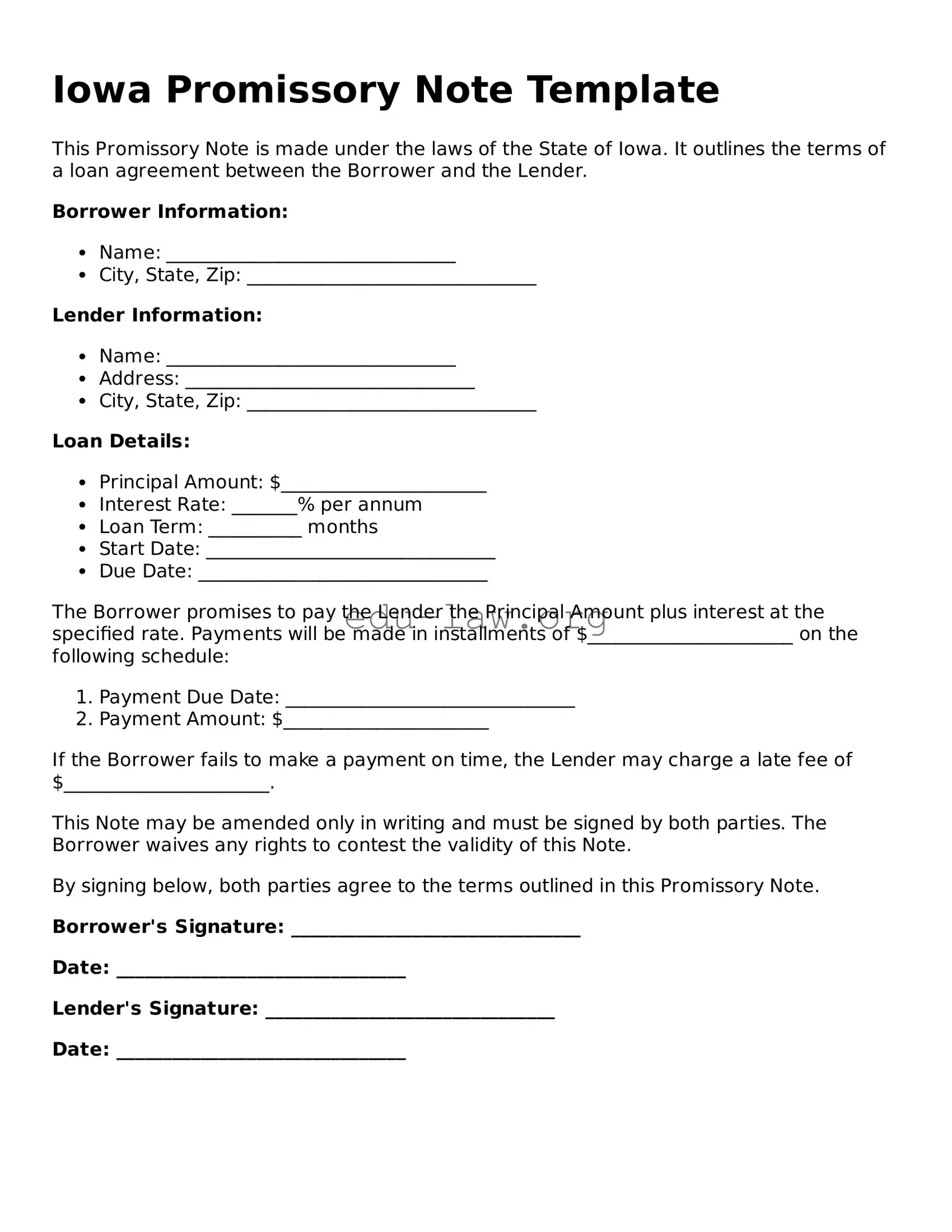
The Iowa Promissory Note form serves as a crucial financial instrument for individuals and businesses engaging in lending agreements within the state. It outlines the borrower's commitment to repay a specified amount of money, along with any applicable interest, to the lender by a predetermined date. This document not only specifies the principal amount and interest rate but also includes essential terms such as payment schedules, late fees, and the consequences of default. Additionally, it may incorporate clauses that address prepayment options and governing law, ensuring that both parties understand their rights and obligations. Understanding the nuances of this form is vital for both lenders and borrowers to protect their interests and facilitate smooth transactions.
Iowa Promissory Note Template
This Promissory Note is made under the laws of the State of Iowa. It outlines the terms of a loan agreement between the Borrower and the Lender.
Borrower Information:
Lender Information:
Loan Details:
The Borrower promises to pay the Lender the Principal Amount plus interest at the specified rate. Payments will be made in installments of $______________________ on the following schedule:
If the Borrower fails to make a payment on time, the Lender may charge a late fee of $______________________.
This Note may be amended only in writing and must be signed by both parties. The Borrower waives any rights to contest the validity of this Note.
By signing below, both parties agree to the terms outlined in this Promissory Note.
Borrower's Signature: _______________________________
Date: _______________________________
Lender's Signature: _______________________________
Date: _______________________________
| Fact Name | Description |
|---|---|
| Definition | An Iowa Promissory Note is a written promise to pay a specific amount of money to a designated person or entity at a specified time. |
| Governing Law | The Iowa Promissory Note is governed by the Iowa Uniform Commercial Code (UCC), specifically Chapter 554. |
| Requirements | The note must include the date, amount, payee, and signatures of the parties involved to be legally binding. |
| Types | Iowa recognizes various types of promissory notes, including secured and unsecured notes, each serving different purposes. |
After obtaining the Iowa Promissory Note form, you'll need to fill it out accurately to ensure it serves its intended purpose. This form is a legal document that outlines the terms of a loan agreement between a borrower and a lender. Following these steps will help you complete the form correctly.
What is a promissory note in Iowa?
A promissory note is a written promise to pay a specific amount of money to a designated person or entity at a particular time or on demand. In Iowa, this document serves as a legal instrument that outlines the terms of a loan, including the principal amount, interest rate, repayment schedule, and any consequences for defaulting on the loan. It is important for both the borrower and lender to understand the terms clearly before signing.
Who can create a promissory note in Iowa?
In Iowa, any individual or business entity can create a promissory note, provided they have the legal capacity to enter into a contract. This includes adults who are of sound mind and not under duress. Additionally, both parties involved—the lender and the borrower—must agree to the terms laid out in the note.
What information should be included in an Iowa promissory note?
An effective promissory note should include several key pieces of information: the names and addresses of both the borrower and lender, the principal amount being borrowed, the interest rate, the repayment schedule, and any collateral involved. It’s also wise to include a statement regarding late fees and the consequences of defaulting on the loan. Clear and concise language helps prevent misunderstandings later on.
Is a promissory note legally binding in Iowa?
Yes, a properly executed promissory note is legally binding in Iowa. This means that if one party fails to uphold their end of the agreement, the other party can seek legal recourse. However, for the note to be enforceable, it must contain all essential elements of a contract, including mutual consent and consideration (something of value exchanged between the parties).
Do I need a lawyer to draft a promissory note in Iowa?
While it is not legally required to have a lawyer draft a promissory note, consulting with one can provide valuable guidance. A legal professional can help ensure that the document meets all legal requirements and adequately protects the interests of both parties. For those who choose to draft the note independently, using a template can be helpful, but it’s still important to understand the implications of the terms included.
Can a promissory note be modified after it is signed?
Yes, a promissory note can be modified after it has been signed, but both parties must agree to the changes. It is essential to document any modifications in writing and have both parties sign the amended note. This helps avoid confusion and ensures that the updated terms are legally enforceable.
What happens if a borrower defaults on a promissory note in Iowa?
If a borrower defaults on a promissory note, the lender has several options for recourse. The lender may choose to negotiate a new payment plan or pursue legal action to recover the owed amount. In some cases, if collateral was involved, the lender may have the right to seize that collateral. It’s important for both parties to understand the terms regarding default before signing the note to minimize potential conflicts in the future.
Not including the date on the form. This can lead to confusion about when the agreement was made.
Failing to clearly state the amount of the loan. Be specific to avoid disputes later.
Omitting the interest rate. If applicable, this detail is crucial for understanding repayment terms.
Not specifying the payment schedule. Clearly outline when payments are due and how they should be made.
Forgetting to include borrower and lender information. Both parties must be clearly identified to avoid confusion.
Neglecting to sign the document. Both parties should sign to validate the agreement.
Using vague language. Be precise and clear to ensure that all terms are understood by both parties.
Not keeping a copy of the signed note. Both parties should retain a copy for their records.
When dealing with a promissory note in Iowa, several other forms and documents may come into play. These documents help clarify the terms of the agreement, ensure compliance with state laws, and protect the interests of both parties involved. Here’s a brief overview of some commonly used documents alongside the Iowa Promissory Note form.
Each of these documents plays a vital role in the lending process. They not only help to clarify the terms of the agreement but also protect the rights of both the lender and borrower. Understanding these documents can lead to a smoother transaction and fewer disputes down the line.
A promissory note is a financial instrument that outlines a borrower's promise to repay a loan to a lender under specified terms. Similar to a promissory note, a personal loan agreement serves to document the terms of a loan between individuals. This document specifies the amount borrowed, the interest rate, repayment schedule, and any consequences for defaulting on the loan. Both documents provide clarity and protection for both parties involved, ensuring that everyone understands their rights and obligations.
A mortgage agreement is another document that bears similarities to a promissory note. In this case, the promissory note is often part of the mortgage package. The mortgage agreement secures the loan with the property itself, meaning if the borrower fails to repay, the lender can take possession of the property. Both documents detail the repayment terms and the consequences of non-payment, but the mortgage also includes the collateral aspect, making it a bit more complex.
A car loan agreement also shares characteristics with a promissory note. When someone borrows money to purchase a vehicle, they typically sign a car loan agreement that outlines the loan amount, interest rate, and repayment terms. Just like a promissory note, this agreement serves to protect the lender's interests while detailing the borrower's obligations. Both documents ensure that the borrower understands their commitment to repay the loan, often over a set period.
A student loan agreement can be compared to a promissory note as well. When students borrow money to finance their education, they often sign a student loan agreement that details the loan amount, interest rates, and repayment options. Similar to a promissory note, this agreement is a formal acknowledgment of the debt and the borrower's promise to repay it. Both documents aim to protect the lender while providing the borrower with a clear understanding of their financial responsibilities.
A business loan agreement is another document akin to a promissory note. When a business seeks funding, it may enter into a loan agreement that specifies the loan amount, interest rate, and repayment terms. This document, like a promissory note, outlines the expectations and responsibilities of both the lender and the borrower. It serves to formalize the transaction, ensuring that both parties are aware of their obligations and rights.
A lease agreement, while primarily for rental properties, has similarities to a promissory note in that it outlines payment obligations. In a lease, a tenant agrees to pay rent to a landlord over a specified period. Like a promissory note, the lease agreement clearly states the amount due, the payment schedule, and the consequences of failing to pay. Both documents aim to protect the interests of the party providing the asset, whether it's money or property.
An IOU, or informal loan acknowledgment, is also similar to a promissory note. An IOU is a simple document that states one party owes money to another. While it may lack the formal structure of a promissory note, it still serves as a recognition of debt. Both documents signify a borrower's obligation to repay, though an IOU may not include detailed terms like interest rates or repayment schedules.
Lastly, a credit card agreement can be likened to a promissory note. When individuals use credit cards, they are essentially borrowing money from the credit card issuer. The credit card agreement outlines the terms of borrowing, including interest rates and repayment expectations. Like a promissory note, this agreement establishes the borrower's obligation to repay the borrowed amount, ensuring that both parties understand the terms of the financial arrangement.
When filling out the Iowa Promissory Note form, it is important to be careful and thorough. Here are some key dos and don'ts to keep in mind:
Understanding the Iowa Promissory Note form can be tricky. Here are five common misconceptions about it:
Clarifying these misconceptions can help individuals navigate the process of creating and using promissory notes in Iowa effectively.
When filling out and using the Iowa Promissory Note form, there are several important considerations to keep in mind. Understanding these key points can help ensure that the document is completed correctly and serves its intended purpose.