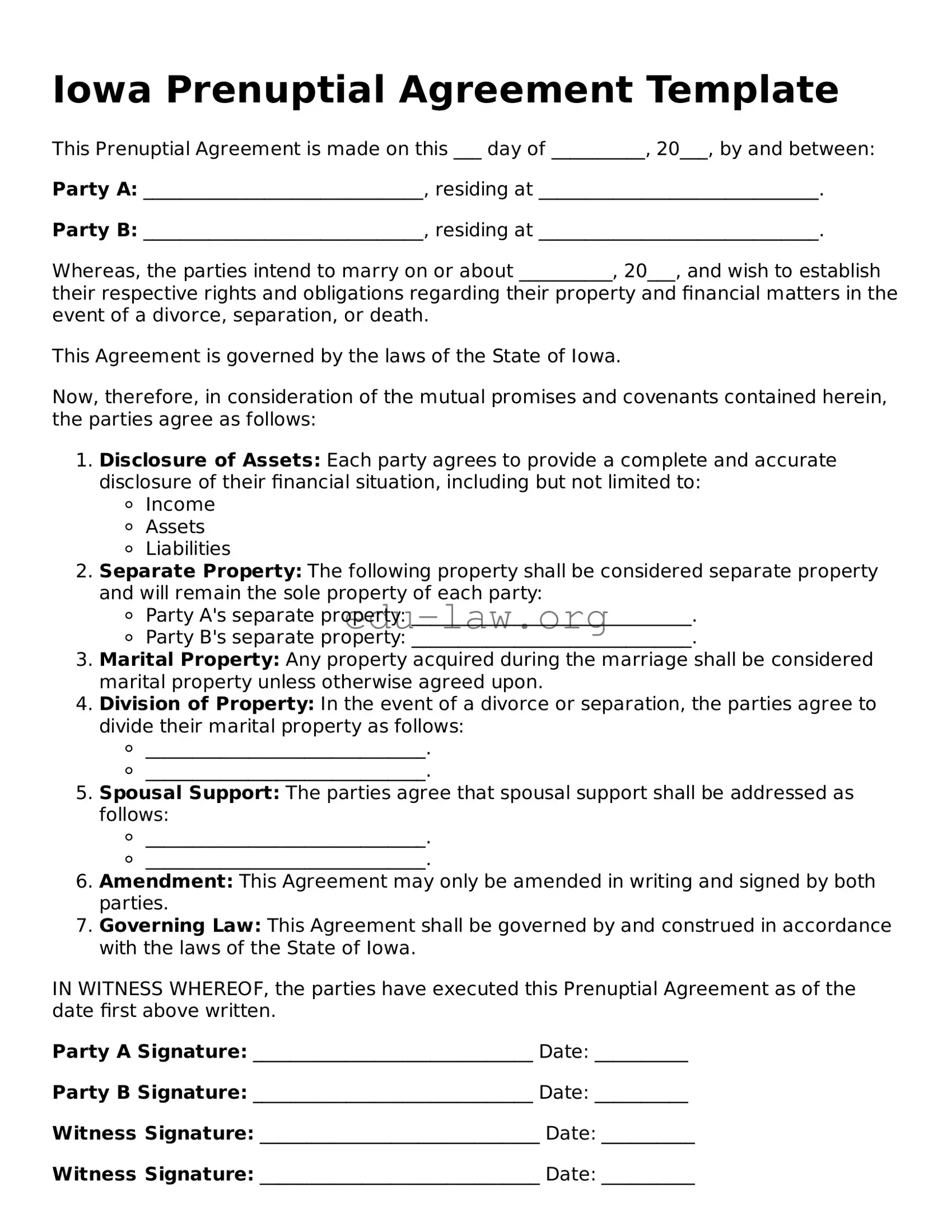
In Iowa, a prenuptial agreement serves as a crucial tool for couples preparing for marriage, allowing them to outline their financial rights and responsibilities before tying the knot. This legal document can address a variety of important matters, including the division of assets and debts, spousal support, and inheritance rights. By clearly defining these terms, the agreement helps to minimize potential conflicts in the event of divorce or separation. Additionally, it can protect individual property and ensure that both parties understand their financial obligations. Couples may also use the agreement to establish how they will manage their finances during the marriage. Crafting a comprehensive prenuptial agreement requires careful consideration and open communication, making it an essential step for many couples seeking to build a solid foundation for their future together.
Iowa Prenuptial Agreement Template
This Prenuptial Agreement is made on this ___ day of __________, 20___, by and between:
Party A: ______________________________, residing at ______________________________.
Party B: ______________________________, residing at ______________________________.
Whereas, the parties intend to marry on or about __________, 20___, and wish to establish their respective rights and obligations regarding their property and financial matters in the event of a divorce, separation, or death.
This Agreement is governed by the laws of the State of Iowa.
Now, therefore, in consideration of the mutual promises and covenants contained herein, the parties agree as follows:
IN WITNESS WHEREOF, the parties have executed this Prenuptial Agreement as of the date first above written.
Party A Signature: ______________________________ Date: __________
Party B Signature: ______________________________ Date: __________
Witness Signature: ______________________________ Date: __________
Witness Signature: ______________________________ Date: __________
| Fact Name | Details |
|---|---|
| Definition | A prenuptial agreement is a legal document that outlines the distribution of assets and responsibilities in the event of divorce or separation. |
| Governing Law | The laws governing prenuptial agreements in Iowa are found in the Iowa Code, specifically Chapter 596. |
| Purpose | These agreements aim to protect individual assets and clarify financial responsibilities before marriage. |
| Requirements | For a prenuptial agreement to be valid in Iowa, it must be in writing and signed by both parties. |
| Full Disclosure | Both parties are required to fully disclose their financial situations to ensure fairness and transparency. |
| Enforceability | Courts in Iowa will enforce prenuptial agreements unless they are found to be unconscionable or were signed under duress. |
| Modification | Agreements can be modified after marriage, but any changes must also be made in writing and signed by both parties. |
| Legal Counsel | It is highly recommended that both parties seek independent legal advice before signing a prenuptial agreement to ensure understanding and fairness. |
Filling out the Iowa Prenuptial Agreement form requires careful attention to detail. The next steps will guide you through the process to ensure that all necessary information is provided accurately.
What is a prenuptial agreement in Iowa?
A prenuptial agreement, often called a prenup, is a legal contract created by two individuals before they get married. This agreement outlines how assets and debts will be divided in the event of divorce or death. In Iowa, a prenup can cover various aspects, including property rights, spousal support, and even the handling of debts acquired during the marriage.
Why should I consider a prenuptial agreement?
Considering a prenup can provide peace of mind for both partners. It helps clarify financial responsibilities and expectations, reducing potential conflicts in the future. If either partner has significant assets, children from a previous relationship, or specific financial concerns, a prenup can protect those interests.
What should be included in a prenuptial agreement?
A well-drafted prenup typically includes provisions regarding the division of property, management of debts, spousal support, and any other financial matters relevant to the couple. It can also address how future income or assets will be treated. However, it’s essential to ensure that the agreement complies with Iowa law to be enforceable.
Are prenuptial agreements enforceable in Iowa?
Yes, prenuptial agreements are generally enforceable in Iowa as long as they meet certain legal requirements. Both parties must voluntarily enter into the agreement, and it should be fair and reasonable at the time of enforcement. Additionally, full disclosure of assets and liabilities is crucial for the agreement's validity.
How do we create a prenuptial agreement?
Creating a prenup involves several steps. First, both partners should openly discuss their financial situations and what they want the agreement to cover. It’s advisable to consult with separate legal professionals to ensure that each party’s interests are represented. Once drafted, both parties should review and sign the agreement, ideally well in advance of the wedding.
Can a prenuptial agreement be changed after marriage?
Yes, a prenuptial agreement can be modified after marriage. However, both parties must agree to the changes, and it is best to put any amendments in writing and have them notarized. This ensures that the updated terms are clear and legally binding.
What happens if we don’t have a prenuptial agreement?
If a couple does not have a prenup and later divorces, Iowa’s laws will govern the division of property and debts. This may lead to outcomes that neither party anticipates or desires. Without a prenup, the court will decide how to divide assets, which can be a lengthy and contentious process.
Is it too late to get a prenuptial agreement if we are already engaged?
No, it is not too late to create a prenuptial agreement if you are already engaged. Many couples choose to draft and sign a prenup shortly before their wedding. However, it is important to allow enough time for both parties to review and negotiate the terms, ensuring that the agreement is fair and comprehensive.
Failing to fully disclose assets and debts. Both parties must provide a complete list of their financial situations. Omitting information can lead to disputes later.
Not understanding the legal implications. It’s crucial to comprehend how a prenuptial agreement affects your rights and obligations. Seek advice if needed.
Using vague language. Clarity is key. Avoid ambiguous terms that could be interpreted in multiple ways. Specificity helps prevent misunderstandings.
Not considering future changes. Life circumstances can evolve. Ensure the agreement addresses potential future events, such as children or career changes.
Neglecting to have the agreement reviewed by a lawyer. Both parties should consult their own legal counsel. This ensures that the agreement is fair and enforceable.
Signing under pressure. Both parties should take their time to review the agreement. Signing in haste can lead to feelings of regret or resentment later.
Prenuptial agreements can be vital in establishing clear expectations and protections for both parties before entering into marriage. However, they are often accompanied by other important documents that help clarify financial arrangements, property rights, and other considerations. Below is a list of forms and documents commonly used alongside the Iowa Prenuptial Agreement.
Understanding these documents can enhance the effectiveness of a prenuptial agreement and provide additional layers of protection and clarity. Each plays a unique role in safeguarding the interests of both parties as they embark on their marital journey.
A cohabitation agreement is similar to a prenuptial agreement in that it outlines the rights and responsibilities of two individuals living together in a long-term relationship without being married. Like a prenuptial agreement, a cohabitation agreement can address issues such as property division, financial responsibilities, and support obligations. This document serves to protect both parties' interests and can help clarify expectations, reducing potential conflicts should the relationship end.
A postnuptial agreement, while created after marriage, shares many features with a prenuptial agreement. Both documents are designed to manage the financial aspects of a relationship, including asset division and spousal support. A postnuptial agreement can be particularly useful for couples who may have experienced changes in their financial situation or personal circumstances and wish to formalize their agreements regarding property and finances, similar to what a prenuptial agreement does before marriage.
Lastly, a marital settlement agreement is comparable to a prenuptial agreement in that it is often used during divorce proceedings. This document details how assets, debts, and responsibilities will be divided between spouses. While a prenuptial agreement is designed to prevent disputes before marriage, a marital settlement agreement aims to resolve those disputes after a marriage has ended. Both documents focus on protecting individual interests and ensuring a fair distribution of shared resources.
When filling out the Iowa Prenuptial Agreement form, it is important to approach the process thoughtfully. A prenuptial agreement can help clarify financial responsibilities and expectations for both parties. Here is a list of things you should and shouldn't do when completing this form.
By following these guidelines, individuals can help ensure that their prenuptial agreement is clear, fair, and legally binding.
When it comes to prenuptial agreements in Iowa, many people hold misconceptions that can lead to confusion or even conflict down the line. Here are nine common myths about the Iowa Prenuptial Agreement form, along with clarifications to help you navigate this important legal document.
This is a widespread belief, but prenuptial agreements can benefit anyone. They help clarify financial expectations and protect both parties, regardless of their financial status.
While they do address divorce, prenuptial agreements can also outline financial responsibilities during the marriage, ensuring both parties are on the same page.
While having legal representation is highly recommended, a prenup can still be valid even if one party chooses not to hire a lawyer. However, this may lead to challenges in enforcement later.
Not everything can be included. Courts typically won't enforce provisions that are illegal, unethical, or that violate public policy.
These agreements can be modified or revoked. If both parties agree to changes, they can draft a new agreement or amend the existing one.
While a prenup can simplify certain aspects of divorce, it doesn’t guarantee that the process will be easy. Emotions and disputes can still arise.
Many people enter into second or subsequent marriages and choose to create a prenup to protect their assets and ensure fairness to all parties involved.
As long as both parties agree, you can change your mind. Open communication is key to discussing any concerns or changes regarding the agreement.
In reality, they can foster trust by promoting open discussions about finances and expectations, ultimately strengthening the relationship.
Understanding these misconceptions can help couples approach prenuptial agreements with clarity and confidence. Communication and transparency are vital in any relationship, especially when discussing financial matters.
When considering a prenuptial agreement in Iowa, understanding the key aspects of the form can help ensure that both parties are protected and informed. Here are some important takeaways:
By keeping these points in mind, couples can approach the prenuptial agreement process with confidence and clarity.