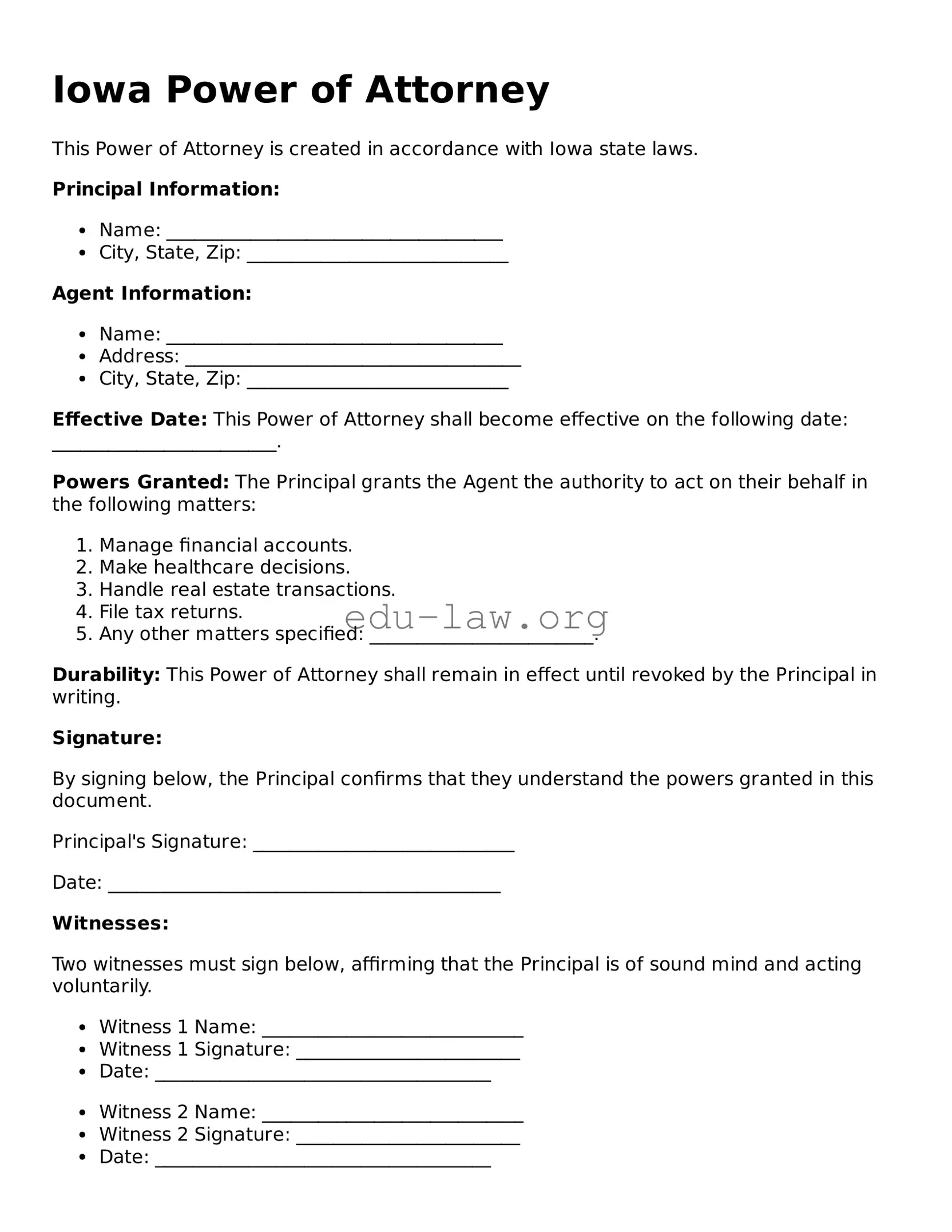
The Iowa Power of Attorney form serves as a critical legal document that allows individuals to appoint an agent to make decisions on their behalf. This form can be utilized for various purposes, including financial management and health care decisions, depending on the specific needs of the individual. In Iowa, the form must be signed by the principal, the person granting authority, and it is recommended that it be notarized to ensure its validity. The appointed agent is granted powers that can be broad or limited, allowing for flexibility in how responsibilities are delegated. Importantly, the form can specify when the authority becomes effective, whether immediately or upon the occurrence of a certain event, such as the principal’s incapacitation. Additionally, it is essential for individuals to understand that they can revoke or amend the Power of Attorney at any time, as long as they are mentally competent. This document plays a vital role in ensuring that a person's wishes are honored, especially in times of crisis or when they are unable to communicate their preferences directly.
Iowa Power of Attorney
This Power of Attorney is created in accordance with Iowa state laws.
Principal Information:
Agent Information:
Effective Date: This Power of Attorney shall become effective on the following date: ________________________.
Powers Granted: The Principal grants the Agent the authority to act on their behalf in the following matters:
Durability: This Power of Attorney shall remain in effect until revoked by the Principal in writing.
Signature:
By signing below, the Principal confirms that they understand the powers granted in this document.
Principal's Signature: ____________________________
Date: __________________________________________
Witnesses:
Two witnesses must sign below, affirming that the Principal is of sound mind and acting voluntarily.
Notarization: This document must be notarized to be valid.
Notary Public Signature: ______________________
Date: ____________________________________
My Commission Expires: ____________________
| Fact Name | Description |
|---|---|
| Definition | The Iowa Power of Attorney form allows an individual (the principal) to designate another person (the agent) to make decisions on their behalf regarding financial and legal matters. |
| Governing Law | This form is governed by the Iowa Code, specifically Chapter 635A, which outlines the requirements and powers granted through a Power of Attorney. |
| Durability | The Iowa Power of Attorney can be made durable, meaning it remains effective even if the principal becomes incapacitated, unless specified otherwise. |
| Revocation | The principal has the right to revoke the Power of Attorney at any time, as long as they are mentally competent, by providing written notice to the agent and any relevant third parties. |
Filling out the Iowa Power of Attorney form is an important step in ensuring that your financial and legal matters are managed according to your wishes. After completing the form, you will need to sign it in front of a notary public to make it legally binding.
What is a Power of Attorney in Iowa?
A Power of Attorney (POA) is a legal document that allows one person to make decisions on behalf of another. In Iowa, this can cover financial, medical, or other personal matters. The person granting authority is known as the principal, while the person receiving authority is called the agent or attorney-in-fact.
Why would I need a Power of Attorney?
You may need a Power of Attorney to ensure that someone you trust can make important decisions if you become unable to do so. This could be due to illness, injury, or other circumstances that affect your decision-making capacity.
What types of Power of Attorney are available in Iowa?
Iowa recognizes several types of Power of Attorney, including General, Limited, Durable, and Medical. A General POA gives broad authority, while a Limited POA restricts the agent’s powers to specific tasks. A Durable POA remains effective even if the principal becomes incapacitated. A Medical POA specifically allows the agent to make healthcare decisions.
How do I create a Power of Attorney in Iowa?
To create a Power of Attorney in Iowa, you must fill out a form that specifies the powers granted to your agent. It’s important to sign the document in front of a notary public or two witnesses to ensure its validity. Make sure to provide copies to your agent and any relevant institutions.
Can I revoke a Power of Attorney in Iowa?
Yes, you can revoke a Power of Attorney at any time, as long as you are mentally competent. To revoke it, you should create a written notice of revocation and notify your agent and any institutions that received the original POA.
What happens if I don’t have a Power of Attorney?
If you don’t have a Power of Attorney and become incapacitated, a court may need to appoint a guardian to make decisions on your behalf. This process can be lengthy and may not reflect your wishes.
Can my agent be held liable for their actions?
Your agent is generally not liable for decisions made in good faith while acting under the authority of the Power of Attorney. However, they can be held accountable if they act outside their authority or engage in misconduct.
Is a Power of Attorney effective immediately?
A Power of Attorney can be effective immediately upon signing, or it can be set to activate only under certain conditions, such as your incapacitation. This is known as a springing Power of Attorney.
Do I need a lawyer to create a Power of Attorney?
While it is not legally required to have a lawyer, consulting one is highly recommended. A lawyer can help ensure that the document meets all legal requirements and accurately reflects your wishes.
Can I use a Power of Attorney from another state in Iowa?
Generally, Iowa will recognize a Power of Attorney created in another state, as long as it complies with the laws of that state. However, it’s wise to review the document to ensure it meets Iowa's requirements for your specific needs.
Not specifying the powers granted. When filling out the Iowa Power of Attorney form, it’s crucial to clearly state what powers you are giving to your agent. Failing to do so can lead to confusion and disputes later.
Choosing the wrong agent. Selecting someone who is not trustworthy or capable can result in mismanagement of your affairs. It’s important to choose someone who understands your wishes and can act in your best interest.
Not signing in front of a witness. In Iowa, the Power of Attorney form must be signed in the presence of a witness. Neglecting this step can invalidate the document.
Forgetting to date the document. A date is essential for determining when the Power of Attorney becomes effective. Omitting this detail can create complications.
Failing to update the form. Life changes, such as marriage, divorce, or the death of an agent, may require updates to your Power of Attorney. Keeping the document current is vital.
Not considering alternate agents. If your primary agent is unavailable or unable to serve, having an alternate named can prevent delays in decision-making.
Ignoring state-specific requirements. Each state has its own rules regarding Power of Attorney forms. It’s important to ensure that the Iowa form meets all local legal requirements.
Not discussing the document with your agent. Communication is key. Failing to inform your agent about your wishes can lead to misunderstandings and actions that do not align with your intentions.
A Power of Attorney (POA) form in Iowa allows an individual to appoint someone else to make decisions on their behalf. Along with this important document, several other forms may be used to ensure comprehensive legal planning. Below are five commonly used documents that often accompany the Iowa Power of Attorney form.
Using these documents in conjunction with a Power of Attorney can help ensure that both health care and financial decisions align with an individual's wishes. It is essential to review each document carefully and consult with a legal professional if needed.
The Iowa Power of Attorney form shares similarities with the General Power of Attorney document. Both documents grant an individual the authority to act on behalf of another person in a variety of financial and legal matters. The General Power of Attorney can be broad or limited in scope, allowing the appointed agent to manage tasks such as handling bank accounts, signing contracts, and making healthcare decisions. This flexibility is a key feature that aligns with the intent behind the Iowa Power of Attorney form.
Another document akin to the Iowa Power of Attorney is the Durable Power of Attorney. This form also allows one person to make decisions for another, but it remains effective even if the principal becomes incapacitated. This durability is crucial for individuals who want to ensure their financial and legal affairs are managed without interruption during periods of diminished capacity, making it a vital tool for long-term planning.
The Medical Power of Attorney is another related document. While the Iowa Power of Attorney can cover various areas, the Medical Power of Attorney specifically focuses on healthcare decisions. This document empowers an agent to make medical choices on behalf of the principal, ensuring that their health care preferences are honored when they are unable to communicate those wishes themselves.
The Limited Power of Attorney is also similar, but it restricts the agent's authority to specific tasks or timeframes. This type of document is useful for individuals who need someone to handle particular matters, such as selling a property or managing a business transaction, without granting full control over their affairs. This specificity helps maintain control while still allowing for necessary delegation.
The Springing Power of Attorney is another variant that resembles the Iowa Power of Attorney. This document becomes effective only under certain conditions, typically when the principal becomes incapacitated. This conditional nature allows individuals to retain control over their affairs until a specific event occurs, providing peace of mind that authority will only transfer when truly needed.
The Financial Power of Attorney is closely related as well. It specifically authorizes an agent to manage the principal's financial matters, such as paying bills, managing investments, and filing taxes. This focused approach ensures that financial decisions are handled efficiently, aligning with the broader purposes of the Iowa Power of Attorney while maintaining a clear emphasis on financial responsibilities.
The Revocable Living Trust is another document that shares similarities with the Iowa Power of Attorney. While it primarily focuses on estate planning, it can allow for the management of assets during the principal's lifetime and after death. Like a Power of Attorney, it provides a mechanism for delegating authority, but it also has the added benefit of avoiding probate, which can streamline the distribution of assets.
Finally, the Advance Healthcare Directive, while distinct, shares the goal of ensuring that an individual's healthcare preferences are respected. This document combines elements of a Medical Power of Attorney and a living will, allowing individuals to outline their medical treatment preferences and appoint someone to make decisions on their behalf. This comprehensive approach complements the functions of the Iowa Power of Attorney, particularly in the realm of healthcare decision-making.
When filling out the Iowa Power of Attorney form, there are important dos and don’ts to keep in mind. Following these guidelines can help ensure that the form is completed correctly and serves its intended purpose.
By adhering to these guidelines, you can help ensure that your Power of Attorney is valid and effective when needed.
Many people have misunderstandings about the Iowa Power of Attorney form. These misconceptions can lead to confusion and potentially serious issues. Here are seven common myths explained:
This is not true. Anyone can create a Power of Attorney, regardless of age. It’s a useful tool for anyone who wants to ensure their affairs are handled if they become unable to do so.
While many use it for financial decisions, a Power of Attorney can also cover health care decisions. You can specify what medical decisions your agent can make on your behalf.
This is a common fear. However, you can still make your own decisions as long as you are capable. The Power of Attorney only comes into effect when you cannot make decisions for yourself.
This is false. You can revoke a Power of Attorney at any time, as long as you are competent. Just inform your agent and provide a written notice of revocation.
Different states have different requirements and forms. It’s important to use the Iowa-specific Power of Attorney form to ensure it meets local laws.
Many people think a Power of Attorney is only for emergencies. In reality, it’s a proactive step to prepare for any situation where you might need assistance.
This is not the case unless you have a Power of Attorney in place. Without it, your family may need to go through a lengthy legal process to gain authority to make decisions on your behalf.
Understanding these misconceptions can help you make informed decisions about your Power of Attorney. It’s always best to consult with a legal professional to ensure your needs are met.
When filling out and using the Iowa Power of Attorney form, keep the following key takeaways in mind: