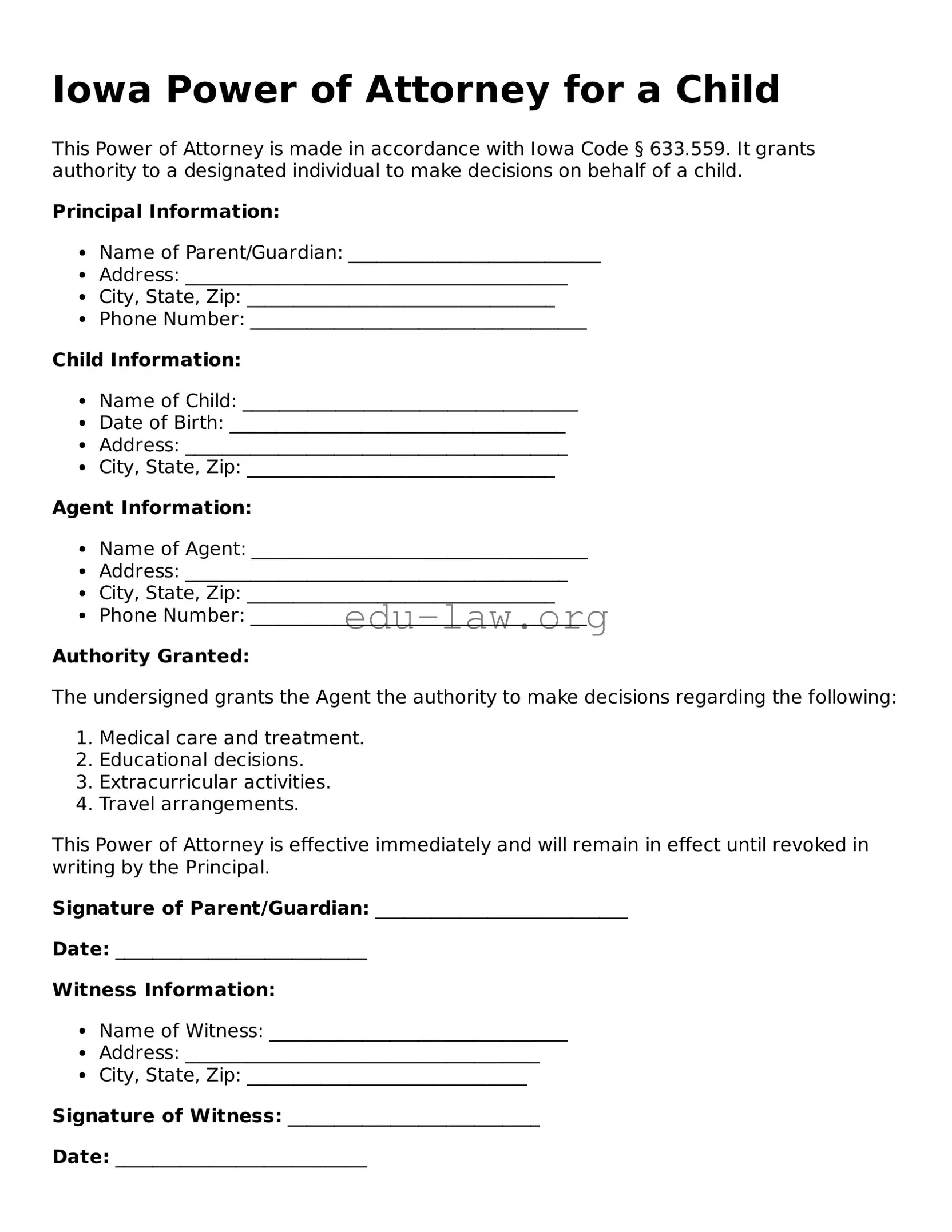
In Iowa, the Power of Attorney for a Child form serves as a crucial legal tool for parents and guardians seeking to delegate certain responsibilities and decision-making authority for their children to a trusted individual. This form allows parents to designate someone—often a relative or close family friend—who can step in and make important decisions regarding the child's education, healthcare, and general welfare in their absence. The flexibility of this document is significant, as it can be tailored to specify the duration of the authority granted, whether it be temporary or more long-term. Moreover, the form ensures that the appointed agent has the legal backing to act on behalf of the child, which can be particularly important in emergencies or during extended periods of parental absence. Understanding the nuances of this form, including the rights it conveys and the responsibilities it entails, is essential for anyone considering this option. Proper completion and notarization of the form are necessary steps to ensure its validity and effectiveness, providing peace of mind for parents while ensuring the child's needs are met consistently.
Iowa Power of Attorney for a Child
This Power of Attorney is made in accordance with Iowa Code § 633.559. It grants authority to a designated individual to make decisions on behalf of a child.
Principal Information:
Child Information:
Agent Information:
Authority Granted:
The undersigned grants the Agent the authority to make decisions regarding the following:
This Power of Attorney is effective immediately and will remain in effect until revoked in writing by the Principal.
Signature of Parent/Guardian: ___________________________
Date: ___________________________
Witness Information:
Signature of Witness: ___________________________
Date: ___________________________
| Fact Name | Description |
|---|---|
| Purpose | The Iowa Power of Attorney for a Child form allows a parent or legal guardian to grant temporary authority to another adult for the care of their child. |
| Governing Law | This form is governed by Iowa Code Section 633.552. |
| Duration | The authority granted can be effective for a specific period or until revoked by the parent or guardian. |
| Eligibility | Only a parent or legal guardian can complete and sign this form. |
| Notarization | The form must be signed in the presence of a notary public to be valid. |
| Revocation | A parent or guardian can revoke the Power of Attorney at any time, in writing. |
| Limitations | The agent cannot make medical decisions unless specifically authorized in the form. |
| Agent's Responsibilities | The designated agent is responsible for the child's day-to-day care and decision-making. |
| Emergency Situations | This form can be useful in emergencies when parents are unavailable. |
| Access to Information | The agent may access educational and medical records for the child as needed. |
Filling out the Iowa Power of Attorney for a Child form is a straightforward process that allows you to designate someone to make decisions on behalf of your child. To ensure that everything is completed correctly, follow the steps outlined below carefully.
Once you have completed these steps, your Iowa Power of Attorney for a Child form will be ready for use. Make sure to keep a copy for your records and inform the designated attorney-in-fact about their responsibilities.
What is a Power of Attorney for a Child in Iowa?
A Power of Attorney for a Child in Iowa is a legal document that allows a parent or guardian to appoint another adult to make decisions on behalf of their child. This can include decisions related to healthcare, education, and general welfare. It is particularly useful when parents are unavailable, such as during travel or extended work commitments.
Who can be designated as an agent in the Power of Attorney for a Child?
The agent can be any trusted adult, such as a relative, family friend, or neighbor. However, it is essential to choose someone who is responsible and capable of making decisions in the best interest of the child.
How long does the Power of Attorney for a Child remain valid?
The Power of Attorney for a Child can remain in effect for a specified period, as outlined in the document. It can also be revoked by the parent or guardian at any time, as long as they provide written notice to the agent.
Is the Power of Attorney for a Child form required to be notarized?
Yes, in Iowa, the Power of Attorney for a Child must be signed in the presence of a notary public. This helps ensure that the document is legally binding and recognized by institutions such as schools and healthcare providers.
Can the Power of Attorney for a Child be used for medical decisions?
Yes, the Power of Attorney for a Child allows the designated agent to make medical decisions on behalf of the child. This includes consenting to medical treatments and accessing medical records, which can be crucial in emergencies.
What happens if the parent or guardian wants to revoke the Power of Attorney?
If a parent or guardian wishes to revoke the Power of Attorney, they must provide written notice to the agent. It is also advisable to notify any institutions that may have relied on the document, such as schools or healthcare providers.
Are there any limitations on the authority of the agent?
Yes, the Power of Attorney can specify limitations on the agent’s authority. For example, a parent may choose to limit the agent's ability to make certain medical decisions or restrict access to specific information. Clear communication about these limitations is important.
Where can I obtain a Power of Attorney for a Child form in Iowa?
The Power of Attorney for a Child form can typically be obtained from legal websites, local law offices, or state government websites. It’s advisable to ensure that the form complies with Iowa law and is properly filled out to avoid any issues.
Failing to specify the duration of the power of attorney. It’s important to indicate how long the authority lasts, whether it’s for a specific period or until revoked.
Not identifying the child clearly. Ensure that the child’s full name, date of birth, and any other identifying information are accurately filled out to avoid confusion.
Omitting the agent’s information. The individual granted power of attorney must be clearly identified with their full name and contact information.
Neglecting to include specific powers. It’s crucial to outline what decisions the agent can make on behalf of the child. Be as detailed as possible.
Forgetting to sign and date the form. A signature is essential for the document to be valid, and dating it establishes when the authority begins.
Not having the form witnessed or notarized. Depending on state requirements, having a witness or notary may be necessary for the document to be legally binding.
Using outdated or incorrect forms. Always ensure you have the most recent version of the Power of Attorney for a Child form to avoid any legal issues.
Overlooking the need for revocation instructions. If circumstances change, it’s important to know how to revoke the power of attorney properly.
The Iowa Power of Attorney for a Child form serves as an important legal document that allows a parent or guardian to designate another individual to make decisions on behalf of their child. However, this form is often accompanied by several other documents to ensure comprehensive care and legal authority. Below is a list of related forms and documents that can enhance the effectiveness of the Power of Attorney for a Child.
Each of these documents plays a crucial role in ensuring that the designated caregiver has the necessary authority and information to act in the best interest of the child. By preparing these forms alongside the Power of Attorney for a Child, parents and guardians can provide a clear framework for care and decision-making.
The Iowa Power of Attorney for a Child form is similar to the General Power of Attorney. This document grants an individual the authority to act on behalf of another person in a variety of legal and financial matters. Both forms allow for the delegation of responsibilities, ensuring that the appointed agent can make decisions when the principal is unable to do so. However, the General Power of Attorney is broader in scope, covering financial and legal decisions for adults, while the Power of Attorney for a Child is specifically tailored for the care and custody of minors.
Another document that shares similarities is the Medical Power of Attorney. This form allows an individual to designate someone to make healthcare decisions on their behalf if they become incapacitated. Both the Medical Power of Attorney and the Power of Attorney for a Child empower a trusted individual to act in the best interests of another person. However, the Medical Power of Attorney focuses solely on health-related decisions, while the Power of Attorney for a Child encompasses broader responsibilities, including education and general welfare.
The Temporary Guardianship form is also comparable to the Iowa Power of Attorney for a Child. This document allows a parent or legal guardian to appoint another adult to care for their child for a limited time. Both documents provide a legal framework for ensuring that a child’s needs are met when the parent is unavailable. However, the Temporary Guardianship is typically used for a specific duration, whereas the Power of Attorney for a Child can be more flexible in terms of duration and scope of authority.
Lastly, the Child Custody Agreement bears some resemblance to the Power of Attorney for a Child. This agreement outlines the legal arrangements regarding the care and custody of a child between parents or guardians. Both documents aim to protect the child’s welfare and ensure that their needs are prioritized. However, while a Child Custody Agreement is usually part of divorce or separation proceedings and focuses on the rights of parents, the Power of Attorney for a Child is more about granting authority to a third party for caregiving purposes without altering custody rights.
When filling out the Iowa Power of Attorney for a Child form, it’s important to keep a few key points in mind. Here’s a list of what you should and shouldn’t do:
When it comes to the Iowa Power of Attorney for a Child form, many people hold misconceptions that can lead to confusion. Understanding these common myths can help parents and guardians make informed decisions. Here are ten misconceptions about this important legal document:
By dispelling these misconceptions, parents and guardians can better navigate the process of using the Iowa Power of Attorney for a Child form. Understanding the true nature of this document can ensure that children's needs are met during times of transition or absence.
Filling out and using the Iowa Power of Attorney for a Child form can be straightforward if you keep a few important points in mind. Here are some key takeaways:
By following these guidelines, you can ensure that the Power of Attorney for a Child form serves its purpose effectively and safely.