The Iowa Operating Agreement form serves as a crucial document for individuals and entities looking to establish a limited liability company (LLC) in Iowa. This form outlines the internal workings and management structure of the LLC, ensuring that all members are on the same page regarding their roles and responsibilities. Key aspects include the distribution of profits and losses, the process for adding or removing members, and the procedures for making important business decisions. Additionally, the agreement addresses how disputes will be resolved, providing a framework that can help prevent misunderstandings among members. By clearly defining these elements, the Iowa Operating Agreement not only protects the interests of all parties involved but also fosters a sense of stability and professionalism within the business. Understanding the importance of this document is essential for anyone looking to form an LLC in Iowa, as it lays the groundwork for a successful and compliant business operation.
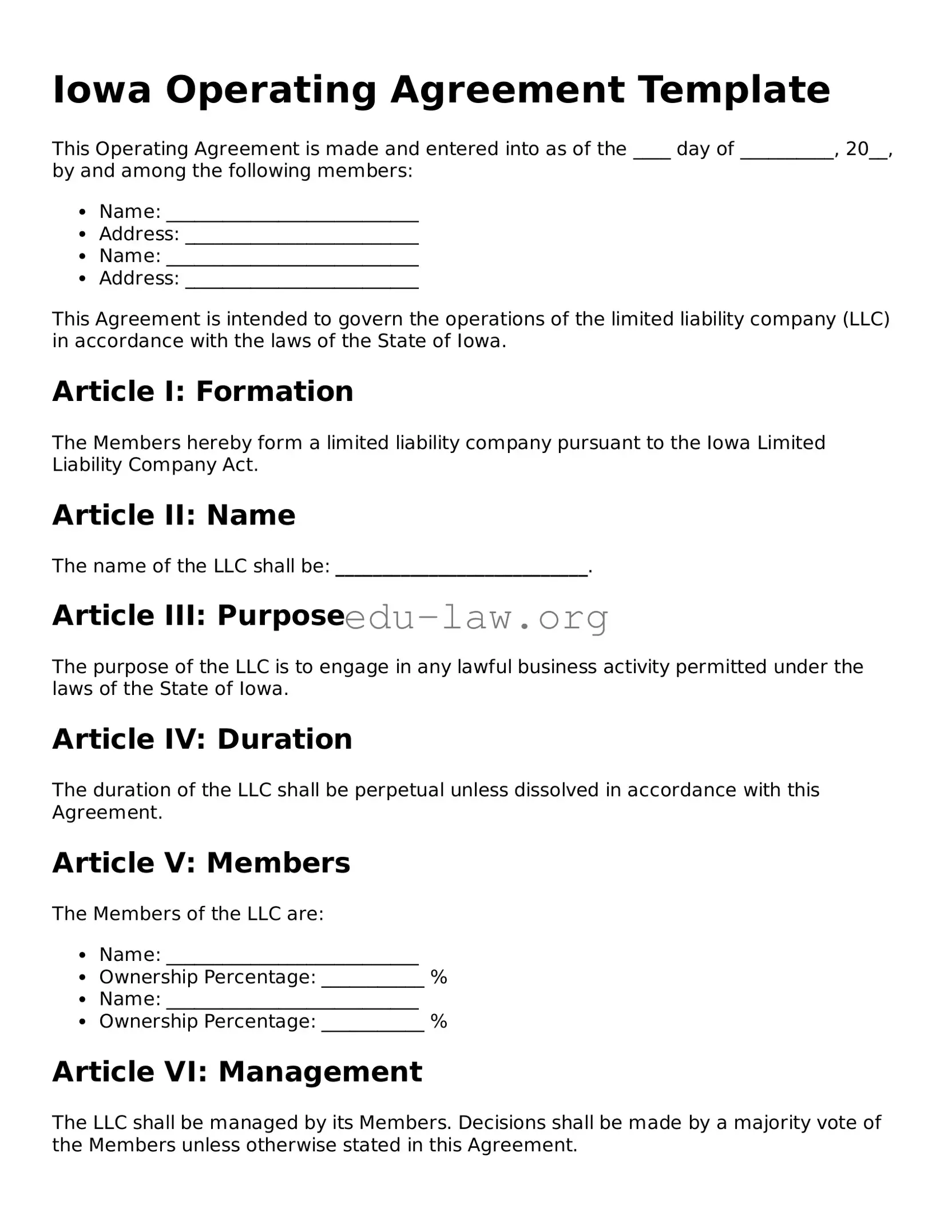
Iowa Operating Agreement Template
This Operating Agreement is made and entered into as of the ____ day of __________, 20__, by and among the following members:
This Agreement is intended to govern the operations of the limited liability company (LLC) in accordance with the laws of the State of Iowa.
Article I: Formation
The Members hereby form a limited liability company pursuant to the Iowa Limited Liability Company Act.
Article II: Name
The name of the LLC shall be: ___________________________.
Article III: Purpose
The purpose of the LLC is to engage in any lawful business activity permitted under the laws of the State of Iowa.
Article IV: Duration
The duration of the LLC shall be perpetual unless dissolved in accordance with this Agreement.
Article V: Members
The Members of the LLC are:
Article VI: Management
The LLC shall be managed by its Members. Decisions shall be made by a majority vote of the Members unless otherwise stated in this Agreement.
Article VII: Capital Contributions
The Members shall contribute capital to the LLC as follows:
Article VIII: Distributions
Distributions of profits and losses shall be allocated to the Members in proportion to their ownership percentages.
Article IX: Indemnification
The LLC shall indemnify its Members to the fullest extent permitted by Iowa law against any losses or liabilities incurred in connection with the LLC.
Article X: Amendments
This Agreement may be amended only by a written agreement signed by all Members.
Article XI: Governing Law
This Agreement shall be governed by and construed in accordance with the laws of the State of Iowa.
IN WITNESS WHEREOF, the Members have executed this Operating Agreement as of the date first above written.
_____________________________ Member Signature
_____________________________ Member Signature
| Fact Name | Description |
|---|---|
| Purpose | The Iowa Operating Agreement form is designed for use by Limited Liability Companies (LLCs) to outline the management structure and operational procedures. |
| Governing Law | This agreement is governed by the Iowa Code, specifically Chapter 489, which pertains to the Iowa Uniform Limited Liability Company Act. |
| Members' Rights | The agreement defines the rights and responsibilities of the members, including voting rights and profit-sharing arrangements. |
| Flexibility | Iowa allows LLCs significant flexibility in structuring their Operating Agreements, enabling customization to meet the specific needs of the business. |
| Filing Requirements | While the Operating Agreement itself does not need to be filed with the state, it is recommended to keep it on record for internal purposes and member reference. |
| Amendments | The agreement can be amended as needed, provided all members agree to the changes, ensuring that it remains relevant as the business evolves. |
Once you have the Iowa Operating Agreement form in front of you, it’s essential to complete it accurately to ensure that all members of your business are on the same page regarding operations and responsibilities. Follow the steps below to fill out the form correctly.
What is an Iowa Operating Agreement?
An Iowa Operating Agreement is a legal document that outlines the management structure and operating procedures of a limited liability company (LLC) in Iowa. It serves as a blueprint for how the LLC will function, detailing the rights and responsibilities of its members and managers.
Is an Operating Agreement required in Iowa?
No, an Operating Agreement is not legally required in Iowa. However, having one is highly recommended. It helps prevent misunderstandings among members and provides clarity on how the business should be run. Without it, the default rules of Iowa's LLC law will apply.
Who should create the Operating Agreement?
What should be included in the Operating Agreement?
The Operating Agreement should cover several key areas, including the management structure, member roles, voting rights, profit distribution, and procedures for adding or removing members. It may also address dispute resolution and what happens if the LLC is dissolved.
Can the Operating Agreement be changed?
Yes, the Operating Agreement can be amended. Typically, the process for making changes is outlined within the document itself. It usually requires a vote among members. Keeping the agreement updated is essential as the business evolves.
How is the Operating Agreement executed?
The Operating Agreement is executed by having all members sign the document. It is advisable to keep a signed copy with the LLC’s records. Although notarization is not required, it can add an extra layer of authenticity.
What happens if there is no Operating Agreement?
If there is no Operating Agreement, the LLC will be governed by Iowa's default LLC laws. This may not align with the members' intentions and could lead to disputes. It’s much safer to have a tailored agreement in place.
Can I use a template for the Operating Agreement?
Yes, using a template can be a good starting point. However, it’s important to customize the template to fit your specific business needs. Consider consulting a legal professional to ensure the agreement meets all necessary requirements and adequately protects your interests.
Where can I find an Iowa Operating Agreement template?
Templates for Iowa Operating Agreements can be found online through various legal websites and resources. Many offer free or paid options. Ensure you choose a reputable source and review the template carefully to ensure it meets your needs.
Incomplete Information: Many individuals fail to provide all necessary details. This includes missing names, addresses, or the date of the agreement. Incomplete forms can lead to delays or legal complications.
Incorrect Member Designation: Some people mislabel members as managers or vice versa. Understanding the roles of each party is crucial for proper governance.
Failure to Specify Voting Rights: Not clearly defining how voting will occur can create confusion. This omission may lead to disputes among members later.
Ignoring State-Specific Requirements: Each state has unique regulations. Failing to adhere to Iowa's specific requirements can invalidate the agreement.
Not Including a Buyout Clause: A buyout clause is essential for outlining what happens if a member wants to leave. Neglecting this can lead to complications in the future.
Missing Signatures: Some individuals forget to sign the document. Without signatures, the agreement lacks legal validity.
Overlooking Amendments: Failing to include a process for amendments can hinder future changes. Flexibility is important for adapting to new circumstances.
The Iowa Operating Agreement is an essential document for businesses operating as limited liability companies (LLCs) in Iowa. Alongside this agreement, several other forms and documents may be required to ensure proper compliance and management of the LLC. Below is a list of commonly used documents that complement the Operating Agreement.
Each of these documents plays a vital role in the smooth operation and governance of an LLC. Together with the Iowa Operating Agreement, they help establish a strong foundation for the business and its members.
The Iowa Operating Agreement form is similar to the Limited Liability Company (LLC) Operating Agreement used in other states. Both documents outline the management structure, responsibilities, and ownership interests of the members in an LLC. They serve as a foundational document that helps to protect the members' personal assets by clearly defining the operational procedures and decision-making processes of the company.
Another comparable document is the Partnership Agreement. This agreement is utilized when two or more individuals decide to operate a business together. Like the Operating Agreement, it specifies the roles and responsibilities of each partner, how profits and losses will be shared, and procedures for resolving disputes. Both documents aim to provide clarity and structure to the business relationship.
The Corporate Bylaws serve a similar purpose for corporations. They outline the rules governing the internal management of the corporation, including the roles of directors and officers, meeting protocols, and voting rights. While an Operating Agreement is specific to LLCs, Corporate Bylaws fulfill a similar role in ensuring smooth operations and governance for corporations.
The Shareholders Agreement is another document that shares similarities with the Iowa Operating Agreement. This agreement is typically used in corporations to define the rights and obligations of shareholders. It addresses issues such as share transfers, voting rights, and management decisions, much like how an Operating Agreement dictates the management and operational aspects of an LLC.
A Joint Venture Agreement also bears resemblance to the Operating Agreement. This document is created when two or more parties collaborate on a specific project or business activity. It outlines the contributions, responsibilities, and profit-sharing arrangements of each party, similar to how an Operating Agreement delineates the roles of LLC members.
The Non-Disclosure Agreement (NDA) can be compared in terms of protecting business interests. While an NDA focuses on confidentiality, it is often included alongside Operating Agreements to safeguard sensitive information shared among members. Both documents work together to ensure that the business operates securely and that proprietary information remains protected.
The Employment Agreement is another document that may share some commonalities with the Operating Agreement. This agreement outlines the terms of employment for individuals within the company, including duties, compensation, and termination procedures. While not directly related to ownership, it helps establish clear expectations for employees, just as the Operating Agreement does for members.
The Buy-Sell Agreement is similar in that it addresses ownership interests, particularly when a member wishes to exit the business. This agreement outlines the process for buying out a member’s interest, ensuring that the remaining members can maintain control and continuity. It complements the Operating Agreement by providing additional clarity on ownership transitions.
Lastly, the Articles of Organization is a foundational document for LLCs that is filed with the state. While the Operating Agreement governs the internal workings, the Articles of Organization establish the LLC's existence legally. Both documents are essential for the formation and operation of an LLC, working in tandem to ensure compliance and clarity.
When filling out the Iowa Operating Agreement form, it is essential to follow specific guidelines to ensure accuracy and compliance. Here are some important dos and don'ts:
By adhering to these guidelines, you can help ensure that your Operating Agreement is completed correctly and serves its intended purpose effectively.
Understanding the Iowa Operating Agreement form is essential for anyone involved in a business partnership or limited liability company (LLC). However, several misconceptions can lead to confusion. Below are five common misconceptions about this important document.
Many believe that an Operating Agreement is optional. In reality, while Iowa does not require one by law, having this document is crucial for outlining the management structure and operational guidelines of the LLC.
Some people confuse the Operating Agreement with the Articles of Organization. The Articles of Organization are filed with the state to officially form the LLC, while the Operating Agreement governs the internal operations and relationships among members.
It is a common belief that a verbal agreement suffices. However, an Operating Agreement should be a written document to ensure clarity and to serve as a legal reference in case of disputes.
While it is important for all members to participate in the creation of the Operating Agreement, not every detail requires unanimous consent. Members can establish voting thresholds for various decisions, allowing for flexibility in governance.
Some believe that the Operating Agreement is a static document. In fact, it can and should be updated as the business evolves or as members’ needs change. Regular reviews can help ensure that it remains relevant and effective.
When filling out and using the Iowa Operating Agreement form, keep the following key points in mind:
Following these guidelines will help ensure that your Operating Agreement is effective and beneficial for your business.