The Iowa Notice to Quit form serves as a crucial legal document in the landlord-tenant relationship, signaling the beginning of a potential eviction process. This form is typically used by landlords to formally notify tenants that they must vacate the rental property within a specified timeframe. The notice outlines the reasons for termination, which can include non-payment of rent, lease violations, or other breaches of the rental agreement. It is essential for landlords to ensure that the notice is delivered correctly, as improper service can lead to delays or complications in eviction proceedings. Tenants, on the other hand, must understand their rights and the implications of receiving such a notice. The form includes important details such as the date of the notice, the address of the rental property, and the specific actions required from the tenant. Understanding the nuances of this form can empower both parties to navigate the often complex landscape of rental agreements and evictions in Iowa.
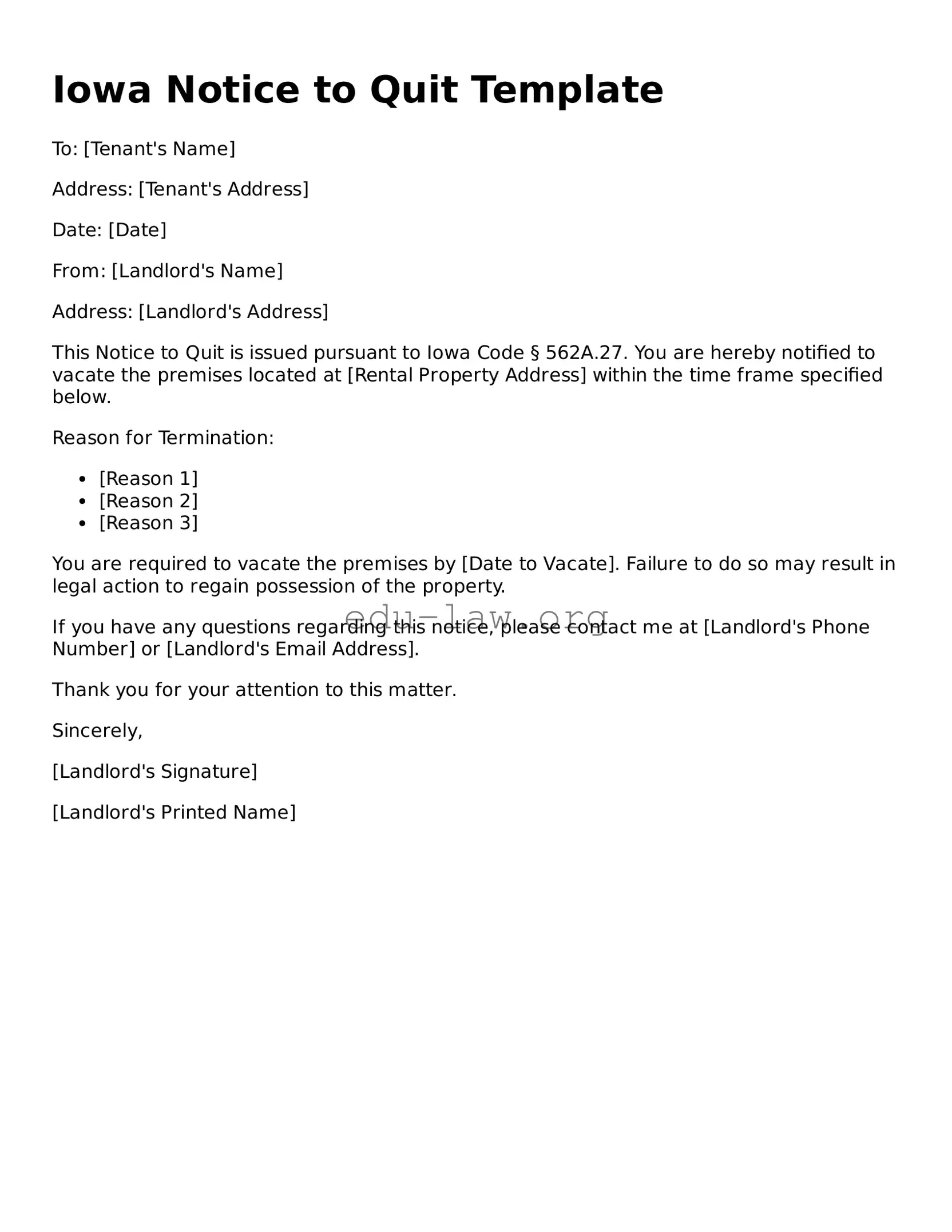
Iowa Notice to Quit Template
To: [Tenant's Name]
Address: [Tenant's Address]
Date: [Date]
From: [Landlord's Name]
Address: [Landlord's Address]
This Notice to Quit is issued pursuant to Iowa Code § 562A.27. You are hereby notified to vacate the premises located at [Rental Property Address] within the time frame specified below.
Reason for Termination:
You are required to vacate the premises by [Date to Vacate]. Failure to do so may result in legal action to regain possession of the property.
If you have any questions regarding this notice, please contact me at [Landlord's Phone Number] or [Landlord's Email Address].
Thank you for your attention to this matter.
Sincerely,
[Landlord's Signature]
[Landlord's Printed Name]
| Fact Name | Details |
|---|---|
| Purpose | The Iowa Notice to Quit form is used by landlords to inform tenants of their intent to terminate a lease agreement. |
| Governing Law | This form is governed by Iowa Code § 562A, which outlines the rights and responsibilities of landlords and tenants. |
| Notice Period | Typically, landlords must provide a notice period of at least 30 days before the termination of the lease. |
| Delivery Methods | The notice can be delivered in person, by mail, or by posting it on the tenant's door. |
| Content Requirements | The notice must clearly state the reason for termination, such as non-payment of rent or lease violations. |
| Tenant's Rights | Tenants have the right to respond to the notice and may seek legal counsel if they believe the notice is unjust. |
| Legal Action | If the tenant does not vacate, the landlord may initiate eviction proceedings in court. |
| Record Keeping | It is advisable for landlords to keep a copy of the Notice to Quit for their records. |
Once you have the Iowa Notice to Quit form in hand, it's time to fill it out accurately. This form is essential for notifying a tenant of the need to vacate the property. Completing it correctly ensures that you follow the legal process, which can help prevent complications down the line.
What is the Iowa Notice to Quit form?
The Iowa Notice to Quit form is a legal document used by landlords to formally notify tenants that they must vacate the rental property. This notice is often a precursor to eviction proceedings and outlines the reasons for the termination of the lease agreement.
When should a landlord use the Notice to Quit?
A landlord should use the Notice to Quit when a tenant has violated the terms of the lease, such as failing to pay rent, engaging in illegal activities, or causing damage to the property. It can also be used when the lease has expired, and the landlord does not wish to renew it.
How much notice must be given in the Notice to Quit?
The amount of notice required can vary based on the reason for the eviction. For non-payment of rent, a 3-day notice is typically sufficient. For other lease violations, a 30-day notice may be necessary. Always check the specific circumstances and applicable laws.
Does the Notice to Quit need to be in writing?
Yes, the Notice to Quit must be in writing to be legally enforceable. A verbal notice is insufficient and may not hold up in court if the situation escalates to an eviction proceeding.
What information should be included in the Notice to Quit?
The Notice to Quit should include the tenant's name, the address of the rental property, the reason for the notice, the date by which the tenant must vacate, and the landlord's contact information. Clarity is crucial to avoid confusion and potential legal disputes.
Can a tenant contest a Notice to Quit?
Yes, a tenant has the right to contest a Notice to Quit. If they believe the notice is unjust or based on incorrect information, they can respond to the landlord and potentially seek legal advice. It is advisable for tenants to document their communications and any relevant evidence.
What happens if a tenant does not comply with the Notice to Quit?
If a tenant does not vacate the property by the specified date, the landlord may proceed with eviction proceedings. This typically involves filing a lawsuit in the appropriate court to obtain a judgment for eviction.
Is there a specific format for the Notice to Quit?
While there is no official state form for the Notice to Quit, it is important that the document is clear, concise, and includes all necessary information. Many landlords choose to use templates or seek legal assistance to ensure compliance with Iowa law.
Can a Notice to Quit be served electronically?
In Iowa, a Notice to Quit is generally required to be served in person or via certified mail. Electronic service may not be sufficient unless both parties have agreed to such methods in writing. Always check local regulations for specific requirements.
What should a landlord do after serving a Notice to Quit?
After serving a Notice to Quit, the landlord should keep a copy of the notice and any proof of service, such as a certified mail receipt or a signed acknowledgment from the tenant. If the tenant does not comply, the landlord may need to consult with a legal professional to initiate eviction proceedings.
Incorrect Tenant Information: Many individuals fail to accurately list the tenant's full name or provide the correct address. This can lead to delays or complications in the eviction process.
Missing Signature: A common mistake is not signing the form. Without a signature, the notice may be deemed invalid.
Improper Date: Some people forget to date the notice. The date is essential for establishing the timeline of the eviction process.
Failure to Specify the Reason: Not clearly stating the reason for the eviction can result in confusion and may weaken the case in court.
Inadequate Notice Period: Providing insufficient notice time can lead to legal challenges. Ensure that the notice period complies with Iowa law.
Not Following Delivery Requirements: Some individuals do not deliver the notice according to legal requirements. Proper delivery methods must be used to ensure validity.
Ignoring Local Laws: Each jurisdiction may have specific rules regarding notices to quit. Failing to adhere to these can invalidate the notice.
Using Outdated Forms: Using an old version of the Notice to Quit can lead to errors. Always ensure you are using the most current form.
Neglecting to Keep Copies: Failing to retain copies of the notice can create issues later on. Always keep a record for your files.
The Iowa Notice to Quit form serves as an essential document in the landlord-tenant relationship, particularly when a landlord seeks to terminate a lease agreement. However, this form is often accompanied by other important documents that facilitate the eviction process or clarify the terms of the lease. Below is a list of additional forms and documents that may be used alongside the Iowa Notice to Quit.
Each of these documents plays a crucial role in ensuring that both landlords and tenants understand their rights and responsibilities. By utilizing these forms appropriately, both parties can navigate the complexities of rental agreements and evictions with greater clarity and fairness.
The Iowa Notice to Quit form is similar to the Eviction Notice. Both documents serve as a formal notification to tenants that they must vacate the rental property. An Eviction Notice typically outlines the reasons for the eviction, such as failure to pay rent or lease violations. It is often the first step in the legal process for landlords seeking to remove a tenant from their property. The Iowa Notice to Quit also informs tenants of the need to leave, but it may not always detail the reasons as explicitly as an Eviction Notice does.
Another document that resembles the Iowa Notice to Quit is the Lease Termination Letter. This letter is used by landlords to notify tenants that their lease agreement will not be renewed. Like the Notice to Quit, it communicates the end of the tenancy, but it usually provides a specific date for when the tenant must vacate. The Lease Termination Letter can be issued for various reasons, including the landlord's decision to sell the property or a mutual agreement to end the lease.
The Three-Day Notice to Pay Rent or Quit is also similar. This document is commonly used in many states, including Iowa, to inform tenants that they have three days to pay overdue rent or face eviction. It emphasizes the urgency of the situation and gives tenants a short window to rectify the issue. While the Iowa Notice to Quit may not specify a time frame for vacating, it serves a similar purpose by prompting tenants to address their rental obligations.
The 30-Day Notice to Vacate is another comparable document. This notice is typically given by landlords to tenants to inform them that they must leave the property within 30 days. It is often used in month-to-month rental agreements. The Iowa Notice to Quit can serve a similar function, although it may not always specify a 30-day period. Both documents aim to ensure that tenants are aware of their need to vacate the premises.
The Notice of Non-Renewal is also akin to the Iowa Notice to Quit. This document is sent by landlords to inform tenants that their lease will not be renewed at the end of the current term. It provides tenants with advance notice to find alternative housing. While the Notice of Non-Renewal focuses on the end of the lease term, the Iowa Notice to Quit addresses the immediate need to vacate, often due to specific issues with the tenancy.
Lastly, the Demand for Possession is similar to the Iowa Notice to Quit in that it is used to request that a tenant leave the property. This document is often filed in court as part of the eviction process. It formally demands that the tenant vacate the premises and may be accompanied by legal proceedings. While the Iowa Notice to Quit serves as an initial warning, the Demand for Possession indicates that the landlord is prepared to take legal action if the tenant does not comply.
When filling out the Iowa Notice to Quit form, it’s important to follow certain guidelines to ensure the process goes smoothly. Here’s a list of things you should and shouldn’t do:
By following these guidelines, you can help ensure that your Notice to Quit is valid and effective.
Understanding the Iowa Notice to Quit form is crucial for both landlords and tenants. However, several misconceptions can lead to confusion. Here are eight common misunderstandings:
The Notice to Quit is not an eviction notice. It simply informs the tenant that they must vacate the property. An eviction process follows if the tenant does not comply.
The Notice to Quit must be delivered in specific ways outlined by Iowa law. This typically includes personal delivery or certified mail to ensure proper notification.
A Notice to Quit can only be issued for valid reasons, such as non-payment of rent or lease violations. It cannot be used arbitrarily.
Once a Notice to Quit is received, tenants have a limited time to respond or vacate the property, usually specified in the notice itself.
The Notice to Quit must include specific details, such as the reason for the notice, the date by which the tenant must vacate, and the landlord's contact information.
Ignoring a Notice to Quit can lead to legal action. If the tenant fails to leave by the deadline, the landlord may proceed with eviction proceedings.
While landlords typically issue this notice, tenants may also have valid reasons to notify landlords if they believe the property is uninhabitable.
A Notice to Quit can be rescinded if both parties agree to resolve the issue. Communication is key in such situations.
Being aware of these misconceptions can help both landlords and tenants navigate the process more effectively and avoid unnecessary disputes.
Filling out and using the Iowa Notice to Quit form is an important step for landlords seeking to terminate a lease. Here are some key takeaways to keep in mind:
By following these guidelines, landlords can navigate the process more smoothly and maintain a clear line of communication with their tenants.