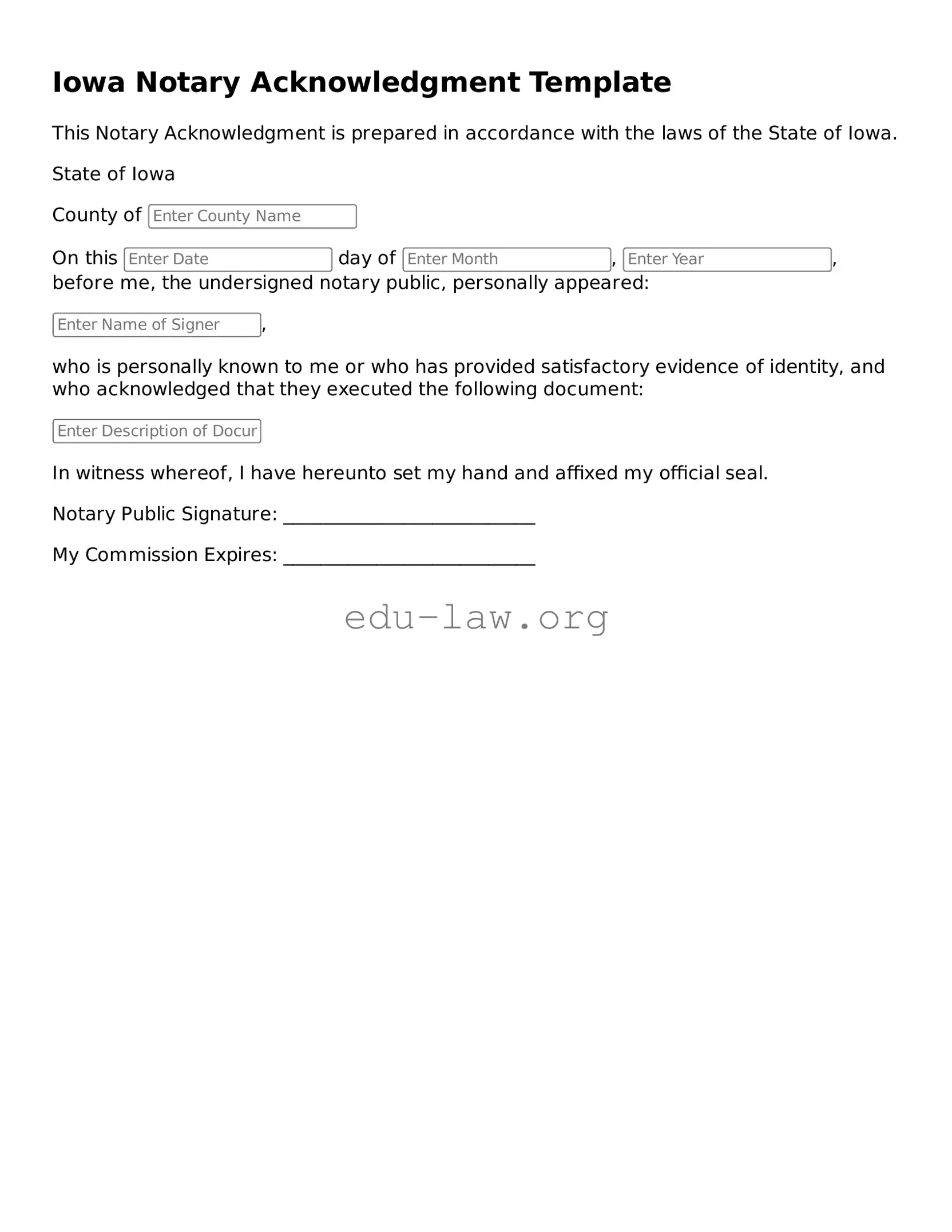
The Iowa Notary Acknowledgment form plays a crucial role in verifying the authenticity of signatures on important documents. This form is essential when individuals need to confirm that they signed a document willingly and in the presence of a notary public. By using this acknowledgment, parties can ensure that their agreements hold up in legal situations. The form requires specific information, including the names of the signers, the date of the acknowledgment, and the notary's details. It also includes a space for the notary's signature and seal, which adds a layer of legitimacy. Understanding how to properly complete and utilize this form can save time and prevent complications in legal matters. Whether you're dealing with real estate transactions, powers of attorney, or other legal documents, the Iowa Notary Acknowledgment is a vital tool in your legal toolkit.
Iowa Notary Acknowledgment Template
This Notary Acknowledgment is prepared in accordance with the laws of the State of Iowa.
State of Iowa
County of
On this day of , , before me, the undersigned notary public, personally appeared:
,
who is personally known to me or who has provided satisfactory evidence of identity, and who acknowledged that they executed the following document:
In witness whereof, I have hereunto set my hand and affixed my official seal.
Notary Public Signature: ___________________________
My Commission Expires: ___________________________
| Fact Name | Description |
|---|---|
| Purpose | The Iowa Notary Acknowledgement form is used to verify the identity of the signer and confirm that they signed the document willingly. |
| Governing Law | This form is governed by Iowa Code Chapter 9B, which outlines notarial acts and the responsibilities of notaries public. |
| Signature Requirement | The signer must be present in front of the notary at the time of signing the document. |
| Notary's Role | The notary public must complete the form by filling in their details, including their name, commission number, and the date of the notarization. |
| Record Keeping | Notaries are required to keep a record of the documents they notarize, which can be helpful for future reference. |
| Validity | The Iowa Notary Acknowledgement remains valid as long as it is properly completed and signed by the notary. |
Once you have the Iowa Notary Acknowledgement form in hand, you’re ready to complete it. This form is essential for verifying the identity of a signer and ensuring that the document is legally binding. Follow these steps carefully to ensure accuracy and compliance.
After completing the form, make sure to review it for any errors. Once everything is in order, you can proceed with the next steps related to the document that requires notarization.
What is an Iowa Notary Acknowledgment form?
The Iowa Notary Acknowledgment form is a legal document used to confirm that a signature on a document was made voluntarily and that the person signing is who they claim to be. This form serves as a safeguard against fraud and ensures that the signatory understands the contents of the document they are signing. It is commonly used in various transactions, including real estate deeds, contracts, and other legal documents that require notarization.
Who can serve as a notary public in Iowa?
In Iowa, a notary public must be at least 18 years old, a resident of the state, and possess the ability to read and write in English. Additionally, applicants must complete a training course and pass an examination. Once approved, notaries receive a commission from the state, allowing them to perform notarial acts, including the acknowledgment of signatures.
How do I complete an Iowa Notary Acknowledgment form?
To complete the Iowa Notary Acknowledgment form, first ensure that the individual signing the document is present. The notary will ask the signer to provide valid identification to verify their identity. Once verified, the signer will acknowledge that they are signing the document voluntarily. The notary will then complete the form by filling in details such as the date, the signer's name, and their own signature and seal. It is important that all information is accurate to ensure the document's validity.
Is there a fee for notarization in Iowa?
Yes, Iowa law allows notaries to charge a fee for their services. The maximum fee for most notarial acts, including acknowledgments, is set by the state. Notaries may also charge additional fees for travel or other related services. It is advisable to confirm the fee beforehand to avoid any surprises during the process.
How long is an Iowa Notary Acknowledgment valid?
An Iowa Notary Acknowledgment does not have an expiration date in itself. However, the validity of the document it accompanies can depend on the specific legal requirements of that document. It is essential to ensure that the acknowledgment is executed at the time of signing to maintain its relevance. If the document is not used within a reasonable timeframe, it may be prudent to have it re-acknowledged to ensure its acceptance.
Can I use an Iowa Notary Acknowledgment form for documents signed outside of Iowa?
While the Iowa Notary Acknowledgment form is designed for use within Iowa, it may still be accepted for documents signed outside of the state if the notary is commissioned in Iowa. However, it is crucial to check the specific requirements of the jurisdiction where the document will be used. Some states may have their own acknowledgment forms or specific rules regarding notarization, so verifying acceptance is always a good practice.
Failing to provide the correct date of the acknowledgment. The date must reflect when the notary performed the acknowledgment, not when the document was signed.
Not including the name of the signer. The form should clearly state the full name of the individual whose signature is being acknowledged.
Omitting the notary's signature. The notary must sign the acknowledgment to validate it. Without this signature, the form is incomplete.
Neglecting to include the notary's seal. The seal serves as an official mark of the notary's authority and must be affixed to the form.
Using an incorrect notary commission expiration date. It is essential to ensure that the date reflects the current status of the notary's commission.
Not properly identifying the type of document being acknowledged. The acknowledgment should specify what document the notary is certifying.
Leaving out the county where the acknowledgment takes place. This information is necessary to establish jurisdiction and validity.
When engaging in legal transactions, various forms and documents often accompany the Iowa Notary Acknowledgement form. Each of these documents serves a specific purpose, ensuring that all parties involved are protected and that the transaction is legally binding. Understanding these forms can help streamline the process and provide clarity.
Each of these documents plays a crucial role in various legal contexts. By familiarizing yourself with them, you can navigate legal transactions more effectively and ensure that your rights and interests are safeguarded.
The Iowa Notary Acknowledgment form is similar to the Affidavit. An affidavit is a written statement confirmed by oath or affirmation, used as evidence in court. Both documents require a notary public to verify the identity of the signer and to ensure that the signature is made voluntarily. The main difference lies in the purpose; while the acknowledgment confirms the signing of a document, an affidavit presents facts that the affiant swears are true.
Another similar document is the Jurat. A jurat is a certification that a signer has sworn to the truth of the contents of a document before a notary. Like the acknowledgment, it requires the notary to witness the signing. However, the jurat specifically indicates that the signer has taken an oath regarding the document's contents, making it more formal in nature than an acknowledgment.
The Power of Attorney (POA) document also shares similarities with the Iowa Notary Acknowledgment. A POA grants one person the authority to act on behalf of another in legal or financial matters. Both documents require notarization to ensure authenticity and to prevent fraud. The key distinction is that a POA typically involves granting authority, while an acknowledgment merely confirms the signing of a document.
The Warranty Deed is another document comparable to the Notary Acknowledgment form. A warranty deed transfers ownership of real property and includes a notary acknowledgment to validate the signatures of the parties involved. Both documents serve to confirm that the signing party is who they claim to be, but a warranty deed also provides guarantees about the title of the property being transferred.
When filling out the Iowa Notary Acknowledgment form, it’s important to get it right. Here are some things you should and shouldn’t do to ensure a smooth process:
When it comes to the Iowa Notary Acknowledgement form, there are several misconceptions that can lead to confusion. Understanding these misconceptions can help individuals navigate the notarial process more effectively.
By dispelling these misconceptions, individuals can approach the notarial process with greater confidence and clarity.
When filling out and using the Iowa Notary Acknowledgment form, keep these key takeaways in mind: