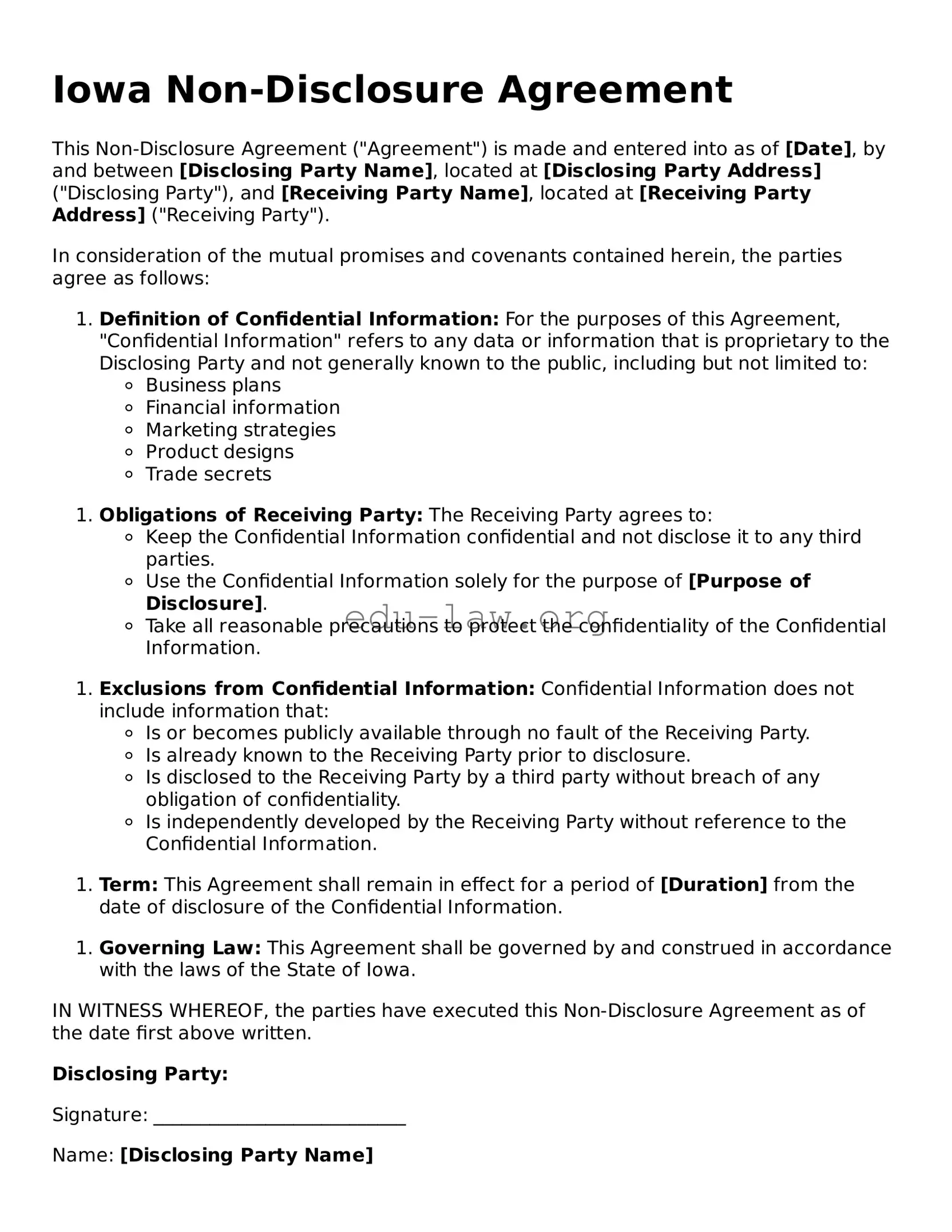
In the realm of business and professional relationships, confidentiality plays a crucial role in protecting sensitive information. The Iowa Non-disclosure Agreement (NDA) form serves as a vital tool for individuals and organizations looking to safeguard their proprietary data, trade secrets, and other confidential materials. This legally binding document establishes clear expectations regarding the sharing and handling of sensitive information between parties. By outlining the obligations of the disclosing and receiving parties, the NDA helps prevent unauthorized disclosure and misuse of confidential information. Key elements typically included in the form are definitions of what constitutes confidential information, the duration of the confidentiality obligation, and the consequences of breach. Additionally, the NDA may specify any exclusions from confidentiality, such as information that becomes publicly available or is already known to the receiving party. Understanding the nuances of this agreement is essential for anyone engaged in business negotiations or collaborations in Iowa.
Iowa Non-Disclosure Agreement
This Non-Disclosure Agreement ("Agreement") is made and entered into as of [Date], by and between [Disclosing Party Name], located at [Disclosing Party Address] ("Disclosing Party"), and [Receiving Party Name], located at [Receiving Party Address] ("Receiving Party").
In consideration of the mutual promises and covenants contained herein, the parties agree as follows:
IN WITNESS WHEREOF, the parties have executed this Non-Disclosure Agreement as of the date first above written.
Disclosing Party:
Signature: ___________________________
Name: [Disclosing Party Name]
Title: [Title]
Date: [Date]
Receiving Party:
Signature: ___________________________
Name: [Receiving Party Name]
Title: [Title]
Date: [Date]
| Fact Name | Description |
|---|---|
| Definition | An Iowa Non-disclosure Agreement (NDA) is a legal contract that protects confidential information shared between parties. |
| Purpose | The primary purpose of an NDA is to prevent the unauthorized disclosure of sensitive information. |
| Governing Law | The NDA is governed by the laws of the State of Iowa. |
| Parties Involved | Typically, the agreement involves a disclosing party and a receiving party. |
| Duration | The duration of confidentiality obligations can vary, often lasting several years after the agreement is signed. |
| Enforceability | NDAs are generally enforceable in Iowa, provided they are reasonable in scope and duration. |
| Exclusions | Information that is publicly available or already known to the receiving party may be excluded from the NDA. |
| Consequences of Breach | Violating an NDA can result in legal action, including claims for damages or injunctive relief. |
| Common Uses | NDAs are commonly used in business negotiations, employment relationships, and partnerships. |
After obtaining the Iowa Non-disclosure Agreement form, you will need to fill it out accurately. This process ensures that all necessary information is provided, which is essential for the agreement to be valid and enforceable.
What is a Non-disclosure Agreement (NDA) in Iowa?
A Non-disclosure Agreement (NDA) in Iowa is a legally binding contract that establishes a confidential relationship between parties. It protects sensitive information from being disclosed to unauthorized individuals or entities. This agreement is commonly used in business settings to safeguard trade secrets, proprietary information, and other confidential data during negotiations or collaborations.
When should I use an NDA?
You should consider using an NDA when sharing sensitive information with another party, such as during business negotiations, partnerships, or when hiring employees. An NDA helps ensure that your confidential information remains protected, especially if you are discussing ideas, plans, or proprietary processes that could be misused if disclosed.
Who can sign an NDA in Iowa?
Any individual or entity can sign an NDA in Iowa, including businesses, freelancers, employees, and contractors. It is essential that all parties involved understand the terms of the agreement and agree to uphold the confidentiality obligations specified within it.
What should be included in an NDA?
An effective NDA should include several key components: a clear definition of what constitutes confidential information, the obligations of the parties regarding that information, the duration of the confidentiality obligation, and any exclusions from confidentiality. Additionally, it should specify the governing law, which in this case would be Iowa law.
How long does the confidentiality obligation last?
The duration of the confidentiality obligation can vary based on the terms set forth in the NDA. Typically, it lasts for a specific period, such as two to five years, or until the information becomes public knowledge. It’s important to clearly outline this duration in the agreement to avoid any misunderstandings later.
What happens if someone breaches the NDA?
If a party breaches the NDA, the other party may have the right to seek legal remedies. This could include monetary damages, injunctive relief to prevent further disclosure, or other legal actions. The specific consequences of a breach should be outlined in the NDA to provide clarity on the repercussions of violating the agreement.
Can an NDA be modified after it is signed?
Yes, an NDA can be modified after it is signed, but both parties must agree to the changes. Modifications should be documented in writing and signed by all parties involved to ensure that the new terms are enforceable. It is advisable to consult legal counsel when making any modifications to ensure compliance with applicable laws.
Is it necessary to have a lawyer review my NDA?
While it is not legally required to have a lawyer review your NDA, it is highly recommended. A legal expert can help ensure that the agreement is comprehensive, enforceable, and tailored to your specific needs. This can prevent potential issues down the line and provide peace of mind regarding the protection of your confidential information.
Incomplete Information: Many individuals fail to fill in all required fields. This can include missing names, addresses, or specific details about the confidential information being protected.
Incorrect Dates: Some people mistakenly enter the wrong dates. Ensure that the effective date and expiration date are accurate to avoid any legal issues.
Not Specifying the Purpose: It's important to clearly outline the purpose of the agreement. A vague description can lead to misunderstandings about what information is covered.
Failure to Sign: Some individuals overlook the necessity of signatures. Both parties must sign the document for it to be legally binding.
A Non-disclosure Agreement (NDA) is an important document for protecting sensitive information. When creating or entering into an NDA in Iowa, several other forms and documents may also be relevant. Below is a list of commonly used documents that complement the NDA.
Each of these documents serves a unique purpose and can help ensure that sensitive information is protected in various business relationships. It is important to understand the role each document plays in safeguarding your interests.
The Iowa Non-disclosure Agreement (NDA) shares similarities with a Confidentiality Agreement. Both documents aim to protect sensitive information shared between parties. While an NDA typically focuses on preventing the disclosure of proprietary information, a Confidentiality Agreement may also encompass obligations regarding the use of that information. In essence, both documents serve to safeguard intellectual property and trade secrets, ensuring that the parties involved maintain discretion regarding the shared data.
Another document akin to the Iowa NDA is the Non-compete Agreement. This agreement restricts individuals from engaging in similar business activities that could harm a former employer or business partner. While the primary focus of a Non-disclosure Agreement is on confidentiality, the Non-compete Agreement extends beyond that, often prohibiting individuals from working in the same industry for a specified period. Both documents work in tandem to protect business interests, albeit from slightly different angles.
The Non-solicitation Agreement also bears resemblance to the Iowa NDA. This document prevents one party from soliciting clients or employees from another party for a certain duration. Like the NDA, it seeks to protect the relationships and goodwill that a business has cultivated. While the NDA centers on the confidentiality of information, the Non-solicitation Agreement emphasizes the preservation of business connections and the prevention of competitive harm.
A Mutual Non-disclosure Agreement is another closely related document. In this case, both parties agree to protect each other's confidential information. Unlike a unilateral NDA, where only one party is obligated to keep information secret, a Mutual NDA fosters a balanced approach, ensuring that both sides are equally responsible for safeguarding sensitive data. This type of agreement is often used in joint ventures or collaborations where both parties are sharing proprietary information.
Similar to the Iowa NDA is the Proprietary Information Agreement. This document specifically addresses the handling of proprietary information shared between parties. It outlines what constitutes proprietary information and the obligations of the receiving party regarding its use and disclosure. Like the NDA, it aims to prevent unauthorized sharing and misuse of valuable business information, reinforcing the importance of confidentiality in professional relationships.
The Employment Agreement often contains confidentiality clauses that echo the principles found in the Iowa NDA. When employees sign an Employment Agreement, they may be required to keep company information confidential, especially if they have access to sensitive data. This integration of confidentiality provisions within employment contracts highlights the necessity of protecting a company’s interests while also establishing clear expectations for employees regarding their responsibilities.
Lastly, the Licensing Agreement can also be compared to the Iowa NDA. This document allows one party to use the intellectual property of another under specific conditions, often including confidentiality provisions. Both agreements emphasize the importance of protecting proprietary information. In a Licensing Agreement, the licensor may require the licensee to keep certain information confidential, similar to the obligations outlined in an NDA. This ensures that the intellectual property remains secure while allowing for its use under agreed-upon terms.
When filling out the Iowa Non-disclosure Agreement (NDA) form, it's essential to ensure accuracy and compliance. Here are nine important dos and don'ts to keep in mind:
Non-disclosure agreements (NDAs) are important legal tools used to protect sensitive information. However, there are several misconceptions surrounding the Iowa Non-disclosure Agreement form that can lead to confusion. Here’s a look at six common misconceptions:
This is not true. NDAs can vary significantly in terms of language, scope, and enforceability. The Iowa Non-disclosure Agreement form is tailored to meet specific state laws and requirements, making it unique compared to NDAs used in other states.
While NDAs are designed to protect confidential information, they do not completely silence individuals. Many NDAs allow for certain disclosures, such as discussions with legal counsel or disclosures required by law.
This misconception overlooks the fact that individuals can also benefit from NDAs. Freelancers, contractors, and even employees may need to sign NDAs to protect sensitive information they handle.
In reality, many NDAs have specified durations. They may only remain in effect for a certain number of years, after which the obligations to keep information confidential may expire.
Not every NDA is enforceable. Courts may refuse to enforce an NDA if it is overly broad or if it imposes unreasonable restrictions on an individual's ability to work or communicate.
While having legal counsel can be beneficial, it is not always necessary. Many individuals and businesses can create effective NDAs using templates or forms, as long as they understand the key elements that need to be included.
Understanding these misconceptions can help individuals and businesses navigate the complexities of non-disclosure agreements more effectively. Being informed about what an NDA entails can lead to better decision-making and protection of sensitive information.
When dealing with sensitive information in Iowa, a Non-disclosure Agreement (NDA) is an essential tool. Here are key takeaways to consider when filling out and using this form:
Using an NDA effectively can safeguard your business interests and foster trust between parties. By following these key takeaways, you can navigate the process with confidence.