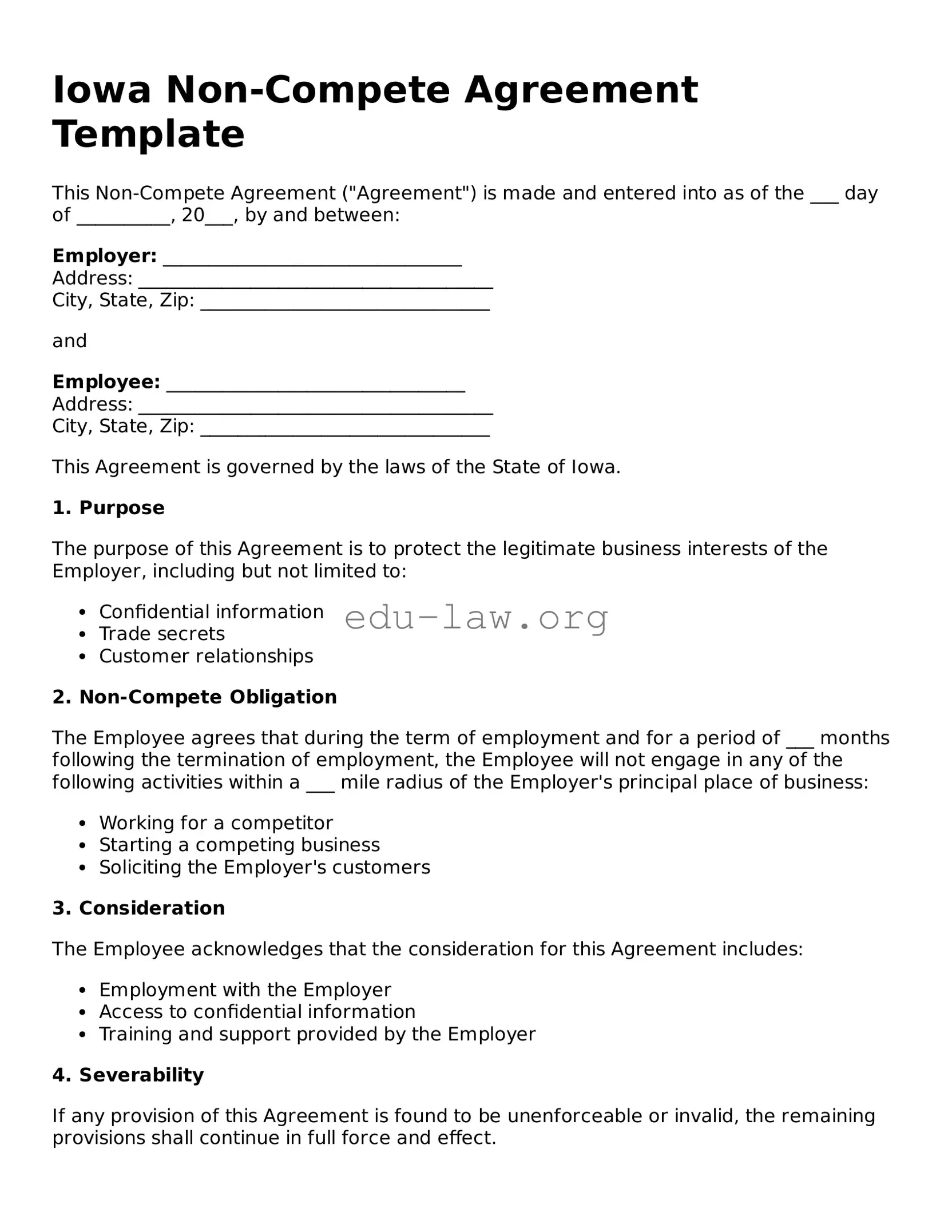
The Iowa Non-compete Agreement form plays a crucial role in the relationship between employers and employees, particularly when it comes to protecting business interests and intellectual property. This form outlines the terms under which an employee agrees not to enter into competition with their employer after leaving the company. Key aspects of the form include the duration of the non-compete period, the geographic scope of the restriction, and the specific activities that are prohibited. It is essential for both parties to understand these elements, as they can significantly impact future employment opportunities for the individual and safeguard the employer's proprietary information. Additionally, the enforceability of such agreements in Iowa is subject to certain legal standards, which aim to balance the interests of employers in protecting their businesses with the rights of employees to seek gainful employment. Understanding these nuances is vital for anyone considering signing a non-compete agreement in Iowa.
Iowa Non-Compete Agreement Template
This Non-Compete Agreement ("Agreement") is made and entered into as of the ___ day of __________, 20___, by and between:
Employer: ________________________________
Address: ______________________________________
City, State, Zip: _______________________________
and
Employee: ________________________________
Address: ______________________________________
City, State, Zip: _______________________________
This Agreement is governed by the laws of the State of Iowa.
1. Purpose
The purpose of this Agreement is to protect the legitimate business interests of the Employer, including but not limited to:
2. Non-Compete Obligation
The Employee agrees that during the term of employment and for a period of ___ months following the termination of employment, the Employee will not engage in any of the following activities within a ___ mile radius of the Employer's principal place of business:
3. Consideration
The Employee acknowledges that the consideration for this Agreement includes:
4. Severability
If any provision of this Agreement is found to be unenforceable or invalid, the remaining provisions shall continue in full force and effect.
5. Governing Law
This Agreement shall be governed by and construed in accordance with the laws of the State of Iowa.
IN WITNESS WHEREOF, the parties have executed this Non-Compete Agreement as of the date first above written.
Employer Signature: ________________________________
Date: ______________________________________
Employee Signature: ________________________________
Date: ______________________________________
| Fact Name | Details |
|---|---|
| Governing Law | The Iowa Non-compete Agreement is governed by Iowa Code Section 614.18. |
| Purpose | This agreement is designed to protect an employer's legitimate business interests. |
| Duration | Iowa courts generally enforce non-compete agreements for a reasonable duration, typically up to two years. |
| Geographic Scope | The agreement must specify a reasonable geographic area where the restrictions apply. |
| Consideration | For the agreement to be enforceable, there must be adequate consideration, such as employment or training. |
| Reasonableness Standard | The restrictions must be reasonable in scope and not overly broad to be enforceable. |
| Employee Rights | Employees have the right to negotiate the terms of the agreement before signing. |
| Enforceability | Non-compete agreements may be deemed unenforceable if they impose undue hardship on the employee. |
| Judicial Review | Iowa courts may modify overly restrictive agreements to make them reasonable and enforceable. |
Filling out the Iowa Non-compete Agreement form is a straightforward process. Once completed, this form will need to be signed by both parties involved. It is essential to ensure all information is accurate to avoid any potential issues later.
What is a Non-compete Agreement in Iowa?
A Non-compete Agreement is a legal contract between an employer and an employee. It restricts the employee from working for competitors or starting a competing business for a specified period after leaving the company. In Iowa, these agreements must be reasonable in scope and duration to be enforceable.
What are the key elements of a valid Non-compete Agreement in Iowa?
For a Non-compete Agreement to be valid in Iowa, it must protect a legitimate business interest. The agreement should be reasonable in geographic scope, duration, and the type of work restricted. Courts typically evaluate these factors to determine enforceability.
How long can a Non-compete Agreement last in Iowa?
The duration of a Non-compete Agreement in Iowa can vary. Generally, courts favor shorter durations, typically ranging from six months to two years. However, the specific length should align with the nature of the business and the employee's role.
Are Non-compete Agreements enforceable in Iowa?
Yes, Non-compete Agreements can be enforceable in Iowa if they meet certain criteria. They must protect legitimate business interests and be reasonable in terms of duration, geographic area, and the scope of restricted activities. Courts will assess these factors on a case-by-case basis.
Can an employee negotiate a Non-compete Agreement?
Yes, employees can negotiate the terms of a Non-compete Agreement. It is advisable to discuss any concerns or desired changes with the employer before signing. Negotiating may lead to more favorable terms, such as a shorter duration or a narrower scope.
What happens if I violate a Non-compete Agreement?
If you violate a Non-compete Agreement, the employer may take legal action against you. This could result in a lawsuit seeking damages or an injunction to prevent you from working with competitors. It is essential to understand the potential consequences before signing.
Can I still work in my field if I sign a Non-compete Agreement?
Yes, you can still work in your field, but your options may be limited. The Non-compete Agreement will specify the restrictions, such as the companies you cannot work for or the geographical areas you cannot operate in. Review the agreement carefully to understand your limitations.
Is there a difference between a Non-compete Agreement and a Non-disclosure Agreement?
Yes, there is a difference. A Non-compete Agreement restricts your ability to work for competitors after leaving a job, while a Non-disclosure Agreement protects confidential information. Both serve different purposes but may be used together in employment contracts.
Can I challenge a Non-compete Agreement in court?
Yes, you can challenge a Non-compete Agreement in court if you believe it is unreasonable or overly restrictive. Courts will evaluate the agreement based on its reasonableness and the protection of legitimate business interests. Consulting with a legal professional is advisable in such situations.
What should I do if I am presented with a Non-compete Agreement?
If you are presented with a Non-compete Agreement, take time to read and understand it fully. Consider consulting a legal professional for advice. Discuss any concerns with your employer before signing to ensure you are comfortable with the terms.
Failing to clearly define the scope of the non-compete agreement. It's important to specify what types of activities are restricted.
Not including a time frame for the non-compete. A specific duration helps clarify how long the restrictions will apply.
Neglecting to mention the geographic area where the non-compete is enforceable. This should be clearly outlined to avoid confusion.
Using vague or ambiguous language can lead to misunderstandings. It's essential to use clear and precise terms throughout the agreement.
Overlooking the need for consideration. The agreement must provide something of value to the employee in exchange for signing.
Not ensuring that the agreement complies with state laws. Different states have varying regulations regarding non-compete agreements.
Failing to provide an opportunity for the employee to seek legal advice before signing. This can help ensure that the employee fully understands their rights.
Forgetting to keep a copy of the signed agreement. Both parties should retain a copy for their records to avoid future disputes.
Not reviewing or updating the agreement periodically. As business circumstances change, the terms of the non-compete may need to be adjusted.
When entering into a non-compete agreement in Iowa, several other documents may be necessary to ensure clarity and legal compliance. These forms help outline the terms of employment, protect confidential information, and establish the overall relationship between the parties involved. Below is a list of commonly used documents that often accompany a non-compete agreement.
Using these documents in conjunction with a non-compete agreement can provide a comprehensive framework for the employment relationship. Each document serves a specific purpose, ensuring that both parties understand their rights and obligations. This proactive approach can help prevent misunderstandings and legal disputes down the line.
The Iowa Non-compete Agreement shares similarities with the Employment Contract. Both documents serve to outline the terms of the working relationship between an employer and an employee. An Employment Contract typically includes details about job responsibilities, compensation, and duration of employment, while the Non-compete Agreement specifically focuses on restrictions regarding post-employment activities. Together, these documents help protect the employer's interests while clarifying the expectations for the employee, creating a comprehensive framework for the professional relationship.
Another document that resembles the Iowa Non-compete Agreement is the Confidentiality Agreement, often referred to as a Non-disclosure Agreement (NDA). Like the Non-compete Agreement, a Confidentiality Agreement aims to protect sensitive information. While the Non-compete Agreement restricts an employee's ability to work for competitors after leaving a job, the Confidentiality Agreement ensures that an employee does not disclose proprietary information during or after their employment. Both documents are crucial for safeguarding a company's competitive edge and intellectual property.
The Iowa Non-compete Agreement also bears similarities to the Non-solicitation Agreement. This type of agreement prevents an employee from soliciting clients or employees of the company after their departure. While the Non-compete Agreement restricts the employee from working for competitors, the Non-solicitation Agreement specifically targets the relationships that the employee developed during their tenure. Both agreements are designed to protect a business's interests and ensure that its workforce and clientele remain intact after an employee leaves.
Lastly, the Iowa Non-compete Agreement can be compared to the Partnership Agreement, particularly in the context of business partnerships. A Partnership Agreement outlines the roles, responsibilities, and profit-sharing arrangements among partners. Similar to a Non-compete Agreement, it may include clauses that restrict partners from engaging in competing businesses or ventures during and after the partnership. Both documents aim to establish clear boundaries and expectations, fostering a cooperative environment while protecting the interests of all parties involved.
When filling out the Iowa Non-compete Agreement form, it's important to approach the process with care. Here are some guidelines to follow, as well as some common pitfalls to avoid.
Following these guidelines can help ensure that you fill out the Iowa Non-compete Agreement form correctly and protect your interests. Always prioritize clarity and comprehension when dealing with legal documents.
Non-compete agreements can be a source of confusion for many. Here are nine common misconceptions about the Iowa Non-compete Agreement form:
Understanding these misconceptions can help individuals navigate their rights and obligations when faced with a non-compete agreement in Iowa.
When filling out and using the Iowa Non-compete Agreement form, consider the following key takeaways: