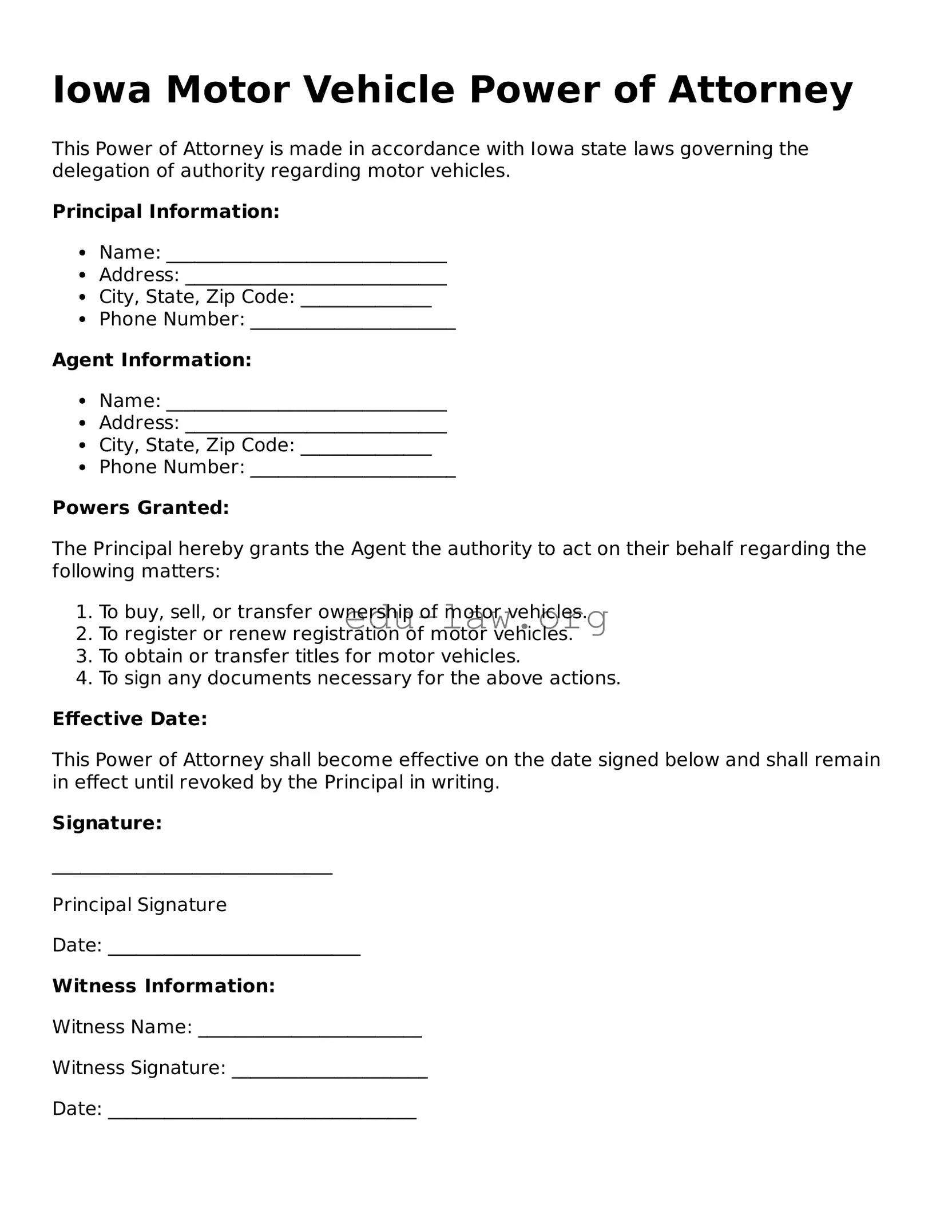
The Iowa Motor Vehicle Power of Attorney form serves as a crucial legal document that empowers an individual to act on behalf of another person concerning motor vehicle transactions. This form is particularly useful when the vehicle owner is unable to attend to necessary paperwork due to various reasons, such as being out of state or having health issues. It allows the designated agent to perform specific actions, including signing titles, registering vehicles, and transferring ownership. By clearly outlining the scope of authority granted, this form helps to ensure that all transactions are handled smoothly and legally. It is important for both parties to understand their rights and responsibilities, as well as the implications of granting such authority. Having a properly executed Motor Vehicle Power of Attorney can save time and prevent potential complications in vehicle management.
Iowa Motor Vehicle Power of Attorney
This Power of Attorney is made in accordance with Iowa state laws governing the delegation of authority regarding motor vehicles.
Principal Information:
Agent Information:
Powers Granted:
The Principal hereby grants the Agent the authority to act on their behalf regarding the following matters:
Effective Date:
This Power of Attorney shall become effective on the date signed below and shall remain in effect until revoked by the Principal in writing.
Signature:
______________________________
Principal Signature
Date: ___________________________
Witness Information:
Witness Name: ________________________
Witness Signature: _____________________
Date: _________________________________
| Fact Name | Details |
|---|---|
| Purpose | The Iowa Motor Vehicle Power of Attorney form allows an individual to authorize another person to handle motor vehicle transactions on their behalf. |
| Governing Law | This form is governed by Iowa Code Section 321.1 and related statutes. |
| Required Signatures | The form must be signed by the principal (the person granting authority) and may require notarization. |
| Duration | The authority granted through this form remains in effect until revoked by the principal or until the specific transaction is completed. |
| Usage | This form is typically used for transferring ownership, registering vehicles, or obtaining titles. |
| Revocation | The principal can revoke the power of attorney at any time, provided they notify the agent and any relevant parties. |
Filling out the Iowa Motor Vehicle Power of Attorney form is a straightforward process that allows one person to authorize another to act on their behalf regarding motor vehicle matters. After completing the form, it’s important to review the information for accuracy before submitting it to the appropriate authority.
What is the Iowa Motor Vehicle Power of Attorney form?
The Iowa Motor Vehicle Power of Attorney form is a legal document that allows one person to authorize another person to act on their behalf regarding motor vehicle transactions. This can include tasks such as signing titles, registering vehicles, and handling other related matters with the Iowa Department of Transportation.
Who can be designated as an agent in this form?
Any individual over the age of 18 can be designated as an agent. This could be a family member, friend, or a trusted professional. It is important to choose someone who is responsible and trustworthy, as they will have the authority to make decisions regarding your motor vehicle.
What types of transactions can the agent perform?
The agent can perform various transactions, including but not limited to transferring ownership of a vehicle, signing documents necessary for registration, and obtaining or renewing license plates. Essentially, the agent can handle most tasks related to motor vehicle management as specified in the form.
Do I need to have the form notarized?
Yes, the Iowa Motor Vehicle Power of Attorney form must be notarized to be valid. This means that you and your agent must sign the document in the presence of a notary public, who will then affix their seal to confirm the authenticity of the signatures.
Is there a specific format for filling out the form?
While the form itself will provide fields for necessary information, it is crucial to fill it out completely and accurately. Include details such as the names of both the principal and the agent, the specific powers being granted, and any limitations or conditions that may apply. Always double-check for accuracy before signing.
How long is the Power of Attorney valid?
The Iowa Motor Vehicle Power of Attorney remains valid until it is revoked by the principal or until the specific transaction for which it was granted is completed. It is advisable to keep a copy of the document for your records and to inform the agent of any changes to its status.
Can I revoke the Power of Attorney once it is granted?
Yes, you can revoke the Power of Attorney at any time, as long as you are mentally competent to do so. To revoke it, you should provide a written notice to the agent and any relevant parties, such as the Iowa Department of Transportation, if applicable. It’s best to also create a new document if you plan to designate a different agent.
What should I do if my agent is unable to fulfill their duties?
If your designated agent is unable to fulfill their duties, you may need to revoke the existing Power of Attorney and appoint a new agent. Ensure that the new agent is fully aware of their responsibilities and that the necessary paperwork is completed and notarized to avoid any confusion.
Where can I obtain the Iowa Motor Vehicle Power of Attorney form?
The Iowa Motor Vehicle Power of Attorney form can typically be obtained from the Iowa Department of Transportation's website or through local county treasurer’s offices. Make sure to use the most recent version of the form to ensure compliance with current laws and regulations.
Incomplete Information: Many individuals fail to fill out all required fields, leaving essential information blank. This can lead to delays or rejection of the form.
Incorrect Signatures: Some people forget to sign the form or use a signature that does not match the name on the document. This inconsistency can cause issues during processing.
Not Notarizing: Not all forms require notarization, but if it is needed and not completed, the document may be deemed invalid.
Using Outdated Forms: Individuals sometimes use older versions of the Power of Attorney form. Always ensure you have the most current version to avoid complications.
Failing to Specify Powers: The form should clearly outline the powers being granted. Vague descriptions can lead to misunderstandings about the authority given.
Ignoring State-Specific Requirements: Each state has unique rules. Failing to adhere to Iowa's specific requirements can result in the form being rejected.
Not Keeping Copies: After submitting the form, individuals often neglect to keep a copy for their records. This can create problems if there are questions or disputes later on.
Overlooking Revocation Procedures: Many people forget to understand how to revoke the Power of Attorney once it is no longer needed. This can lead to unintended consequences.
When dealing with motor vehicle transactions in Iowa, the Motor Vehicle Power of Attorney form is often accompanied by several other important documents. Each of these forms serves a unique purpose and can streamline the process of transferring ownership, registering vehicles, or handling other related matters. Below is a list of common documents that you might encounter alongside the Power of Attorney form.
Understanding these documents can greatly simplify the process of handling motor vehicle transactions in Iowa. Each form plays a vital role in ensuring that everything is conducted legally and efficiently. If you find yourself needing assistance, don't hesitate to reach out for guidance.
The Iowa Motor Vehicle Power of Attorney form is similar to the general Power of Attorney document. Both forms allow one person to grant another individual the authority to act on their behalf. This can include making decisions about financial matters, property transactions, or legal issues. In the context of vehicle ownership, the Motor Vehicle Power of Attorney is specifically tailored to handle matters related to motor vehicles, such as title transfers and registration, while a general Power of Attorney covers a broader range of responsibilities.
Another document that shares similarities is the Durable Power of Attorney. Like the Iowa Motor Vehicle Power of Attorney, a Durable Power of Attorney allows someone to act on behalf of another person. The key difference lies in its durability; it remains effective even if the principal becomes incapacitated. This is particularly important for long-term planning, ensuring that decisions regarding vehicle ownership or sales can continue without interruption.
The Limited Power of Attorney is also akin to the Iowa Motor Vehicle Power of Attorney. This document restricts the authority granted to specific tasks or timeframes. For instance, if you only want someone to handle the sale of your vehicle while you are out of town, a Limited Power of Attorney would be appropriate. It offers flexibility while still providing the necessary legal authority to manage vehicle-related matters.
The Vehicle Title Transfer form bears resemblance to the Iowa Motor Vehicle Power of Attorney in that both are used in the context of vehicle ownership. However, the Vehicle Title Transfer form is specifically designed for transferring ownership from one party to another. While the Motor Vehicle Power of Attorney grants authority to act on behalf of the owner, the title transfer form officially changes the ownership records with the state.
The Bill of Sale is another document that can be compared to the Iowa Motor Vehicle Power of Attorney. A Bill of Sale serves as a receipt and proof of transaction when a vehicle is sold. While the Motor Vehicle Power of Attorney allows someone to manage the sale process on behalf of the owner, the Bill of Sale finalizes the transaction, providing legal evidence of the sale and details about the vehicle involved.
The Release of Liability form is similar as well. When selling a vehicle, the seller may want to protect themselves from future liabilities related to the vehicle. The Release of Liability form informs the state that the seller is no longer responsible for the vehicle after the sale. While the Motor Vehicle Power of Attorney allows someone to act on behalf of the owner during the sale, the Release of Liability ensures that the seller's obligations are cleared after the transaction.
The Application for Title and Registration is another document that relates closely to the Iowa Motor Vehicle Power of Attorney. This application is necessary for obtaining a new title and registering a vehicle with the state. If someone is acting under a Power of Attorney, they may need to submit this application to complete the process of transferring ownership or registering a vehicle on behalf of the principal.
Lastly, the Consent to Transfer Vehicle form is similar in that it provides permission for the transfer of ownership. If the vehicle owner cannot be present for the transfer, this form allows another party to complete the transaction. The Iowa Motor Vehicle Power of Attorney serves a similar purpose by granting authority to act on behalf of the owner, ensuring that all necessary actions related to the vehicle can be taken without the owner's physical presence.
When filling out the Iowa Motor Vehicle Power of Attorney form, it's essential to approach the task with care. Here are five important do's and don'ts to keep in mind:
By following these guidelines, you can help ensure that the process goes smoothly and that the power of attorney is valid and effective.
The Iowa Motor Vehicle Power of Attorney form can often be misunderstood. Here are five common misconceptions that people may have about this important document:
Understanding these misconceptions can help individuals make informed decisions regarding their motor vehicle transactions in Iowa.
Filling out and using the Iowa Motor Vehicle Power of Attorney form can be straightforward if you keep a few key points in mind. Here are some essential takeaways to consider:
By following these guidelines, you can effectively utilize the Iowa Motor Vehicle Power of Attorney form to manage your vehicle-related affairs with confidence.