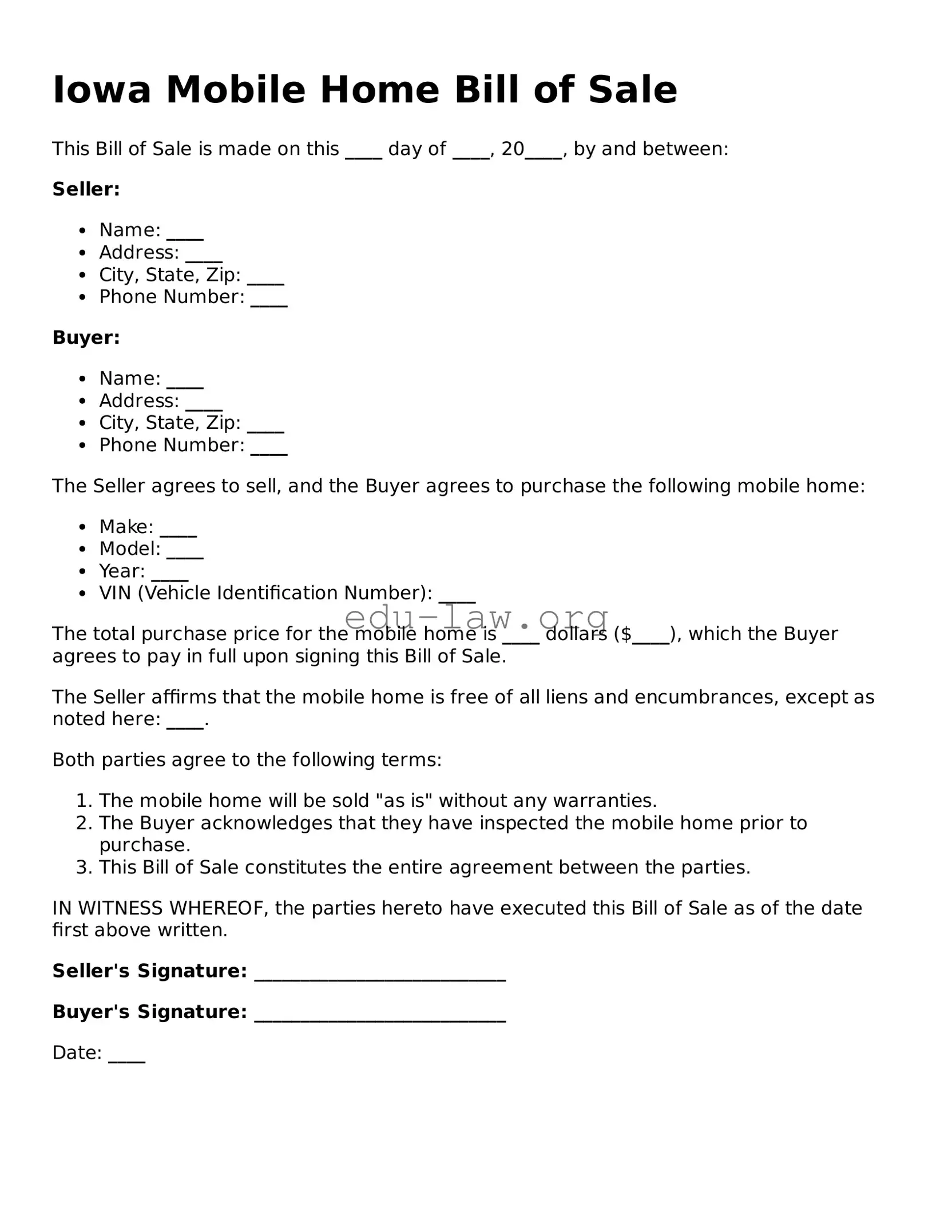
The Iowa Mobile Home Bill of Sale form serves as a crucial document in the transfer of ownership for mobile homes within the state. This form is essential for both buyers and sellers, as it provides a clear record of the transaction. It includes important details such as the names and addresses of both parties involved, a description of the mobile home being sold, and the sale price. Additionally, the form may require information about any liens on the property, ensuring that the buyer is aware of any existing financial obligations. By completing this form, sellers can protect themselves from future claims regarding ownership, while buyers can establish proof of their new ownership. Understanding the significance of this document can streamline the buying and selling process, making it easier for all parties involved to navigate the complexities of mobile home transactions in Iowa.
Iowa Mobile Home Bill of Sale
This Bill of Sale is made on this ____ day of ____, 20____, by and between:
Seller:
Buyer:
The Seller agrees to sell, and the Buyer agrees to purchase the following mobile home:
The total purchase price for the mobile home is ____ dollars ($____), which the Buyer agrees to pay in full upon signing this Bill of Sale.
The Seller affirms that the mobile home is free of all liens and encumbrances, except as noted here: ____.
Both parties agree to the following terms:
IN WITNESS WHEREOF, the parties hereto have executed this Bill of Sale as of the date first above written.
Seller's Signature: ___________________________
Buyer's Signature: ___________________________
Date: ____
| Fact Name | Description |
|---|---|
| Purpose | The Iowa Mobile Home Bill of Sale form is used to document the sale of a mobile home, providing a legal record of the transaction. |
| Governing Law | This form is governed by Iowa Code § 435.1, which outlines the regulations for mobile homes and their sale in the state. |
| Seller Information | The form requires the seller's name, address, and contact information to ensure clear identification of the seller in the transaction. |
| Buyer Information | Buyers must also provide their name and contact details, ensuring both parties are documented in the sale. |
| Mobile Home Details | Essential details about the mobile home, such as make, model, year, and identification number, must be included to identify the property accurately. |
| Purchase Price | The form requires the purchase price to be stated clearly, establishing the financial terms of the sale. |
| Signatures | Both the seller and buyer must sign the form to validate the transaction and confirm their agreement to the terms outlined. |
Once you have the Iowa Mobile Home Bill of Sale form in front of you, it's time to fill it out accurately. This form will help you document the sale of a mobile home, ensuring both the buyer and seller have a clear record of the transaction. Follow the steps below to complete the form correctly.
After completing these steps, both the buyer and seller should keep a copy of the Bill of Sale for their records. This document serves as proof of the transaction and can be helpful for future reference or legal purposes.
What is the Iowa Mobile Home Bill of Sale form?
The Iowa Mobile Home Bill of Sale form is a legal document used to transfer ownership of a mobile home from one party to another. This form serves as proof of the transaction and outlines the details of the sale, including the names of the buyer and seller, the mobile home's identification number, and the sale price. It is essential for ensuring that both parties have a clear understanding of the terms of the sale and for establishing legal ownership after the transaction is completed.
Why is it important to use a Bill of Sale for a mobile home?
Using a Bill of Sale is crucial for several reasons. First, it provides a written record of the transaction, which can be important for future reference. Second, it protects both the buyer and seller by clearly outlining the terms of the sale, thereby reducing the risk of disputes. Third, many states, including Iowa, require a Bill of Sale to register the mobile home with the Department of Transportation or other relevant authorities. Without this document, the buyer may face difficulties in establishing ownership.
What information is required on the form?
The Iowa Mobile Home Bill of Sale form typically requires specific information to be valid. This includes the full names and addresses of both the seller and the buyer, the mobile home's make, model, year, and identification number (often referred to as the VIN), and the sale price. It may also include the date of the sale and any warranties or conditions agreed upon by both parties. Accurate and complete information is vital to avoid complications later on.
Do I need to have the form notarized?
While notarization is not strictly required for the Iowa Mobile Home Bill of Sale, it is highly recommended. Having the document notarized adds an extra layer of authenticity and can help prevent disputes regarding the validity of the signatures. Additionally, some buyers or lenders may require notarization as part of their own policies or procedures. Always check local regulations or consult with a legal expert to determine the best course of action.
Can I create my own Bill of Sale for a mobile home?
Yes, you can create your own Bill of Sale for a mobile home, provided that it includes all necessary information and complies with Iowa's legal requirements. However, using a standardized form can simplify the process and help ensure that you do not overlook any essential details. Many legal websites and local government offices offer templates that can be filled out to meet your specific needs, making it easier to create a valid document.
What should I do after completing the Bill of Sale?
Once you have completed the Iowa Mobile Home Bill of Sale, both the buyer and seller should keep a copy for their records. The seller should also provide the buyer with any relevant documents, such as the title to the mobile home, if applicable. The buyer may need to take the Bill of Sale to their local Department of Transportation or other regulatory agency to register the mobile home in their name. It is important to follow through with these steps to ensure that the transfer of ownership is legally recognized.
Failing to include all required information about the seller. The seller's full name, address, and contact information must be clearly stated.
Neglecting to provide accurate details about the mobile home. This includes the make, model, year, and Vehicle Identification Number (VIN).
Not signing the form. Both the seller and the buyer must sign the Bill of Sale to make it legally binding.
Overlooking the date of the sale. It’s important to include the exact date when the transaction occurs.
Using incorrect or outdated information. Ensure that all details reflect the current status of the mobile home and the parties involved.
Forgetting to check for any liens or encumbrances. Sellers should confirm that the mobile home is free of any outstanding debts or claims.
Not providing a fair purchase price. The agreed-upon price should be clearly stated to avoid any future disputes.
Omitting the buyer’s information. Just like the seller, the buyer’s full name and contact details are essential for a valid transaction.
Failing to keep a copy of the signed Bill of Sale. Both parties should retain a copy for their records after the sale is complete.
Ignoring state-specific requirements. Each state may have additional regulations, so it’s crucial to be aware of Iowa’s specific rules regarding mobile home sales.
The Iowa Mobile Home Bill of Sale form is an essential document for transferring ownership of a mobile home. However, several other forms and documents often accompany it to ensure a smooth transaction. Below is a list of these documents, each serving a specific purpose in the process.
Using these documents together with the Iowa Mobile Home Bill of Sale helps ensure that both parties are protected and that the transaction proceeds smoothly. Each form plays a vital role in the process, providing clarity and legal backing to the sale.
The Iowa Mobile Home Bill of Sale form shares similarities with the general Vehicle Bill of Sale. Both documents serve as proof of the transfer of ownership from one party to another. They include essential details such as the names of the buyer and seller, a description of the item being sold, and the sale price. Just like a vehicle, a mobile home is a significant asset, and having a formal bill of sale helps protect both parties by documenting the transaction clearly.
Another document that resembles the Mobile Home Bill of Sale is the Boat Bill of Sale. This form is used when ownership of a boat is transferred. Like the Mobile Home Bill of Sale, it requires the identification of the buyer and seller, a detailed description of the boat, and the sale amount. Both documents ensure that the transaction is legally recognized and provide a safeguard against future disputes regarding ownership.
The Real Estate Purchase Agreement is also similar to the Mobile Home Bill of Sale. While it typically deals with land and buildings, the principles of transferring ownership remain the same. This agreement outlines the terms of the sale, including the parties involved, property description, and purchase price. Both documents serve to formalize the sale and protect the interests of both buyer and seller.
The Equipment Bill of Sale is another related document. This form is used when ownership of machinery or equipment is transferred. Much like the Mobile Home Bill of Sale, it includes the buyer's and seller's information, a description of the equipment, and the sale price. Both documents provide a clear record of the transaction, which is important for tax purposes and future ownership verification.
Similarly, the Motorcycle Bill of Sale serves the same purpose for motorcycles as the Mobile Home Bill of Sale does for mobile homes. It captures the necessary details of the transaction, including the identities of the buyer and seller, a description of the motorcycle, and the agreed-upon price. Both documents are essential for ensuring that the transfer of ownership is documented and recognized legally.
Lastly, the Personal Property Bill of Sale is akin to the Mobile Home Bill of Sale in that it can be used for various types of personal property, including mobile homes. This document provides a record of the sale, detailing the buyer and seller information, the description of the property, and the sale price. It serves to protect both parties in the transaction, ensuring clarity and legal recognition of ownership transfer.
When filling out the Iowa Mobile Home Bill of Sale form, it's important to pay attention to detail. Here are some guidelines to help you navigate the process smoothly:
Following these steps will help ensure that your Mobile Home Bill of Sale is filled out correctly and efficiently. Remember, accuracy is key in any legal transaction.
Understanding the Iowa Mobile Home Bill of Sale form can be challenging due to several misconceptions. Here are eight common misunderstandings and clarifications to help you navigate the process more effectively.
Many people believe that a Bill of Sale is optional for mobile home transactions. In Iowa, a Bill of Sale is essential for documenting the transfer of ownership and ensuring that the transaction is legally recognized.
This is a misconception. Anyone can complete a Bill of Sale for a mobile home, provided they follow the necessary guidelines and include all required information.
While notarization is not always required, having the Bill of Sale notarized can add an extra layer of authenticity and protection for both parties involved.
In reality, the classification of mobile homes can vary based on factors like age and size. Different rules may apply, so it’s important to understand how these factors affect the Bill of Sale.
Signing the Bill of Sale is just one step in the process. Buyers must also ensure that the title is transferred and any necessary registrations are completed.
This is not always true. Fees may be shared between the buyer and seller, and it’s important to clarify who will cover specific costs before finalizing the sale.
In Iowa, it is advisable to complete the Bill of Sale promptly after the sale to avoid any legal complications or misunderstandings in the future.
Relying on a verbal agreement can lead to disputes. Having a written Bill of Sale protects both parties and serves as a clear record of the transaction.
By dispelling these misconceptions, individuals can approach the process of buying or selling a mobile home in Iowa with greater confidence and clarity.
When filling out and using the Iowa Mobile Home Bill of Sale form, it is essential to understand several key points to ensure a smooth transaction. Here are ten important takeaways:
By keeping these key points in mind, individuals can navigate the process of completing and using the Iowa Mobile Home Bill of Sale form with greater confidence and clarity.