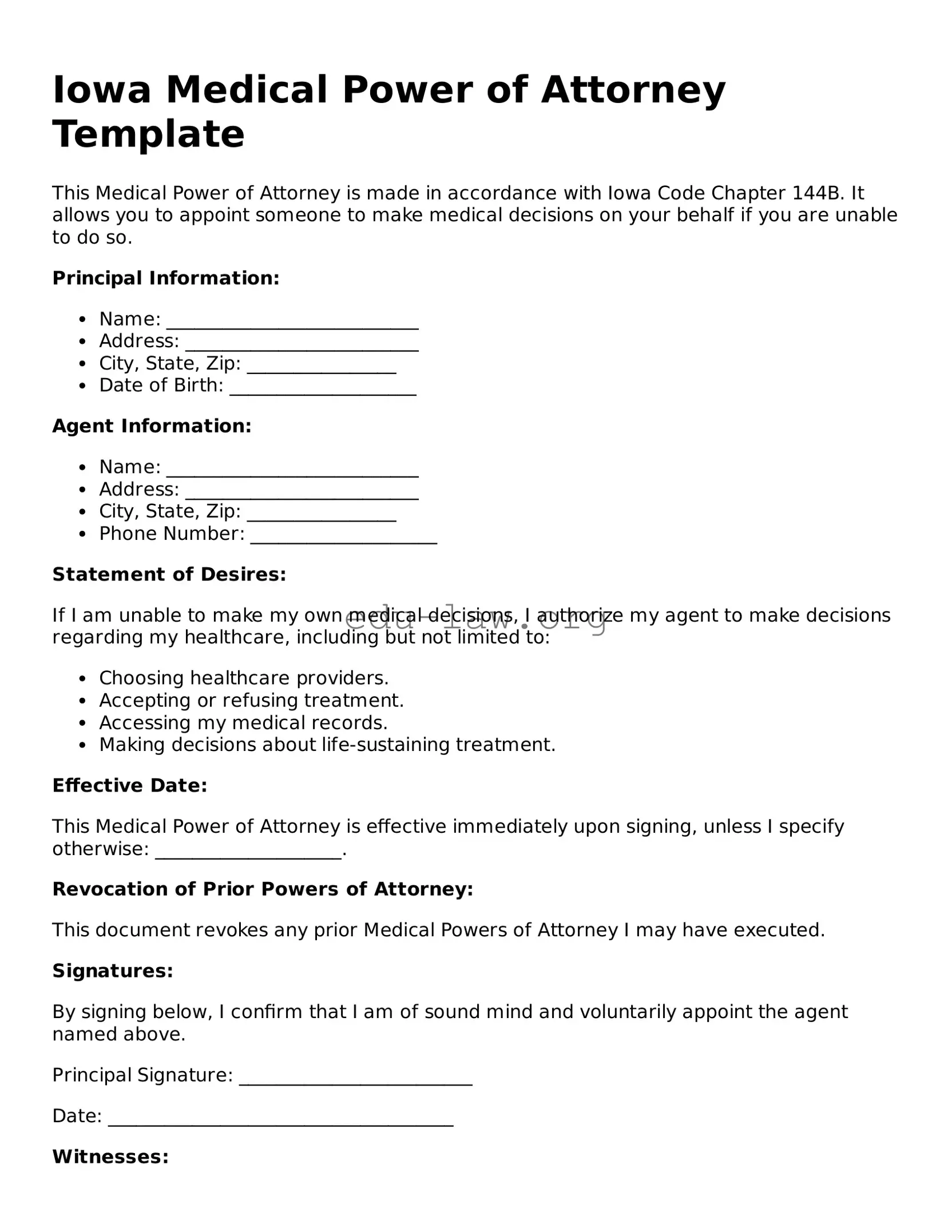
In Iowa, the Medical Power of Attorney form serves as a crucial legal document that allows individuals to designate a trusted person to make healthcare decisions on their behalf in the event they become unable to communicate their wishes. This form empowers the appointed agent to navigate medical choices, ensuring that the individual's preferences regarding treatment, procedures, and end-of-life care are respected. It is important to understand that this document not only covers the selection of an agent but also provides guidance on the types of medical treatments the individual may or may not want. Additionally, the form includes provisions for revocation, allowing individuals to change their appointed agent or their preferences as needed. Understanding the nuances of this form can greatly enhance peace of mind, knowing that one’s healthcare decisions are in the hands of a trusted advocate who is familiar with their values and wishes.
Iowa Medical Power of Attorney Template
This Medical Power of Attorney is made in accordance with Iowa Code Chapter 144B. It allows you to appoint someone to make medical decisions on your behalf if you are unable to do so.
Principal Information:
Agent Information:
Statement of Desires:
If I am unable to make my own medical decisions, I authorize my agent to make decisions regarding my healthcare, including but not limited to:
Effective Date:
This Medical Power of Attorney is effective immediately upon signing, unless I specify otherwise: ____________________.
Revocation of Prior Powers of Attorney:
This document revokes any prior Medical Powers of Attorney I may have executed.
Signatures:
By signing below, I confirm that I am of sound mind and voluntarily appoint the agent named above.
Principal Signature: _________________________
Date: _____________________________________
Witnesses:
Two witnesses are required. They must not be related to you or your agent.
Notarization:
If desired, this document may be notarized.
Notary Public Signature: ____________________
Date: _____________________________________
| Fact Name | Details |
|---|---|
| Definition | The Iowa Medical Power of Attorney form allows an individual to designate a trusted person to make medical decisions on their behalf if they become unable to do so. |
| Governing Law | This form is governed by the Iowa Code, specifically Chapter 144B, which outlines the regulations surrounding advance directives. |
| Eligibility | Any adult who is of sound mind can create a Medical Power of Attorney in Iowa. This includes individuals who are 18 years or older. |
| Signing Requirements | The form must be signed by the principal (the person granting authority) in the presence of two witnesses or a notary public to be valid. |
| Revocation | A Medical Power of Attorney can be revoked at any time by the principal. This can be done verbally or in writing, but it should be documented for clarity. |
| Durability | This document remains effective even if the principal becomes incapacitated, ensuring that medical decisions can be made when needed most. |
Completing the Iowa Medical Power of Attorney form is an important step in ensuring that your healthcare preferences are honored. After filling out the form, it will need to be signed and witnessed according to Iowa law. This will help ensure that your wishes regarding medical treatment are clearly communicated to your healthcare providers.
What is a Medical Power of Attorney in Iowa?
A Medical Power of Attorney (MPOA) in Iowa is a legal document that allows you to designate someone to make healthcare decisions on your behalf if you become unable to do so. This person, known as your agent, can make choices about your medical treatment, access your medical records, and communicate with healthcare providers. It ensures that your healthcare preferences are honored even when you cannot express them yourself.
Who can be designated as an agent in the Iowa Medical Power of Attorney?
In Iowa, you can choose any competent adult to serve as your agent. This could be a family member, friend, or trusted individual. It is important to select someone who understands your values and wishes regarding medical care. Keep in mind that your agent should be willing to take on this responsibility and be available to make decisions when needed.
Do I need to have a lawyer to create a Medical Power of Attorney in Iowa?
No, you do not need a lawyer to create a Medical Power of Attorney in Iowa. The form can be completed on your own, as long as you follow the state's requirements. However, consulting with a legal professional can provide guidance and ensure that the document accurately reflects your wishes. It may also help clarify any questions you have about the process.
How do I ensure my Medical Power of Attorney is valid in Iowa?
To ensure your Medical Power of Attorney is valid, you must sign the document in the presence of two witnesses or a notary public. The witnesses cannot be your designated agent or related to you by blood or marriage. After signing, keep the original document in a safe place and provide copies to your agent and healthcare providers. This way, your wishes will be readily accessible when needed.
Not Choosing an Appropriate Agent: Selecting someone who may not be capable of making difficult medical decisions can lead to confusion and conflict. It’s essential to choose a trusted individual who understands your wishes.
Failing to Discuss Wishes: Many people forget to have an open conversation with their chosen agent about their healthcare preferences. This lack of communication can result in decisions that do not align with your values.
Inadequate Witnessing: The form requires signatures from witnesses. If these witnesses do not meet the legal requirements, the document could be deemed invalid.
Not Updating the Document: Life circumstances change. Failing to update your Medical Power of Attorney after major life events, such as marriage or divorce, can lead to unintended consequences.
Overlooking Alternate Agents: Designating only one agent without a backup can create issues if the primary agent is unavailable or unwilling to act. It’s wise to name an alternate to ensure your wishes are respected.
Neglecting to Review State Laws: Each state has specific requirements for a Medical Power of Attorney. Ignoring these can result in a form that is not legally binding in Iowa.
Not Storing the Document Properly: After completing the form, it’s crucial to store it in a safe yet accessible place. If your agent cannot find the document when needed, it may not serve its intended purpose.
The Iowa Medical Power of Attorney form is a crucial document for individuals who wish to designate someone to make healthcare decisions on their behalf in case they become incapacitated. Alongside this form, several other documents may be utilized to ensure comprehensive planning for medical care and personal affairs. Below is a list of these documents, each serving a specific purpose.
Utilizing these documents in conjunction with the Iowa Medical Power of Attorney can provide a comprehensive approach to healthcare and personal decision-making. Each form plays a vital role in ensuring that an individual's wishes are respected and followed in times of need.
The Iowa Medical Power of Attorney form shares similarities with the Advance Directive for Health Care. Both documents allow individuals to express their healthcare preferences in advance. They empower designated agents to make medical decisions on behalf of a person who is unable to do so. The Advance Directive typically includes specific instructions regarding medical treatments, while the Medical Power of Attorney focuses more on appointing someone to make decisions. Both documents aim to ensure that a person’s wishes are honored in medical situations where they cannot communicate their desires.
Another document similar to the Iowa Medical Power of Attorney is the Living Will. A Living Will outlines an individual’s wishes regarding life-sustaining treatments and end-of-life care. Like the Medical Power of Attorney, it addresses healthcare decisions but does so in a more directive manner. While the Medical Power of Attorney appoints someone to make decisions, the Living Will provides specific instructions about what treatments a person does or does not want. Together, these documents can provide comprehensive guidance on a person’s healthcare preferences.
The Durable Power of Attorney for Finances also bears resemblance to the Iowa Medical Power of Attorney. While the former focuses on financial and legal decisions, the latter is specifically for healthcare choices. Both documents allow individuals to designate someone to act on their behalf when they are unable to do so. The key difference lies in the area of authority: one manages financial matters, while the other manages health-related decisions. This distinction is crucial for ensuring that the right person is making the right decisions in different aspects of life.
Lastly, the Health Care Proxy is another document that is similar to the Iowa Medical Power of Attorney. A Health Care Proxy allows an individual to appoint someone to make medical decisions if they become incapacitated. Like the Medical Power of Attorney, it emphasizes the importance of having a trusted person in charge of healthcare choices. Both documents serve the same fundamental purpose of ensuring that a person’s healthcare preferences are respected, even when they cannot voice them themselves. This shared goal underscores the importance of having clear and accessible healthcare planning tools.
When filling out the Iowa Medical Power of Attorney form, it's important to approach the process with care. Here are some key things to keep in mind:
By following these guidelines, you can help ensure that your Medical Power of Attorney accurately reflects your wishes and provides peace of mind for you and your loved ones.
Misconceptions about the Iowa Medical Power of Attorney form can lead to misunderstandings regarding its purpose and function. Below are four common misconceptions.
Filling out and using the Iowa Medical Power of Attorney form is an important step in ensuring that your healthcare wishes are honored. Here are some key takeaways to keep in mind:
By keeping these points in mind, you can ensure that your Medical Power of Attorney form effectively reflects your healthcare wishes and provides peace of mind for you and your loved ones.