In the context of marital separation, individuals often seek clarity and structure to navigate the complexities of their new circumstances. The Iowa Marital Separation Agreement form serves as a crucial tool in this process, outlining the rights and responsibilities of each spouse during the separation period. This document addresses key aspects such as the division of property, spousal support, and child custody arrangements. By clearly delineating these elements, the agreement aims to minimize conflict and provide a framework for both parties to follow. It is essential for couples to approach this form with a comprehensive understanding of their individual needs and the implications of their decisions. Ultimately, the Iowa Marital Separation Agreement not only facilitates a smoother transition but also lays the groundwork for future interactions between the spouses, ensuring that both parties are equipped to move forward with their lives in a structured manner.
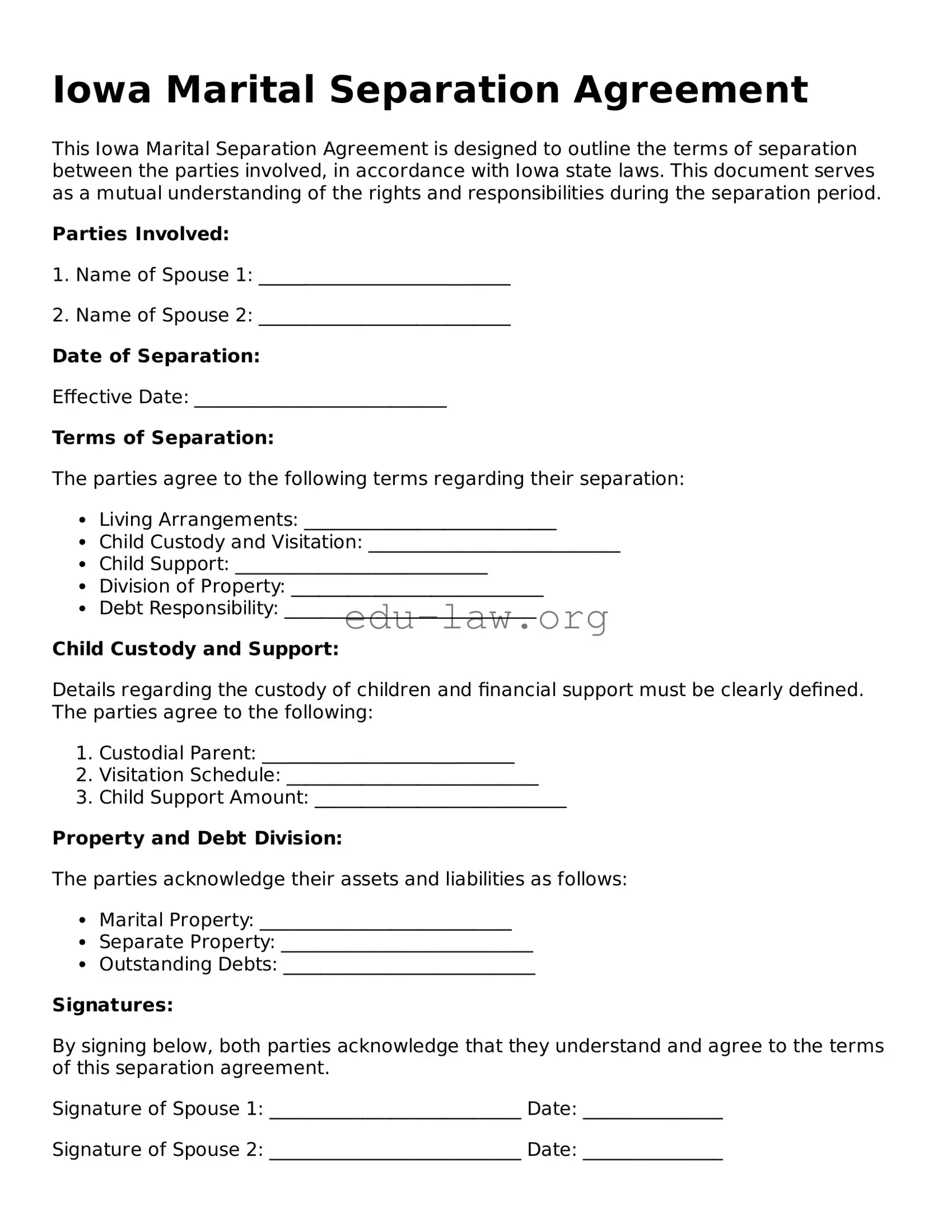
Iowa Marital Separation Agreement
This Iowa Marital Separation Agreement is designed to outline the terms of separation between the parties involved, in accordance with Iowa state laws. This document serves as a mutual understanding of the rights and responsibilities during the separation period.
Parties Involved:
1. Name of Spouse 1: ___________________________
2. Name of Spouse 2: ___________________________
Date of Separation:
Effective Date: ___________________________
Terms of Separation:
The parties agree to the following terms regarding their separation:
Child Custody and Support:
Details regarding the custody of children and financial support must be clearly defined. The parties agree to the following:
Property and Debt Division:
The parties acknowledge their assets and liabilities as follows:
Signatures:
By signing below, both parties acknowledge that they understand and agree to the terms of this separation agreement.
Signature of Spouse 1: ___________________________ Date: _______________
Signature of Spouse 2: ___________________________ Date: _______________
This agreement is intended to serve as a binding contract between the parties. It is advisable to consult with a legal professional to ensure that all aspects of the agreement comply with Iowa law.
| Fact Name | Description |
|---|---|
| Definition | The Iowa Marital Separation Agreement is a legal document that outlines the terms of separation between spouses. |
| Governing Law | This agreement is governed by the Iowa Code, particularly Chapter 598, which pertains to dissolution of marriage and separation. |
| Purpose | The agreement helps clarify issues such as property division, child custody, and support obligations. |
| Voluntary Nature | Both parties must voluntarily agree to the terms outlined in the separation agreement. |
| Enforceability | Once signed, the agreement is generally enforceable in court, provided it meets legal standards. |
| Child Custody | The agreement can include detailed arrangements for child custody and visitation rights. |
| Financial Arrangements | Spousal support and division of marital assets can be specified in the agreement. |
| Modification | Changes to the agreement can be made if both parties consent and the modifications are documented. |
| Legal Advice | It is advisable for both parties to seek legal counsel before signing the agreement. |
| Filing Requirement | While the agreement does not need to be filed with the court, it may be referenced in divorce proceedings. |
Filling out the Iowa Marital Separation Agreement form is a straightforward process. Once completed, this document will help outline the terms of your separation. It is important to ensure that all information is accurate and reflects the agreement between both parties.
What is a Marital Separation Agreement in Iowa?
A Marital Separation Agreement is a legal document that outlines the terms of a couple's separation. It addresses important issues such as division of property, child custody, visitation rights, and spousal support. This agreement allows both parties to clarify their responsibilities and rights while living separately, ensuring a smoother transition during this challenging time.
How do I create a Marital Separation Agreement in Iowa?
To create a Marital Separation Agreement, both parties should first discuss and agree on the terms. It is advisable to put everything in writing. You can start by drafting the agreement yourself or using templates available online. However, consulting with an attorney is recommended to ensure that the agreement complies with Iowa laws and adequately protects your interests.
Is a Marital Separation Agreement legally binding in Iowa?
Yes, a Marital Separation Agreement is legally binding in Iowa once both parties sign it. However, for it to be enforceable in court, it must be fair and reasonable. If either party fails to adhere to the terms, the other party can seek legal remedies. It is important to ensure that both parties fully understand the agreement before signing.
Can a Marital Separation Agreement be modified?
Yes, a Marital Separation Agreement can be modified if both parties agree to the changes. It is essential to document any modifications in writing and have both parties sign the updated agreement. This ensures clarity and helps prevent future disputes. If significant changes occur in circumstances, such as income or living arrangements, it may be necessary to revisit the agreement.
Failing to include all necessary information. It's crucial to provide complete details about both spouses, including full names, addresses, and contact information.
Not clearly defining the terms of separation. Vague language can lead to misunderstandings. Specificity about child custody, property division, and financial responsibilities is essential.
Overlooking state-specific requirements. Each state has its own laws regarding separation agreements. Ignoring Iowa's specific requirements can invalidate the agreement.
Neglecting to address debts. Many people focus solely on assets but fail to account for shared debts, which can lead to future disputes.
Forgetting to include a dispute resolution clause. A clear process for resolving disagreements can prevent future conflicts.
Not considering tax implications. The financial aspects of separation can have significant tax consequences that should be carefully evaluated.
Failing to review the agreement with legal counsel. Professional guidance can identify potential pitfalls and ensure the agreement is fair and enforceable.
Inadequately addressing spousal support. Clearly outlining any alimony or spousal support arrangements is necessary to avoid confusion later.
Not keeping a copy of the signed agreement. After finalizing the document, both parties should retain copies for their records to avoid disputes about the terms.
When navigating the complexities of marital separation in Iowa, several forms and documents may be necessary to ensure a smooth process. Each document serves a specific purpose and helps clarify the rights and responsibilities of each party involved. Below is a list of commonly used forms that often accompany the Iowa Marital Separation Agreement.
Understanding these documents can greatly assist individuals in preparing for a marital separation. Each form plays a vital role in ensuring that the rights of all parties, especially children, are respected and upheld during this challenging time.
The Iowa Marital Separation Agreement is similar to a Divorce Settlement Agreement. Both documents outline the terms of asset division, child custody, and support obligations. A Divorce Settlement Agreement is finalized when a couple decides to end their marriage, whereas a Marital Separation Agreement is used when couples wish to live apart without officially divorcing. This distinction can affect how property and debts are managed during the separation period.
Another comparable document is the Child Custody Agreement. This agreement specifically addresses the arrangements for child custody and visitation. While the Marital Separation Agreement may include child custody provisions, the Child Custody Agreement focuses solely on the best interests of the children involved. It provides a detailed plan for parenting responsibilities and schedules, ensuring clarity for both parents.
The Property Settlement Agreement is also similar. This document outlines how a couple will divide their assets and debts during a separation or divorce. Like the Marital Separation Agreement, it aims to prevent disputes over property. However, the Property Settlement Agreement is often executed as part of the divorce process, whereas the Marital Separation Agreement can stand alone until the couple decides to divorce.
A Cohabitation Agreement shares similarities as well. This document is used by couples who live together but are not married. It outlines the rights and responsibilities of each partner regarding property and finances. While a Marital Separation Agreement is specific to married couples, both documents serve to clarify expectations and protect individual interests during a separation or cohabitation.
The Separation Agreement is another relevant document. It is essentially a broader term that can encompass various aspects of separation, including financial arrangements and child custody. The Iowa Marital Separation Agreement is a specific type of Separation Agreement tailored to Iowa law, ensuring compliance with state regulations while addressing the needs of the separating couple.
A Non-Marital Separation Agreement is also worth mentioning. This document is used by couples who are not legally married but wish to outline their rights and obligations while living apart. Like the Marital Separation Agreement, it can address financial matters and living arrangements, but it does not have the same legal implications as agreements for married couples.
The Prenuptial Agreement can be compared as well. Although it is created before marriage, it serves a similar purpose in outlining how assets will be divided in the event of separation or divorce. Both agreements aim to protect individual interests and provide clarity, but the Prenuptial Agreement is proactive, while the Marital Separation Agreement is reactive.
The Domestic Partnership Agreement is another similar document. This agreement is designed for couples in a domestic partnership, outlining their rights and responsibilities. It is akin to the Marital Separation Agreement in that it provides a framework for financial and property matters, but it applies to couples who may not be legally married.
Finally, the Financial Disclosure Statement is relevant. This document is often required in divorce proceedings and can be part of a Marital Separation Agreement. It provides a full disclosure of each party's financial situation, ensuring transparency during the separation process. Both documents help facilitate fair negotiations regarding asset division and support obligations.
When filling out the Iowa Marital Separation Agreement form, it's essential to approach the process with care. Here are some key do's and don'ts to consider:
When considering a Marital Separation Agreement in Iowa, several misconceptions can lead to confusion. Understanding these common misunderstandings is essential for making informed decisions. Here are four prevalent misconceptions:
By addressing these misconceptions, individuals can approach their marital separation with a clearer understanding of their options and responsibilities.
When navigating the Iowa Marital Separation Agreement form, understanding its key components can make the process smoother. Here are some essential takeaways to keep in mind:
By keeping these points in mind, individuals can approach the separation process with greater clarity and confidence.