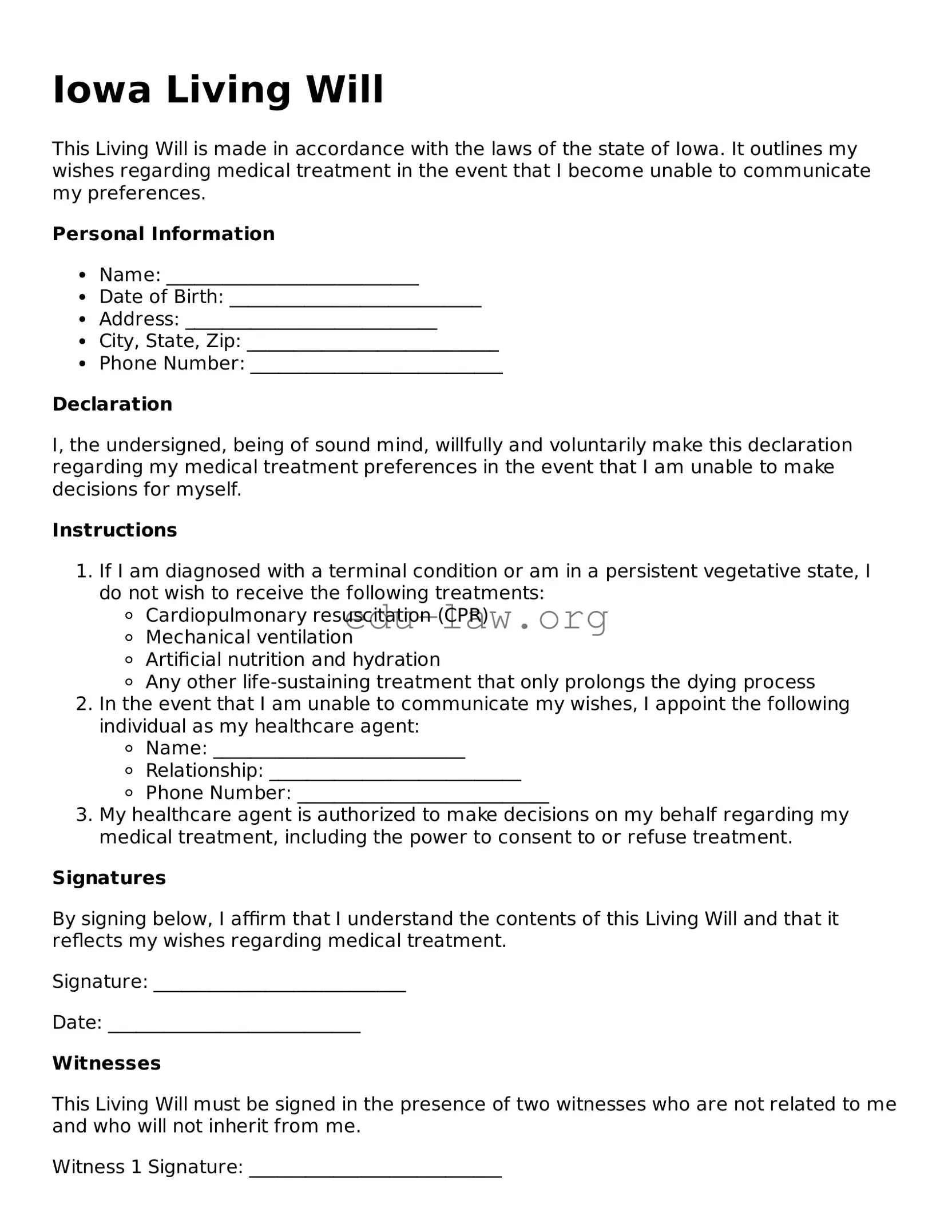
The Iowa Living Will form serves as an essential tool for individuals to communicate their healthcare preferences in the event they become unable to make decisions for themselves. This document outlines a person's wishes regarding life-sustaining treatments and end-of-life care, providing clarity for both family members and medical professionals. Key components of the form include the specification of treatments to be accepted or declined, the designation of a healthcare proxy, and the inclusion of any additional personal instructions. By completing this form, individuals can ensure that their values and desires are respected during critical medical situations, alleviating potential burdens on loved ones and healthcare providers. Understanding the nuances of this form is crucial for anyone looking to make informed decisions about their future healthcare needs.
Iowa Living Will
This Living Will is made in accordance with the laws of the state of Iowa. It outlines my wishes regarding medical treatment in the event that I become unable to communicate my preferences.
Personal Information
Declaration
I, the undersigned, being of sound mind, willfully and voluntarily make this declaration regarding my medical treatment preferences in the event that I am unable to make decisions for myself.
Instructions
Signatures
By signing below, I affirm that I understand the contents of this Living Will and that it reflects my wishes regarding medical treatment.
Signature: ___________________________
Date: ___________________________
Witnesses
This Living Will must be signed in the presence of two witnesses who are not related to me and who will not inherit from me.
Witness 1 Signature: ___________________________
Date: ___________________________
Witness 2 Signature: ___________________________
Date: ___________________________
| Fact Name | Description |
|---|---|
| Governing Law | The Iowa Living Will is governed by Iowa Code Chapter 144A. |
| Purpose | This form allows individuals to express their wishes regarding medical treatment in the event they become unable to communicate. |
| Eligibility | Any adult resident of Iowa can complete a Living Will, provided they are of sound mind. |
| Witness Requirements | The form must be signed in the presence of two witnesses, who cannot be related to the individual or entitled to any part of their estate. |
| Revocation | A Living Will can be revoked at any time by the individual, either verbally or in writing. |
| Storage Recommendations | It is advisable to keep the Living Will in a safe place and share copies with family members and healthcare providers. |
Completing the Iowa Living Will form is an important step in expressing your healthcare preferences. After filling out the form, ensure that it is signed and witnessed according to the state's requirements. This process helps ensure that your wishes are respected in medical situations where you may not be able to communicate them.
What is a Living Will in Iowa?
A Living Will is a legal document that allows you to express your wishes regarding medical treatment in the event that you become unable to communicate your preferences. It specifically addresses situations where you are terminally ill or permanently unconscious and unable to make decisions about your care.
Who can create a Living Will in Iowa?
Any adult who is at least 18 years old and is of sound mind can create a Living Will in Iowa. This includes individuals who are capable of understanding the nature and consequences of their decisions regarding medical treatment.
What should be included in a Living Will?
Your Living Will should clearly outline your preferences for medical treatment. This may include decisions about life-sustaining treatments, resuscitation efforts, and other interventions. It’s essential to be specific about what you want and do not want in various medical scenarios.
How do I create a Living Will in Iowa?
To create a Living Will, you can use a standard form provided by the state or consult with an attorney for personalized guidance. After completing the form, you must sign it in the presence of two witnesses or a notary public to ensure its validity.
Can I change or revoke my Living Will?
Yes, you can change or revoke your Living Will at any time as long as you are competent. To revoke it, you can destroy the document, create a new one, or simply state your intention to revoke it in writing. Make sure to inform your healthcare providers and family members of any changes.
Do I need a lawyer to create a Living Will?
No, you do not need a lawyer to create a Living Will in Iowa. However, consulting with a legal professional can provide clarity and ensure that your document meets all legal requirements and accurately reflects your wishes.
Is a Living Will the same as a Power of Attorney for Healthcare?
No, a Living Will and a Power of Attorney for Healthcare are different documents. A Living Will focuses on your medical treatment preferences, while a Power of Attorney for Healthcare allows you to designate someone to make healthcare decisions on your behalf if you are unable to do so.
Where should I keep my Living Will?
Store your Living Will in a safe but accessible place. Inform your family members, healthcare proxy, and primary care physician about its location. It’s also wise to carry a card in your wallet indicating that you have a Living Will.
What happens if I don’t have a Living Will?
If you do not have a Living Will, healthcare providers will make decisions based on what they believe is in your best interest. This may not align with your personal wishes, which is why having a Living Will is important for ensuring your preferences are respected.
Can I include specific medical treatments in my Living Will?
Yes, you can specify which medical treatments you want or do not want in your Living Will. This includes decisions about mechanical ventilation, feeding tubes, and other life-sustaining measures. Be as clear and detailed as possible to avoid confusion later on.
Failing to clearly state medical preferences. Individuals often overlook the importance of being specific about their treatment choices.
Not signing the document. A common mistake is to forget the required signatures, which invalidates the form.
Neglecting to date the form. Without a date, it can create confusion regarding the validity of the document.
Using vague language. Phrases like “do everything possible” can lead to misinterpretation by healthcare providers.
Overlooking witness requirements. Failing to have the necessary witnesses can render the document ineffective.
Not reviewing the form regularly. Preferences may change over time, and it’s crucial to update the document accordingly.
Forgetting to inform family members. It is vital to discuss the living will with loved ones to ensure they understand your wishes.
Assuming the form is a one-time task. People often mistakenly believe that once completed, the form requires no further attention.
When preparing a Living Will in Iowa, individuals often consider additional forms and documents to ensure their healthcare preferences are clearly communicated and respected. Each of these documents serves a specific purpose in the realm of healthcare decision-making.
By considering these additional forms and documents, individuals can create a comprehensive plan that reflects their healthcare wishes and eases the burden on loved ones during difficult times. It is essential to review and update these documents regularly to ensure they align with your current preferences.
The Iowa Living Will form is similar to the Advance Directive, which serves as a broader term encompassing various documents that outline a person's healthcare preferences. An Advance Directive typically includes both a Living Will and a Healthcare Power of Attorney. While a Living Will focuses specifically on end-of-life decisions and medical treatments one wishes or does not wish to receive, an Advance Directive allows individuals to appoint someone to make healthcare decisions on their behalf if they become unable to do so. This combination provides a comprehensive approach to managing medical care in critical situations.
Another document akin to the Iowa Living Will is the Durable Power of Attorney for Health Care. This document empowers a designated individual, known as an agent, to make medical decisions on behalf of the person who created the document. Unlike a Living Will, which primarily addresses specific treatment preferences, the Durable Power of Attorney grants broader authority to the agent to make choices based on the person's values and wishes. This flexibility can be vital in unforeseen medical scenarios, ensuring that decisions align with the individual's overall healthcare goals.
The Do Not Resuscitate (DNR) order also shares similarities with the Iowa Living Will. A DNR order is a specific medical directive that instructs healthcare providers not to perform CPR or other life-saving measures in the event of cardiac arrest or respiratory failure. While a Living Will may include broader directives about end-of-life care, a DNR focuses solely on resuscitation efforts. Both documents aim to respect the individual's wishes regarding life-sustaining treatments, but they address different aspects of medical care.
Lastly, the Physician Orders for Life-Sustaining Treatment (POLST) form is another document that aligns with the Iowa Living Will. POLST is designed for individuals with serious health conditions and outlines specific medical interventions they wish to receive or avoid. Unlike a Living Will, which is often created in advance and may not be updated frequently, a POLST form is intended to be more dynamic, reflecting the patient's current health status and preferences. Both documents ensure that healthcare providers understand and honor the individual's wishes regarding medical treatment, but POLST provides a more immediate and actionable plan for emergency situations.
When filling out the Iowa Living Will form, it is important to approach the process thoughtfully. Here are five things you should and shouldn't do:
There are several misconceptions about the Iowa Living Will form that can lead to confusion. Understanding the truth behind these myths can help individuals make informed decisions about their healthcare wishes.
This is not true. Anyone over the age of 18 can create a Living Will. It's important for all adults to consider their healthcare preferences.
While both documents are important, they serve different purposes. A Living Will outlines your wishes regarding medical treatment, while a Power of Attorney designates someone to make decisions on your behalf.
This is false. You can update or revoke your Living Will at any time as long as you are mentally competent.
This is a common misunderstanding. A Living Will can guide medical decisions in various situations, not just terminal illnesses.
While healthcare providers are required to honor your wishes, they must also consider the specific circumstances of your medical condition.
In Iowa, you must have at least two witnesses when signing your Living Will to ensure its validity.
A Living Will specifically addresses end-of-life care and does not cover every medical situation. It’s wise to discuss your overall healthcare preferences with your loved ones and healthcare providers.
Filling out and using the Iowa Living Will form is an important step in planning for future medical care. Here are some key takeaways to consider: