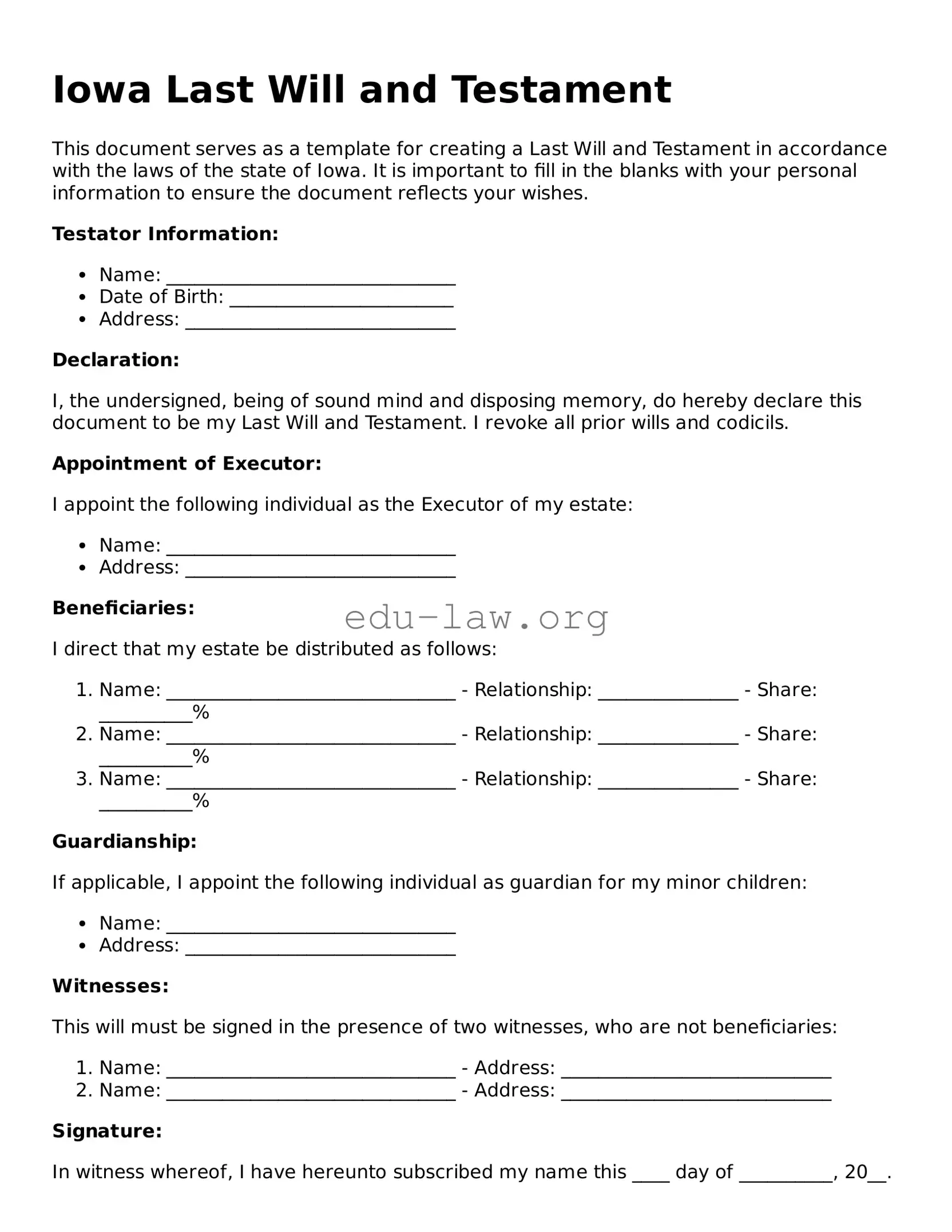
Creating a Last Will and Testament is an essential step in ensuring that your wishes are honored after your passing. In Iowa, this legal document outlines how your assets will be distributed, who will care for your minor children, and who will manage your estate. The Iowa Last Will and Testament form allows you to specify your beneficiaries, whether they are family members, friends, or charitable organizations. It also provides space for appointing an executor, the person responsible for carrying out the instructions in your will. Additionally, the form can include provisions for guardianship of dependents, ensuring that your loved ones are taken care of according to your preferences. Understanding the key components of this form is crucial for making informed decisions about your estate planning. By addressing these important aspects, you can create a comprehensive will that reflects your intentions and provides peace of mind for both you and your family.
Iowa Last Will and Testament
This document serves as a template for creating a Last Will and Testament in accordance with the laws of the state of Iowa. It is important to fill in the blanks with your personal information to ensure the document reflects your wishes.
Testator Information:
Declaration:
I, the undersigned, being of sound mind and disposing memory, do hereby declare this document to be my Last Will and Testament. I revoke all prior wills and codicils.
Appointment of Executor:
I appoint the following individual as the Executor of my estate:
Beneficiaries:
I direct that my estate be distributed as follows:
Guardianship:
If applicable, I appoint the following individual as guardian for my minor children:
Witnesses:
This will must be signed in the presence of two witnesses, who are not beneficiaries:
Signature:
In witness whereof, I have hereunto subscribed my name this ____ day of __________, 20__.
_______________________________
(Signature of Testator)
This Last Will and Testament is executed in accordance with the laws of the state of Iowa, and it is intended to be legally binding.
| Fact Name | Description |
|---|---|
| Legal Requirement | Iowa law requires that a will must be in writing to be valid. |
| Age Requirement | The testator must be at least 18 years old to create a valid will in Iowa. |
| Witness Requirement | A will must be signed by at least two witnesses who are present at the same time. |
| Signature Requirement | The testator must sign the will, or someone else can sign it in their presence and at their direction. |
| Revocation | A will can be revoked by creating a new will or by destroying the existing will. |
| Holographic Wills | Iowa recognizes holographic wills, which are handwritten and signed by the testator. |
| Self-Proving Wills | A self-proving will includes a notarized affidavit from the witnesses, simplifying the probate process. |
| Probate Process | After death, the will must be filed with the probate court to be validated. |
| Intestacy Laws | If someone dies without a will, Iowa's intestacy laws dictate how their assets will be distributed. |
| Governing Law | The Iowa Code, specifically Chapter 633, governs wills and estates in Iowa. |
Filling out the Iowa Last Will and Testament form is an important step in ensuring that your wishes regarding your estate are clearly documented. After completing the form, it will need to be signed and witnessed according to Iowa law to ensure its validity.
What is a Last Will and Testament in Iowa?
A Last Will and Testament is a legal document that outlines how a person wants their assets distributed after their death. It can also specify guardianship for minor children and other important wishes. In Iowa, having a will helps ensure that your wishes are honored and can simplify the probate process for your loved ones.
Who can create a Last Will and Testament in Iowa?
In Iowa, any person who is at least 18 years old and of sound mind can create a Last Will and Testament. This means you should be able to understand the nature of your decisions and the consequences of creating a will.
What are the requirements for a valid will in Iowa?
To be valid in Iowa, a will must be in writing, signed by the person making the will (the testator), and witnessed by at least two individuals. These witnesses must be present at the same time and should not be beneficiaries of the will to avoid any conflicts of interest.
Can I change my will after it has been created?
Yes, you can change your will at any time while you are alive. This can be done by creating a new will or by adding a codicil, which is an amendment to the existing will. Just remember that any changes must also meet the same requirements for validity.
What happens if I die without a will in Iowa?
If you die without a will, your assets will be distributed according to Iowa's intestacy laws. This means the state will determine how your property is divided, which may not align with your wishes. It’s always best to have a will to ensure your preferences are followed.
Can I write my own will in Iowa?
Yes, you can write your own will in Iowa, but it must still meet the legal requirements to be valid. Many people choose to use templates or legal forms to ensure they include all necessary elements. However, consulting with a lawyer can provide additional peace of mind.
Is it necessary to have a lawyer to create a will in Iowa?
While it is not necessary to have a lawyer to create a will in Iowa, it is often recommended. A lawyer can help ensure that your will is legally sound and that it accurately reflects your wishes. They can also provide guidance on complex situations, such as blended families or significant assets.
How can I revoke a will in Iowa?
You can revoke a will in Iowa by creating a new will that explicitly states that the previous will is revoked. Alternatively, you can physically destroy the old will or make a written declaration stating your intent to revoke it. Always ensure that the new will meets the legal requirements.
What should I do with my will after it is completed?
Once your will is completed, store it in a safe place, such as a safe deposit box or with your attorney. Inform your loved ones of its location. It's also a good idea to review your will periodically, especially after major life events, to ensure it still reflects your wishes.
Can I use a Last Will and Testament from another state in Iowa?
A will created in another state may be valid in Iowa as long as it meets the legal requirements of Iowa law. However, it’s wise to check with a legal expert to ensure that the will complies with Iowa’s regulations and effectively carries out your wishes.
Not Clearly Identifying the Testator
One common mistake is failing to clearly identify the person making the will, known as the testator. It’s essential to include full legal names and any relevant identification details. This ensures that there is no confusion about who the will belongs to, especially if there are multiple individuals with similar names.
Overlooking Witness Requirements
Many individuals forget to comply with the witness requirements outlined by Iowa law. A will must be signed in the presence of two witnesses who are not beneficiaries. Failing to have the appropriate witnesses can lead to the will being contested or deemed invalid.
Inadequate Asset Description
When listing assets, some people make the mistake of being vague. It’s crucial to provide clear and specific descriptions of all assets. This includes real estate, personal belongings, and financial accounts. Ambiguity can lead to disputes among heirs and complicate the distribution process.
Neglecting to Update the Will
Life changes, such as marriage, divorce, or the birth of a child, often prompt the need for a will update. However, many individuals neglect this important step. An outdated will may not reflect current wishes, potentially leading to unintended consequences after one's passing.
A Last Will and Testament is a crucial document for individuals wishing to outline their wishes regarding the distribution of their assets after death. In Iowa, several other forms and documents may accompany the will to ensure that a person's estate is managed according to their preferences. Below is a list of these documents, along with a brief description of each.
Understanding these documents can help individuals ensure that their wishes are honored and that their loved ones are taken care of. Each document serves a unique purpose in the estate planning process, contributing to a well-rounded approach to managing one's affairs.
The Iowa Last Will and Testament is often compared to a Living Will. While a Last Will and Testament primarily addresses the distribution of assets after death, a Living Will focuses on healthcare decisions made while an individual is still alive but unable to communicate their wishes. Both documents are essential for ensuring that a person's preferences are honored, but they serve different purposes. A Living Will outlines medical treatment preferences, while a Last Will and Testament provides instructions for the distribution of property and appoints guardians for minor children.
An Advance Directive is another document similar to a Last Will and Testament. This legal instrument encompasses both a Living Will and a Durable Power of Attorney for Health Care. It allows individuals to specify their healthcare preferences and appoint someone to make medical decisions on their behalf. Like the Last Will, an Advance Directive is a proactive measure that ensures a person's wishes are respected, but it is specifically focused on health-related decisions rather than the distribution of assets.
The Durable Power of Attorney shares similarities with the Last Will and Testament in that both documents deal with the management of an individual's affairs. A Durable Power of Attorney grants someone the authority to make financial or legal decisions on behalf of another person, particularly if they become incapacitated. While the Last Will takes effect after death, the Durable Power of Attorney is active during a person’s lifetime, ensuring that their financial matters are handled according to their wishes.
A Trust, particularly a revocable living trust, is often compared to a Last Will and Testament. Both documents are used for estate planning and allow individuals to dictate how their assets will be managed and distributed. However, a trust can provide more immediate benefits, as it can take effect during a person's lifetime and avoid the probate process after death. This can result in a faster and more private distribution of assets compared to what is typically required with a Last Will.
Lastly, a Letter of Instruction can be viewed as a companion document to a Last Will and Testament. While the will provides legal directives for asset distribution, a Letter of Instruction offers personal guidance to loved ones. This informal document can include details about funeral arrangements, the location of important documents, and personal messages. It serves as a way to communicate wishes and provide clarity, complementing the legal framework established by the Last Will.
When filling out the Iowa Last Will and Testament form, it's important to approach the task with care. Here are some helpful tips on what you should and shouldn't do:
When it comes to creating a Last Will and Testament in Iowa, there are several misconceptions that can lead to confusion. Here are four common misunderstandings:
Understanding these misconceptions can help you navigate the process of creating a Last Will and Testament in Iowa with confidence.
When preparing your Iowa Last Will and Testament, consider the following key takeaways:
Taking these steps can help ensure that your wishes are honored and that the process is smooth for your loved ones.