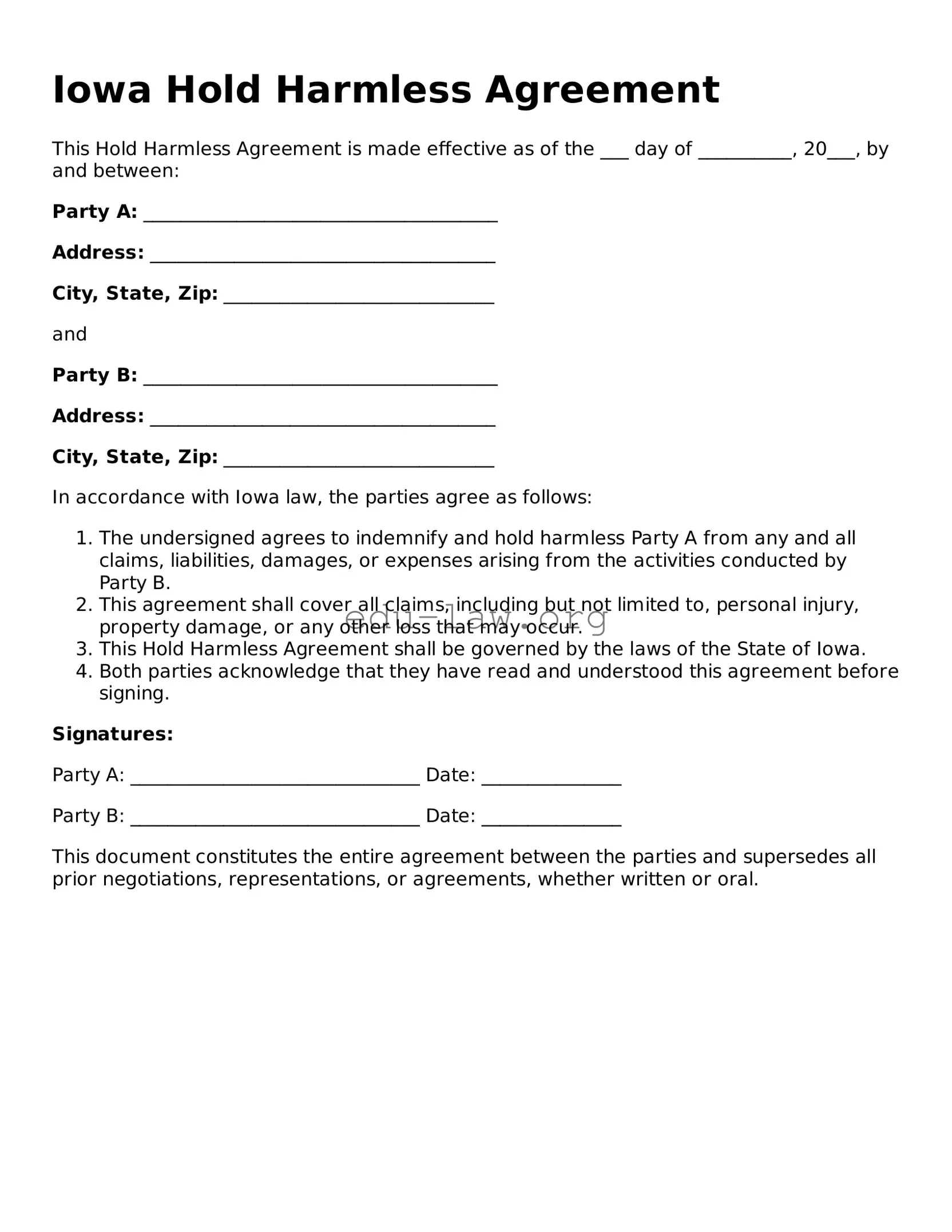
The Iowa Hold Harmless Agreement form serves as a crucial legal document designed to protect parties from liability in various situations, particularly in contractual relationships. This agreement essentially ensures that one party agrees not to hold the other responsible for any injuries or damages that may occur during the course of a specific activity or event. Commonly utilized in contexts such as property rentals, construction projects, and organized events, the form outlines the responsibilities of each party and clarifies the extent of liability waivers. By signing this agreement, individuals and organizations can mitigate risks associated with accidents or unforeseen circumstances. It is important to understand that while the Hold Harmless Agreement can offer significant protections, its enforceability may depend on specific language and state laws. Thus, both parties should approach this document with careful consideration, ensuring that the terms are clear and mutually agreed upon to avoid potential disputes in the future.
Iowa Hold Harmless Agreement
This Hold Harmless Agreement is made effective as of the ___ day of __________, 20___, by and between:
Party A: ______________________________________
Address: _____________________________________
City, State, Zip: _____________________________
and
Party B: ______________________________________
Address: _____________________________________
City, State, Zip: _____________________________
In accordance with Iowa law, the parties agree as follows:
Signatures:
Party A: _______________________________ Date: _______________
Party B: _______________________________ Date: _______________
This document constitutes the entire agreement between the parties and supersedes all prior negotiations, representations, or agreements, whether written or oral.
| Fact Name | Description |
|---|---|
| Definition | The Iowa Hold Harmless Agreement is a legal document that protects one party from liability for certain actions or events. |
| Purpose | This agreement is often used in situations where one party may be exposed to risk, such as during events or activities organized by another party. |
| Governing Law | The agreement is governed by Iowa state law, which outlines the enforceability and requirements of such contracts. |
| Key Components | Typically includes the names of the parties, the scope of the agreement, and specific liabilities being waived. |
| Enforceability | To be enforceable, the agreement must be clear, voluntary, and not against public policy. |
| Common Uses | Frequently used in sports, recreational activities, and events where participants may face potential risks. |
| Limitations | The agreement may not protect against gross negligence or intentional misconduct by the party seeking protection. |
Completing the Iowa Hold Harmless Agreement form is a straightforward process that requires careful attention to detail. Once you have filled out the form, it will be ready for submission to the relevant parties. Follow the steps outlined below to ensure that all necessary information is accurately provided.
What is an Iowa Hold Harmless Agreement?
An Iowa Hold Harmless Agreement is a legal document that protects one party from liability for certain risks associated with a specific activity or event. This agreement is often used in various contexts, such as rental agreements, construction contracts, or events. By signing this document, one party agrees not to hold the other party responsible for any injuries or damages that may occur during the specified activity, thus providing a layer of protection against potential lawsuits.
Who typically uses a Hold Harmless Agreement in Iowa?
Various individuals and organizations utilize Hold Harmless Agreements in Iowa. Common users include landlords, event organizers, contractors, and businesses. For example, a landlord may require tenants to sign this agreement to protect against claims arising from accidents on the property. Similarly, event organizers may ask participants to sign a Hold Harmless Agreement to mitigate risks associated with the event, ensuring that they are not held liable for injuries that may occur.
Are Hold Harmless Agreements enforceable in Iowa?
Yes, Hold Harmless Agreements are generally enforceable in Iowa, provided they meet certain legal criteria. The agreement must be clear and specific about the risks involved and the extent of liability being waived. Additionally, both parties must voluntarily agree to the terms, and the agreement should not violate public policy. Courts in Iowa will typically uphold these agreements unless they are deemed unconscionable or overly broad in scope.
What should be included in an Iowa Hold Harmless Agreement?
An effective Hold Harmless Agreement should include several key elements. First, it should clearly identify the parties involved and the specific activity or event covered by the agreement. It should outline the risks associated with the activity and specify the extent of liability being waived. Additionally, the agreement should include a statement indicating that both parties understand the terms and voluntarily agree to them. Lastly, having the agreement signed and dated by both parties is crucial for its enforceability.
Can a Hold Harmless Agreement protect against gross negligence?
Failing to provide accurate personal information. It's crucial to ensure that all names, addresses, and contact details are correct. Inaccurate information can lead to complications down the line.
Not reading the entire agreement before signing. Understanding the terms and conditions is essential. Rushing through the document can lead to misunderstandings about obligations and rights.
Omitting necessary signatures. Every required party must sign the form. Missing signatures can invalidate the agreement.
Ignoring the date. Failing to date the agreement can create confusion regarding when the terms take effect.
Using incorrect terminology. It's important to use the right terms as defined in the agreement. Misunderstanding or misusing terms can lead to legal issues.
Not including all relevant parties. Ensure that all individuals or entities involved in the agreement are listed. Leaving someone out can lead to disputes.
Assuming the agreement is standard. Each Hold Harmless Agreement can have unique clauses. It's essential to review the specific language used in your document.
Neglecting to consult with a legal professional. Seeking advice can help clarify any uncertainties. Professional guidance can prevent future problems.
Failing to keep a copy of the signed agreement. Always retain a copy for your records. This can be vital if any disputes arise later.
A Hold Harmless Agreement is often used in various situations to protect parties from liability. In Iowa, several other documents may accompany this agreement to provide additional clarity and protection. Here’s a list of commonly used forms and documents that are often associated with the Iowa Hold Harmless Agreement.
Understanding these additional documents can help ensure that all parties involved are aware of their rights and responsibilities. Proper documentation can significantly reduce the risk of misunderstandings and legal issues down the line.
The Iowa Hold Harmless Agreement is similar to a Liability Waiver. A Liability Waiver is a document that releases one party from legal responsibility for any injuries or damages that may occur during an activity. Like the Hold Harmless Agreement, it emphasizes the understanding that participants assume the risks involved. Both documents aim to protect one party from lawsuits resulting from accidents or injuries that may arise during the specified activity.
Another document similar to the Iowa Hold Harmless Agreement is the Indemnity Agreement. An Indemnity Agreement involves one party agreeing to compensate another for any losses or damages incurred. This document also serves to protect a party from financial loss due to claims made by third parties. Like the Hold Harmless Agreement, it establishes a clear understanding of responsibilities and liabilities between the parties involved.
The Release of Liability form is also comparable to the Iowa Hold Harmless Agreement. This form is used to release one party from any future claims or legal actions that may arise from an activity. It requires participants to acknowledge the risks involved and agree not to hold the other party responsible for any injuries. Both documents are designed to limit legal exposure for the party providing the activity or service.
Lastly, the Consent to Participate form shares similarities with the Iowa Hold Harmless Agreement. This form is often used in activities that involve a certain level of risk, such as sports or recreational events. It requires participants to acknowledge that they understand the risks and agree to participate willingly. While the primary focus of the Consent to Participate is on informed consent, it also serves to protect the organizing party from liability, much like the Hold Harmless Agreement.
When filling out the Iowa Hold Harmless Agreement form, it is essential to follow certain guidelines to ensure accuracy and compliance. Below is a list of things you should and shouldn't do.
The Iowa Hold Harmless Agreement form is often misunderstood. Here are ten common misconceptions:
Understanding these misconceptions can help individuals and businesses make informed decisions regarding the use of the Iowa Hold Harmless Agreement form.
When filling out and using the Iowa Hold Harmless Agreement form, keep these key points in mind:
By following these guidelines, you can effectively use the Iowa Hold Harmless Agreement to protect your interests and clarify responsibilities.