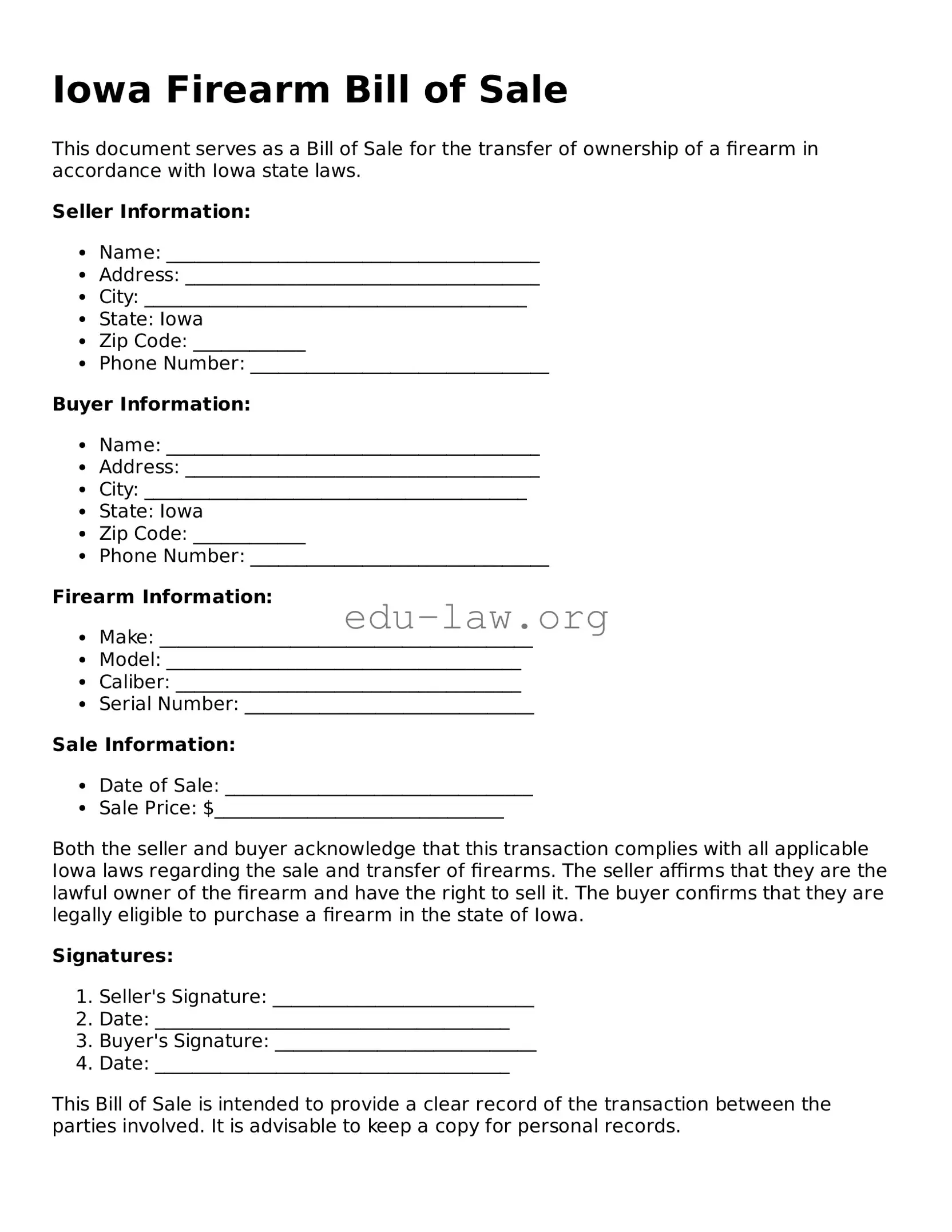
The Iowa Firearm Bill of Sale form serves as a crucial document for individuals looking to buy or sell firearms within the state. This form is designed to provide a clear record of the transaction, ensuring that both parties have a written agreement that outlines the details of the sale. Key elements typically included in the form are the names and addresses of both the buyer and the seller, a description of the firearm being sold, and the purchase price. Additionally, the form often requires the date of the transaction, which helps establish a timeline for ownership transfer. By utilizing this form, both buyers and sellers can protect themselves legally, as it serves as proof of ownership and can be important for future reference. Understanding the nuances of this document is essential for anyone involved in firearm transactions in Iowa, as it helps ensure compliance with state laws and regulations while promoting responsible firearm ownership.
Iowa Firearm Bill of Sale
This document serves as a Bill of Sale for the transfer of ownership of a firearm in accordance with Iowa state laws.
Seller Information:
Buyer Information:
Firearm Information:
Sale Information:
Both the seller and buyer acknowledge that this transaction complies with all applicable Iowa laws regarding the sale and transfer of firearms. The seller affirms that they are the lawful owner of the firearm and have the right to sell it. The buyer confirms that they are legally eligible to purchase a firearm in the state of Iowa.
Signatures:
This Bill of Sale is intended to provide a clear record of the transaction between the parties involved. It is advisable to keep a copy for personal records.
| Fact Name | Description |
|---|---|
| Purpose | The Iowa Firearm Bill of Sale form is used to document the sale or transfer of a firearm between parties. |
| Governing Law | The transfer of firearms in Iowa is governed by Iowa Code Chapter 724. |
| Parties Involved | The form requires the information of both the seller and the buyer, including names and addresses. |
| Firearm Details | Specific details about the firearm must be included, such as make, model, and serial number. |
| Signature Requirement | Both the seller and buyer must sign the form to validate the transaction. |
| Record Keeping | It is advisable for both parties to keep a copy of the completed form for their records. |
| Legal Protection | This form provides legal protection to both the buyer and seller by documenting the transaction. |
Filling out the Iowa Firearm Bill of Sale form is an important step in ensuring that the transfer of ownership is documented properly. After completing the form, both the buyer and seller should retain a copy for their records. This will help provide clarity and legal protection for both parties involved in the transaction.
What is the Iowa Firearm Bill of Sale form?
The Iowa Firearm Bill of Sale form is a document used to record the sale or transfer of a firearm between two parties in Iowa. It serves as proof of the transaction and includes important details about the firearm and the individuals involved in the sale.
Is the Iowa Firearm Bill of Sale form required by law?
No, Iowa does not require a Bill of Sale for private firearm transactions. However, having one can help protect both the buyer and seller by providing a written record of the sale. It may also assist in resolving any future disputes regarding ownership.
What information should be included in the Bill of Sale?
The Bill of Sale should include the names and addresses of both the buyer and seller, the date of the transaction, a description of the firearm (including make, model, caliber, and serial number), and the sale price. Both parties should sign the document to validate the transaction.
Can I create my own Bill of Sale for a firearm?
Yes, you can create your own Bill of Sale. Just make sure to include all necessary information to ensure clarity and legality. Templates are available online, but personalizing the document to fit your specific transaction is always a good idea.
Do I need to have the Bill of Sale notarized?
Notarization is not required in Iowa for a firearm Bill of Sale. However, having it notarized can add an extra layer of protection, confirming the identities of the parties involved and the authenticity of the signatures.
What if the firearm has a lien or is stolen?
It is crucial to verify the firearm's status before completing the sale. If there is a lien on the firearm or if it is reported stolen, you could face legal issues. Always conduct a thorough check to ensure the firearm is free of any encumbrances.
Can I use the Iowa Firearm Bill of Sale form for all types of firearms?
Yes, the Bill of Sale can be used for various types of firearms, including handguns, rifles, and shotguns. Just ensure that the description of the firearm is accurate and complete to avoid any confusion.
What should I do with the Bill of Sale after the transaction?
Both the buyer and seller should keep a copy of the Bill of Sale for their records. This documentation can be useful for future reference, especially if questions about ownership arise later on.
Incomplete Information: Many individuals fail to provide all required details on the form. This can include missing names, addresses, or firearm descriptions. Each section is essential for ensuring the transaction is valid and traceable.
Incorrect Identification: Using an outdated or incorrect form of identification can lead to complications. Buyers and sellers must ensure that the identification matches the information provided on the bill of sale.
Failure to Sign: Some people neglect to sign the document after filling it out. A signature is crucial as it signifies agreement between both parties. Without it, the bill of sale may not be considered legally binding.
Not Keeping Copies: After completing the form, it is important to retain copies for personal records. Failing to do so can lead to issues in the future, especially if questions arise regarding the transaction.
The Iowa Firearm Bill of Sale form serves as a crucial document in the transfer of firearm ownership. However, it is often accompanied by other forms and documents that help ensure the transaction is legal and well-documented. Below is a list of several such documents that are commonly used in conjunction with the Bill of Sale.
Each of these documents plays a vital role in the process of firearm transfer, helping to maintain compliance with state and federal laws. It is essential for both buyers and sellers to be aware of these forms to ensure a smooth and legal transaction.
The Iowa Firearm Bill of Sale form shares similarities with the general Bill of Sale. A Bill of Sale is a legal document that records the transfer of ownership of an item from one person to another. Just like the Firearm Bill of Sale, it includes essential details such as the buyer's and seller's names, the date of the transaction, and a description of the item being sold. This form serves as proof of ownership and can protect both parties in case of disputes, making it a crucial document in various transactions.
Another document that resembles the Iowa Firearm Bill of Sale is the Vehicle Bill of Sale. This document is used when buying or selling a vehicle. Like the Firearm Bill of Sale, it includes the names of the buyer and seller, the vehicle identification number (VIN), and details about the transaction. Both documents ensure that ownership is legally transferred and provide a record for future reference, which is especially important for registration and insurance purposes.
The Boat Bill of Sale is also similar to the Iowa Firearm Bill of Sale. When someone buys or sells a boat, this document captures the essential details of the transaction. It includes information about the buyer and seller, the boat's specifications, and the sale price. Just as with firearms, having a Bill of Sale for a boat protects both parties and provides a clear record of ownership transfer.
The Mobile Home Bill of Sale functions similarly to the Iowa Firearm Bill of Sale. This document is used when transferring ownership of a mobile home. It includes the names of the buyer and seller, the mobile home's identification number, and the sale price. Both documents serve as proof of ownership and help avoid future disputes regarding the ownership of the property.
In the realm of personal property, the Equipment Bill of Sale is another document that mirrors the Iowa Firearm Bill of Sale. This form is utilized when selling or buying equipment, such as tools or machinery. It contains similar elements, including the names of the parties involved, a description of the equipment, and the sale price. Just like the Firearm Bill of Sale, it provides a legal record of the transaction and protects the interests of both parties.
The Art Bill of Sale is also akin to the Iowa Firearm Bill of Sale. This document is used in transactions involving artwork. It includes details about the buyer and seller, a description of the artwork, and the agreed-upon price. Both documents serve to establish ownership and protect the rights of the buyer and seller, ensuring that the transaction is documented and legally binding.
The Livestock Bill of Sale is another document that shares similarities with the Iowa Firearm Bill of Sale. This form is utilized when buying or selling livestock, such as cattle or horses. It includes pertinent details such as the names of the buyer and seller, a description of the livestock, and the sale price. Both documents provide a record of the transaction and help clarify ownership, which is essential in agricultural contexts.
The Business Bill of Sale is similar in nature to the Iowa Firearm Bill of Sale, particularly when ownership of a business or its assets is being transferred. This document outlines the details of the sale, including the names of the parties, the assets involved, and the purchase price. Both documents serve to formalize the transfer of ownership and provide legal protection for both the buyer and seller.
Lastly, the Real Estate Bill of Sale is akin to the Iowa Firearm Bill of Sale in that it facilitates the transfer of ownership of real property. This document includes details about the buyer and seller, a description of the property, and the sale price. Both forms are critical in establishing legal ownership and protecting the interests of all parties involved in the transaction.
When filling out the Iowa Firearm Bill of Sale form, it’s important to get it right. Here’s a quick guide on what to do and what to avoid.
Do:
Don't:
The Iowa Firearm Bill of Sale form is often misunderstood, leading to confusion among buyers and sellers. Here are ten common misconceptions about this form, clarified for better understanding.
While it is a good practice to have a Bill of Sale for documentation, it is not legally required for private sales in Iowa. However, having one can provide clarity and protection for both parties.
Notarization is not a requirement for the Iowa Firearm Bill of Sale. However, some individuals may choose to have it notarized for added security and validation.
Any individual engaged in a private sale can create a Bill of Sale. It is not limited to licensed firearm dealers.
The Iowa Firearm Bill of Sale can be used for all types of firearms, including rifles and shotguns, not just handguns.
While the Bill of Sale signifies the transfer of ownership, it does not prevent the parties from agreeing to a return or exchange under different terms.
It is advisable for the buyer to provide valid identification to confirm their identity and eligibility to purchase a firearm, even if not legally mandated.
While private sales do not require a background check, federal laws still apply, and certain restrictions exist regarding who can legally purchase firearms.
While it can provide some protection, it does not absolve the seller of all responsibility, especially if the firearm is used in a crime.
While including details such as make, model, and serial number is recommended for clarity, it is not a strict legal requirement.
Changes can be made if both parties agree to the amendments, but it is advisable to document any changes formally to avoid future misunderstandings.
Understanding these misconceptions can help individuals navigate the process of buying and selling firearms more effectively and responsibly. It is always wise to stay informed and seek guidance when needed.
When filling out and using the Iowa Firearm Bill of Sale form, it is important to keep several key points in mind:
Following these guidelines will help ensure a smooth transaction and legal compliance when buying or selling a firearm in Iowa.