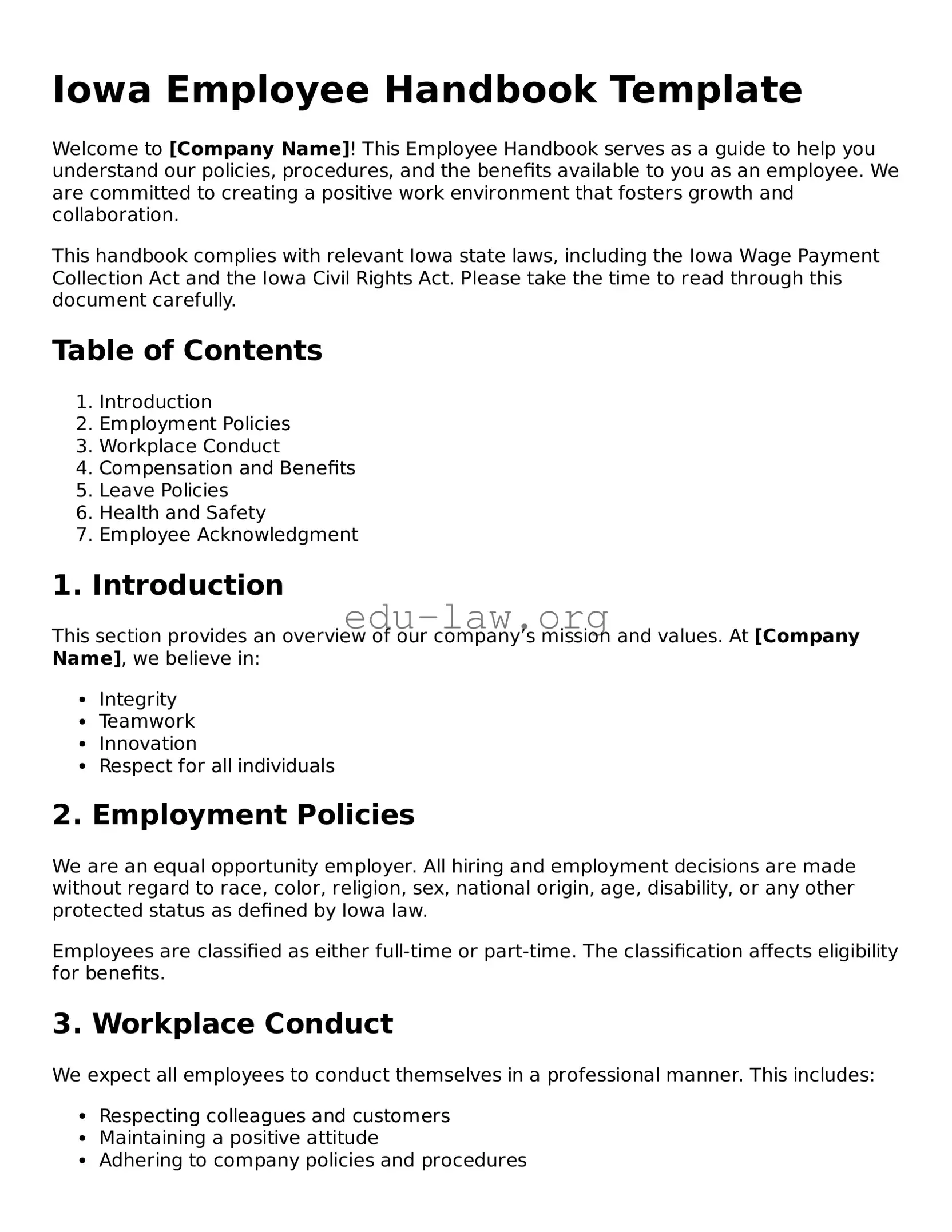
The Iowa Employee Handbook form serves as a crucial document for businesses operating in the state, outlining essential policies and procedures that govern the workplace. This form typically includes sections on employee conduct, workplace safety, anti-discrimination policies, and benefits, ensuring that employees understand their rights and responsibilities. Additionally, it addresses issues such as attendance, dress code, and disciplinary actions, providing clarity on what is expected from each team member. By establishing a clear framework, the handbook helps foster a positive work environment and can protect the organization from potential legal disputes. Employers are encouraged to tailor the handbook to reflect their unique culture and operational needs while remaining compliant with state and federal laws. Regular updates to the handbook are essential to adapt to changes in legislation and workplace dynamics, making it a living document that evolves alongside the organization.
Iowa Employee Handbook Template
Welcome to [Company Name]! This Employee Handbook serves as a guide to help you understand our policies, procedures, and the benefits available to you as an employee. We are committed to creating a positive work environment that fosters growth and collaboration.
This handbook complies with relevant Iowa state laws, including the Iowa Wage Payment Collection Act and the Iowa Civil Rights Act. Please take the time to read through this document carefully.
Table of Contents
1. Introduction
This section provides an overview of our company’s mission and values. At [Company Name], we believe in:
2. Employment Policies
We are an equal opportunity employer. All hiring and employment decisions are made without regard to race, color, religion, sex, national origin, age, disability, or any other protected status as defined by Iowa law.
Employees are classified as either full-time or part-time. The classification affects eligibility for benefits.
3. Workplace Conduct
We expect all employees to conduct themselves in a professional manner. This includes:
4. Compensation and Benefits
Your compensation package includes your salary and any applicable benefits. Paydays occur on a [insert frequency, e.g., bi-weekly] basis. Benefits may include:
5. Leave Policies
Employees are entitled to various types of leave, including:
Requests for leave should be made in writing to your supervisor at least [insert notice period] in advance.
6. Health and Safety
Your safety is our priority. We adhere to all applicable health and safety regulations. Employees are encouraged to report unsafe conditions to management immediately.
7. Employee Acknowledgment
Please sign and return the acknowledgment form included in this handbook to confirm that you have read and understood the policies outlined herein.
Thank you for being a part of [Company Name]. We look forward to a successful partnership!
| Fact Name | Details |
|---|---|
| Purpose | The Iowa Employee Handbook provides guidelines and policies for employees. |
| Governing Law | The handbook is governed by Iowa state employment laws. |
| Contents | It typically includes company policies, employee rights, and responsibilities. |
| Updates | The handbook should be reviewed and updated regularly to reflect current laws. |
| Distribution | Employers must provide the handbook to all employees upon hiring. |
| Acknowledgment | Employees may be required to sign an acknowledgment of receipt and understanding. |
| Compliance | The handbook must comply with federal and state employment regulations. |
| Accessibility | It should be easily accessible to all employees, both in print and digitally. |
Once you have the Iowa Employee Handbook form in front of you, it’s important to proceed carefully to ensure that all necessary information is accurately provided. Completing this form is a straightforward process, and following these steps will help you fill it out correctly.
After completing the form, submit it to your supervisor or the HR department as instructed. They will review it and ensure that it is properly filed in your employee record.
What is the purpose of the Iowa Employee Handbook form?
The Iowa Employee Handbook form serves as a vital document for both employers and employees. It outlines the policies, procedures, and expectations within the workplace. This handbook helps to create a clear understanding of the company's rules, benefits, and responsibilities. By providing this information, employers can foster a positive work environment and ensure that employees are aware of their rights and obligations. It also serves as a reference point for resolving potential disputes, as it contains guidelines that both parties can refer to when questions arise.
Who is required to have an Employee Handbook in Iowa?
In Iowa, while there is no legal requirement for every employer to have an Employee Handbook, it is highly recommended for businesses of all sizes. Having a handbook is particularly beneficial for companies with multiple employees, as it helps to standardize policies and practices. Employers in industries with specific regulations may find it essential to outline compliance measures clearly. Even small businesses can benefit from having a handbook, as it sets expectations and provides a framework for addressing workplace issues.
What should be included in the Iowa Employee Handbook?
An effective Iowa Employee Handbook should include several key components. Start with an introduction that outlines the company’s mission and values. Next, include sections on employment policies, such as hiring practices, equal opportunity employment, and anti-discrimination policies. It is also important to cover employee benefits, including health insurance, vacation policies, and leave options. Additionally, a clear code of conduct, disciplinary procedures, and safety guidelines should be outlined. Finally, consider including an acknowledgment form for employees to sign, confirming they have read and understood the handbook.
How often should the Employee Handbook be updated?
Completing the Iowa Employee Handbook form can be straightforward, yet many individuals stumble over common pitfalls. Here’s a list of ten mistakes to avoid when filling out this important document:
By avoiding these common mistakes, employees can ensure that they are well-informed and prepared to navigate their workplace effectively. Understanding the significance of each section in the Iowa Employee Handbook form is crucial for a smooth employment experience.
The Iowa Employee Handbook is an essential document for outlining workplace policies and expectations. However, several other forms and documents complement it, ensuring that both employers and employees have a clear understanding of their rights and responsibilities. Below is a list of commonly used forms and documents that often accompany the Employee Handbook.
These forms and documents play a crucial role in maintaining a structured and compliant workplace. They ensure that both employees and employers are on the same page regarding expectations, responsibilities, and legal requirements. Having these documents readily available can help facilitate a smooth working relationship and protect the interests of all parties involved.
The Iowa Employee Handbook is similar to the Employee Manual, which serves as a comprehensive guide for employees about company policies and procedures. Both documents outline expectations, rights, and responsibilities of employees, ensuring everyone understands workplace norms. The Employee Manual typically includes sections on conduct, benefits, and grievance procedures, much like the Iowa Employee Handbook, fostering a clear understanding of the workplace environment.
Another comparable document is the Company Policy Guide. This guide focuses on specific policies, such as attendance, dress code, and workplace behavior. While the Iowa Employee Handbook provides an overview, the Company Policy Guide delves deeper into each policy, offering detailed explanations. Both documents aim to create a cohesive work culture by establishing clear guidelines for employee conduct.
The Orientation Packet is also similar, as it is often provided to new hires during their onboarding process. This packet typically includes essential information about the company, such as its mission, values, and key policies. Like the Iowa Employee Handbook, the Orientation Packet helps new employees acclimate to the company culture and understand their roles and responsibilities from day one.
The Safety Manual shares similarities with the Iowa Employee Handbook by emphasizing the importance of workplace safety. Both documents outline safety protocols and procedures to ensure a secure working environment. The Safety Manual may focus more on specific safety regulations and emergency procedures, while the Employee Handbook provides a broader context for safety within the company’s overall policies.
The Benefits Guide is another document that parallels the Iowa Employee Handbook. This guide details the benefits offered to employees, including health insurance, retirement plans, and leave policies. While the Employee Handbook provides an overview of benefits, the Benefits Guide breaks down each offering, helping employees understand their options and how to access them effectively.
The Code of Conduct is similar in that it establishes the ethical standards and expectations for employee behavior. Both documents aim to promote a respectful and professional workplace. The Code of Conduct may offer more specific examples of acceptable and unacceptable behaviors, while the Iowa Employee Handbook provides a broader framework for maintaining a positive work environment.
The Training Manual is also akin to the Iowa Employee Handbook, focusing on employee development and training requirements. This manual outlines the training programs available, expectations for participation, and resources for skill enhancement. Both documents emphasize the importance of continuous learning and development within the organization.
The Leave Policy Document shares similarities with the Iowa Employee Handbook by detailing the various types of leave available to employees, such as sick leave, vacation, and family leave. While the Employee Handbook provides a general overview, the Leave Policy Document typically includes specific eligibility criteria, procedures for requesting leave, and any necessary documentation, ensuring employees are well-informed about their rights.
Finally, the Performance Evaluation Guide is comparable to the Iowa Employee Handbook in that it outlines the process for assessing employee performance. Both documents emphasize the importance of feedback and professional growth. The Performance Evaluation Guide may provide specific criteria and timelines for evaluations, while the Employee Handbook offers a broader understanding of how performance impacts career advancement within the company.
When filling out the Iowa Employee Handbook form, it is important to follow certain guidelines to ensure accuracy and compliance. Here are five things to do and five things to avoid:
Things You Should Do:
Things You Shouldn't Do:
When it comes to the Iowa Employee Handbook form, several misconceptions can lead to confusion for both employers and employees. Here are ten common misunderstandings:
Understanding these misconceptions can help create a more effective employee handbook that benefits both employers and employees in Iowa.
When filling out and utilizing the Iowa Employee Handbook form, there are several important aspects to keep in mind. These key takeaways will help ensure that the process is smooth and effective for both employers and employees.
By keeping these takeaways in mind, both employers and employees can benefit from a well-structured and informative Employee Handbook.