The Iowa Do Not Resuscitate (DNR) Order form serves as a critical document for individuals who wish to express their preferences regarding medical interventions in life-threatening situations. This form allows patients to communicate their desire not to receive cardiopulmonary resuscitation (CPR) or other life-sustaining treatments in the event of cardiac or respiratory arrest. It is essential for patients to understand that the DNR Order is not a decision to forgo all medical care; rather, it specifically addresses the circumstances under which resuscitation efforts should not be initiated. The form must be completed and signed by the patient or their legal representative, ensuring that their wishes are respected. Additionally, healthcare providers are required to honor this directive, promoting patient autonomy and aligning medical practices with individual values. By understanding the implications and requirements of the Iowa DNR Order form, individuals can make informed decisions about their end-of-life care, fostering peace of mind for themselves and their families.
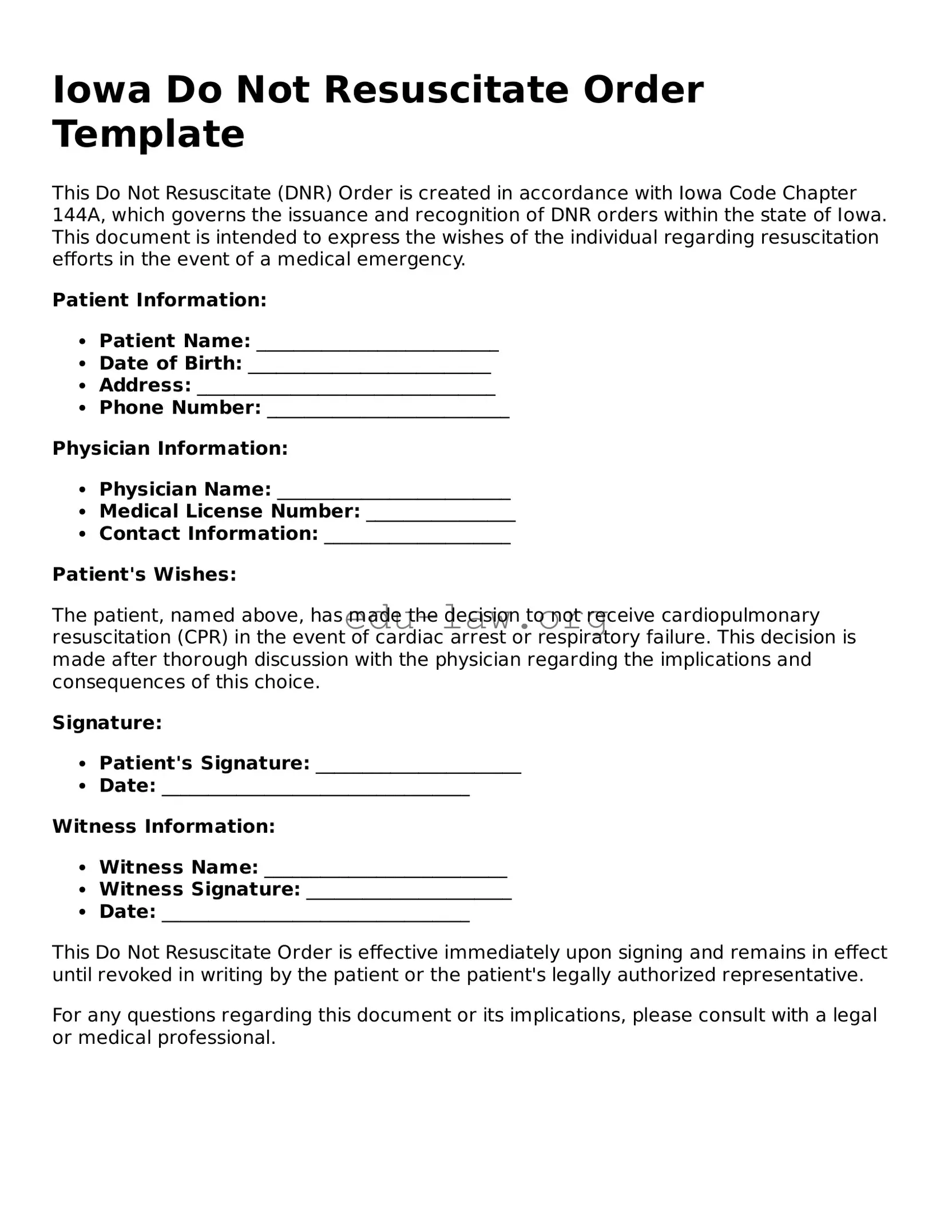
Iowa Do Not Resuscitate Order Template
This Do Not Resuscitate (DNR) Order is created in accordance with Iowa Code Chapter 144A, which governs the issuance and recognition of DNR orders within the state of Iowa. This document is intended to express the wishes of the individual regarding resuscitation efforts in the event of a medical emergency.
Patient Information:
Physician Information:
Patient's Wishes:
The patient, named above, has made the decision to not receive cardiopulmonary resuscitation (CPR) in the event of cardiac arrest or respiratory failure. This decision is made after thorough discussion with the physician regarding the implications and consequences of this choice.
Signature:
Witness Information:
This Do Not Resuscitate Order is effective immediately upon signing and remains in effect until revoked in writing by the patient or the patient's legally authorized representative.
For any questions regarding this document or its implications, please consult with a legal or medical professional.
| Fact Name | Description |
|---|---|
| Purpose | The Iowa Do Not Resuscitate (DNR) Order form allows individuals to express their wishes regarding resuscitation efforts in the event of a medical emergency. |
| Governing Law | The DNR Order in Iowa is governed by Iowa Code Chapter 144A, which outlines the legal framework for advance directives. |
| Eligibility | Any adult, or a parent or legal guardian of a minor, can complete a DNR Order in Iowa, provided they are of sound mind. |
| Signature Requirement | The form must be signed by the individual or their authorized representative, along with a witness signature, to be valid. |
| Health Care Provider Notification | Health care providers must be informed of the existence of a DNR Order to ensure that the individual's wishes are honored. |
| Revocation | A DNR Order can be revoked at any time by the individual or their authorized representative, verbally or in writing. |
| Emergency Medical Services (EMS) | EMS personnel are required to honor a valid DNR Order during emergency situations, as long as it is presented at the scene. |
Filling out the Iowa Do Not Resuscitate Order form requires careful attention to detail. Once completed, the form will guide medical personnel in accordance with your wishes regarding resuscitation efforts in emergencies.
What is a Do Not Resuscitate (DNR) Order in Iowa?
A Do Not Resuscitate Order is a legal document that allows a person to refuse resuscitation efforts in the event of a cardiac arrest or respiratory failure. In Iowa, this order ensures that emergency medical personnel respect an individual's wishes not to undergo life-saving measures, such as CPR or intubation, when they are unable to communicate those wishes themselves.
Who can request a DNR Order in Iowa?
In Iowa, a DNR Order can be requested by a patient who is at least 18 years old and has the capacity to make their own medical decisions. If the patient is unable to make decisions, a legal representative, such as a guardian or an authorized family member, can initiate the request.
How do I obtain a DNR Order in Iowa?
To obtain a DNR Order, a patient must complete the official Iowa DNR Order form. This form can be acquired from healthcare providers, hospitals, or online through the Iowa Department of Public Health. After filling out the form, it must be signed by both the patient and a physician to be valid.
Is a DNR Order valid in all healthcare settings in Iowa?
Yes, once a DNR Order is properly completed and signed, it is valid in all healthcare settings in Iowa, including hospitals, nursing homes, and at home. However, it is essential to ensure that the order is readily accessible to healthcare providers in case of an emergency.
What should I do with my DNR Order after it is completed?
After completing the DNR Order, keep the original document in a safe but easily accessible place. It is also advisable to provide copies to your healthcare providers, family members, and anyone else who may be involved in your care. This ensures that your wishes are known and respected in an emergency situation.
Can a DNR Order be revoked or changed?
Yes, a DNR Order can be revoked or changed at any time by the patient or their legal representative. To revoke the order, simply destroy the original document and inform your healthcare providers of the change. If you wish to create a new DNR Order, you will need to complete a new form.
What happens if I do not have a DNR Order?
If you do not have a DNR Order in place and experience a medical emergency, healthcare providers are required to perform life-saving measures, such as CPR or intubation, regardless of your wishes. It is important to communicate your preferences clearly to your family and healthcare team.
Does having a DNR Order mean I will not receive other medical care?
No, having a DNR Order does not mean that you will not receive other medical care. You will continue to receive necessary treatments and interventions for your medical conditions, except for resuscitation efforts in the event of cardiac or respiratory arrest.
Can I discuss my DNR Order with my healthcare provider?
Absolutely! Discussing your DNR Order with your healthcare provider is encouraged. They can help you understand the implications of the order, answer any questions you may have, and ensure that your wishes are accurately reflected in your medical records.
Are there any age restrictions for a DNR Order in Iowa?
In Iowa, individuals must be at least 18 years old to request a DNR Order. However, minors can have a DNR Order if they have the consent of a parent or legal guardian, and the order is deemed appropriate by a physician. It is crucial to follow the legal guidelines for minors to ensure that their wishes are respected.
Failing to provide complete information about the patient. It's essential to include the full name, date of birth, and any other identifying details.
Not signing the form. The absence of a signature can render the document invalid, so ensure that it is signed by the patient or their legal representative.
Overlooking the need for a witness. In Iowa, a witness signature is required to validate the Do Not Resuscitate Order. This step is often missed.
Using incorrect or outdated forms. Always check that you are using the most current version of the Iowa Do Not Resuscitate Order form.
Not discussing the order with healthcare providers. Communication with doctors and nurses about the patient's wishes is crucial for ensuring that the order is respected.
Forgetting to provide copies to relevant parties. After completing the form, distribute copies to healthcare providers, family members, and keep one for personal records.
Neglecting to review the order periodically. Life circumstances can change. Regularly review and update the Do Not Resuscitate Order to reflect current wishes.
The Iowa Do Not Resuscitate Order form is an important document for individuals who wish to express their wishes regarding medical treatment in emergencies. Along with this form, there are several other documents that can support a person's healthcare decisions. Here are a few commonly used forms:
Having these documents in place can help ensure that an individual's healthcare wishes are respected and followed. It is always a good idea to discuss these forms with family members and healthcare providers to ensure everyone understands the person's preferences.
The Iowa Do Not Resuscitate (DNR) Order form is similar to the Advance Directive, which allows individuals to outline their healthcare preferences in advance. Like the DNR, an Advance Directive can specify what types of medical treatment a person does or does not want if they become unable to communicate their wishes. This document can include a DNR provision, making it a comprehensive tool for end-of-life care decisions.
Another document closely related to the DNR is the Living Will. This legal document provides guidance on a person's wishes regarding medical treatment in situations where they are terminally ill or permanently unconscious. Similar to a DNR, a Living Will can specify the desire to forego resuscitation efforts, ensuring that healthcare providers respect the individual’s preferences during critical moments.
The Medical Power of Attorney (POA) is also akin to the DNR form. This document designates a trusted person to make healthcare decisions on behalf of someone who is incapacitated. While the DNR focuses specifically on resuscitation, a Medical POA can address a broader range of medical decisions, including whether or not to initiate resuscitation efforts based on the principal's wishes.
The Physician Orders for Life-Sustaining Treatment (POLST) form shares similarities with the DNR as well. POLST is a medical order that outlines a patient’s preferences for life-sustaining treatments, including resuscitation. It is designed for individuals with serious illnesses or frailty, ensuring that their treatment preferences are documented and followed by healthcare providers, similar to the DNR's intent.
The Do Not Hospitalize (DNH) order is another document that aligns with the DNR form. A DNH order indicates that a patient should not be transferred to a hospital for treatment, particularly in end-of-life situations. This document reflects a patient's desire to remain at home or in a preferred setting, much like a DNR signifies a wish to avoid certain medical interventions.
The Comfort Care Order is also comparable to the DNR form. This document focuses on ensuring that a patient receives comfort measures rather than aggressive treatments. It emphasizes quality of life and pain management, aligning with the principles behind a DNR, which seeks to avoid unnecessary interventions during the dying process.
The Hospice Care Plan is another related document. When a patient enters hospice care, they typically express their preferences for end-of-life care, including decisions about resuscitation. This care plan often includes a DNR directive, emphasizing the focus on comfort and dignity rather than curative treatments.
The Patient Self-Determination Act (PSDA) is relevant as well. This federal law requires healthcare providers to inform patients of their rights to make decisions about their medical care, including the right to create a DNR order. The PSDA supports the autonomy of individuals in making informed choices about their treatment, just as the DNR allows for the expression of those choices.
Lastly, the End-of-Life Care Plan is similar to the DNR form in that it encompasses a broader spectrum of care preferences. This plan can include directives about resuscitation, pain management, and other treatments. It serves as a comprehensive guide to ensure that healthcare providers honor the patient’s wishes as they approach the end of life, much like the specific intent of a DNR order.
When filling out the Iowa Do Not Resuscitate (DNR) Order form, it is crucial to follow certain guidelines. Here are eight things you should and shouldn't do:
Understanding the Iowa Do Not Resuscitate (DNR) Order form is crucial for individuals and families making healthcare decisions. However, several misconceptions can cloud this important topic. Below is a list of common misunderstandings, along with clarifications for each.
This is not accurate. A DNR order specifically addresses resuscitation efforts in the event of cardiac arrest. Other medical treatments and interventions can still be administered based on the patient's needs and preferences.
While many individuals with terminal illnesses choose to have a DNR order, it is not limited to this group. People of various health conditions may opt for a DNR based on their personal values and wishes regarding end-of-life care.
This misconception is false. A DNR order can be revoked or modified at any time by the patient or their authorized representative. It is important to communicate any changes to healthcare providers.
Iowa DNR orders are valid in various settings, including at home, in nursing facilities, and during transport. However, it is essential to ensure that the order is properly documented and accessible in these environments.
Choosing a DNR order is a personal decision that reflects an individual's values regarding quality of life and medical intervention. It does not equate to a desire to end life but rather to avoid unwanted resuscitation efforts.
While many healthcare professionals are familiar with DNR orders, misunderstandings can occur. It is crucial for patients and families to clearly communicate their wishes and ensure that all providers are aware of the DNR status.
This is misleading. A DNR order specifically pertains to resuscitation efforts in the case of cardiac arrest. It does not prevent other emergency interventions that may be necessary in different medical situations.
In Iowa, a DNR order can be signed by a physician, but it can also be completed by a patient or their authorized representative, provided it meets specific legal requirements. It is important to follow the appropriate procedures for documentation.
Each state has its own laws and regulations regarding DNR orders. Therefore, it is essential to be familiar with Iowa's specific requirements and procedures to ensure the order is valid and honored.
Clarifying these misconceptions can help individuals make informed decisions about their healthcare preferences and ensure their wishes are respected in critical situations.
When filling out and using the Iowa Do Not Resuscitate (DNR) Order form, consider the following key takeaways:
Understanding these key points can help ensure that the DNR Order is properly filled out and respected in accordance with the individual's wishes.