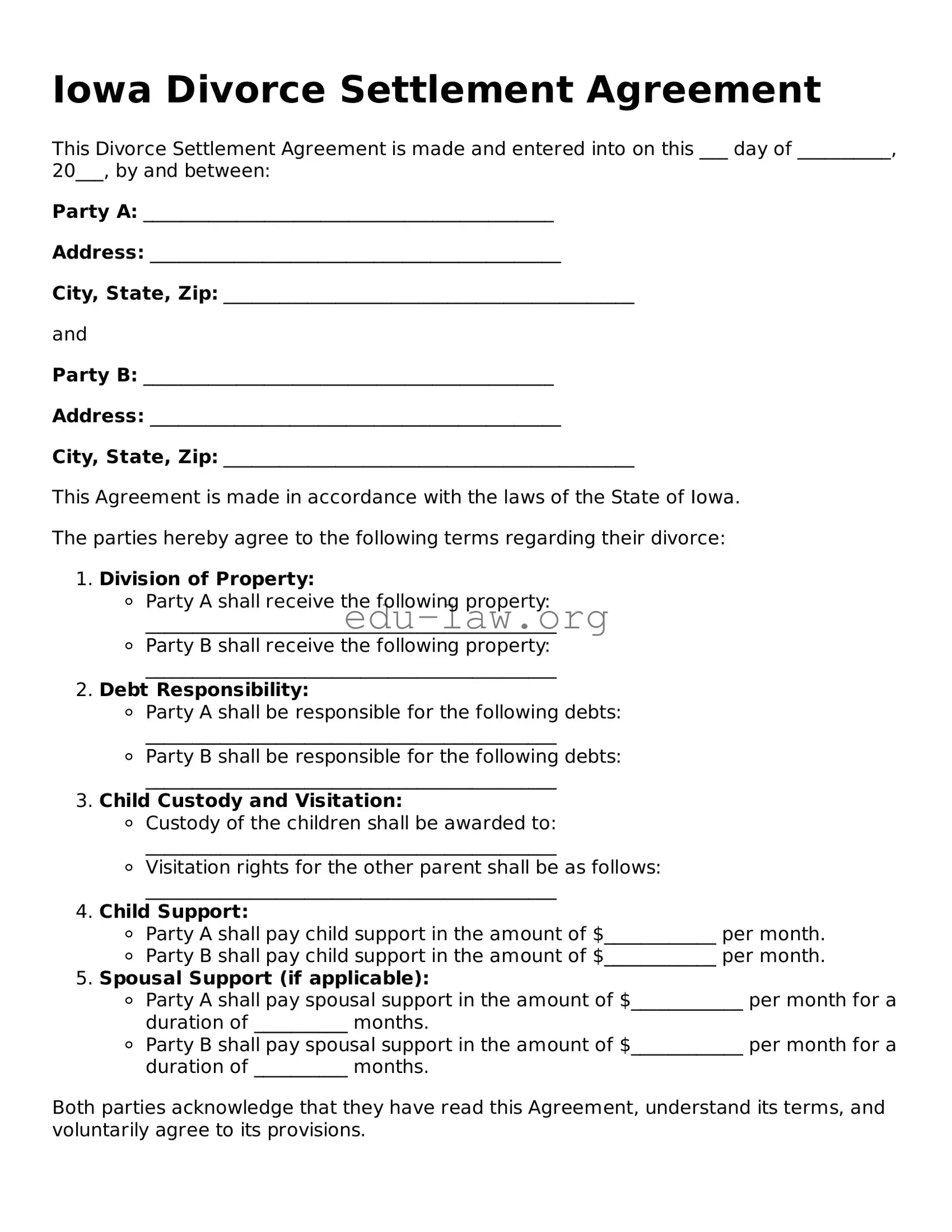
When navigating the complexities of divorce in Iowa, the Divorce Settlement Agreement form serves as a crucial document for couples seeking to formalize their separation. This form outlines the terms of the divorce, addressing key aspects such as property division, spousal support, child custody, and visitation rights. By detailing the agreements made between the parties, the form aims to minimize future disputes and clarify each individual's responsibilities. The importance of this document cannot be overstated, as it not only reflects the negotiations that took place but also serves as a legally binding contract once approved by the court. Completing this form accurately is essential, as it ensures that both parties understand their rights and obligations moving forward. Understanding the components of the Divorce Settlement Agreement is vital for anyone going through this process, as it lays the foundation for a smoother transition into post-divorce life.
Iowa Divorce Settlement Agreement
This Divorce Settlement Agreement is made and entered into on this ___ day of __________, 20___, by and between:
Party A: ____________________________________________
Address: ____________________________________________
City, State, Zip: ____________________________________________
and
Party B: ____________________________________________
Address: ____________________________________________
City, State, Zip: ____________________________________________
This Agreement is made in accordance with the laws of the State of Iowa.
The parties hereby agree to the following terms regarding their divorce:
Both parties acknowledge that they have read this Agreement, understand its terms, and voluntarily agree to its provisions.
IN WITNESS WHEREOF, the parties have executed this Divorce Settlement Agreement as of the date first above written.
Party A Signature: ___________________________ Date: ____________
Party B Signature: ___________________________ Date: ____________
Witness Signature: ___________________________ Date: ____________
| Fact Name | Description |
|---|---|
| Purpose | The Iowa Divorce Settlement Agreement form outlines the terms agreed upon by both parties regarding the division of assets, debts, and other relevant issues during a divorce. |
| Governing Law | This form is governed by the Iowa Code Chapter 598, which covers divorce and dissolution of marriage in Iowa. |
| Mutual Agreement | Both parties must voluntarily agree to the terms included in the settlement agreement. This ensures that the arrangement is fair and acceptable to everyone involved. |
| Required Signatures | The form must be signed by both spouses, indicating their acceptance of the terms. Notarization is also recommended to validate the agreement. |
| Child Custody and Support | If children are involved, the form should address custody arrangements and child support obligations, ensuring the best interests of the children are prioritized. |
| Property Division | The agreement should clearly outline how marital property and debts will be divided. This includes real estate, personal property, and financial accounts. |
| Modification Clause | In some cases, the agreement may include a clause that allows for modifications in the future, should circumstances change for either party. |
After obtaining the Iowa Divorce Settlement Agreement form, you will need to complete it accurately to reflect the terms of your divorce. This form will require personal information, details about your marriage, and agreements regarding property, debts, and any children involved.
What is an Iowa Divorce Settlement Agreement form?
The Iowa Divorce Settlement Agreement form is a legal document that outlines the terms of a divorce. It includes details about asset division, child custody, visitation rights, and spousal support. This agreement helps both parties reach a mutual understanding and can simplify the divorce process.
Who needs to fill out this form?
Both spouses involved in the divorce must fill out and sign the form. It’s essential that both parties agree on the terms laid out in the agreement. If there are children involved or significant assets, this form becomes even more critical.
Can the terms in the agreement be changed after it is signed?
Yes, the terms can be modified after signing, but both parties must agree to the changes. If circumstances change, such as a job loss or relocation, it may be necessary to revisit the agreement and make adjustments.
Is it necessary to have a lawyer when completing this form?
While it is not legally required to have a lawyer, it is highly recommended. A lawyer can help ensure that the agreement is fair and complies with Iowa law. They can also provide valuable advice on your rights and responsibilities.
How do I file the Divorce Settlement Agreement form?
After both parties have completed and signed the form, you need to file it with the appropriate Iowa court. This typically involves submitting the form along with any other required documents. Check with your local court for specific filing procedures.
What happens if we cannot agree on the terms?
If you and your spouse cannot agree on the terms of the settlement, you may need to go to mediation or court. Mediation involves a neutral third party who helps facilitate discussions. If mediation fails, the court will make decisions regarding asset division, custody, and support.
Is the Divorce Settlement Agreement form legally binding?
Yes, once signed and filed with the court, the agreement is legally binding. Both parties are expected to adhere to the terms outlined in the document. Failure to comply can result in legal consequences.
What should I include in the Divorce Settlement Agreement?
Your agreement should include details about property division, debts, child custody arrangements, visitation schedules, and any spousal support. Be thorough to avoid misunderstandings later on.
Where can I find the Iowa Divorce Settlement Agreement form?
You can typically find the form on the Iowa Judicial Branch website or at your local courthouse. Many legal aid organizations also provide access to these forms and can offer assistance in filling them out.
Inaccurate Information: Many people provide incorrect details about their assets, debts, or income. This can lead to disputes later on.
Missing Signatures: Some individuals forget to sign the form or have their spouse sign it. A missing signature can invalidate the agreement.
Not Including All Assets: It's common to overlook certain assets, such as retirement accounts or personal property. Ensure all items are listed.
Ambiguous Language: Using vague terms can create confusion. Clearly define terms and conditions to avoid misinterpretation.
Ignoring State Laws: Some people fail to consider Iowa's specific laws regarding divorce settlements. Familiarize yourself with these regulations.
When navigating the complexities of divorce in Iowa, several forms and documents complement the Divorce Settlement Agreement. Each document serves a specific purpose in ensuring a smooth transition and resolution of matters related to the dissolution of marriage.
Understanding these documents is vital for anyone going through the divorce process in Iowa. Each form plays a critical role in ensuring that all aspects of the divorce are addressed, promoting fairness and clarity for both parties involved.
The Iowa Divorce Settlement Agreement form shares similarities with the Marital Settlement Agreement, commonly used in various states. Both documents serve the purpose of outlining the terms of a divorce, including asset division, child custody, and support arrangements. Just like the Iowa form, a Marital Settlement Agreement is a legally binding contract between spouses, ensuring that both parties agree to the terms before finalizing the divorce. This document can help reduce conflicts and streamline the divorce process, making it easier for both parties to move forward.
Another document akin to the Iowa Divorce Settlement Agreement is the Separation Agreement. This agreement is often used when couples decide to live apart but are not ready to file for divorce. Similar to the Divorce Settlement Agreement, it addresses issues like property division, child custody, and financial support. The key difference lies in the fact that a Separation Agreement can lead to divorce later, while the Divorce Settlement Agreement is specifically for finalizing the divorce. Both documents require clear communication and mutual consent to ensure that both parties are satisfied with the arrangements.
The Parenting Plan is another document that bears resemblance to the Iowa Divorce Settlement Agreement. While the latter encompasses a broader range of divorce-related issues, the Parenting Plan focuses specifically on the care and custody of children. It outlines visitation schedules, decision-making responsibilities, and child support arrangements. Like the Divorce Settlement Agreement, the Parenting Plan must be agreed upon by both parents and is often submitted to the court for approval. This ensures that the best interests of the children are prioritized during the divorce process.
Lastly, the Property Settlement Agreement is similar in nature to the Iowa Divorce Settlement Agreement. This document specifically addresses the division of marital property and debts. It lays out how assets will be divided between the spouses, which can include real estate, bank accounts, and personal belongings. While the Divorce Settlement Agreement encompasses a wider array of issues, the Property Settlement Agreement zeroes in on financial matters, making it essential for couples who want to ensure a fair distribution of their assets during the divorce.
When completing the Iowa Divorce Settlement Agreement form, attention to detail is essential. Here are five important do's and don'ts to consider:
When it comes to the Iowa Divorce Settlement Agreement form, several misconceptions can lead to confusion. Understanding the truth behind these myths can help individuals navigate the divorce process more smoothly. Here are four common misconceptions:
This is not true. The Iowa Divorce Settlement Agreement form is required for all divorce cases, regardless of whether children are part of the equation. It outlines the terms of the divorce, including asset division and spousal support.
This is a misconception. While the agreement is legally binding once signed, it can be modified later if both parties agree to the changes. It’s important to document any modifications properly.
While it is possible to complete the form without an attorney, seeking legal advice is highly recommended. An attorney can help ensure that all terms are fair and that your rights are protected.
This is misleading. Although the form is a crucial step in the divorce process, other factors can affect the timeline, such as court schedules and the complexity of the case. Patience is often necessary.
Filling out and using the Iowa Divorce Settlement Agreement form is a crucial step in the divorce process. Here are some key takeaways to keep in mind:
By following these key points, individuals can navigate the Iowa Divorce Settlement Agreement form more effectively.