When starting a business in Iowa, one of the most critical steps is filing the Articles of Incorporation. This document serves as the foundation for your corporation, outlining essential details that define your business structure and operations. The form requires specific information, including the corporation's name, which must be unique and compliant with state regulations. Additionally, the Articles must specify the purpose of the corporation, whether for profit or nonprofit activities. The registered agent's name and address are also necessary, ensuring that there is a designated point of contact for legal matters. Furthermore, the form requires the number of shares the corporation is authorized to issue, along with the names and addresses of the initial directors. Completing the Articles of Incorporation accurately is vital, as it not only establishes your corporation legally but also lays the groundwork for its future governance and compliance with Iowa law. Understanding these components will help ensure a smoother incorporation process and set your business on the path to success.
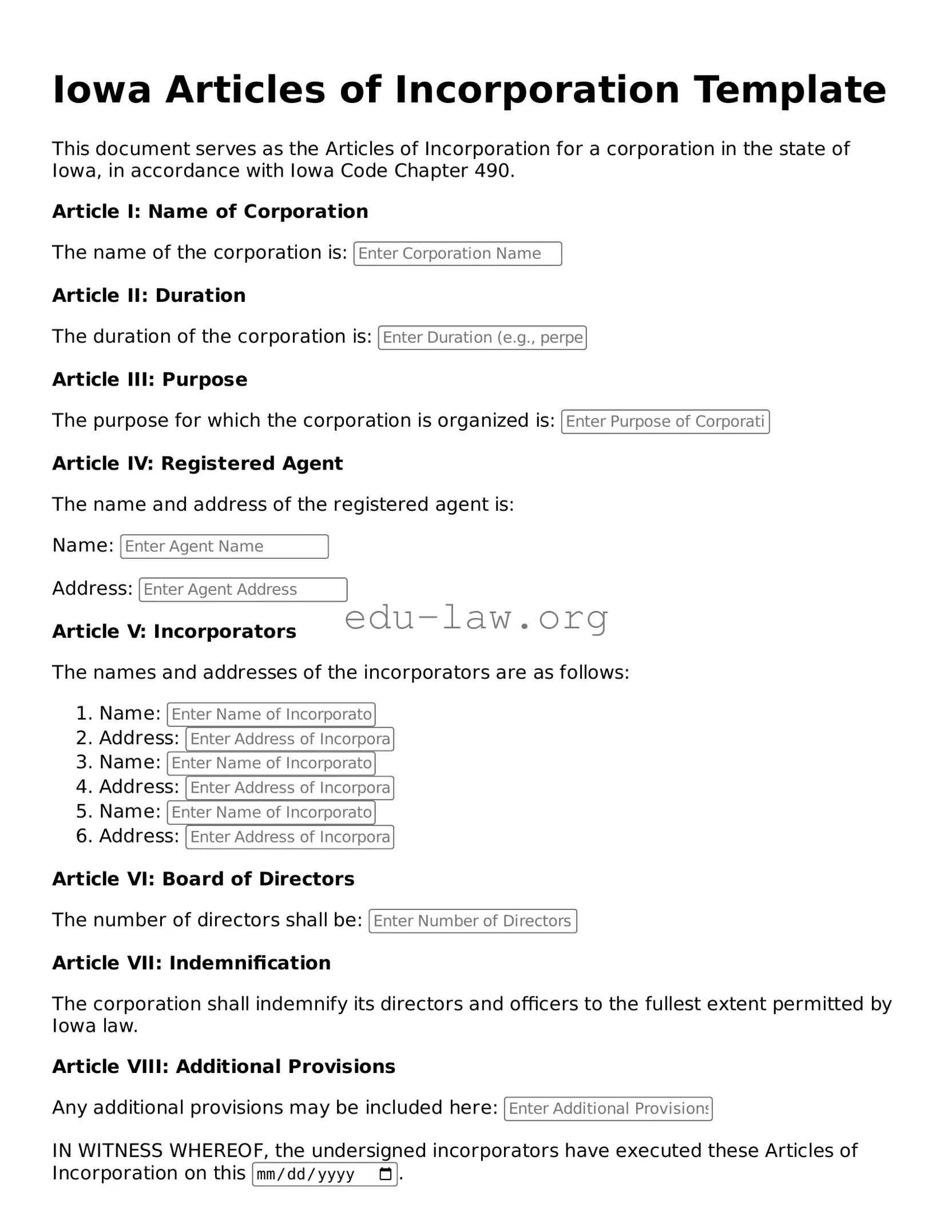
Iowa Articles of Incorporation Template
This document serves as the Articles of Incorporation for a corporation in the state of Iowa, in accordance with Iowa Code Chapter 490.
Article I: Name of Corporation
The name of the corporation is:
Article II: Duration
The duration of the corporation is:
Article III: Purpose
The purpose for which the corporation is organized is:
Article IV: Registered Agent
The name and address of the registered agent is:
Name:
Address:
Article V: Incorporators
The names and addresses of the incorporators are as follows:
Article VI: Board of Directors
The number of directors shall be:
Article VII: Indemnification
The corporation shall indemnify its directors and officers to the fullest extent permitted by Iowa law.
Article VIII: Additional Provisions
Any additional provisions may be included here:
IN WITNESS WHEREOF, the undersigned incorporators have executed these Articles of Incorporation on this .
Signature of Incorporator:
By completing this document, you are taking the first step in establishing your corporation in Iowa. Please ensure all information is accurate and complete.
| Fact Name | Description |
|---|---|
| Purpose | The Iowa Articles of Incorporation form is used to legally establish a corporation in the state of Iowa. |
| Governing Law | The form is governed by the Iowa Business Corporation Act, specifically Iowa Code Chapter 490. |
| Filing Requirement | To complete the incorporation process, the form must be filed with the Iowa Secretary of State. |
| Information Needed | Key information required includes the corporation's name, purpose, registered agent, and the number of shares authorized. |
| Filing Fee | A filing fee is required upon submission, which varies based on the type of corporation being formed. |
| Processing Time | Typically, processing takes about 5 to 10 business days, but expedited options may be available for faster service. |
After completing the Iowa Articles of Incorporation form, you will need to submit it to the appropriate state office along with any required fees. Ensure all information is accurate to avoid delays in processing.
What are the Articles of Incorporation in Iowa?
The Articles of Incorporation is a legal document that establishes a corporation in the state of Iowa. This document outlines essential details about the corporation, including its name, purpose, duration, registered agent, and the number of shares it is authorized to issue. Filing this document with the Iowa Secretary of State is a critical step in forming a corporation, as it officially recognizes the business entity under state law.
Who needs to file Articles of Incorporation in Iowa?
Any individual or group looking to create a corporation in Iowa must file Articles of Incorporation. This includes businesses that wish to operate as a corporation, whether for profit or nonprofit purposes. It is important to note that sole proprietorships and partnerships do not need to file this document, as they are not considered separate legal entities.
What information is required on the Articles of Incorporation form?
When completing the Articles of Incorporation form, several key pieces of information must be provided. This includes the corporation's name, which must be unique and not already in use by another entity in Iowa. Additionally, the form requires the corporation's purpose, the name and address of the registered agent, and the number of shares the corporation is authorized to issue. It may also include details about the incorporators and any additional provisions that the corporation wishes to include.
How do I file the Articles of Incorporation in Iowa?
Filing the Articles of Incorporation in Iowa can be done online or via mail. To file online, individuals can visit the Iowa Secretary of State's website and complete the form electronically. For those who prefer to file by mail, a printed version of the form must be completed and sent to the Secretary of State’s office, along with the required filing fee. It is essential to ensure that all information is accurate and complete to avoid delays in processing the application.
Omitting Required Information: Many individuals forget to include essential details such as the corporation's name, registered agent, and the purpose of the business. Each of these elements is crucial for the form's acceptance.
Incorrectly Stating the Registered Agent: The registered agent must have a physical address in Iowa. Some people mistakenly provide a P.O. Box or an address outside of the state, which leads to rejection of the application.
Failing to Sign the Document: The Articles of Incorporation must be signed by the incorporators. Neglecting to sign or having an incorrect signature can result in delays or denial of the filing.
Not Paying the Required Fees: Each submission requires a filing fee. Many applicants overlook this step or miscalculate the amount, which can lead to the return of the application.
When forming a corporation in Iowa, the Articles of Incorporation is a crucial document. However, it is often accompanied by other forms and documents that help establish and operate your corporation smoothly. Here are some of the commonly used documents alongside the Articles of Incorporation:
Each of these documents plays a vital role in the establishment and operation of your corporation. Ensuring that you have all the necessary paperwork in order will help you run your business more effectively and in compliance with the law.
The Iowa Articles of Incorporation form is similar to the Certificate of Incorporation used in many other states. This document serves a similar purpose, allowing individuals to formally establish a corporation within their respective state. Like the Iowa form, it typically requires basic information about the corporation, such as its name, purpose, and the details of its registered agent. Both documents serve as the foundational step in the corporate formation process.
Another document akin to the Articles of Incorporation is the Articles of Organization for Limited Liability Companies (LLCs). This document is used to establish an LLC, providing essential information about the business structure, management, and ownership. Both the Articles of Incorporation and Articles of Organization serve to create a legal entity, but they cater to different business structures, with one focusing on corporations and the other on LLCs.
The Corporate Bylaws can also be compared to the Articles of Incorporation. While the Articles establish the corporation's existence, the Bylaws outline the internal governance structure. They detail how the corporation will operate, including the roles of directors and officers, meeting protocols, and voting procedures. Together, they create a comprehensive framework for managing the corporation.
Similarly, the Statement of Information is another document that shares characteristics with the Articles of Incorporation. Required in some states, this document provides updates about the corporation's key details after formation. It often includes information about the business address, officers, and registered agent, ensuring that the state has current information on file.
The Certificate of Good Standing is another related document. This certificate verifies that a corporation is properly registered and compliant with state regulations. While the Articles of Incorporation are necessary for initial formation, the Certificate of Good Standing serves as proof that the corporation is in good standing with the state, which can be important for conducting business or applying for loans.
The Application for Employer Identification Number (EIN) is also similar in that it is a necessary step for corporations after incorporation. This application, submitted to the IRS, allows a corporation to obtain a unique identification number for tax purposes. Both documents are essential for establishing a corporation's legal identity and ensuring compliance with tax regulations.
Another comparable document is the Partnership Agreement, which outlines the terms of a partnership. While the Articles of Incorporation focus on corporations, the Partnership Agreement serves a similar function for partnerships by detailing the roles, responsibilities, and profit-sharing arrangements among partners. Both documents are foundational for their respective business structures.
The Business License is also related, as it is often required for a corporation to legally operate within a specific jurisdiction. While the Articles of Incorporation establish the corporation itself, the Business License ensures compliance with local regulations and permits the corporation to conduct business activities legally.
The Shareholder Agreement can be likened to the Articles of Incorporation as well. This document outlines the rights and responsibilities of shareholders within a corporation. While the Articles provide basic information about the corporation's formation, the Shareholder Agreement details the relationship between shareholders and the management of the corporation, ensuring clarity in governance and ownership rights.
Finally, the Franchise Agreement is another document that has similarities to the Articles of Incorporation. This agreement is used when a corporation grants rights to another party to operate a business under its brand. While the Articles of Incorporation establish the corporation, the Franchise Agreement defines the relationship and obligations between the franchisor and franchisee, illustrating how businesses can expand their reach while maintaining brand integrity.
When filling out the Iowa Articles of Incorporation form, it is crucial to follow certain guidelines to ensure a smooth process. Below is a list of things you should and shouldn't do.
Following these guidelines can help streamline the incorporation process in Iowa, allowing you to focus on building your business.
Many people have misunderstandings about the Iowa Articles of Incorporation form. Here are six common misconceptions:
This is false. Any business entity, regardless of size, can benefit from filing Articles of Incorporation. This includes small businesses, startups, and nonprofits.
In reality, amendments can be made to the Articles of Incorporation after they are filed. This allows businesses to adapt to changes in their structure or operations.
While filing is an important step, it does not ensure success. Factors such as market demand, management, and financial planning play crucial roles in a business's success.
Although having legal assistance can be beneficial, it is not mandatory. Many business owners successfully complete the process on their own using available resources.
This is incorrect. The Articles of Incorporation establish the business as a legal entity, while a business license is required to operate legally in a specific jurisdiction.
Each state has its own specific requirements and forms. It’s essential to understand Iowa’s unique regulations when filing.
Filling out the Iowa Articles of Incorporation form is a critical step in establishing a corporation in the state. Here are some key takeaways to keep in mind:
By following these guidelines, you can navigate the process more smoothly and set a strong foundation for your new corporation.