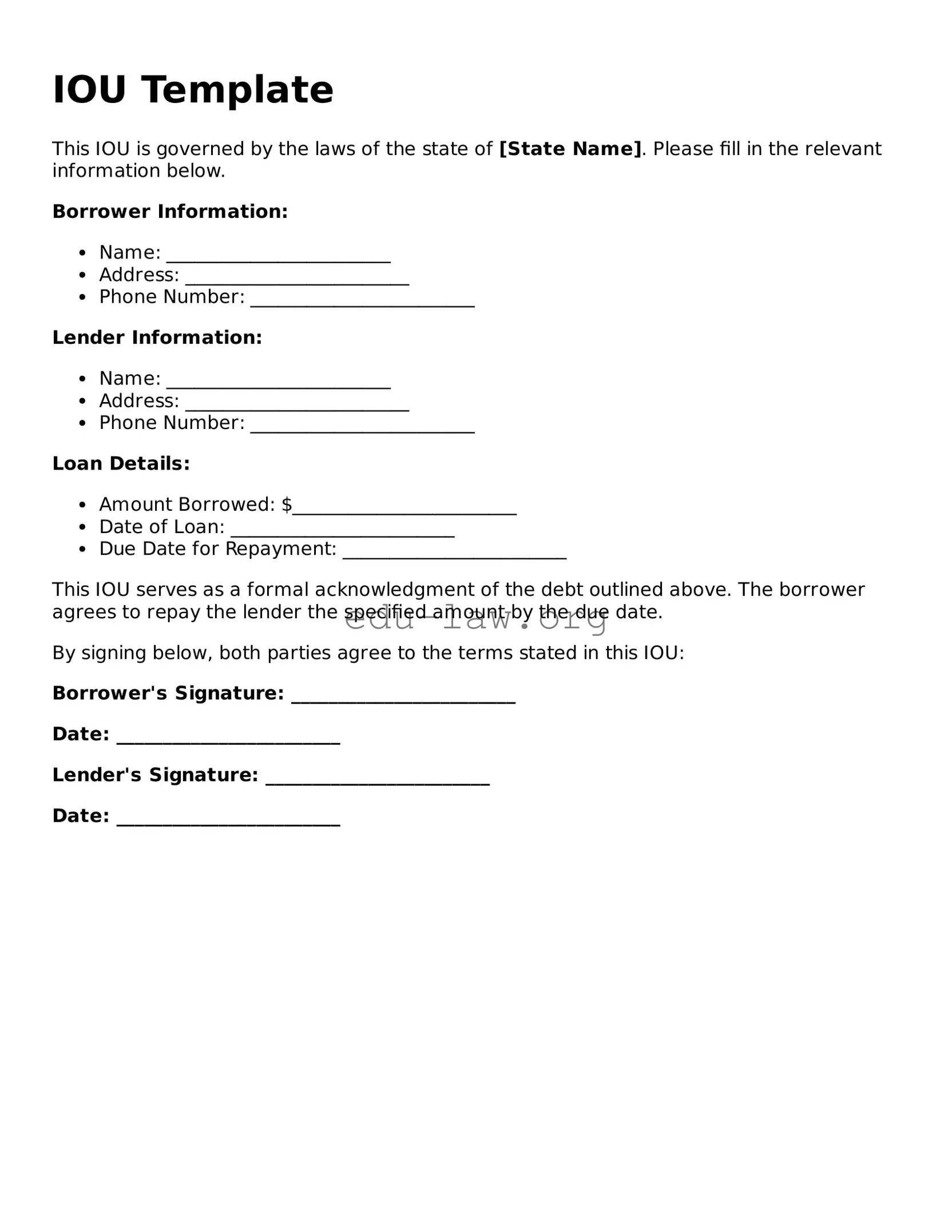
The IOU form serves as a simple yet effective tool for documenting informal loans or debts between individuals. This form typically includes essential details such as the names of the parties involved, the amount owed, and the date by which the debt is to be repaid. In many cases, an IOU may also outline any interest rates or repayment terms agreed upon by both parties. While it is not a legally binding contract, it provides a clear record of the obligation, helping to prevent misunderstandings or disputes in the future. Understanding the nuances of an IOU form can empower individuals to manage personal finances more effectively, fostering trust and accountability in financial transactions. Whether used among friends, family members, or acquaintances, this form can play a crucial role in maintaining healthy relationships while navigating the complexities of borrowing and lending money.
IOU Template
This IOU is governed by the laws of the state of [State Name]. Please fill in the relevant information below.
Borrower Information:
Lender Information:
Loan Details:
This IOU serves as a formal acknowledgment of the debt outlined above. The borrower agrees to repay the lender the specified amount by the due date.
By signing below, both parties agree to the terms stated in this IOU:
Borrower's Signature: ________________________
Date: ________________________
Lender's Signature: ________________________
Date: ________________________
| Fact Name | Description |
|---|---|
| Definition | An IOU is a simple document acknowledging a debt. It typically includes the amount owed and the names of the parties involved. |
| Legality | IOUs are generally considered legally binding, provided they meet certain conditions, such as clarity on the amount and terms. |
| State-Specific Forms | Some states may have specific requirements for IOUs. For example, California’s Civil Code Section 1624 requires certain contracts to be in writing. |
| Informal Nature | Unlike formal contracts, IOUs can be informal and do not require notarization or witnesses to be valid. |
| Repayment Terms | While an IOU can specify repayment terms, it often does not. Clarity on repayment can help avoid disputes later on. |
| Enforcement | If disputes arise, an IOU can be enforced in court, but the burden of proof lies with the creditor to show the debt exists. |
Once you have the IOU form in hand, it's important to ensure that all necessary information is accurately filled out. This will help in maintaining clear records of the agreement between the parties involved. Follow these steps carefully to complete the form correctly.
What is an IOU form?
An IOU form is a simple document that acknowledges a debt. It serves as a written record of a loan or an obligation to repay money. The term "IOU" stands for "I owe you," indicating that one party owes a specific amount to another. This form is often used in informal lending situations between friends, family, or acquaintances.
When should I use an IOU form?
You should consider using an IOU form when you lend money to someone or when someone owes you money. It is particularly useful in informal situations where a formal contract may not be necessary. An IOU can help clarify the terms of the loan and provide a reference point for both parties.
What information should be included in an IOU form?
An effective IOU form should include the names of both the lender and the borrower, the amount owed, the date of the loan, and any repayment terms. Additionally, it can be beneficial to include signatures from both parties to confirm their agreement to the terms outlined in the document.
Is an IOU legally binding?
Can an IOU be used for non-monetary debts?
Yes, an IOU can also be used to acknowledge non-monetary debts. For example, if someone agrees to perform a service or return an item, an IOU can document that obligation. However, clarity is essential; the IOU should specify what is owed and the terms of fulfillment.
What happens if the borrower does not repay the debt?
If the borrower fails to repay the debt, the lender may take several steps. First, they can remind the borrower of the obligation. If the situation does not resolve, the lender may consider legal action, depending on the amount owed and local laws. Having an IOU can support the lender's claims in such cases.
Can I modify an IOU after it has been signed?
Modifying an IOU after it has been signed is possible, but both parties must agree to the changes. It is advisable to document any modifications in writing and have both parties sign the updated agreement to avoid confusion or disputes later on.
Is it necessary to notarize an IOU?
Notarization is not typically required for an IOU to be valid. However, having the document notarized can add an extra layer of credibility and help prevent disputes. If the amount is substantial or if there are concerns about enforceability, notarization may be a wise choice.
Where can I find a template for an IOU form?
IOU templates are widely available online. Many legal websites offer free or paid templates that can be customized to suit your needs. When selecting a template, ensure it includes all necessary information and is appropriate for your specific situation.
Not including the date. It's essential to write the date when the IOU is created. This helps establish when the debt was acknowledged.
Failing to write the full names of both parties. Using full legal names instead of nicknames ensures clarity and reduces confusion.
Omitting the amount owed. Clearly stating the amount in both numerical and written form prevents misunderstandings.
Not specifying the repayment terms. Including details about when and how the debt will be repaid is crucial for both parties.
Leaving out signatures. Both parties should sign the IOU to confirm their agreement and acceptance of the terms.
Neglecting to include contact information. Providing a phone number or email address allows for easy communication regarding the debt.
Writing the document in a vague manner. Clear and concise language helps avoid misinterpretations of the terms.
Not keeping a copy. Both parties should retain a copy of the signed IOU for their records.
Using an outdated or incorrect form. Always ensure that the IOU form being used is current and appropriate for the situation.
Ignoring the importance of witnesses. Having a neutral third party sign as a witness can add an extra layer of credibility to the agreement.
An IOU form is often accompanied by various other documents that help clarify the terms of a loan or debt arrangement. These additional forms can provide essential details about the agreement, establish a record of transactions, or protect the interests of the parties involved. Below is a list of common documents frequently used alongside an IOU form.
Each of these documents serves a specific purpose and can be crucial for both lenders and borrowers. They provide clarity and legal backing to the financial arrangements made between parties, ensuring that all terms are understood and agreed upon.
The IOU form, which stands for "I Owe You," is a simple document acknowledging a debt between two parties. It is informal and often lacks the legal complexities of more formal agreements. However, several other documents share similarities with the IOU form, each serving a unique purpose while maintaining the core function of debt acknowledgment.
One such document is the promissory note. A promissory note is a written promise to pay a specified amount of money to a designated party at a particular time or on demand. Unlike an IOU, a promissory note is more formal and typically includes details such as interest rates and payment schedules. This document is often used in loan agreements and carries more legal weight, making it enforceable in court.
A loan agreement is another document that bears resemblance to the IOU form. This written contract outlines the terms of a loan between a lender and a borrower. It specifies the loan amount, repayment terms, interest rates, and consequences for default. While an IOU is often a simple acknowledgment, a loan agreement provides a comprehensive framework for the transaction, offering greater protection to both parties.
Next, there is the debt acknowledgment letter. This letter serves as a formal recognition of an outstanding debt, detailing the amount owed and the terms of repayment. Unlike an IOU, which may be written informally, a debt acknowledgment letter is typically more structured and may include additional information such as payment history. It can serve as a useful document in case of disputes, providing a clear record of the debt.
The receipt is another document that shares characteristics with the IOU form. A receipt serves as proof of payment for goods or services rendered. While it does not explicitly acknowledge a debt, it confirms that a transaction has taken place. In some cases, a receipt can also indicate that a debt has been settled, making it an important document for record-keeping.
A credit agreement also resembles the IOU form in that it outlines the terms under which credit is extended to a borrower. This document typically includes details about credit limits, repayment terms, and interest rates. While an IOU is often informal, a credit agreement is more comprehensive and legally binding, providing clear guidelines for both the lender and the borrower.
The bill of exchange is another financial instrument similar to an IOU. It is a written order from one party to another to pay a specified sum at a set time. While an IOU acknowledges a debt, a bill of exchange facilitates payment between parties, often used in international trade. This document adds a layer of formality and can be transferred between parties, unlike a simple IOU.
A lease agreement also shares some common ground with an IOU. This document outlines the terms under which one party rents property from another. While it primarily pertains to rental arrangements, it often includes clauses about payment obligations and can serve as a record of debts related to unpaid rent. The lease agreement provides a more detailed framework for understanding the financial responsibilities of both parties.
The acknowledgment of debt form is a more formal version of an IOU. This document explicitly states the amount owed and the repayment terms, providing a clear acknowledgment of the debt. It is often used in situations where a borrower wishes to formalize their obligation to repay a loan, offering both parties legal protection in case of disputes.
Lastly, the personal guarantee is a document where an individual agrees to be responsible for another person's debt. While an IOU is a simple acknowledgment of debt, a personal guarantee adds a layer of accountability, making the guarantor liable for repayment if the borrower defaults. This document is particularly important in business transactions, where lenders may require additional assurance of repayment.
When filling out an IOU form, it's essential to approach the task thoughtfully. Here are some important do's and don'ts to keep in mind:
By following these guidelines, you can ensure that your IOU form is clear, comprehensive, and legally sound. This will help both parties understand their obligations and avoid misunderstandings in the future.
The IOU form is a simple yet powerful tool for documenting debts. However, several misconceptions surround its use. Understanding these can help clarify its purpose and ensure it is used effectively. Below is a list of common misconceptions about the IOU form:
By addressing these misconceptions, individuals can use the IOU form more effectively. It can serve as a useful tool for managing debts, fostering trust, and promoting clear communication between parties.
Understanding how to properly fill out and use an IOU form can help ensure that financial agreements are clear and enforceable. Here are some key takeaways:
By following these guidelines, individuals can create an IOU that is both effective and easy to understand. This can lead to smoother financial transactions and help maintain trust between parties.