In Indiana, the Transfer-on-Death Deed (TODD) offers a straightforward way for property owners to transfer real estate to their beneficiaries without the complications of probate. This legal tool allows individuals to designate one or more beneficiaries who will automatically inherit the property upon the owner's death. By utilizing this form, property owners can maintain control of their assets during their lifetime while ensuring a seamless transition after they pass away. The TODD must be properly executed and recorded to be valid, requiring the signatures of the owner and a witness. Additionally, it’s essential to understand that the deed can be revoked or modified at any time before the owner's death, providing flexibility in estate planning. This method not only simplifies the transfer process but also minimizes the potential for family disputes, making it an appealing option for many Indiana residents looking to secure their legacy.
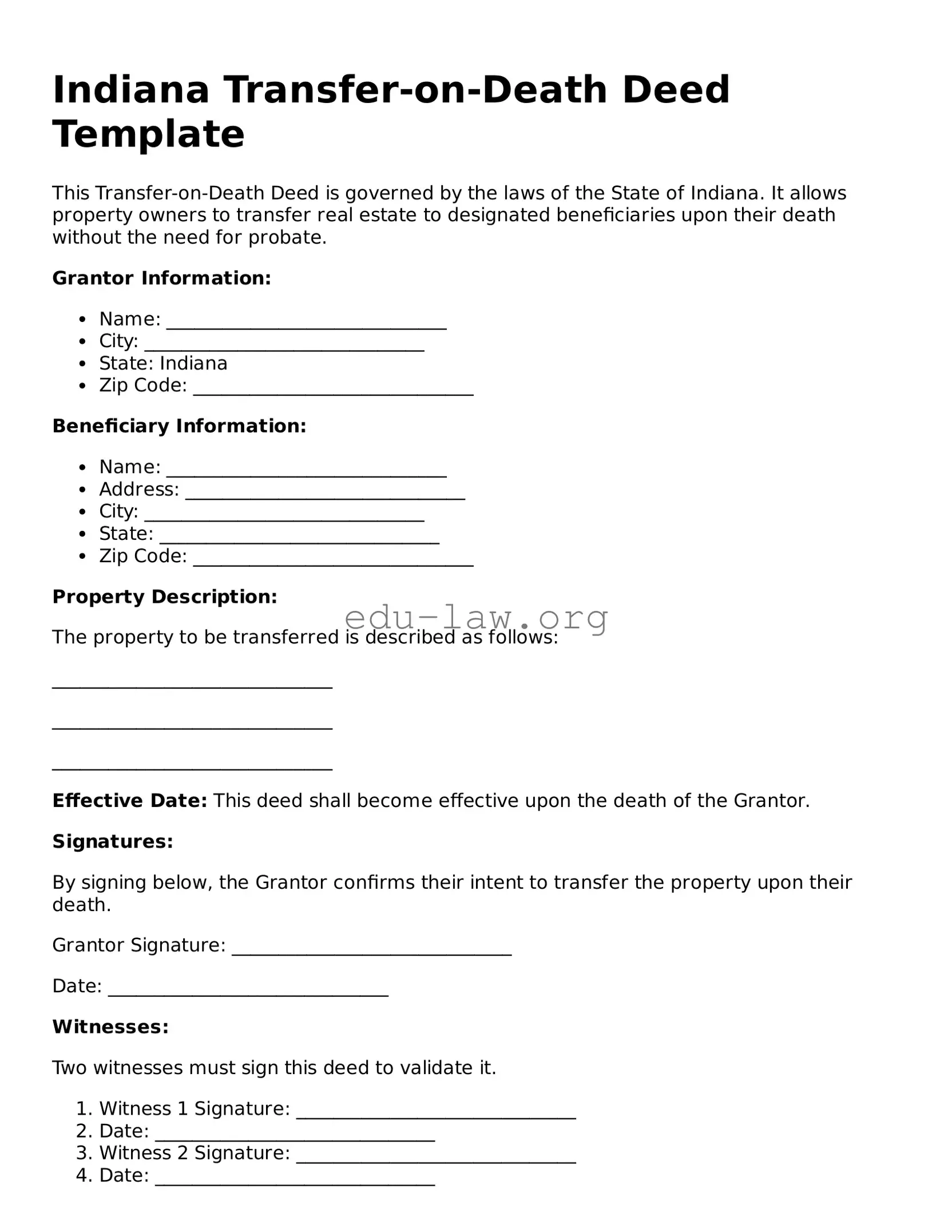
Indiana Transfer-on-Death Deed Template
This Transfer-on-Death Deed is governed by the laws of the State of Indiana. It allows property owners to transfer real estate to designated beneficiaries upon their death without the need for probate.
Grantor Information:
Beneficiary Information:
Property Description:
The property to be transferred is described as follows:
______________________________
______________________________
______________________________
Effective Date: This deed shall become effective upon the death of the Grantor.
Signatures:
By signing below, the Grantor confirms their intent to transfer the property upon their death.
Grantor Signature: ______________________________
Date: ______________________________
Witnesses:
Two witnesses must sign this deed to validate it.
Notary Public:
This deed must be notarized to be legally binding.
Notary Signature: ______________________________
Date: ______________________________
| Fact Name | Details |
|---|---|
| Definition | An Indiana Transfer-on-Death Deed allows property owners to transfer real estate to beneficiaries upon their death without going through probate. |
| Governing Law | This deed is governed by Indiana Code § 32-17-14. |
| Eligibility | Any individual who owns real estate in Indiana can create a Transfer-on-Death Deed. |
| Beneficiaries | Property owners can name one or more beneficiaries in the deed. |
| Revocation | The deed can be revoked at any time by the property owner before their death. |
| Filing Requirement | The deed must be recorded with the county recorder in the county where the property is located. |
| Effectiveness | The Transfer-on-Death Deed becomes effective immediately upon recording. |
| Tax Implications | Property transferred via this deed does not affect the property owner’s taxes during their lifetime. |
| Survivorship | If a beneficiary predeceases the property owner, their share can be transferred to their descendants unless otherwise stated. |
| Legal Assistance | While legal assistance is not required, it is recommended to ensure the deed is completed correctly. |
Filling out the Indiana Transfer-on-Death Deed form is an important step in planning for the future of your property. Once you have completed the form, it will need to be signed and recorded with the county recorder's office to ensure its effectiveness. Below are the steps to guide you through the process of filling out the form.
After completing these steps, the Transfer-on-Death Deed will be ready for recording. This will ensure that your wishes regarding the property are honored, providing peace of mind for you and your loved ones.
What is a Transfer-on-Death Deed in Indiana?
A Transfer-on-Death Deed (TODD) in Indiana allows an individual to transfer real estate to designated beneficiaries upon the owner's death, without the need for probate. This deed enables property owners to maintain control over their property during their lifetime while ensuring a smooth transition to heirs after their passing. It is a useful estate planning tool that can simplify the transfer process and potentially reduce costs associated with probate proceedings.
Who can create a Transfer-on-Death Deed?
Any individual who owns real estate in Indiana can create a Transfer-on-Death Deed. The property owner must be of sound mind and at least 18 years old. The deed must be executed in accordance with Indiana law, which includes signing the document in the presence of a notary public. Multiple owners can also use this deed, allowing them to designate different beneficiaries for their respective interests in the property.
How do I complete a Transfer-on-Death Deed?
To complete a Transfer-on-Death Deed, the property owner must fill out the form with specific information, including the legal description of the property, the names of the beneficiaries, and the owner's signature. It is essential to ensure that the deed is properly notarized and recorded with the county recorder's office where the property is located. Failure to record the deed may result in complications regarding the transfer of ownership after death.
Can I change or revoke a Transfer-on-Death Deed?
Yes, a Transfer-on-Death Deed can be revoked or modified at any time during the owner's lifetime. To do this, the owner must execute a new deed or a formal revocation document. It is crucial to record any changes with the county recorder to ensure that the most current version of the deed is recognized. This flexibility allows property owners to adapt their estate plans as circumstances change.
What happens if a beneficiary predeceases the property owner?
If a beneficiary named in a Transfer-on-Death Deed passes away before the property owner, the property will typically pass to the deceased beneficiary's heirs, unless the deed specifies otherwise. Property owners can also choose to name alternate beneficiaries in the event that the primary beneficiary is unable to inherit. This provision helps ensure that the property is transferred according to the owner’s wishes, even if unforeseen circumstances arise.
Are there any tax implications associated with a Transfer-on-Death Deed?
Generally, a Transfer-on-Death Deed does not trigger immediate tax consequences for the property owner. The property remains part of the owner's estate until their death. However, beneficiaries may be subject to estate taxes depending on the overall value of the estate and current tax laws. It is advisable for property owners to consult with a tax professional to understand any potential tax implications related to their specific situation.
Is a Transfer-on-Death Deed valid in all states?
No, a Transfer-on-Death Deed is not valid in all states. While many states have adopted similar laws allowing for transfer-on-death arrangements, the rules and requirements can vary significantly. It is important for property owners to familiarize themselves with the laws specific to Indiana or consult with an attorney to ensure compliance and proper execution of the deed.
What are the advantages of using a Transfer-on-Death Deed?
The primary advantages of a Transfer-on-Death Deed include avoiding probate, maintaining control over the property during the owner's lifetime, and providing a straightforward method for transferring real estate to beneficiaries. This deed can save time and money for heirs, allowing them to inherit property without the complexities often associated with probate proceedings. Additionally, it allows property owners to make changes as needed, ensuring that their estate plans remain relevant and effective.
When filling out the Indiana Transfer-on-Death Deed form, individuals often encounter several common mistakes. These errors can lead to complications in the transfer of property upon death. Below is an expanded list of four frequent mistakes:
Incomplete Information: Failing to provide all necessary details can invalidate the deed. This includes missing the names of the grantor and grantee, as well as the legal description of the property. Each section must be filled out completely to ensure clarity and legality.
Improper Signatures: The deed must be signed by the grantor. If the grantor is unable to sign due to incapacity, a valid power of attorney must be used. Neglecting to have the deed notarized can also render it ineffective, as Indiana law requires notarization for the deed to be valid.
Failure to Record the Deed: After completing the form, it is essential to record the Transfer-on-Death Deed with the county recorder's office. Failing to do so means the deed may not be recognized upon the grantor's death, leading to potential disputes among heirs.
Not Updating the Deed: Life changes, such as marriage, divorce, or the birth of children, may necessitate updates to the Transfer-on-Death Deed. Failing to revise the deed can result in unintended consequences regarding property distribution.
By being aware of these common mistakes, individuals can better navigate the process of completing a Transfer-on-Death Deed in Indiana. Proper attention to detail can help ensure that property is transferred smoothly according to the grantor's wishes.
When planning for the transfer of property in Indiana, several important documents often accompany the Transfer-on-Death Deed. These documents help clarify intentions, ensure compliance with legal requirements, and facilitate the smooth transition of property ownership. Below is a list of common forms and documents used in conjunction with the Transfer-on-Death Deed.
Understanding these documents can help ensure that property transfers occur smoothly and according to the owner's wishes. It is advisable to consult with a legal expert to navigate these forms effectively and to confirm that all necessary steps are taken in the estate planning process.
The Indiana Transfer-on-Death Deed (TODD) allows property owners to transfer real estate to beneficiaries without going through probate. This document is similar to a Living Trust, which also facilitates the transfer of assets upon the owner's death. A Living Trust holds property during the owner's lifetime and specifies how it should be distributed after death. Both documents aim to bypass the lengthy probate process, but a Living Trust can cover a broader range of assets, including bank accounts and personal property, while the TODD is limited to real estate.
Another document akin to the TODD is the Last Will and Testament. A will outlines how a person's assets will be distributed after their death, including real estate. However, unlike a TODD, a will must go through probate, which can be time-consuming and costly. The TODD allows for a smoother transition of property directly to beneficiaries, avoiding the probate court altogether.
The Life Estate Deed is also comparable to the TODD. This document allows an individual to retain the right to use a property during their lifetime while designating a beneficiary who will receive the property upon their death. While both documents allow for the transfer of property outside of probate, a Life Estate Deed grants the original owner certain rights during their lifetime, whereas a TODD does not allow the owner to retain any rights after the transfer is executed.
A Durable Power of Attorney (DPOA) shares similarities with the TODD in that both documents deal with the management of property. A DPOA allows someone to manage another person's financial affairs while they are alive, including real estate transactions. However, the key difference lies in the timing; a TODD becomes effective only upon the death of the property owner, while a DPOA is active during the owner's lifetime.
The Joint Tenancy with Right of Survivorship is another document that resembles the TODD. In a joint tenancy, two or more individuals own property together, and upon the death of one owner, the property automatically transfers to the surviving owner(s). This arrangement is similar to a TODD in that it avoids probate, but it requires co-ownership during the owner's lifetime, whereas a TODD allows for a single owner to designate beneficiaries without shared ownership.
The Beneficiary Deed is a document that operates similarly to the TODD. Like the TODD, a Beneficiary Deed allows property owners to name beneficiaries who will inherit the property upon their death, bypassing probate. Both documents are designed to simplify the transfer process, but the terminology and specific state laws governing each can differ. In Indiana, the TODD is the preferred method for transferring real estate, while Beneficiary Deeds may be more common in other states.
The Revocable Trust is another related document. Similar to a Living Trust, a Revocable Trust allows individuals to maintain control over their assets during their lifetime while designating how those assets should be distributed after death. The main difference is that a Revocable Trust may require more management and oversight than a TODD, which is a straightforward deed that can be filed with the county recorder.
A Charitable Remainder Trust (CRT) also has similarities to the TODD in terms of transferring property. A CRT allows individuals to donate assets to a charity while retaining the right to receive income from those assets during their lifetime. Upon the donor's death, the remaining assets go to the designated charity. While both the CRT and TODD facilitate the transfer of property, the CRT is specifically designed for charitable giving and has tax implications that a TODD does not.
Finally, a Transfer-on-Death Account (TOD Account) is similar to the TODD in that it allows for the transfer of assets without probate. A TOD Account is a type of bank or investment account that allows the account holder to name a beneficiary who will inherit the account upon the holder's death. Both documents streamline the transfer process and ensure that assets go directly to the intended recipient without the need for court intervention.
When filling out the Indiana Transfer-on-Death Deed form, it is essential to follow specific guidelines to ensure accuracy and compliance. Below are four recommendations on what to do and what to avoid.
Understanding the Indiana Transfer-on-Death Deed (TODD) can be challenging. Many people hold misconceptions that can lead to confusion or mistakes. Here’s a list of common misunderstandings about the TODD form:
Addressing these misconceptions is crucial for anyone considering a Transfer-on-Death Deed in Indiana. Proper understanding can lead to more informed decisions and smoother transitions for your loved ones.
When considering the Indiana Transfer-on-Death Deed, it is essential to understand its implications and the process involved. Here are key takeaways to keep in mind:
Understanding these key points can help ensure a smooth process when using the Indiana Transfer-on-Death Deed. It is vital to approach this matter thoughtfully and to consider the needs of both yourself and your beneficiaries.