In the realm of estate planning and administration, navigating the complexities of probate can often feel overwhelming, especially for those dealing with the loss of a loved one. For residents of Indiana, the Small Estate Affidavit provides a streamlined alternative for settling the affairs of a deceased individual when their estate falls below a certain threshold. This form is designed to simplify the transfer of assets without the need for formal probate proceedings, making it an invaluable tool for families seeking to minimize the time and expense associated with estate settlement. To utilize the Small Estate Affidavit, specific criteria must be met, including the total value of the estate and the types of assets involved. The affidavit allows heirs or beneficiaries to claim personal property and financial accounts directly, provided they can demonstrate their relationship to the deceased and their entitlement to the assets. Understanding the nuances of this form can empower individuals to efficiently manage their loved one's estate while adhering to Indiana's legal requirements.
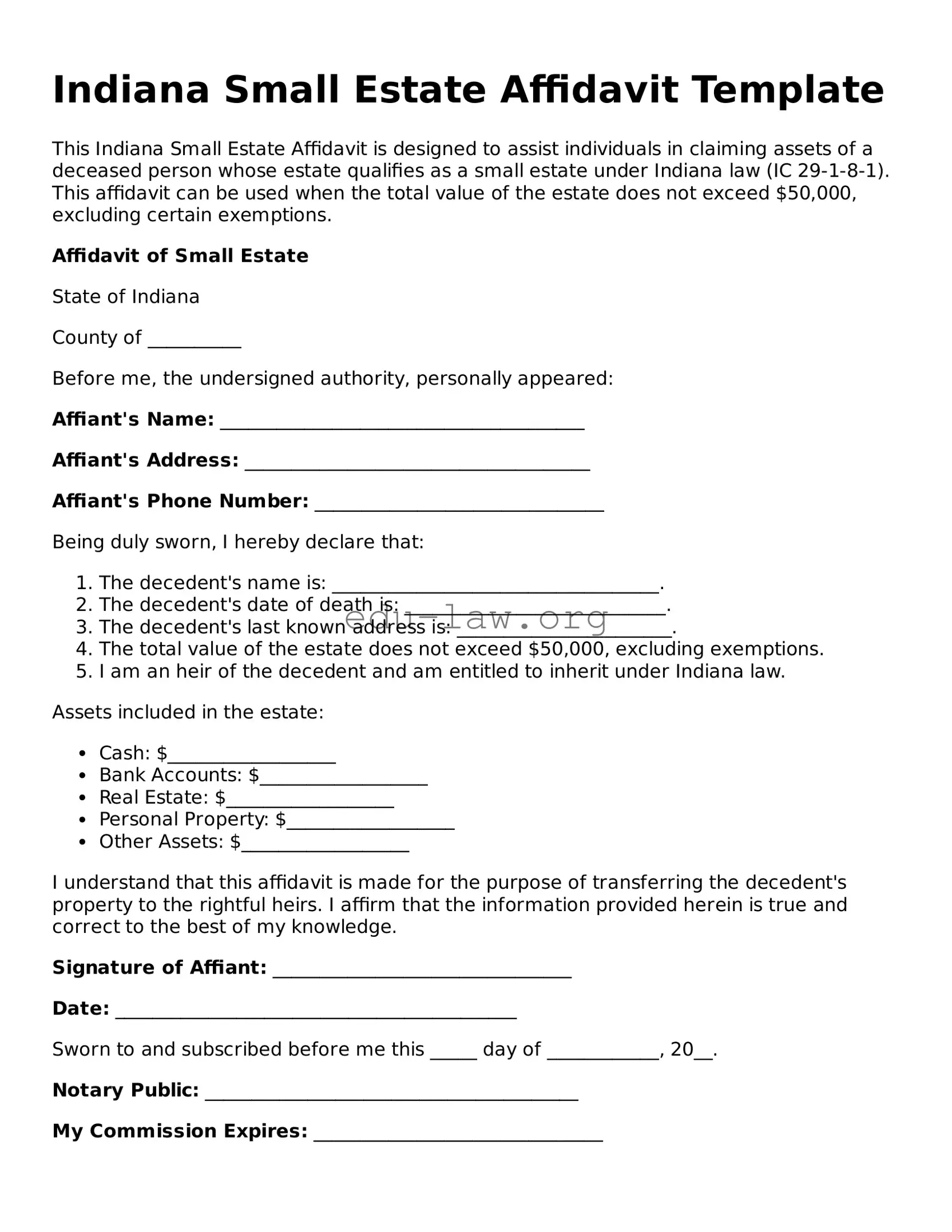
Indiana Small Estate Affidavit Template
This Indiana Small Estate Affidavit is designed to assist individuals in claiming assets of a deceased person whose estate qualifies as a small estate under Indiana law (IC 29-1-8-1). This affidavit can be used when the total value of the estate does not exceed $50,000, excluding certain exemptions.
Affidavit of Small Estate
State of Indiana
County of __________
Before me, the undersigned authority, personally appeared:
Affiant's Name: _______________________________________
Affiant's Address: _____________________________________
Affiant's Phone Number: _______________________________
Being duly sworn, I hereby declare that:
Assets included in the estate:
I understand that this affidavit is made for the purpose of transferring the decedent's property to the rightful heirs. I affirm that the information provided herein is true and correct to the best of my knowledge.
Signature of Affiant: ________________________________
Date: ___________________________________________
Sworn to and subscribed before me this _____ day of ____________, 20__.
Notary Public: ________________________________________
My Commission Expires: _______________________________
| Fact Name | Description |
|---|---|
| Eligibility | In Indiana, the Small Estate Affidavit can be used when the total value of the estate is less than $50,000, excluding real estate. |
| Governing Law | The use of the Small Estate Affidavit is governed by Indiana Code § 29-1-8-1. |
| Filing Requirements | The affidavit must be signed by the heirs and filed with the local probate court. |
| Property Distribution | Once approved, the affidavit allows heirs to collect and distribute the estate's assets without formal probate proceedings. |
| Time Frame | The process can typically be completed more quickly than traditional probate, often taking just a few weeks. |
After obtaining the Indiana Small Estate Affidavit form, you will need to complete it accurately to proceed with settling the estate. The following steps will guide you through the process of filling out the form correctly.
What is the Indiana Small Estate Affidavit form?
The Indiana Small Estate Affidavit is a legal document that allows individuals to claim the assets of a deceased person without going through the lengthy and often costly probate process. This form is specifically designed for estates that meet certain criteria, typically involving a total value of less than $50,000 for personal property or less than $100,000 when real estate is included. By using this affidavit, heirs can access the deceased's assets more quickly and efficiently.
Who can use the Small Estate Affidavit in Indiana?
In Indiana, the Small Estate Affidavit can be used by individuals who are entitled to inherit from the deceased person. This often includes spouses, children, or other close relatives. However, it is essential that the person filing the affidavit is an heir or has a legal claim to the assets. Additionally, the deceased must have passed away at least 45 days prior to the filing of the affidavit.
What information is required to complete the Small Estate Affidavit?
To complete the Small Estate Affidavit, you will need to provide specific information about the deceased, including their name, date of death, and last known address. You will also need to list the assets of the estate, including their estimated values. Furthermore, the affidavit must include a statement affirming that the total value of the estate falls within the limits set by Indiana law. Signatures from all heirs may also be required, depending on the situation.
How do I file the Small Estate Affidavit in Indiana?
Filing the Small Estate Affidavit in Indiana involves a few straightforward steps. First, complete the affidavit form with the necessary information. Afterward, you will need to sign the document in front of a notary public. Once notarized, you can submit the affidavit to the appropriate court or financial institution holding the deceased's assets. It is advisable to keep copies of the filed affidavit for your records and for any future reference.
Not providing accurate information about the deceased. Ensure that the name, date of death, and other personal details are correct.
Forgetting to include all heirs. All individuals entitled to inherit must be listed on the form.
Neglecting to sign the affidavit. The affidavit must be signed by the person making the claim.
Using outdated forms. Always check that you are using the most current version of the Indiana Small Estate Affidavit.
Failing to provide necessary identification. A valid ID may be required to verify the identity of the affiant.
Omitting details about the estate's assets. A complete list of assets must be included to support the claim.
Not including a statement about debts. Any known debts of the deceased should be disclosed in the affidavit.
Incorrectly estimating the value of the estate. The total value of the estate must meet Indiana's small estate threshold.
Not having the form notarized. The affidavit typically needs to be notarized to be valid.
Ignoring local court requirements. Different counties may have specific rules or additional documents needed.
When dealing with the Indiana Small Estate Affidavit, several other forms and documents may be necessary to facilitate the estate settlement process. Understanding these documents can help streamline the process and ensure that all legal requirements are met.
Each of these documents plays a vital role in the estate settlement process in Indiana. Having them prepared and organized can help facilitate a smoother transition and ensure that the decedent's wishes are honored.
The Indiana Small Estate Affidavit form shares similarities with the Affidavit of Heirship. Both documents are used to establish the rightful heirs of a deceased person's estate. The Affidavit of Heirship is often utilized when a person dies without a will, allowing heirs to claim property without going through a lengthy probate process. Like the Small Estate Affidavit, it requires the signature of individuals who can attest to the family relationships and the decedent's wishes, simplifying the transfer of assets to the rightful heirs.
Another document comparable to the Indiana Small Estate Affidavit is the Will. A Will outlines an individual’s wishes regarding the distribution of their assets after death. While the Small Estate Affidavit is used when the estate is below a certain value, a Will can be used for larger estates. However, both documents serve the common purpose of ensuring that the deceased’s assets are distributed according to their intentions, whether through a formal probate process or a simplified affidavit approach.
The Transfer on Death (TOD) designation also bears resemblance to the Small Estate Affidavit. A TOD allows individuals to designate beneficiaries for certain assets, such as bank accounts or real estate, without going through probate. Similar to the Small Estate Affidavit, it facilitates the direct transfer of assets upon death, making the process more efficient and less burdensome for the heirs. Both documents aim to streamline the transfer of property and minimize delays for beneficiaries.
Lastly, the Petition for Probate is another document that relates to the Indiana Small Estate Affidavit. While the Small Estate Affidavit is used for smaller estates to avoid probate, a Petition for Probate initiates the formal probate process for larger estates. Both documents require information about the deceased and their assets. However, the key difference lies in the size of the estate and the legal proceedings involved, with the Small Estate Affidavit providing a more straightforward alternative for qualifying estates.
When filling out the Indiana Small Estate Affidavit form, it's important to follow certain guidelines to ensure the process goes smoothly. Here are ten things to keep in mind:
Following these guidelines will help you navigate the Indiana Small Estate Affidavit form with confidence.
The Indiana Small Estate Affidavit is a useful tool for settling the estates of individuals who have passed away. However, several misconceptions surround this form that can lead to confusion. Here are six common misunderstandings:
While it is true that the Small Estate Affidavit is designed for estates valued at $50,000 or less, this limit applies only to personal property. Real estate can be included in the affidavit, but it may require additional steps.
In reality, not all heirs need to agree for the Small Estate Affidavit to be used. The form can be completed by one or more heirs, as long as they are entitled to the property under Indiana law.
This is misleading. The Small Estate Affidavit is primarily for transferring property and does not address the settlement of debts. Heirs may still need to deal with outstanding debts separately.
While the Small Estate Affidavit simplifies the probate process, it still requires careful attention to detail. Gathering necessary documents and ensuring compliance with state laws can take time.
Although many people successfully navigate the Small Estate Affidavit process without a lawyer, consulting with one can provide valuable guidance and help avoid potential pitfalls.
This is incorrect. If errors are discovered after the affidavit is filed, it can be amended. However, it is important to follow the proper procedures for making changes to ensure validity.
Understanding these misconceptions can help individuals navigate the process of using the Indiana Small Estate Affidavit more effectively. Proper knowledge can lead to smoother transitions during what is often a challenging time.
Filling out and using the Indiana Small Estate Affidavit form can be a straightforward process, but it’s important to understand the key aspects to ensure everything is done correctly. Here are some essential takeaways:
Understanding these key points can help streamline the process and ensure that you are taking the right steps in managing a small estate in Indiana.