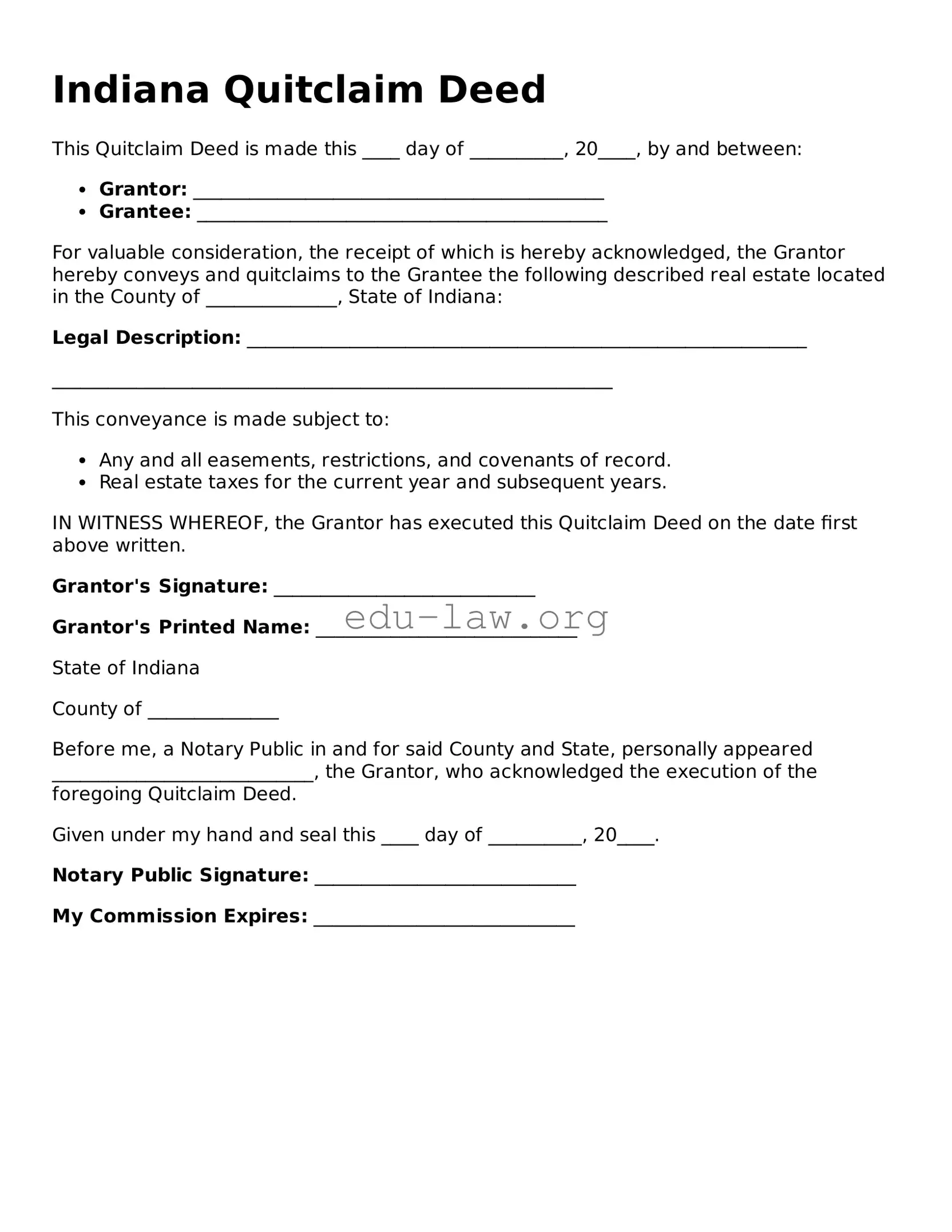
The Indiana Quitclaim Deed is an essential legal document that facilitates the transfer of real estate ownership from one party to another. This form is particularly useful when the granter, or seller, wishes to convey their interest in a property without providing any warranties about the title. It is commonly used among family members, friends, or in situations where the parties involved have a high level of trust. The Quitclaim Deed must include specific information, such as the names of the granter and grantee, a description of the property being transferred, and the date of the transaction. Additionally, it requires the granter’s signature and may need to be notarized to ensure its validity. Understanding the nuances of the Indiana Quitclaim Deed is crucial for anyone looking to navigate property transfers smoothly and effectively, as it can impact future ownership rights and responsibilities.
Indiana Quitclaim Deed
This Quitclaim Deed is made this ____ day of __________, 20____, by and between:
For valuable consideration, the receipt of which is hereby acknowledged, the Grantor hereby conveys and quitclaims to the Grantee the following described real estate located in the County of ______________, State of Indiana:
Legal Description: ____________________________________________________________
____________________________________________________________
This conveyance is made subject to:
IN WITNESS WHEREOF, the Grantor has executed this Quitclaim Deed on the date first above written.
Grantor's Signature: ____________________________
Grantor's Printed Name: ____________________________
State of Indiana
County of ______________
Before me, a Notary Public in and for said County and State, personally appeared ____________________________, the Grantor, who acknowledged the execution of the foregoing Quitclaim Deed.
Given under my hand and seal this ____ day of __________, 20____.
Notary Public Signature: ____________________________
My Commission Expires: ____________________________
| Fact Name | Description |
|---|---|
| Definition | A quitclaim deed is a legal document used to transfer ownership of real estate without any warranties regarding the title. |
| Governing Law | The Indiana Quitclaim Deed is governed by Indiana Code Title 32, Article 28. |
| Purpose | This form is commonly used to transfer property between family members or to clear up title issues. |
| Parties Involved | The document typically involves a grantor (the person transferring the property) and a grantee (the person receiving the property). |
| Consideration | While a monetary exchange is not always required, the deed often includes a nominal consideration amount. |
| Recording | To ensure legal validity and public notice, the quitclaim deed must be recorded with the county recorder's office. |
| Limitations | Quitclaim deeds do not guarantee that the grantor has clear title to the property, which can lead to potential disputes. |
Once you have the Indiana Quitclaim Deed form in hand, it’s time to fill it out accurately. This deed is essential for transferring property ownership, and ensuring that all information is correct is crucial for a smooth transaction. Follow the steps below to complete the form effectively.
After filling out and filing the Quitclaim Deed, the next step involves ensuring that the document is recorded properly. This recording protects the new owner's rights and provides public notice of the property transfer. Keep a copy of the recorded deed for your records.
What is a Quitclaim Deed in Indiana?
A Quitclaim Deed is a legal document used to transfer ownership of real estate from one party to another in Indiana. Unlike other types of deeds, a Quitclaim Deed does not guarantee that the person transferring the property has clear title. Instead, it simply conveys whatever interest the grantor has in the property, if any. This makes it a popular choice for transferring property between family members or in situations where the grantor does not want to provide warranties about the title.
When should I use a Quitclaim Deed?
Quitclaim Deeds are often used in specific situations. For instance, they are commonly used in divorce settlements to transfer property between spouses. They can also be used to add or remove someone from the title of a property, such as when a parent wants to transfer ownership to a child. Additionally, if a property is being transferred as a gift, a Quitclaim Deed can simplify the process.
How do I complete a Quitclaim Deed in Indiana?
Completing a Quitclaim Deed involves several steps. First, you need to obtain the form, which can often be found online or at local county offices. Next, fill out the form with the necessary information, including the names of the grantor and grantee, a description of the property, and the date of the transfer. It's essential to ensure that the information is accurate to avoid complications later. After completing the form, the grantor must sign it in the presence of a notary public, who will also sign and stamp the document.
Do I need to have the Quitclaim Deed notarized?
Yes, in Indiana, a Quitclaim Deed must be notarized to be legally valid. This means that the person transferring the property (the grantor) must sign the deed in front of a notary public, who will verify the identity of the signer and witness the signing. Notarization helps prevent fraud and ensures that the document is properly executed.
Is there a fee to file a Quitclaim Deed in Indiana?
Yes, there are fees associated with filing a Quitclaim Deed in Indiana. Each county may have different fees, so it’s advisable to check with your local county recorder’s office for the exact amount. Typically, the fee is based on the number of pages in the document. Additionally, if the property has a mortgage or other liens, there may be additional costs associated with those transactions.
How do I record a Quitclaim Deed in Indiana?
To record a Quitclaim Deed in Indiana, you must take the completed and notarized deed to the county recorder's office where the property is located. The recorder will review the document to ensure it meets all legal requirements and then officially record it in the public records. This process makes the transfer of ownership public and protects the rights of the new owner.
What happens after I file a Quitclaim Deed?
Once a Quitclaim Deed is filed, it becomes part of the public record. This means that anyone can access it to verify the ownership of the property. The new owner (grantee) will have the rights to the property as specified in the deed. However, since a Quitclaim Deed does not guarantee clear title, it’s important for the grantee to conduct due diligence, such as a title search, to ensure there are no outstanding liens or claims against the property.
Can I revoke a Quitclaim Deed in Indiana?
Revoking a Quitclaim Deed is not a straightforward process. Once a Quitclaim Deed is executed and recorded, it generally cannot be undone unilaterally. If the grantor wishes to regain ownership, they would typically need to execute a new deed transferring the property back to themselves or negotiate with the grantee. Legal advice may be necessary in such situations to navigate the complexities involved.
Incorrect Names: One common mistake is failing to list the names of all parties accurately. It is essential to ensure that the names of the grantor (the person transferring the property) and the grantee (the person receiving the property) are spelled correctly and match their identification documents.
Omitting Property Description: Another frequent error involves not providing a complete legal description of the property. The description should include the lot number, block number, and any other identifiers that clarify the property’s location. Without this information, the deed may be considered invalid.
Improper Signatures: Signatures must be executed correctly. Each party involved in the transaction must sign the deed in the appropriate place. Additionally, if the grantor is a business entity, the deed must be signed by an authorized representative.
Failure to Notarize: Many individuals neglect to have the deed notarized. In Indiana, a quitclaim deed must be notarized to be legally binding. Without a notary’s signature and seal, the document may not be accepted by the county recorder.
Ignoring Local Recording Requirements: Lastly, some people overlook the specific recording requirements of their local county. Each county may have different rules regarding the submission of the deed, including fees and additional documents that may be required. It is crucial to check these requirements to ensure proper filing.
The Indiana Quitclaim Deed is a legal document used to transfer property ownership without guaranteeing that the title is free from claims. When completing a property transfer, several other forms and documents may be necessary to ensure a smooth process. Below is a list of commonly used documents that often accompany the Quitclaim Deed in Indiana.
Using these documents in conjunction with the Indiana Quitclaim Deed can help ensure that the property transfer process is legally sound and transparent. It is advisable to consult with a legal professional to ensure all necessary paperwork is completed accurately and in accordance with state laws.
The Indiana Quitclaim Deed is often compared to a Warranty Deed. Both documents serve the purpose of transferring property ownership, but they differ significantly in the level of protection they offer to the buyer. A Warranty Deed guarantees that the seller holds clear title to the property and provides assurances against any claims or liens. In contrast, a Quitclaim Deed simply transfers whatever interest the seller has in the property, without any warranties. This means that if the seller has no legal claim to the property, the buyer receives nothing, making the Warranty Deed a safer option for those seeking security in their real estate transactions.
Another document similar to the Quitclaim Deed is the Bargain and Sale Deed. Like the Quitclaim Deed, a Bargain and Sale Deed transfers ownership of property but typically implies that the seller has some interest in the property, even if it does not guarantee a clear title. This type of deed may be used in situations where the seller is not able to provide a full warranty of title. Buyers should be aware that while they receive a property interest, they may still face risks regarding any existing claims or encumbrances on the property.
The Special Purpose Deed is yet another document that shares similarities with the Quitclaim Deed. This type of deed is often used in specific situations, such as transferring property between family members or in cases of divorce. While a Quitclaim Deed is straightforward and transfers whatever interest the seller has, a Special Purpose Deed can also serve specific legal purposes, such as conveying property for tax purposes or other unique circumstances. However, like the Quitclaim, it does not provide any guarantees regarding the title.
Lastly, the General Warranty Deed is worth mentioning as a counterpart to the Quitclaim Deed. This deed offers the highest level of protection to the buyer, as it includes several covenants that assure the buyer of the seller’s clear title and the right to sell the property. In contrast, the Quitclaim Deed lacks these assurances, making it a less secure option for buyers. While the General Warranty Deed is ideal for those seeking full protection, the Quitclaim Deed may be more appropriate in situations where the parties know each other well, such as family transfers, where trust is established.
When filling out the Indiana Quitclaim Deed form, it's important to follow certain guidelines to ensure accuracy and compliance. Here are six key dos and don'ts:
When dealing with property transfers in Indiana, the Quitclaim Deed form is often misunderstood. Here are five common misconceptions that can lead to confusion:
This is a common misconception. A Quitclaim Deed transfers whatever interest the grantor has in the property, but it does not guarantee that the grantor has any ownership at all. If the grantor has no ownership, the recipient receives nothing.
Many believe that this type of deed comes with a warranty or guarantee of title. In reality, a Quitclaim Deed offers no warranties. It simply conveys the interest without any assurances regarding the property’s title or potential claims against it.
While it is often used in familial transactions, a Quitclaim Deed can be utilized in various situations, including sales or transfers between strangers. Its flexibility makes it a common choice for many types of property transfers.
Although it can be quicker than other methods, the speed of a Quitclaim Deed transfer depends on various factors, such as local recording requirements and the readiness of both parties. It may not always be the most efficient option.
This is misleading. While the Quitclaim Deed transfers any interest the grantor may have, it does not absolve them of any past liabilities related to the property. The grantor may still be held accountable for debts or claims associated with the property.
Understanding these misconceptions can help individuals make informed decisions when considering property transfers using the Indiana Quitclaim Deed form.
When filling out and using the Indiana Quitclaim Deed form, it is essential to understand several key points to ensure the process goes smoothly. Below are important takeaways to consider:
Understanding these key points can help ensure that the process of using the Indiana Quitclaim Deed form is effective and legally sound.