Entering into a marriage is a significant milestone, often filled with joy and anticipation. However, it is also a time to consider the practical aspects of a partnership, including financial matters. In Indiana, a prenuptial agreement serves as a proactive tool for couples to outline their financial rights and responsibilities before tying the knot. This legal document can address a variety of issues, such as the division of property, spousal support, and debt management, should the marriage end in divorce or separation. It is essential for both parties to fully disclose their assets and liabilities during the preparation of this agreement, ensuring transparency and fairness. By discussing and agreeing on these matters ahead of time, couples can foster open communication and reduce potential conflicts in the future. The Indiana Prenuptial Agreement form not only provides a framework for financial arrangements but also reflects the couple's mutual respect and commitment to a harmonious partnership.
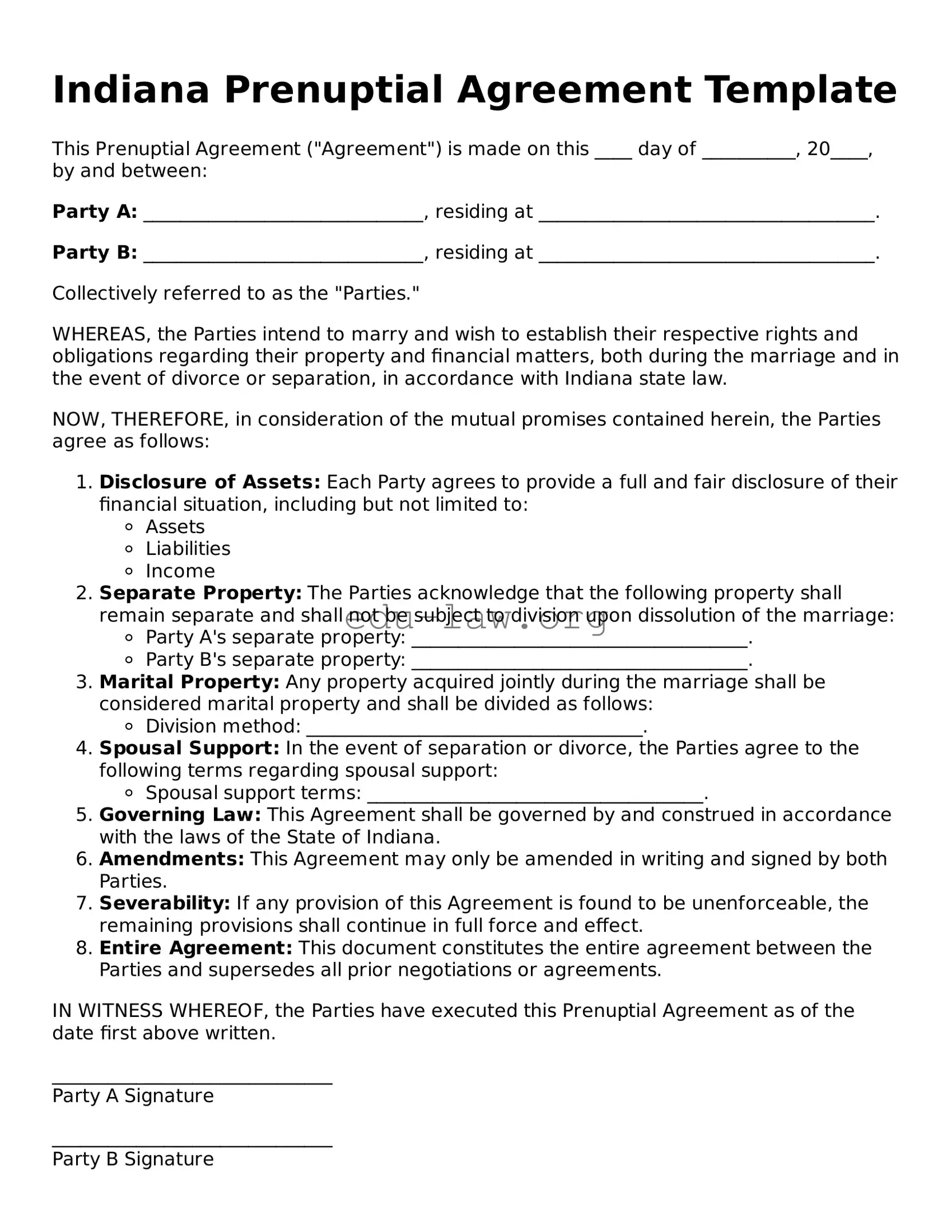
Indiana Prenuptial Agreement Template
This Prenuptial Agreement ("Agreement") is made on this ____ day of __________, 20____, by and between:
Party A: ______________________________, residing at ____________________________________.
Party B: ______________________________, residing at ____________________________________.
Collectively referred to as the "Parties."
WHEREAS, the Parties intend to marry and wish to establish their respective rights and obligations regarding their property and financial matters, both during the marriage and in the event of divorce or separation, in accordance with Indiana state law.
NOW, THEREFORE, in consideration of the mutual promises contained herein, the Parties agree as follows:
IN WITNESS WHEREOF, the Parties have executed this Prenuptial Agreement as of the date first above written.
______________________________
Party A Signature
______________________________
Party B Signature
______________________________
Date
| Fact Name | Details |
|---|---|
| Definition | An Indiana prenuptial agreement is a legal document created by two individuals before marriage to outline the division of assets and responsibilities in the event of divorce or separation. |
| Governing Law | Indiana Code Title 31, Article 11 governs prenuptial agreements in the state. |
| Enforceability | For a prenuptial agreement to be enforceable, it must be in writing and signed by both parties. |
| Full Disclosure | Both parties must fully disclose their assets and liabilities for the agreement to be valid. |
| Independent Counsel | It is advisable for both parties to seek independent legal counsel to ensure fairness and understanding of the agreement. |
| Modification | Prenuptial agreements can be modified after marriage, but any changes must also be in writing and signed by both parties. |
| Limitations | Certain matters, such as child custody and child support, cannot be dictated by a prenuptial agreement. |
| Timing | It is best to create a prenuptial agreement well in advance of the wedding to avoid any claims of coercion. |
Completing the Indiana Prenuptial Agreement form requires careful attention to detail. This document outlines the financial rights and responsibilities of both parties entering into marriage. To ensure accuracy and clarity, follow the steps below to fill out the form correctly.
What is a prenuptial agreement in Indiana?
A prenuptial agreement, commonly known as a prenup, is a legal document that couples create before marriage. It outlines the division of assets and responsibilities in the event of a divorce or separation. In Indiana, this agreement can help protect individual property and clarify financial expectations between partners.
Why should I consider a prenuptial agreement?
Couples often consider a prenuptial agreement to safeguard their financial interests. It can be particularly beneficial if one partner has significant assets, debts, or children from a previous relationship. A prenup can provide peace of mind by clearly defining how property will be divided, thus potentially reducing conflict during a divorce.
What should be included in an Indiana prenuptial agreement?
In Indiana, a prenuptial agreement can include various provisions, such as the division of property, spousal support, and debt responsibility. Couples may also address how future income or property acquired during the marriage will be handled. It is essential to be clear and specific to avoid ambiguity and ensure enforceability.
How do I create a valid prenuptial agreement in Indiana?
To create a valid prenuptial agreement in Indiana, both parties must voluntarily sign the document. It is advisable for each partner to have independent legal counsel to ensure that their rights are protected. The agreement should be in writing and signed before the marriage takes place. Full disclosure of assets and liabilities is also necessary for the agreement to be enforceable.
Can a prenuptial agreement be modified or revoked?
Yes, a prenuptial agreement can be modified or revoked after marriage. Both parties must agree to any changes, and it is recommended that these modifications be made in writing and signed by both individuals. This ensures clarity and helps prevent disputes in the future.
What happens if a prenuptial agreement is challenged in court?
If a prenuptial agreement is challenged in court, the judge will evaluate its validity based on several factors. These may include whether both parties entered into the agreement voluntarily, whether there was full disclosure of assets, and whether the terms are fair and reasonable. If the agreement is found to be valid, it will be upheld; otherwise, the court may disregard it.
Neglecting Full Disclosure of Assets: One common mistake is failing to fully disclose all assets and debts. Each party should provide a comprehensive list of their financial situation. This includes bank accounts, real estate, investments, and liabilities. Incomplete information can lead to disputes later on.
Using Ambiguous Language: Clarity is crucial in a prenuptial agreement. Vague terms can create confusion and misinterpretation. Couples should strive for precise language to ensure that both parties understand their rights and obligations.
Not Considering Future Changes: Life circumstances can change dramatically. Couples often overlook the importance of addressing potential future scenarios, such as the birth of children or significant career changes. Including provisions for these possibilities can help prevent conflicts down the road.
Forgetting to Review State Laws: Each state has its own laws regarding prenuptial agreements. Failing to familiarize oneself with Indiana's specific requirements may result in an unenforceable agreement. Couples should ensure their document complies with state regulations.
Not Seeking Legal Advice: Attempting to navigate the complexities of a prenuptial agreement without professional guidance can be risky. Couples often underestimate the value of consulting with a legal expert. An attorney can provide insights and help draft a fair agreement that protects both parties.
When preparing a prenuptial agreement in Indiana, several other forms and documents may be necessary to ensure a comprehensive understanding of each party's rights and obligations. These documents help clarify financial matters and provide additional legal protections for both individuals entering into marriage.
Incorporating these documents alongside a prenuptial agreement can provide a clearer picture of both parties' financial situations and intentions. This proactive approach can lead to a more harmonious marriage and reduce potential conflicts in the future.
The Indiana Prenuptial Agreement form shares similarities with a Cohabitation Agreement. Both documents serve to outline the rights and responsibilities of individuals in a relationship, whether married or living together. A Cohabitation Agreement is particularly useful for couples who choose to live together without marriage. It can address issues like property division, financial responsibilities, and even child custody arrangements, much like a prenuptial agreement does for married couples. Both documents aim to provide clarity and protection for both parties, reducing potential disputes in the future.
Another document that resembles the Indiana Prenuptial Agreement is a Postnuptial Agreement. This agreement is similar in purpose but is created after the marriage has taken place. Like a prenuptial agreement, a postnuptial agreement can outline how assets will be divided in the event of divorce or separation. It can also cover financial responsibilities during the marriage. The key difference is the timing of its creation, but both documents serve to protect individual interests and clarify expectations within the relationship.
A Marital Settlement Agreement also bears resemblance to the Indiana Prenuptial Agreement. This document is typically used during divorce proceedings to outline the terms of asset division, child custody, and support obligations. While a prenuptial agreement is proactive, a marital settlement agreement is reactive, addressing issues that arise after a marriage has ended. Both documents aim to provide a clear framework for financial and personal responsibilities, ensuring that both parties understand their rights and obligations.
The Indiana Prenuptial Agreement form is also similar to a Domestic Partnership Agreement. This type of agreement is designed for couples who are in a domestic partnership, which may not have the same legal recognition as marriage. Like a prenuptial agreement, a Domestic Partnership Agreement can outline the distribution of assets, financial responsibilities, and other important matters. It serves to protect the interests of both partners and can help avoid conflicts in case the relationship ends.
Lastly, a Separation Agreement has characteristics akin to the Indiana Prenuptial Agreement. This document comes into play when a couple decides to live apart but is not yet divorced. It can outline issues such as property division, child custody, and support obligations, much like a prenuptial agreement anticipates potential future disputes. Both agreements aim to provide a structured approach to managing the complexities of a relationship, whether in its beginning stages or during a transition.
When filling out the Indiana Prenuptial Agreement form, it’s essential to approach the task carefully. Here’s a list of things you should and shouldn’t do:
Many individuals considering a prenuptial agreement in Indiana may hold misconceptions that can lead to confusion or hesitance. Understanding these misunderstandings is crucial for making informed decisions. Below are five common misconceptions about the Indiana Prenuptial Agreement form, along with clarifications.
This is a widespread belief, but prenuptial agreements can benefit couples of all financial backgrounds. They provide clarity and security regarding financial matters, which can be particularly important in any marriage.
While financial aspects are a significant part, these agreements can also address non-financial matters. For example, they can outline responsibilities regarding children, property, and even lifestyle choices during the marriage.
This misconception is incorrect. When properly drafted and executed, prenuptial agreements are generally enforceable in Indiana. However, they must meet specific legal requirements to hold up in court.
While it is ideal to create these agreements prior to the wedding, couples can still draft a postnuptial agreement after marriage. This can be beneficial if circumstances change or if the couple wishes to clarify their financial arrangements.
Many view these agreements as an indication of lack of trust. In reality, they can foster open communication about finances and expectations, ultimately strengthening the relationship. They encourage couples to discuss important issues before entering marriage.
By addressing these misconceptions, couples can approach the topic of prenuptial agreements with a clearer understanding and greater confidence.
When considering a prenuptial agreement in Indiana, it's essential to understand the key aspects of the form and its implications. Here are some important takeaways:
Understanding these key points can help ensure that the prenuptial agreement serves its intended purpose and protects both parties' interests.