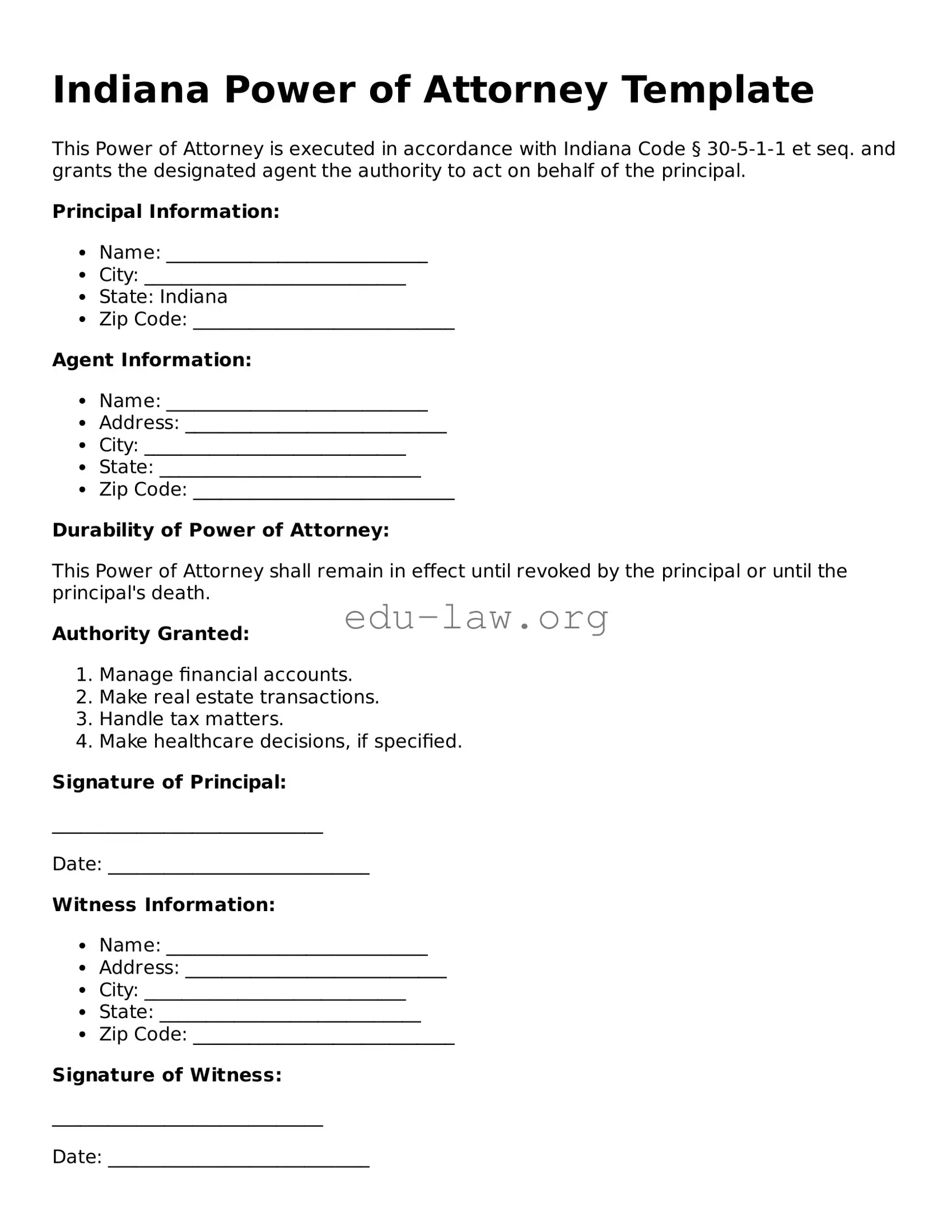
The Indiana Power of Attorney form is a crucial legal document that allows individuals to designate another person to act on their behalf in various matters. This form can cover financial decisions, healthcare choices, or both, depending on the specific needs of the individual. By completing this document, a principal grants authority to an agent, who can then manage financial affairs, make medical decisions, or handle legal matters if the principal becomes incapacitated or unable to make decisions. The form must be signed in the presence of a notary public to ensure its validity. Furthermore, it is essential to understand that the powers granted can be limited or broad, tailored to the specific requirements of the principal. In Indiana, the form also includes provisions for revocation, allowing the principal to withdraw the authority at any time, provided they are mentally competent. This flexibility ensures that individuals can maintain control over their affairs while also preparing for unforeseen circumstances.
Indiana Power of Attorney Template
This Power of Attorney is executed in accordance with Indiana Code § 30-5-1-1 et seq. and grants the designated agent the authority to act on behalf of the principal.
Principal Information:
Agent Information:
Durability of Power of Attorney:
This Power of Attorney shall remain in effect until revoked by the principal or until the principal's death.
Authority Granted:
Signature of Principal:
_____________________________
Date: ____________________________
Witness Information:
Signature of Witness:
_____________________________
Date: ____________________________
Notary Acknowledgment:
State of Indiana
County of ____________________________
Subscribed and sworn before me on this ____ day of ____________, 20__.
_____________________________
Notary Public Signature
My Commission Expires: ________________
| Fact Name | Details |
|---|---|
| Definition | A Power of Attorney (POA) allows one person to act on behalf of another in legal or financial matters. |
| Governing Law | The Indiana Power of Attorney form is governed by Indiana Code Title 30, Article 5. |
| Types | There are various types of POAs, including durable, medical, and limited powers of attorney. |
| Durability | A durable power of attorney remains effective even if the principal becomes incapacitated. |
| Signing Requirements | The form must be signed by the principal and witnessed by at least one person or notarized. |
| Revocation | The principal can revoke the Power of Attorney at any time, as long as they are competent. |
Filling out the Indiana Power of Attorney form is an important step in designating someone to make decisions on your behalf. After completing the form, ensure it is signed and notarized to be legally binding. Below are the steps to guide you through the process.
What is a Power of Attorney in Indiana?
A Power of Attorney (POA) in Indiana is a legal document that allows an individual, known as the principal, to grant authority to another person, called the agent or attorney-in-fact, to make decisions on their behalf. This can include financial matters, healthcare decisions, or other specific tasks as outlined in the document.
What types of Power of Attorney are available in Indiana?
Indiana recognizes several types of Power of Attorney forms. The most common are the General Power of Attorney, which grants broad powers to the agent, and the Limited Power of Attorney, which restricts the agent's authority to specific tasks. Additionally, there is a Healthcare Power of Attorney, specifically for making medical decisions if the principal is unable to do so.
How do I create a Power of Attorney in Indiana?
To create a Power of Attorney in Indiana, the principal must fill out the appropriate form, clearly stating the powers granted to the agent. The document must be signed by the principal in the presence of a notary public or two witnesses. It is advisable to keep copies of the signed document for both the principal and the agent.
Can I revoke a Power of Attorney in Indiana?
Yes, a Power of Attorney can be revoked at any time by the principal, as long as they are mentally competent. To revoke, the principal should create a written notice of revocation and provide it to the agent and any relevant third parties. This ensures that everyone is aware that the authority granted has been terminated.
What happens if the principal becomes incapacitated?
If the principal becomes incapacitated, the Power of Attorney remains in effect unless it is a springing POA, which only activates upon incapacity. The agent can then make decisions on behalf of the principal, as outlined in the document, until the principal is able to resume their own decision-making or until the POA is revoked.
Do I need a lawyer to create a Power of Attorney in Indiana?
While it is not legally required to hire a lawyer to create a Power of Attorney in Indiana, consulting with one can be beneficial. A lawyer can help ensure that the document meets all legal requirements and accurately reflects the principal's wishes, especially if the situation is complex.
Is a Power of Attorney valid in other states?
A Power of Attorney created in Indiana may be valid in other states, but this can depend on the laws of the other state. It is important to check the specific requirements of the state where the POA will be used. Some states may have their own forms or additional requirements that must be met for the document to be recognized.
Not Specifying the Powers Granted: One common mistake is failing to clearly outline the specific powers granted to the agent. This can lead to confusion and disputes later on. It is essential to list the powers in detail to ensure the agent understands their responsibilities.
Incorrectly Identifying the Agent: Another frequent error is misidentifying the agent. The person chosen should be trustworthy and capable. Make sure to provide their full legal name and any necessary identifying information to avoid complications.
Not Signing the Document Properly: A Power of Attorney form must be signed in accordance with state requirements. Failing to sign in front of a notary or witnesses, when required, can render the document invalid. Always check the specific signing requirements for Indiana.
Overlooking Revocation Procedures: Individuals often forget to include instructions for revoking the Power of Attorney. If circumstances change, it is crucial to have a clear process for revocation. This ensures that the original document can be effectively canceled if needed.
When creating a Power of Attorney in Indiana, it’s often beneficial to consider additional forms and documents that can complement this legal tool. These documents can help ensure that your wishes are clearly understood and respected, especially when it comes to managing your affairs.
By considering these additional documents, you can create a comprehensive plan that addresses both your medical and financial needs. This proactive approach can provide peace of mind for you and your loved ones.
The Indiana Power of Attorney form shares similarities with a Living Will, which allows individuals to express their wishes regarding medical treatment in situations where they may no longer be able to communicate. Both documents empower individuals to make decisions about their health care and financial matters, ensuring that their preferences are respected. While the Power of Attorney focuses on financial and legal decisions, the Living Will is specifically tailored to medical scenarios, demonstrating the importance of having clear directives in both areas of life.
Another document akin to the Indiana Power of Attorney is the Healthcare Proxy. This legal instrument designates someone to make health care decisions on behalf of another person if they become incapacitated. Like the Power of Attorney, a Healthcare Proxy emphasizes the importance of appointing a trusted individual to act in one’s best interests. Both documents facilitate the decision-making process during critical times, ensuring that the appointed agents understand and honor the individual’s wishes.
The Advance Directive is also similar to the Indiana Power of Attorney, as it combines elements of both a Living Will and a Healthcare Proxy. This document allows individuals to outline their preferences for medical treatment while simultaneously appointing someone to make decisions on their behalf. This dual function mirrors the comprehensive nature of the Power of Attorney, which addresses both financial and health-related decisions, providing a holistic approach to personal directives.
A Trust Agreement can be compared to the Indiana Power of Attorney in that both documents are used to manage an individual's assets. A Trust Agreement allows a person to place their assets into a trust for the benefit of designated beneficiaries, managed by a trustee. Similarly, the Power of Attorney grants authority to an agent to handle financial matters on behalf of the principal. Both instruments serve to ensure that an individual’s assets are managed according to their wishes, albeit through different mechanisms.
The Will is another document that bears resemblance to the Indiana Power of Attorney. While a Will dictates how a person's assets will be distributed after their death, the Power of Attorney governs decisions made while a person is still alive but incapacitated. Both documents are essential for estate planning, ensuring that an individual’s wishes regarding their property and affairs are respected, whether during their lifetime or after their passing.
A financial Power of Attorney, often a specific subset of the broader Power of Attorney, is closely related to the Indiana version. This document specifically focuses on financial matters, granting authority to an agent to manage financial transactions, pay bills, and handle investments. Like the Indiana Power of Attorney, it is designed to ensure that financial affairs are conducted according to the principal’s wishes, highlighting the importance of having a trusted individual in charge of financial decisions.
The Guardianship document is similar to the Indiana Power of Attorney in that both involve appointing someone to make decisions on behalf of another person. A Guardianship is often established through a court process and is typically used for minors or incapacitated adults. While the Power of Attorney is a voluntary arrangement, Guardianship is usually a legal intervention, underscoring the importance of having a plan in place to manage one’s affairs, whether through personal choice or necessity.
The Affidavit of Heirship is another document that can be likened to the Indiana Power of Attorney, particularly in the context of estate management. This document is used to establish the heirs of a deceased person and can facilitate the transfer of assets without going through probate. While the Power of Attorney is focused on decision-making during a person’s lifetime, both documents play a role in the management and distribution of assets, ensuring that an individual’s wishes are honored after death.
Lastly, the Durable Power of Attorney is a specific type of Power of Attorney that remains in effect even if the principal becomes incapacitated. This document is crucial for ensuring that someone can continue to manage financial and legal matters on behalf of the principal without interruption. Like the Indiana Power of Attorney, the Durable Power of Attorney emphasizes the importance of appointing a trusted agent, ensuring that decisions can be made seamlessly during times of vulnerability.
Filling out a Power of Attorney form in Indiana is a significant step that requires careful attention. Here are some important dos and don’ts to keep in mind:
By following these guidelines, you can help ensure that your Power of Attorney form is filled out correctly and effectively represents your wishes.
Many people have misunderstandings about the Indiana Power of Attorney form. Here are four common misconceptions:
This is not true. While many people use a Power of Attorney for financial decisions, it can also cover health care decisions. You can specify what authority you want to grant, whether it's managing finances, making medical choices, or both.
In reality, you can revoke a Power of Attorney at any time, as long as you are mentally competent. This flexibility allows you to change your mind or update your wishes as your circumstances change.
While consulting a lawyer can be helpful, it is not necessary. You can create a Power of Attorney on your own using the appropriate forms, as long as you understand the requirements and implications.
This misconception overlooks the fact that anyone can become incapacitated due to illness or accidents, regardless of age. Having a Power of Attorney in place ensures that someone you trust can make decisions on your behalf when you cannot.
Understanding the Indiana Power of Attorney form is crucial for anyone considering designating someone to manage their affairs. Here are some key takeaways to keep in mind: