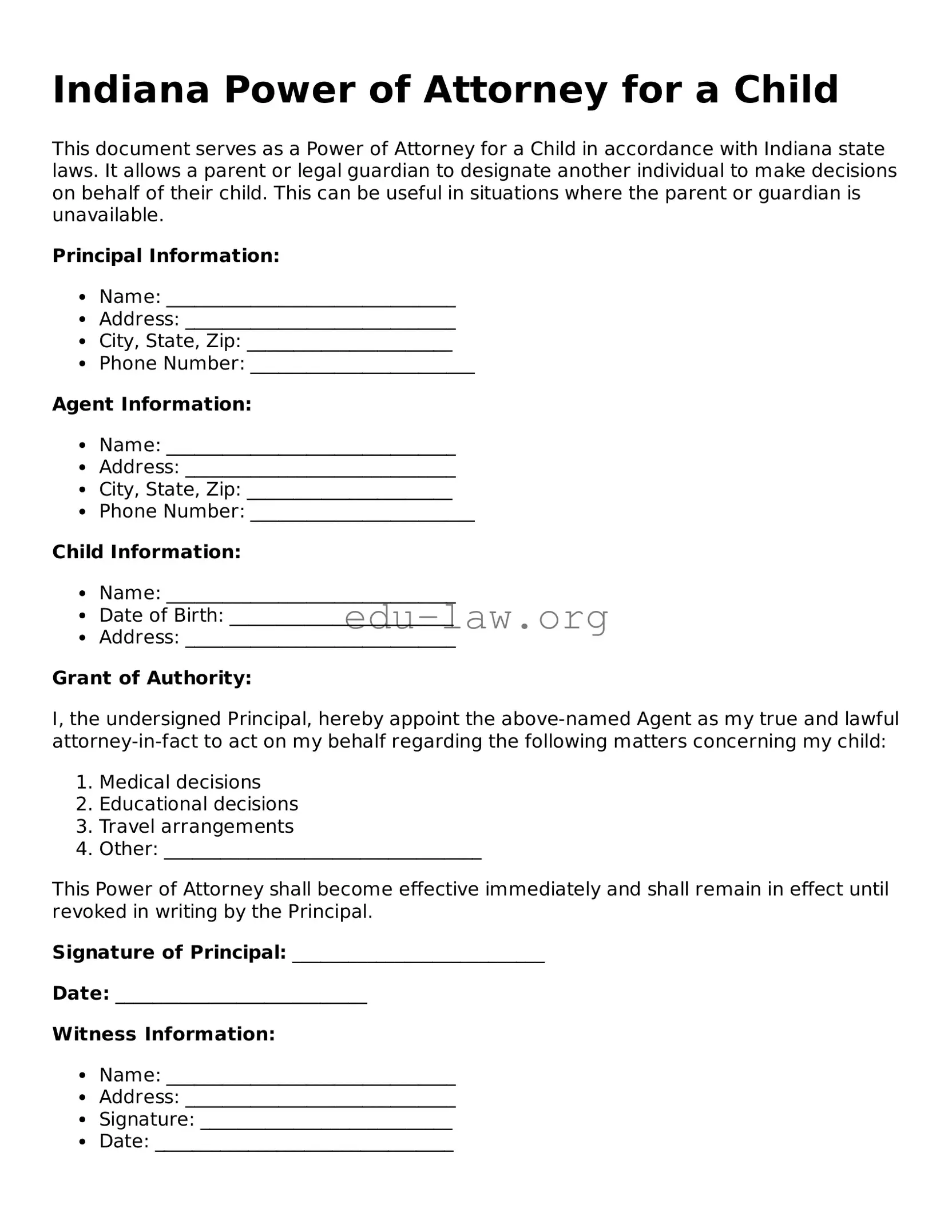
In Indiana, the Power of Attorney for a Child form serves as a crucial legal instrument that empowers a designated adult to make decisions on behalf of a minor child. This form is particularly beneficial for parents or guardians who may find themselves temporarily unable to care for their child due to various circumstances, such as illness, travel, or other commitments. By completing this document, parents can ensure that their child’s needs are met in their absence, allowing another trusted adult to manage everyday responsibilities, including medical decisions, educational choices, and general welfare considerations. The form outlines the specific powers granted to the agent, which can be tailored to suit the unique needs of the family. It also emphasizes the importance of selecting a reliable individual, as this person will play a significant role in the child’s life during the designated period. Understanding the implications and responsibilities associated with this power of attorney is essential for all parties involved, ensuring that the child's best interests remain the top priority.
Indiana Power of Attorney for a Child
This document serves as a Power of Attorney for a Child in accordance with Indiana state laws. It allows a parent or legal guardian to designate another individual to make decisions on behalf of their child. This can be useful in situations where the parent or guardian is unavailable.
Principal Information:
Agent Information:
Child Information:
Grant of Authority:
I, the undersigned Principal, hereby appoint the above-named Agent as my true and lawful attorney-in-fact to act on my behalf regarding the following matters concerning my child:
This Power of Attorney shall become effective immediately and shall remain in effect until revoked in writing by the Principal.
Signature of Principal: ___________________________
Date: ___________________________
Witness Information:
Notary Public:
State of Indiana
County of ___________________________
Subscribed and sworn to before me this _____ day of __________, 20__.
Notary Signature: _______________________________
My Commission Expires: ________________________
| Fact Name | Details |
|---|---|
| Definition | The Indiana Power of Attorney for a Child form allows a parent or guardian to designate another adult to make decisions on behalf of their child. |
| Governing Law | This form is governed by Indiana Code § 30-5-1-1 et seq. |
| Purpose | The primary purpose is to ensure that a trusted individual can care for a child in the absence of the parent or legal guardian. |
| Duration | The authority granted by the form can last for a specific period or until revoked by the parent or guardian. |
| Signature Requirement | The form must be signed by the parent or legal guardian in the presence of a notary public. |
| Revocation | A parent or guardian can revoke the Power of Attorney at any time by providing written notice. |
| Limitations | The form does not grant the agent the authority to make medical decisions unless specified. |
| Additional Considerations | It is advisable to discuss the decision with the child and the appointed agent to ensure clarity and understanding. |
Filling out the Indiana Power of Attorney for a Child form is a straightforward process. This form allows a parent or legal guardian to designate another person to make decisions on behalf of their child. Once completed, it is important to ensure that the designated individual understands their responsibilities and that the document is kept in a safe place.
What is a Power of Attorney for a Child in Indiana?
A Power of Attorney for a Child in Indiana is a legal document that allows a parent or legal guardian to grant authority to another individual to make decisions on behalf of their child. This can include decisions about education, healthcare, and general welfare. It is particularly useful when parents are unable to care for their child temporarily due to travel, illness, or other circumstances.
Who can serve as an attorney-in-fact for my child?
The attorney-in-fact, or the person you designate to make decisions for your child, must be an adult and can be a relative, friend, or any trusted individual. It is essential to choose someone who is responsible and understands your child’s needs. The selected individual will act in the best interest of the child while the Power of Attorney is in effect.
How long does a Power of Attorney for a Child last?
The duration of the Power of Attorney for a Child can vary based on your specific instructions. It can be set for a specific period, such as during a vacation or medical treatment, or until you revoke it. If no end date is specified, it generally remains in effect until the child turns 18 or until you decide to revoke it.
Do I need to have the Power of Attorney for a Child notarized?
Yes, in Indiana, the Power of Attorney for a Child must be signed in the presence of a notary public to be legally valid. This notarization helps ensure that the document is authentic and that the signatures are legitimate. It is advisable to keep a copy of the notarized document for your records as well as provide copies to the attorney-in-fact.
Can I revoke the Power of Attorney for my child once it is established?
Absolutely. As the parent or legal guardian, you have the right to revoke the Power of Attorney at any time. To do so, you should create a written revocation document and notify the attorney-in-fact, as well as any relevant parties, such as schools or healthcare providers. This ensures that everyone is aware that the authority has been terminated.
What if my child has special needs? Can a Power of Attorney still be used?
Yes, a Power of Attorney for a Child can be particularly beneficial for children with special needs. It allows you to designate someone who understands your child's specific requirements and can advocate for their best interests. You may want to include specific instructions in the document regarding medical care, educational decisions, and any other considerations that are important for your child’s unique situation.
Not using the correct form. Always ensure you have the latest version of the Indiana Power of Attorney for a Child form. Using an outdated version can lead to complications.
Missing signatures. Both the parent or guardian and the designated agent must sign the form. A missing signature can invalidate the document.
Failing to provide complete information. Fill in all required fields. Incomplete information can cause delays or issues when the form is needed.
Not specifying the duration. Clearly state how long the power of attorney is valid. Leaving this blank can create confusion about its effectiveness.
Choosing the wrong agent. Select someone trustworthy and capable. The agent will have significant responsibilities, so choose wisely.
Ignoring state-specific requirements. Each state has its own rules. Ensure you understand Indiana's specific requirements for the form to avoid issues.
Not having the document notarized. In Indiana, notarization is often required. Skipping this step can lead to the form being rejected.
Failing to keep copies. Always make copies of the completed form. This is important for your records and can be useful in case of disputes.
Not informing the child. It's essential to explain the situation to the child involved. They should understand who will be caring for them and why.
Neglecting to update the form. Life changes, and so do circumstances. Regularly review and update the power of attorney as needed.
When establishing a Power of Attorney for a Child in Indiana, several additional documents may be necessary to ensure comprehensive legal authority and clarity. These documents can help clarify responsibilities and provide essential information regarding the child's welfare and care.
These documents work together to provide a clear framework for the care and decision-making regarding the child. Properly preparing and organizing these forms can help prevent misunderstandings and ensure that the child's best interests are always prioritized.
The Indiana Power of Attorney for a Child form shares similarities with the General Power of Attorney. Both documents grant authority to an individual to act on behalf of another person. In the case of a General Power of Attorney, this authority can cover a wide range of decisions, including financial and legal matters. However, the Indiana Power of Attorney for a Child is specifically tailored to address the needs of a minor, allowing a designated adult to make decisions related to the child’s care, education, and welfare. This focus on the child's best interests sets it apart from the broader General Power of Attorney.
Another document that resembles the Indiana Power of Attorney for a Child is the Medical Power of Attorney. This form allows an individual to appoint someone else to make medical decisions on their behalf in the event they are unable to do so. Similar to the Power of Attorney for a Child, it ensures that the appointed person can act in the best interest of the individual, whether that be a child or an adult. However, the Medical Power of Attorney is specifically concerned with healthcare-related decisions, while the Indiana form encompasses a wider range of responsibilities, including education and general welfare.
The Guardianship Petition is another document that shares some characteristics with the Indiana Power of Attorney for a Child. A Guardianship Petition is filed in court to obtain legal authority over a minor or an incapacitated adult. While both documents aim to protect the individual’s interests, the Guardianship Petition involves a legal process that grants permanent or long-term authority. In contrast, the Power of Attorney for a Child is a more flexible and often temporary arrangement, allowing parents to designate someone to care for their child without going through the court system.
Lastly, the Child Custody Agreement also has similarities with the Indiana Power of Attorney for a Child. Both documents focus on the care and welfare of a child, ensuring that their needs are met. A Child Custody Agreement is typically established during divorce or separation proceedings to outline parental responsibilities and living arrangements. While the Indiana Power of Attorney allows a designated adult to make decisions for a child, the Child Custody Agreement formalizes the relationship and responsibilities between parents. Both documents emphasize the importance of the child's best interests, but they serve different legal purposes and contexts.
When filling out the Indiana Power of Attorney for a Child form, it’s important to approach the task with care. Here’s a list of things you should and shouldn’t do to ensure the process goes smoothly.
When it comes to the Indiana Power of Attorney for a Child form, several misconceptions can lead to confusion. Understanding these myths is crucial for parents and guardians who wish to ensure their child's well-being in various circumstances. Here are four common misconceptions:
Understanding these misconceptions can help parents and guardians make informed decisions regarding their child's care and ensure that they have the necessary legal protections in place.
Filling out and using the Indiana Power of Attorney for a Child form involves several important considerations. The following key takeaways can guide you through the process.
By following these key takeaways, you can ensure that the Indiana Power of Attorney for a Child form is filled out and utilized effectively, providing peace of mind for both you and the child involved.