The Indiana Notary Acknowledgement form plays a crucial role in the notarization process, ensuring that documents are legally recognized and binding. This form serves as a written statement by a notary public, confirming that a signer has willingly appeared before them and acknowledged their signature on a specific document. It is essential for various legal transactions, including property deeds, contracts, and other agreements, where verification of identity and intent is necessary. The form typically includes important details such as the date of the acknowledgment, the name of the signer, and the notary's official seal. By using this form, individuals can enhance the credibility of their documents, providing assurance to all parties involved that the signatures are authentic and that the signer understood the content of the document. Understanding the nuances of this form can significantly impact the effectiveness of legal proceedings and the enforceability of agreements in Indiana.
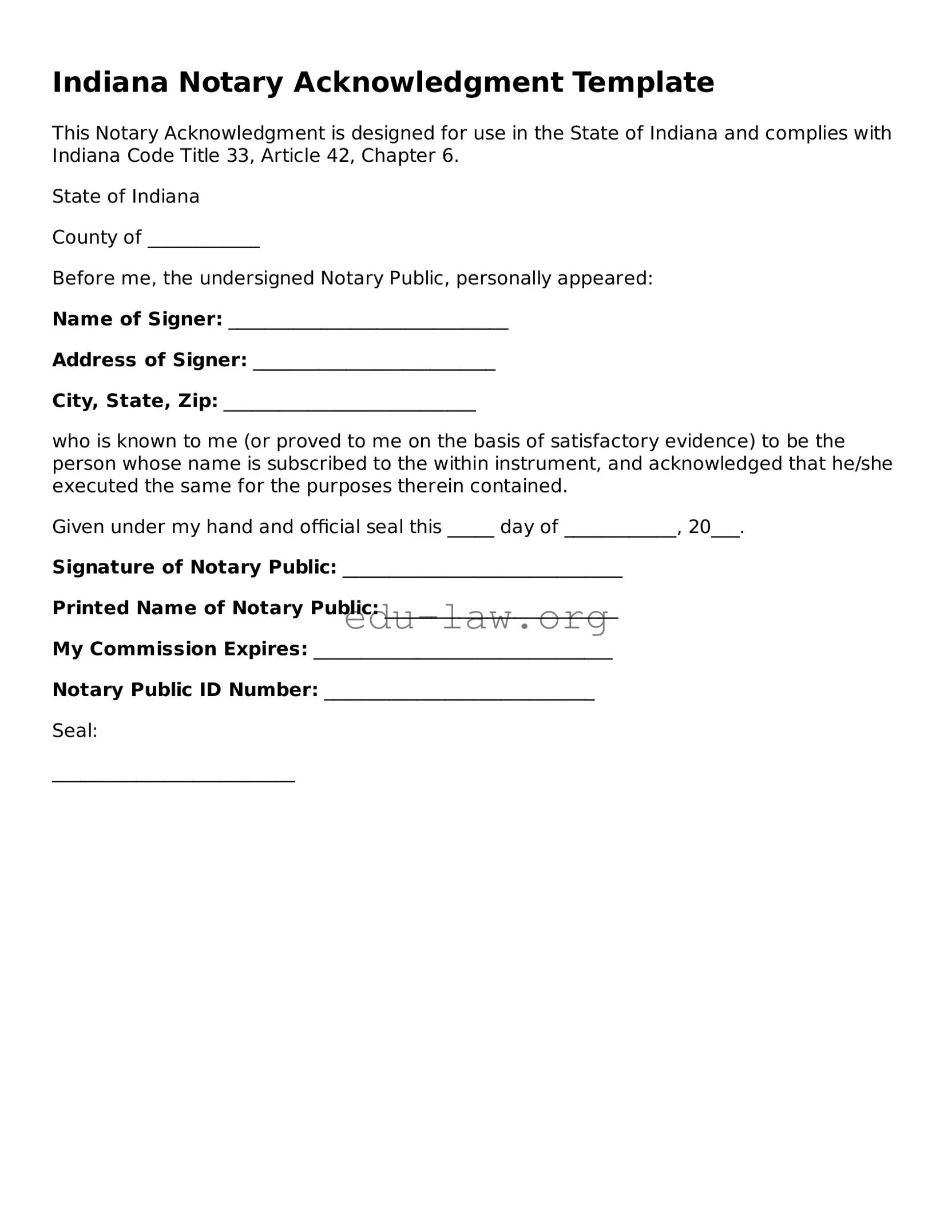
Indiana Notary Acknowledgment Template
This Notary Acknowledgment is designed for use in the State of Indiana and complies with Indiana Code Title 33, Article 42, Chapter 6.
State of Indiana
County of ____________
Before me, the undersigned Notary Public, personally appeared:
Name of Signer: ______________________________
Address of Signer: __________________________
City, State, Zip: ___________________________
who is known to me (or proved to me on the basis of satisfactory evidence) to be the person whose name is subscribed to the within instrument, and acknowledged that he/she executed the same for the purposes therein contained.
Given under my hand and official seal this _____ day of ____________, 20___.
Signature of Notary Public: ______________________________
Printed Name of Notary Public: _________________________
My Commission Expires: ________________________________
Notary Public ID Number: _____________________________
Seal:
__________________________
| Fact Name | Details |
|---|---|
| Purpose | The Indiana Notary Acknowledgement form is used to verify the identity of the signer and their willingness to sign a document voluntarily. |
| Governing Law | This form is governed by Indiana Code § 33-42-4, which outlines the requirements for notarial acts in the state. |
| Signature Requirement | The signer must personally appear before the notary at the time of signing the document. |
| Notary Seal | The notary must affix their official seal to the form, ensuring its authenticity and legality. |
After obtaining the Indiana Notary Acknowledgement form, it is essential to complete it accurately to ensure its validity. Follow these steps to fill out the form correctly.
What is the Indiana Notary Acknowledgement form?
The Indiana Notary Acknowledgement form is a legal document used to verify that a person has signed a document in the presence of a notary public. This form helps ensure the authenticity of the signature and the identity of the signer. It is often used for real estate transactions, legal documents, and other formal agreements.
Who can act as a notary in Indiana?
In Indiana, a notary public must be at least 18 years old, a resident of Indiana or have a place of business in the state, and pass a background check. Notaries are appointed by the state and must complete a training course before they can officially serve.
How do I fill out the Notary Acknowledgement form?
To fill out the form, you will need to provide the name of the person signing the document, the date of the acknowledgment, and the type of document being signed. The notary will then complete their section, which includes their signature, seal, and other identifying information. Ensure that all information is accurate to avoid complications.
Is the Notary Acknowledgement form required for all documents?
No, not all documents require a notary acknowledgment. However, many legal documents, especially those related to real estate, financial transactions, or court proceedings, often do. It’s important to check the specific requirements for the type of document you are dealing with.
What happens if I do not get a document notarized?
If a document that requires notarization is not notarized, it may be considered invalid. This can lead to issues in legal proceedings or when trying to enforce the terms of the document. Always verify whether notarization is necessary for your specific situation.
Can a notary refuse to notarize a document?
Yes, a notary can refuse to notarize a document if they have concerns about the identity of the signer, if the document appears to be incomplete, or if the signer does not understand the document. Notaries have a responsibility to ensure that the process is legitimate and that all parties are acting willingly.
How much does it cost to have a document notarized in Indiana?
The cost of notarization in Indiana can vary. Notaries may charge a fee, which is typically set by state law. As of now, the maximum fee a notary can charge is $10 per signature. It’s advisable to confirm the fee beforehand to avoid any surprises.
How long is a Notary Acknowledgement valid?
The Notary Acknowledgement itself does not expire. However, the document it accompanies may have its own validity period. It’s important to check the specific requirements of the document to ensure it remains enforceable.
Where can I find a notary in Indiana?
You can find a notary in Indiana at various locations, including banks, law offices, and public libraries. Additionally, many notaries offer mobile services and can meet you at a convenient location. You can also search online for notaries in your area.
Failing to include the date of the acknowledgment. This is crucial as it indicates when the notary's services were rendered.
Not having the signer’s name printed clearly. The name must match the identification provided to ensure authenticity.
Omitting the type of identification used by the signer. This helps verify the identity of the individual signing the document.
Forgetting to include the notary’s signature. Without this, the acknowledgment is incomplete and may not be valid.
Neglecting to affix the notary seal. The seal serves as a verification of the notary's authority and the legitimacy of the document.
Using an incorrect notary acknowledgment format. Each state may have specific requirements; using the wrong format can invalidate the document.
Failing to ensure that the signer is present during the acknowledgment. The notary must witness the signing to validate the acknowledgment.
Not keeping a record of the acknowledgment in the notary's journal. This record is important for accountability and future reference.
When engaging in legal transactions, various forms and documents often accompany the Indiana Notary Acknowledgement form. Each of these documents serves a specific purpose, ensuring that the process is clear, organized, and legally sound. Below is a list of common forms that may be utilized alongside the Notary Acknowledgement.
Utilizing these forms in conjunction with the Indiana Notary Acknowledgement can streamline legal processes and provide clarity for all parties involved. Ensuring that each document is properly completed and notarized can significantly reduce the likelihood of future disputes or complications.
The Indiana Notary Acknowledgment form shares similarities with the Affidavit. Both documents require a sworn statement made by an individual before a notary public. In an affidavit, the signer declares the truth of the contents under oath, while the notary verifies the identity of the signer and witnesses the signing. This process ensures that the information is credible and can be relied upon in legal contexts.
Another document akin to the Indiana Notary Acknowledgment is the Power of Attorney. This legal document allows one person to act on behalf of another in legal or financial matters. Like the acknowledgment form, the Power of Attorney must be signed in the presence of a notary. The notary's role is to confirm the identity of the person granting authority and to ensure that the document is executed willingly and without coercion.
The Deed is also similar to the Indiana Notary Acknowledgment form. A deed transfers ownership of property from one party to another. For a deed to be valid, it typically requires notarization. The notary’s function is to confirm the identities of the parties involved and to witness their signatures, which adds a layer of authenticity to the transaction.
The Certification of Document form is another document that resembles the Indiana Notary Acknowledgment. This form is used to verify the authenticity of a document, often for legal or official purposes. A notary public certifies that the copy of the original document is accurate. In both cases, the notary serves as a trusted third party who validates the authenticity of signatures and documents.
Similar to the Indiana Notary Acknowledgment is the Will. A will outlines how a person's assets will be distributed after their death. While not all wills require notarization, having a notary witness the signing can add credibility and help prevent disputes. The notary’s role is to confirm the identity of the testator and ensure that the document is executed according to legal requirements.
Lastly, the Bill of Sale is comparable to the Indiana Notary Acknowledgment form. This document transfers ownership of personal property from one person to another. A notary may be involved to authenticate the transaction, confirming that both parties have agreed to the terms and that the signatures are legitimate. This verification process is essential in preventing fraud and ensuring that the sale is legally binding.
When filling out the Indiana Notary Acknowledgement form, it is important to follow certain guidelines to ensure accuracy and compliance with state requirements. Here are some dos and don'ts to consider:
Many people have misunderstandings about the Indiana Notary Acknowledgement form. Here are four common misconceptions:
Understanding these points can help clarify the role and limitations of the Indiana Notary Acknowledgement form.
When filling out and using the Indiana Notary Acknowledgement form, keep the following key takeaways in mind:
Following these guidelines will help ensure that the notarization process is smooth and compliant with Indiana regulations.