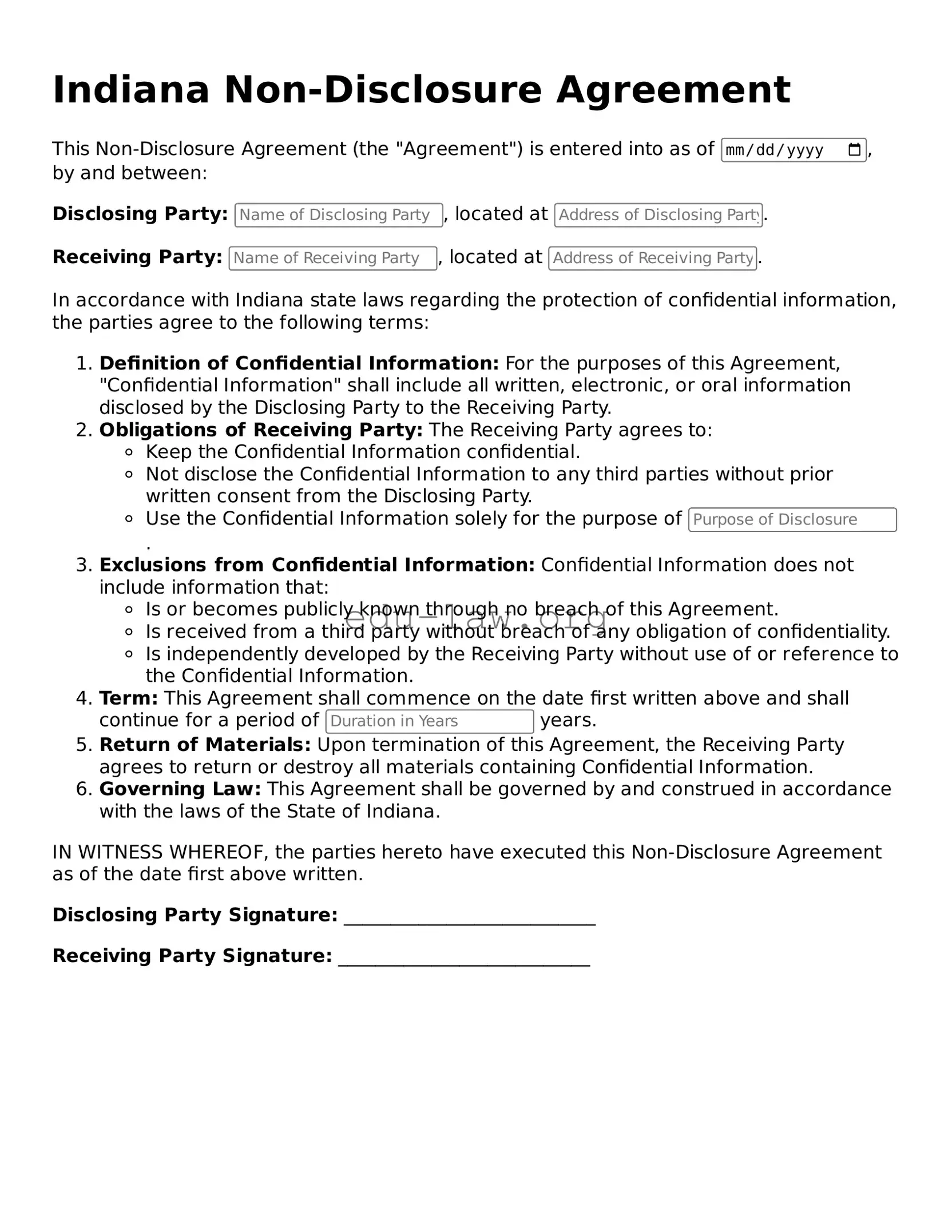
The Indiana Non-disclosure Agreement (NDA) form serves as a crucial tool for individuals and businesses seeking to protect sensitive information. This legal document establishes a confidential relationship between parties, ensuring that proprietary data, trade secrets, and other confidential materials remain secure. Typically, the NDA outlines the specific information deemed confidential, the obligations of the receiving party, and the duration of the confidentiality obligation. It can be utilized in various contexts, such as employment relationships, business partnerships, or during negotiations. By clearly defining what constitutes confidential information and the consequences of unauthorized disclosure, the Indiana NDA helps mitigate risks associated with information leaks. Parties engaging in discussions or collaborations can feel more secure knowing that their proprietary information is legally protected, fostering an environment of trust and openness.
Indiana Non-Disclosure Agreement
This Non-Disclosure Agreement (the "Agreement") is entered into as of , by and between:
Disclosing Party: , located at .
Receiving Party: , located at .
In accordance with Indiana state laws regarding the protection of confidential information, the parties agree to the following terms:
IN WITNESS WHEREOF, the parties hereto have executed this Non-Disclosure Agreement as of the date first above written.
Disclosing Party Signature: ___________________________
Receiving Party Signature: ___________________________
| Fact Name | Description |
|---|---|
| Definition | An Indiana Non-disclosure Agreement (NDA) is a legally binding contract designed to protect confidential information shared between parties. |
| Governing Law | The NDA is governed by Indiana state laws, specifically under the Indiana Uniform Trade Secrets Act. |
| Purpose | It serves to prevent the unauthorized disclosure of sensitive information, which can include trade secrets, business plans, and proprietary data. |
| Parties Involved | The agreement typically involves at least two parties: the disclosing party, who shares the information, and the receiving party, who agrees to keep it confidential. |
| Duration | The duration of confidentiality can vary, but it is common for NDAs to remain in effect for a specified period, often between 1 to 5 years. |
| Enforcement | If a breach occurs, the disclosing party may seek legal remedies, including injunctions and damages, to enforce the terms of the agreement. |
Once you have the Indiana Non-disclosure Agreement form in hand, it’s time to fill it out carefully. Completing this form accurately is essential for ensuring that all parties are on the same page regarding confidentiality. Follow the steps below to guide you through the process.
After completing the form, review it for accuracy. Once all parties have signed, keep copies for future reference. This agreement will serve as a critical document in maintaining confidentiality moving forward.
What is a Non-disclosure Agreement (NDA)?
A Non-disclosure Agreement, commonly referred to as an NDA, is a legal contract that establishes a confidential relationship between two or more parties. It ensures that any sensitive information shared during discussions or collaborations remains protected and cannot be disclosed to unauthorized individuals or entities.
Why should I use an NDA in Indiana?
Using an NDA in Indiana is crucial for protecting your proprietary information. Whether you are a business owner sharing trade secrets, an inventor discussing new ideas, or an employee privy to confidential company data, an NDA safeguards your interests. It provides legal recourse if the other party breaches the agreement.
What types of information can be protected by an NDA?
An NDA can protect various types of information, including business plans, customer lists, financial data, marketing strategies, and proprietary technology. Essentially, any information that is not publicly available and provides a competitive advantage can be safeguarded under an NDA.
How long does the confidentiality obligation last?
The duration of the confidentiality obligation can vary. Typically, NDAs specify a time frame during which the information must remain confidential. This period can range from a few years to indefinitely, depending on the nature of the information and the agreement between the parties involved.
Are there any exceptions to what can be disclosed under an NDA?
Yes, there are certain exceptions. Information that is already public knowledge, independently developed by the receiving party, or disclosed under legal obligations (such as court orders) may not be covered by the NDA. It is important to clearly outline these exceptions in the agreement.
Can an NDA be enforced in Indiana?
Yes, NDAs are enforceable in Indiana as long as they meet certain legal requirements. For an NDA to be valid, it must be clear, reasonable in scope, and not violate public policy. If a breach occurs, the injured party can seek legal remedies, including damages or injunctive relief.
Do I need a lawyer to draft an NDA?
While it is not legally required to have a lawyer draft an NDA, it is highly advisable. A legal professional can help ensure that the agreement is comprehensive, tailored to your specific needs, and compliant with Indiana laws. This can prevent potential issues down the line.
What should I include in an NDA?
An effective NDA should include several key elements: a clear definition of what constitutes confidential information, the obligations of the parties, the duration of the confidentiality, any exceptions to the agreement, and the consequences of a breach. Including these elements can strengthen the enforceability of the NDA.
Can I use a template for my NDA?
Using a template for an NDA can be a convenient starting point. However, it is important to customize the template to fit your specific situation and needs. Generic templates may not address unique aspects of your business or relationship, so careful review and modification are essential.
Not reading the entire agreement thoroughly. Many people skim through the document, missing important clauses that could affect their rights and obligations.
Failing to identify the parties involved. It is crucial to clearly state who is disclosing information and who is receiving it. Ambiguities can lead to confusion later on.
Omitting the definition of confidential information. Without a clear definition, it becomes difficult to determine what information is protected under the agreement.
Neglecting to specify the duration of confidentiality. Not indicating how long the information must remain confidential can lead to misunderstandings.
Not including the purpose of disclosure. Clearly stating why the information is being shared helps to limit its use and protects both parties.
Using vague language. Ambiguous terms can create loopholes that may be exploited. It's important to use precise language to avoid misinterpretation.
Forgetting to include exceptions to confidentiality. There are instances where disclosure may be necessary, such as legal obligations. These should be clearly outlined.
Not having the agreement signed by both parties. An unsigned agreement may be unenforceable, leaving one party unprotected.
Neglecting to keep a copy of the signed agreement. Always retain a copy for your records to ensure you have access to the terms agreed upon.
When entering into a Non-disclosure Agreement (NDA) in Indiana, several other documents may be necessary to ensure comprehensive protection of confidential information. Each of these documents serves a specific purpose and complements the NDA effectively.
Understanding these additional documents can help parties navigate their legal responsibilities effectively. Using the right forms together with the NDA can provide stronger safeguards for sensitive information.
The Indiana Non-disclosure Agreement (NDA) is similar to the Confidentiality Agreement, which serves a similar purpose in protecting sensitive information. Both documents are designed to ensure that parties involved do not disclose proprietary information to outside parties. A Confidentiality Agreement may be used in various contexts, such as employment or partnerships, and often outlines the specific types of information that are considered confidential, just like an NDA. Both documents emphasize the importance of trust and discretion in business relationships.
Another document closely related to the Indiana NDA is the Non-Compete Agreement. While the primary focus of an NDA is on confidentiality, a Non-Compete Agreement restricts an individual from engaging in similar business activities that could harm the interests of their employer or business partner. Both agreements aim to protect business interests, but the Non-Compete Agreement adds an additional layer by preventing competition in the market. This is particularly common in industries where trade secrets are critical to success.
The Non-Disclosure Agreement also shares similarities with a Non-Solicitation Agreement. This type of agreement prevents one party from soliciting the clients or employees of another party. Like an NDA, it seeks to protect the business interests and relationships that have been cultivated over time. The focus here is on maintaining the integrity of the workforce and client base, ensuring that sensitive relationships are not exploited after a business relationship has ended.
A Proprietary Information Agreement is another document that aligns closely with the Indiana NDA. This agreement specifically addresses the protection of proprietary information, which can include trade secrets, formulas, or processes unique to a business. Both agreements require the receiving party to keep this information confidential and outline the consequences of any breaches. They serve to safeguard intellectual property and maintain a competitive edge in the market.
The Mutual Non-Disclosure Agreement is also similar to the Indiana NDA. In this case, both parties agree to protect each other's confidential information. This type of agreement is particularly useful in negotiations where both sides are sharing sensitive information. It establishes a balanced approach to confidentiality, ensuring that neither party feels vulnerable or at risk of having their information disclosed without protection.
Additionally, the Employment Agreement often includes confidentiality clauses that are akin to those found in NDAs. These clauses ensure that employees understand their obligation to keep company information private during and after their employment. While the Employment Agreement covers a broader range of employment terms, the confidentiality aspect is crucial for protecting the company’s interests and trade secrets.
Finally, the Licensing Agreement shares similarities with the Indiana NDA, particularly when it comes to the protection of intellectual property. This document allows one party to use another's intellectual property under specific conditions, often including confidentiality provisions. Both agreements are designed to protect sensitive information and ensure that proprietary rights are not violated, thereby fostering trust between the parties involved.
When filling out the Indiana Non-disclosure Agreement (NDA) form, it’s important to ensure that the information is accurate and complete. Here’s a list of things you should and shouldn’t do:
By following these guidelines, you can help ensure that your NDA is properly completed and legally binding.
When considering the Indiana Non-disclosure Agreement (NDA), several misconceptions may arise. Understanding these can help individuals and businesses navigate the complexities of confidentiality agreements more effectively.
Many believe that only large corporations require NDAs. In reality, any individual or small business that shares sensitive information can benefit from an NDA. These agreements help protect proprietary information, regardless of the size of the entity involved.
While NDAs are designed to be legally binding, there are circumstances where they may not hold up in court. For instance, if the terms are overly broad or unreasonable, a court may choose not to enforce them. It is crucial to draft NDAs carefully to ensure they meet legal standards.
People often think that NDAs are indefinite. However, most NDAs specify a duration for confidentiality obligations. This period can vary based on the nature of the information shared and the agreement between the parties involved.
Some assume that signing an NDA completely prohibits any sharing of information. However, there are exceptions. For example, disclosures may be permitted if required by law or if the information becomes public through no fault of the receiving party.
When dealing with sensitive information in Indiana, using a Non-disclosure Agreement (NDA) is essential. Here are some key takeaways to consider when filling out and using the Indiana Non-disclosure Agreement form:
By keeping these points in mind, individuals and businesses can effectively use the Indiana Non-disclosure Agreement to safeguard their sensitive information.