In the competitive landscape of today's job market, protecting business interests while fostering employee mobility is a delicate balance. Indiana's Non-compete Agreement form serves as a crucial tool for employers seeking to safeguard their proprietary information and trade secrets. This form outlines the terms under which an employee agrees not to engage in similar work or start a competing business within a specified geographic area and time frame after leaving their current position. Key components of the agreement typically include the duration of the restriction, the geographical scope, and the specific activities that are prohibited. Employers must ensure that the terms are reasonable and not overly restrictive, as Indiana courts evaluate these agreements based on their fairness and necessity for protecting legitimate business interests. Additionally, employees should be aware of their rights and the implications of signing such agreements, as they can significantly impact future employment opportunities. Understanding the nuances of the Indiana Non-compete Agreement form is essential for both employers and employees navigating this complex legal landscape.
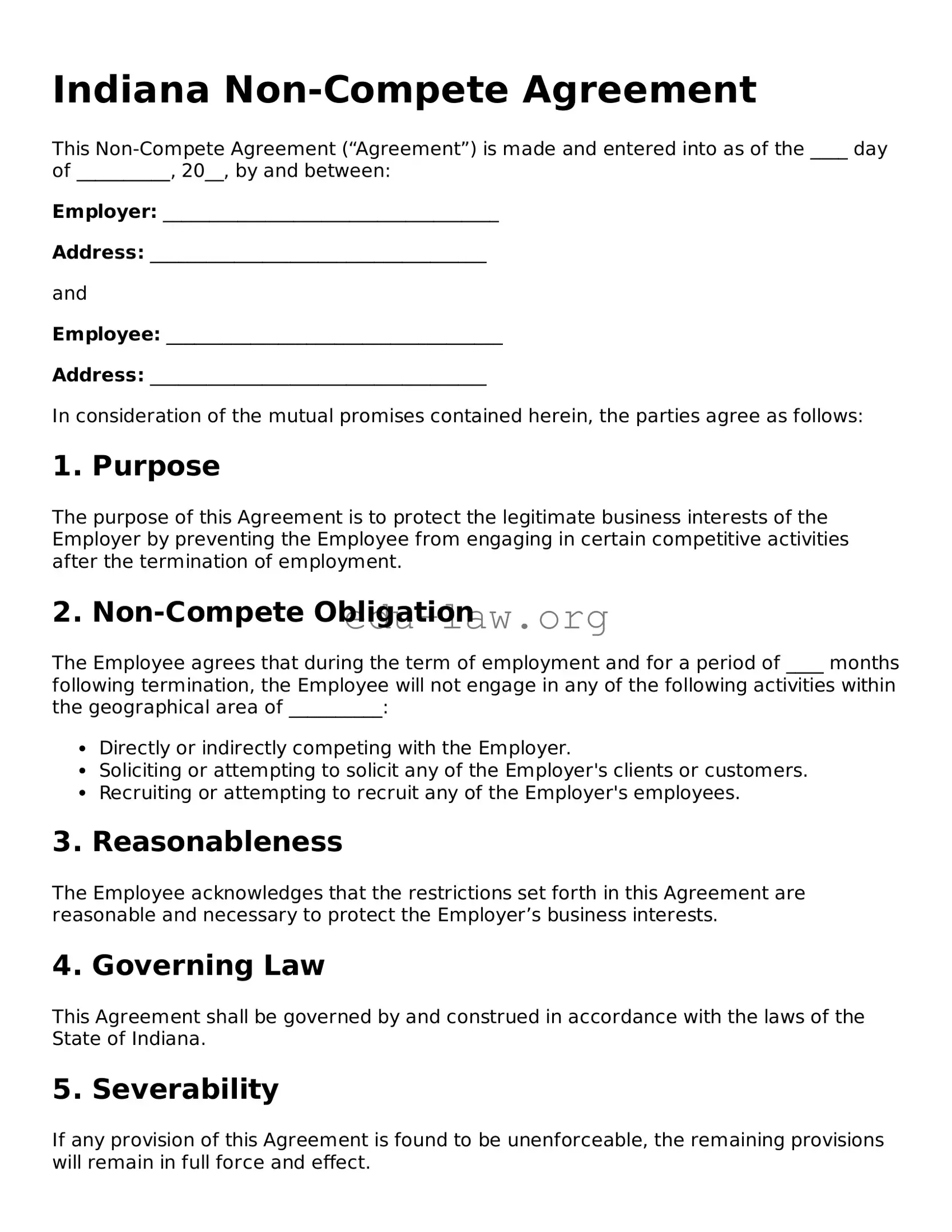
Indiana Non-Compete Agreement
This Non-Compete Agreement (“Agreement”) is made and entered into as of the ____ day of __________, 20__, by and between:
Employer: ____________________________________
Address: ____________________________________
and
Employee: ____________________________________
Address: ____________________________________
In consideration of the mutual promises contained herein, the parties agree as follows:
1. Purpose
The purpose of this Agreement is to protect the legitimate business interests of the Employer by preventing the Employee from engaging in certain competitive activities after the termination of employment.
2. Non-Compete Obligation
The Employee agrees that during the term of employment and for a period of ____ months following termination, the Employee will not engage in any of the following activities within the geographical area of __________:
3. Reasonableness
The Employee acknowledges that the restrictions set forth in this Agreement are reasonable and necessary to protect the Employer’s business interests.
4. Governing Law
This Agreement shall be governed by and construed in accordance with the laws of the State of Indiana.
5. Severability
If any provision of this Agreement is found to be unenforceable, the remaining provisions will remain in full force and effect.
6. Entire Agreement
This Agreement constitutes the entire understanding between the parties regarding the subject matter hereof and supersedes all prior agreements and understandings.
7. Signatures
IN WITNESS WHEREOF, the parties have executed this Non-Compete Agreement as of the date first above written.
Employer Signature: ___________________________
Date: ______________________________________
Employee Signature: ___________________________
Date: ______________________________________
| Fact Name | Details |
|---|---|
| Governing Law | Indiana Code Title 24, Article 2, Chapter 8 |
| Enforceability | Non-compete agreements in Indiana are enforceable if they are reasonable in duration, geographic area, and scope of activity. |
| Consideration Requirement | Indiana requires that non-compete agreements be supported by adequate consideration, such as employment or a promotion. |
| Duration Limitations | Typically, non-compete agreements should not exceed two years in duration to be considered reasonable. |
Completing the Indiana Non-compete Agreement form requires careful attention to detail. This document is essential for outlining the terms of the agreement between the employer and employee regarding post-employment restrictions. Follow these steps to ensure accurate completion of the form.
Once the form is completed and signed by both parties, it is advisable to keep copies for personal records. This ensures that both the employer and employee have access to the agreed-upon terms in the future.
What is a Non-compete Agreement in Indiana?
A Non-compete Agreement is a legal contract between an employer and an employee. It restricts the employee from engaging in activities that compete with the employer’s business for a specified period after leaving the company. This agreement is designed to protect the employer's trade secrets, business relationships, and competitive advantage.
Are Non-compete Agreements enforceable in Indiana?
Yes, Non-compete Agreements can be enforceable in Indiana, but they must meet specific criteria. The agreement should be reasonable in scope, duration, and geographic area. Courts will evaluate whether the restrictions are necessary to protect legitimate business interests without unduly restricting the employee's ability to find work.
How long can a Non-compete Agreement last in Indiana?
The duration of a Non-compete Agreement in Indiana should be reasonable. Typically, agreements lasting one to two years are viewed as acceptable. However, longer durations may be enforceable if justified by the nature of the business and the employee's role.
What are the geographic limitations of a Non-compete Agreement?
Geographic limitations in a Non-compete Agreement should be reasonable and directly related to the employer's business interests. For instance, if an employee works for a local company, a restriction within the same city or region may be appropriate. However, overly broad restrictions that hinder the employee's ability to work in a larger area could be challenged in court.
Can an employee negotiate a Non-compete Agreement?
Absolutely! Employees have the right to negotiate the terms of a Non-compete Agreement before signing. Discussing the duration, geographic scope, and specific restrictions can lead to a more balanced agreement. It's essential for employees to understand the implications of the agreement fully.
What happens if a Non-compete Agreement is violated?
If a Non-compete Agreement is violated, the employer may take legal action against the former employee. This could involve seeking an injunction to prevent the employee from working for a competitor or pursuing damages for any losses incurred due to the violation. The outcome often depends on the agreement's enforceability and the specific circumstances surrounding the case.
Can a Non-compete Agreement be terminated?
Yes, a Non-compete Agreement can be terminated under certain conditions. Both parties can mutually agree to terminate the agreement, or it may become void if the employer does not enforce it within a reasonable time frame. Additionally, if the employee is laid off or terminated without cause, the agreement may also be challenged.
Should I seek legal advice before signing a Non-compete Agreement?
Yes, seeking legal advice before signing a Non-compete Agreement is highly recommended. An attorney can help you understand the implications of the agreement and ensure that your rights are protected. This step is crucial, especially if you have concerns about the terms or potential impact on your future employment opportunities.
Failing to clearly define the scope of the agreement. It is crucial to specify what activities are restricted to avoid ambiguity.
Not specifying the duration of the non-compete clause. A clear timeframe helps both parties understand the limits of the agreement.
Overlooking the geographic area covered by the agreement. The area should be reasonable and relevant to the business interests involved.
Using vague language. Clarity is essential. Terms should be straightforward to prevent misunderstandings.
Neglecting to include consideration. This refers to what the employee receives in exchange for signing the agreement, such as employment or a promotion.
Failing to review state laws. Each state has specific regulations regarding non-compete agreements. Ensure compliance with Indiana laws.
Not consulting a legal professional. Seeking advice can prevent costly mistakes and ensure the agreement is enforceable.
When entering into a Non-compete Agreement in Indiana, several other documents may accompany it to ensure clarity and enforceability. Each of these documents serves a specific purpose and can help both parties understand their rights and obligations. Below is a list of commonly used forms and documents that may be relevant.
Incorporating these documents alongside a Non-compete Agreement can provide a comprehensive framework for protecting both parties' interests. Understanding each document's role is essential for ensuring a smooth and legally sound working relationship.
The Indiana Non-compete Agreement form shares similarities with the Employment Agreement. Both documents outline the terms of the working relationship between an employer and an employee. While the Employment Agreement typically includes details about job responsibilities, compensation, and benefits, it often incorporates non-compete clauses to protect the employer's business interests. This ensures that employees do not engage in competitive activities that could harm the company after leaving their position.
Another document that resembles the Indiana Non-compete Agreement is the Confidentiality Agreement, often referred to as a Non-disclosure Agreement (NDA). Both documents aim to protect sensitive information. The Confidentiality Agreement focuses on safeguarding proprietary information, trade secrets, and other confidential data. In contrast, the Non-compete Agreement restricts an individual's ability to work in similar fields or industries after leaving a company. Together, they create a comprehensive framework for protecting a business's intellectual property and competitive edge.
The Partnership Agreement is also akin to the Indiana Non-compete Agreement. This document outlines the terms and conditions governing a partnership between two or more parties. Like non-compete agreements, Partnership Agreements often include clauses that restrict partners from engaging in competing businesses during and after the partnership. Such provisions help maintain the integrity of the partnership and prevent conflicts of interest, ensuring that all parties remain committed to the partnership's success.
Similar to the Indiana Non-compete Agreement is the Independent Contractor Agreement. This document is used when hiring freelancers or independent contractors. It defines the scope of work, payment terms, and other responsibilities. Often, these agreements include non-compete clauses to prevent contractors from working with direct competitors during or after the contract period. This protects the hiring company’s interests while allowing contractors to operate independently.
Lastly, the Franchise Agreement bears resemblance to the Indiana Non-compete Agreement. A Franchise Agreement outlines the relationship between a franchisor and a franchisee. It includes various terms, including operational guidelines, brand usage, and territory restrictions. Non-compete provisions are often included to prevent franchisees from opening competing businesses within a specified area. This helps maintain brand integrity and ensures that franchisees do not undermine the franchisor’s business model.
When filling out the Indiana Non-compete Agreement form, it is essential to approach the task with care. Here are some important dos and don'ts to keep in mind:
Non-compete agreements are often misunderstood, particularly in Indiana. Here are six common misconceptions about the Indiana Non-compete Agreement form:
This is not true. While non-compete agreements can be enforceable, they must meet certain criteria. They should be reasonable in scope, duration, and geographic area. If they are overly restrictive, a court may refuse to enforce them.
Not every employee is required to sign a non-compete agreement. Employers often reserve these agreements for key employees or those with access to sensitive information. Many positions do not warrant such restrictions.
This is a misconception. A well-drafted non-compete agreement should not completely prevent an employee from working in their field. Instead, it may limit them from working with direct competitors or in specific geographic areas for a certain period.
This is misleading. Signing a non-compete agreement does not bind an employee to their job indefinitely. Employees can still leave their positions; they just need to understand the potential limitations on their future employment.
These agreements serve different purposes. A non-compete agreement restricts an employee from working for competitors, while a non-disclosure agreement protects confidential information. Both are important but address different concerns.
This is a common belief, but non-compete agreements can apply to various positions. Even entry-level employees may be asked to sign these agreements, especially in industries where trade secrets or client relationships are involved.
When considering a Non-compete Agreement in Indiana, it's essential to understand its implications and requirements. Here are some key takeaways to keep in mind:
By keeping these points in mind, you can better navigate the process of creating and using a Non-compete Agreement in Indiana.