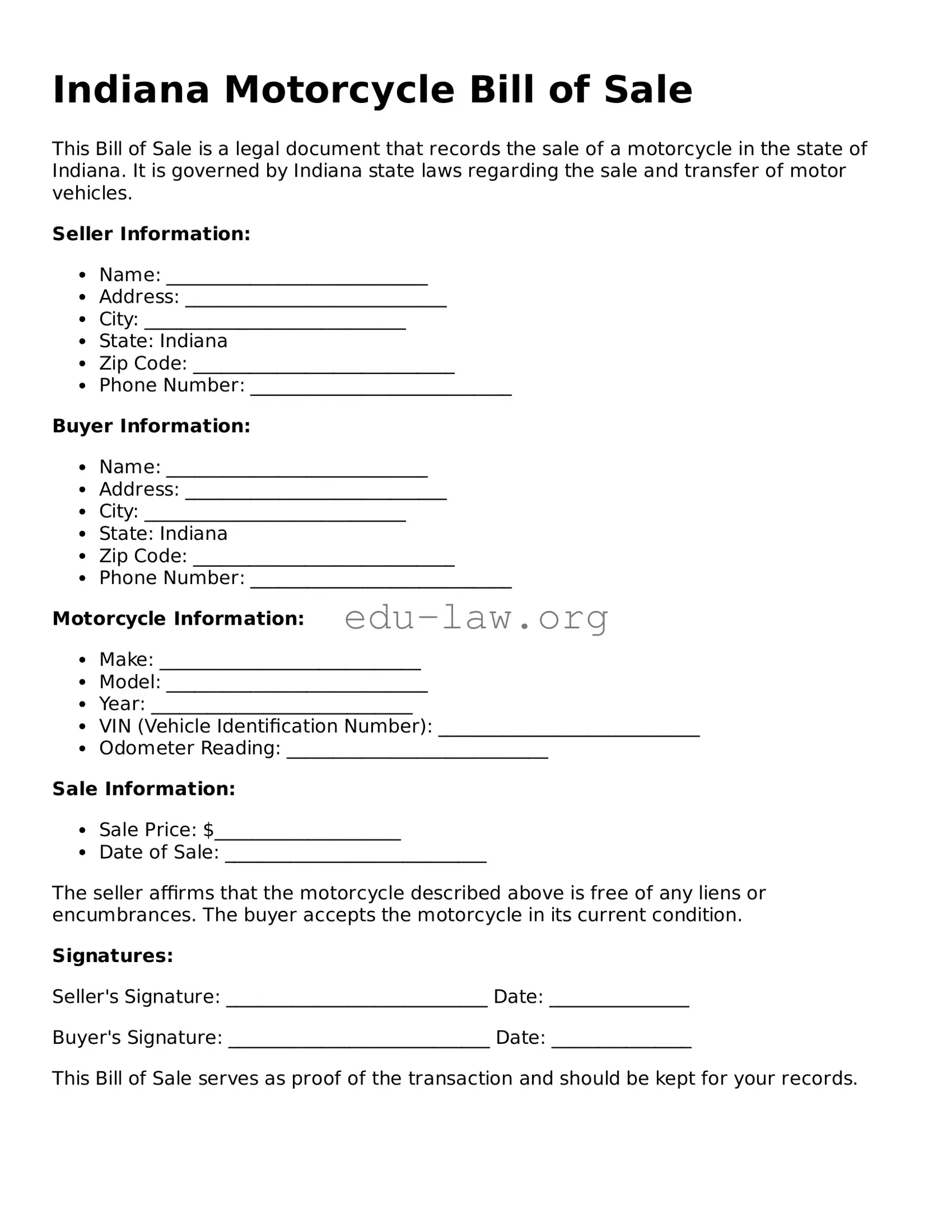
When buying or selling a motorcycle in Indiana, having the right documentation is crucial for a smooth transaction. One essential document you’ll need is the Motorcycle Bill of Sale form. This form serves as a legal record of the sale, detailing important information such as the buyer's and seller's names, contact information, and the motorcycle's make, model, year, and Vehicle Identification Number (VIN). It also outlines the sale price and any terms agreed upon by both parties. By completing this form, you not only protect yourself but also ensure that the transfer of ownership is clear and recognized by the state. Additionally, this document can be helpful for future reference, such as when registering the motorcycle or for insurance purposes. Understanding the importance of this form can make the buying or selling process more straightforward and secure for everyone involved.
Indiana Motorcycle Bill of Sale
This Bill of Sale is a legal document that records the sale of a motorcycle in the state of Indiana. It is governed by Indiana state laws regarding the sale and transfer of motor vehicles.
Seller Information:
Buyer Information:
Motorcycle Information:
Sale Information:
The seller affirms that the motorcycle described above is free of any liens or encumbrances. The buyer accepts the motorcycle in its current condition.
Signatures:
Seller's Signature: ____________________________ Date: _______________
Buyer's Signature: ____________________________ Date: _______________
This Bill of Sale serves as proof of the transaction and should be kept for your records.
| Fact Name | Details |
|---|---|
| Purpose | The Indiana Motorcycle Bill of Sale form serves as a legal document to record the sale and transfer of ownership of a motorcycle. |
| Governing Law | This form is governed by Indiana Code Title 9, Article 17, which pertains to motor vehicles. |
| Required Information | The form typically requires details such as the buyer's and seller's names, addresses, and motorcycle information including make, model, and VIN. |
| Signatures | Both the buyer and seller must sign the form to validate the transaction. |
| Notarization | While notarization is not mandatory, it is recommended for added legal protection. |
| Record Keeping | It is advisable for both parties to keep a copy of the bill of sale for their records. |
| Tax Implications | The sale may be subject to sales tax, which should be calculated based on the purchase price. |
| Transfer of Title | The bill of sale is often required when applying for a new title with the Indiana Bureau of Motor Vehicles. |
| Use in Disputes | This document can serve as evidence in case of disputes regarding ownership or the terms of sale. |
Once you have the Indiana Motorcycle Bill of Sale form in hand, you'll need to provide specific information to ensure a smooth transaction. This document is essential for transferring ownership and can be used for registration purposes. Follow the steps below to complete the form accurately.
After completing the form, both parties should retain a copy for their records. This will help ensure clarity regarding the transaction in the future.
What is a Motorcycle Bill of Sale in Indiana?
A Motorcycle Bill of Sale is a legal document that serves as proof of the sale and transfer of ownership of a motorcycle. This document outlines the details of the transaction, including the buyer and seller's information, the motorcycle's description, and the sale price. It is essential for both parties to ensure a smooth transfer of ownership and to protect their rights in case of any disputes in the future.
Is a Motorcycle Bill of Sale required in Indiana?
While a Motorcycle Bill of Sale is not legally mandated in Indiana, it is highly recommended. Having this document can help clarify the terms of the sale and provide evidence of ownership transfer. Additionally, when registering the motorcycle with the Indiana Bureau of Motor Vehicles (BMV), a Bill of Sale can facilitate the registration process and serve as proof of purchase.
What information should be included in the Motorcycle Bill of Sale?
The Motorcycle Bill of Sale should include several key pieces of information. This includes the names and addresses of both the buyer and seller, the motorcycle's make, model, year, and Vehicle Identification Number (VIN). The sale price and date of the transaction should also be clearly stated. It is advisable to include a statement indicating that the motorcycle is being sold "as-is," which clarifies that the seller is not responsible for any future repairs or issues.
Do I need to have the Motorcycle Bill of Sale notarized?
Notarization is not required for a Motorcycle Bill of Sale in Indiana; however, having the document notarized can provide an additional layer of protection for both the buyer and seller. Notarization can help verify the identities of the parties involved and ensure that the signatures are authentic, which can be beneficial in case of future disputes.
Can I use a generic Bill of Sale template for my motorcycle?
Yes, you can use a generic Bill of Sale template for your motorcycle transaction, but it is essential to ensure that it includes all the necessary information specific to your sale. Customizing the template to reflect the details of your motorcycle and the terms of the sale will help avoid any potential misunderstandings or issues later on.
What if the motorcycle has a lien on it?
If the motorcycle has a lien, it is crucial to address this before completing the sale. The seller should inform the buyer about the lien and work with the lienholder to pay off the debt. Once the lien is cleared, the seller can provide a lien release document, which should be included with the Motorcycle Bill of Sale. This ensures that the buyer receives a clear title to the motorcycle.
How do I register my motorcycle after purchasing it?
After purchasing a motorcycle, the buyer must register it with the Indiana Bureau of Motor Vehicles (BMV). To do this, the buyer will need to provide the Motorcycle Bill of Sale, proof of identity, and any other required documentation, such as proof of insurance. It is advisable to complete the registration process within 60 days of the purchase to avoid any late fees or penalties.
What should I do if I lose my Motorcycle Bill of Sale?
If you lose your Motorcycle Bill of Sale, it is important to act quickly. If you are the buyer, contact the seller and request a duplicate copy. If you are the seller, consider drafting a new Bill of Sale and having both parties sign it again. Keeping a copy of all important documents, including the Bill of Sale, in a safe place can help prevent future issues.
Are there any tax implications when selling or buying a motorcycle?
Yes, there can be tax implications when buying or selling a motorcycle in Indiana. The buyer is typically responsible for paying sales tax on the purchase price when registering the motorcycle. It is important for both parties to be aware of their responsibilities regarding taxes, as failure to comply could result in penalties or fines.
Incomplete Information: Many individuals fail to provide all required details. This includes the names and addresses of both the buyer and seller, as well as the motorcycle's identification number (VIN). Incomplete forms can lead to delays in registration.
Incorrect VIN: Entering the wrong VIN is a common mistake. This number must match the one on the motorcycle's title. A mismatch can cause issues with ownership verification.
Not Including Sale Price: Some people neglect to indicate the sale price of the motorcycle. This figure is crucial for tax purposes and may be necessary for the buyer's future registration.
Failure to Sign: Both parties must sign the document for it to be valid. Forgetting to sign can render the bill of sale ineffective, complicating the transfer of ownership.
Not Keeping Copies: After completing the form, individuals often forget to keep copies for their records. Retaining a copy is essential for both parties in case of disputes or future transactions.
When purchasing or selling a motorcycle in Indiana, several important documents accompany the Motorcycle Bill of Sale. These documents help ensure that the transaction is legally sound and provide necessary information for both parties involved. Below is a list of commonly used forms that complement the Motorcycle Bill of Sale.
Each of these documents plays a crucial role in the motorcycle buying and selling process in Indiana. They help protect the interests of both the buyer and the seller, ensuring a smooth and legally compliant transaction. Understanding these forms can simplify the process and provide peace of mind for all parties involved.
The Indiana Motorcycle Bill of Sale form shares similarities with the Vehicle Bill of Sale. Both documents serve as proof of the transfer of ownership from one party to another. They include essential details such as the buyer's and seller's names, addresses, and signatures. Additionally, both forms typically outline the vehicle's identification number (VIN) and the sale price. This ensures that the transaction is documented clearly and can be referenced in the future if needed.
Another document that resembles the Motorcycle Bill of Sale is the Boat Bill of Sale. Like the motorcycle version, this form is used to transfer ownership of a boat from one individual to another. It contains similar information, including the names and addresses of the parties involved, a description of the boat, and the sale price. Both documents serve to protect the interests of both the buyer and the seller by providing a legal record of the transaction.
The ATV Bill of Sale is also comparable to the Motorcycle Bill of Sale. All-terrain vehicles (ATVs) require a bill of sale to document their sale and transfer of ownership. This form captures essential details, such as the buyer's and seller's information, a description of the ATV, and the sale price. By using this document, both parties can ensure that the transaction is legitimate and traceable.
Similarly, the Snowmobile Bill of Sale functions in much the same way. This document is specifically designed for the sale of snowmobiles. It includes information about the buyer and seller, a description of the snowmobile, and the agreed-upon sale price. Just like the Motorcycle Bill of Sale, this form provides a clear record of ownership transfer, which is crucial for both parties.
The Trailer Bill of Sale is another document that parallels the Motorcycle Bill of Sale. When a trailer changes hands, a bill of sale is often used to document the transaction. This form includes the necessary details about the buyer and seller, as well as a description of the trailer and its sale price. It serves the same purpose as the Motorcycle Bill of Sale by providing a legal record of the ownership transfer.
The Car Bill of Sale shares many characteristics with the Motorcycle Bill of Sale. Both documents are essential for transferring ownership of a vehicle, whether it be a motorcycle or a car. They require the same type of information, such as the buyer's and seller's names, vehicle identification number, and sale price. This documentation helps ensure that the transaction is transparent and legally binding.
Another similar document is the RV Bill of Sale. This form is used for the sale of recreational vehicles. It contains the same key elements as the Motorcycle Bill of Sale, including buyer and seller information, a description of the RV, and the sale price. Both documents help establish a clear record of ownership transfer, which is vital for registration and legal purposes.
Lastly, the Mobile Home Bill of Sale is akin to the Motorcycle Bill of Sale in that it facilitates the transfer of ownership for mobile homes. This document captures essential details, such as the names and addresses of the buyer and seller, a description of the mobile home, and the sale price. Like the Motorcycle Bill of Sale, it serves to protect both parties by providing a formal record of the transaction.
When filling out the Indiana Motorcycle Bill of Sale form, it's important to get it right. Here are five things you should and shouldn't do:
Following these guidelines will help ensure that your transaction goes smoothly and is legally binding.
The Indiana Motorcycle Bill of Sale form is an important document for anyone buying or selling a motorcycle in Indiana. However, several misconceptions surround this form. Here are nine common misunderstandings:
Understanding these misconceptions can help ensure a smoother transaction when buying or selling a motorcycle in Indiana.
When it comes to buying or selling a motorcycle in Indiana, using a Motorcycle Bill of Sale form is crucial. Here are some key takeaways to keep in mind:
By following these guidelines, you can ensure a smooth transaction when buying or selling a motorcycle in Indiana.