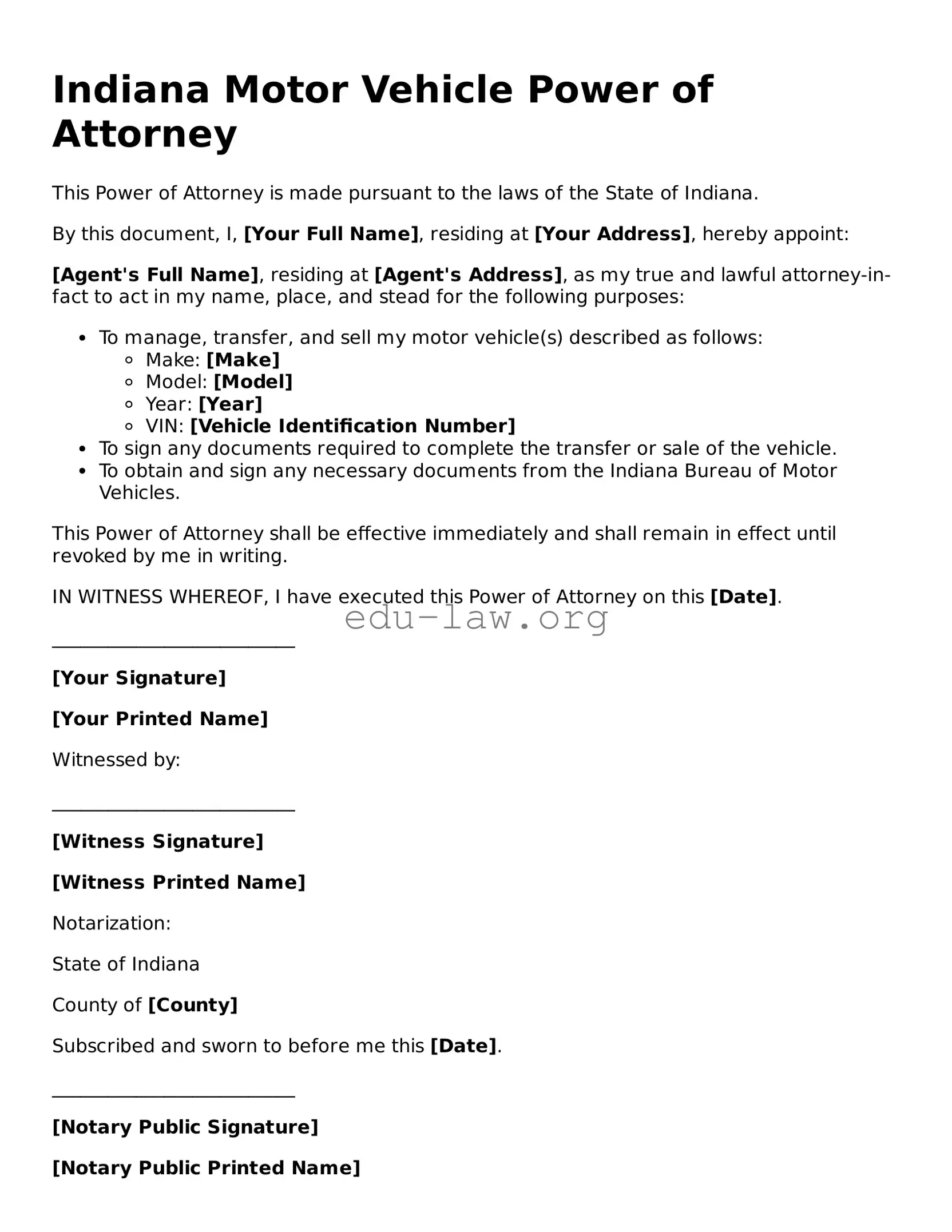
When it comes to managing your vehicle-related affairs in Indiana, the Motor Vehicle Power of Attorney form is an essential tool that can simplify the process. This form allows you to designate another individual—often referred to as your agent—to act on your behalf regarding various motor vehicle transactions. Whether you need to transfer ownership, register a vehicle, or handle title issues, this document grants your agent the authority to take care of these tasks efficiently and effectively. It’s important to ensure that the form is completed accurately, as any errors could lead to delays or complications. Additionally, understanding the specific powers you are granting and the duration of this authority can help prevent misunderstandings down the road. With the right preparation, you can ensure that your vehicle-related matters are handled smoothly, even when you cannot be present to manage them yourself.
Indiana Motor Vehicle Power of Attorney
This Power of Attorney is made pursuant to the laws of the State of Indiana.
By this document, I, [Your Full Name], residing at [Your Address], hereby appoint:
[Agent's Full Name], residing at [Agent's Address], as my true and lawful attorney-in-fact to act in my name, place, and stead for the following purposes:
This Power of Attorney shall be effective immediately and shall remain in effect until revoked by me in writing.
IN WITNESS WHEREOF, I have executed this Power of Attorney on this [Date].
__________________________
[Your Signature]
[Your Printed Name]
Witnessed by:
__________________________
[Witness Signature]
[Witness Printed Name]
Notarization:
State of Indiana
County of [County]
Subscribed and sworn to before me this [Date].
__________________________
[Notary Public Signature]
[Notary Public Printed Name]
My commission expires: [Expiration Date]
| Fact Name | Description |
|---|---|
| Purpose | The Indiana Motor Vehicle Power of Attorney form allows an individual to designate another person to act on their behalf regarding motor vehicle transactions. |
| Governing Law | This form is governed by Indiana Code Title 32, Article 21, which outlines powers of attorney in the state. |
| Principal | The individual granting authority is referred to as the principal. |
| Agent | The person receiving authority to act is known as the agent or attorney-in-fact. |
| Vehicle Transactions | The form can be used for various transactions, including title transfers, registration, and obtaining license plates. |
| Signature Requirement | The principal must sign the form to validate the authority granted to the agent. |
| Notarization | While notarization is not strictly required, it is recommended to enhance the form's credibility. |
| Revocation | The principal can revoke the power of attorney at any time, provided they notify the agent and any relevant parties. |
| Duration | The power of attorney remains effective until revoked by the principal or until the principal's death. |
| Usage | This form is commonly used by individuals who cannot be present for vehicle transactions due to various reasons, such as being out of state. |
Filling out the Indiana Motor Vehicle Power of Attorney form requires careful attention to detail. After completing the form, it will need to be submitted according to state guidelines to ensure that the designated agent can act on your behalf regarding motor vehicle matters.
What is the Indiana Motor Vehicle Power of Attorney form?
The Indiana Motor Vehicle Power of Attorney form is a legal document that allows one person to authorize another to act on their behalf regarding motor vehicle transactions. This can include tasks like signing documents for the sale or transfer of a vehicle, registering a vehicle, or obtaining a title. It is particularly useful when the vehicle owner cannot be present to handle these matters themselves.
Who can be designated as an attorney-in-fact in this form?
Any competent adult can be designated as an attorney-in-fact. This means that the person you choose should be someone you trust, as they will have the authority to make decisions and sign documents related to your motor vehicle. This could be a family member, friend, or even a professional, such as a lawyer or a notary public.
How do I complete the Indiana Motor Vehicle Power of Attorney form?
To complete the form, you will need to provide specific information about yourself, the person you are granting authority to, and details about the vehicle in question. This typically includes the vehicle identification number (VIN), make, model, and year. After filling out the form, both parties should sign it. It’s advisable to have the signatures notarized to ensure the document is valid and recognized by authorities.
Is the Indiana Motor Vehicle Power of Attorney form valid in other states?
The Indiana Motor Vehicle Power of Attorney form is specifically designed for use within Indiana. While some states may recognize similar documents, it’s essential to check the specific laws in the state where you plan to use the form. If you need to conduct vehicle transactions in another state, you may need to complete that state’s version of a power of attorney form to ensure compliance with their regulations.
Failing to provide complete information about the principal. This includes not including the full name, address, and contact details.
Not specifying the exact powers granted to the agent. It is essential to clearly outline what the agent can do regarding the motor vehicle.
Using incorrect or outdated versions of the form. Always ensure that the most current version of the Indiana Motor Vehicle Power of Attorney form is used.
Neglecting to sign the form. The principal's signature is crucial for the validity of the document.
Not having the form notarized when required. In some cases, notarization is necessary to authenticate the document.
Forgetting to date the form. The date is important as it indicates when the powers were granted.
Leaving out the agent’s information. The agent's name and contact details must be clearly stated.
Failing to communicate with the agent about their responsibilities. It is vital for the principal and agent to discuss the powers being granted.
Not reviewing the completed form for accuracy. Errors can lead to complications or delays in processing.
Assuming the form is only needed for specific transactions. The Power of Attorney can be used for various purposes, so understanding its full scope is important.
When dealing with motor vehicle transactions in Indiana, having the right forms is essential. The Indiana Motor Vehicle Power of Attorney form allows one person to authorize another to act on their behalf regarding vehicle matters. However, this form often works in conjunction with several other documents that facilitate various aspects of vehicle ownership and transfer. Below is a list of commonly used forms that complement the Power of Attorney.
Understanding these documents can help streamline the process of buying, selling, or managing a vehicle in Indiana. Each form plays a crucial role in ensuring that all legal aspects are addressed, providing peace of mind for vehicle owners and their representatives.
The Indiana Motor Vehicle Power of Attorney form shares similarities with a general Power of Attorney (POA) document. Both forms allow one person to grant another the authority to act on their behalf. In the case of a general POA, the authority can cover a wide range of decisions, including financial and medical matters. However, the Indiana Motor Vehicle Power of Attorney is specifically tailored to vehicle-related transactions, such as transferring title or registering a vehicle, making it more focused in scope.
Another similar document is the Durable Power of Attorney. This type of POA remains effective even if the principal becomes incapacitated. Like the Indiana Motor Vehicle Power of Attorney, it allows someone to manage specific affairs for the principal. However, while the Durable POA can encompass various aspects of a person's life, the Indiana version is limited to motor vehicle issues, ensuring that vehicle transactions can proceed without interruption.
The Limited Power of Attorney is also comparable. This document grants authority for specific tasks or decisions, rather than a broad range of powers. The Indiana Motor Vehicle Power of Attorney is a form of Limited POA, as it permits the designated agent to perform only vehicle-related actions. This focused delegation helps prevent misuse of power, as the agent's authority is confined to particular transactions involving motor vehicles.
A Bill of Sale can be seen as related in the context of vehicle transactions. While the Indiana Motor Vehicle Power of Attorney allows someone to act on behalf of another in completing a sale, a Bill of Sale is the document that finalizes the transaction. Both documents are essential in the process of transferring ownership, but the Power of Attorney facilitates the transaction, while the Bill of Sale serves as proof of the sale.
The Vehicle Title Application is another document that intersects with the Indiana Motor Vehicle Power of Attorney. When someone needs to register a vehicle or transfer its title, they often must fill out a Vehicle Title Application. The Power of Attorney can authorize someone else to complete this application on behalf of the vehicle owner. Thus, while one document grants authority, the other is a necessary step in the vehicle registration process.
Lastly, the Release of Liability form is relevant in this context. When a vehicle is sold or transferred, the previous owner may need to submit a Release of Liability to notify the state that they are no longer responsible for the vehicle. The Indiana Motor Vehicle Power of Attorney can empower an agent to file this form on behalf of the owner. Both documents help ensure that the transfer of ownership is legally recognized and that liability is properly assigned.
When filling out the Indiana Motor Vehicle Power of Attorney form, it is crucial to follow certain guidelines to ensure that the document is valid and meets your needs. Below are some dos and don'ts to consider:
Understanding the Indiana Motor Vehicle Power of Attorney form can be tricky. Here are some common misconceptions that people often have about this important document:
This form is specifically designed for motor vehicle transactions, such as title transfers or registration. It cannot be used for other types of legal matters.
While it's advisable to seek legal advice, you do not need a lawyer to complete this form. It can be filled out by the vehicle owner.
This is not true. You can revoke a Power of Attorney at any time as long as you follow the proper procedures.
While notarization adds an extra layer of authenticity, it is not a strict requirement for the Power of Attorney to be valid in Indiana.
Businesses can also use this form. A business owner can designate someone to act on behalf of the business in vehicle transactions.
The Power of Attorney is typically effective until the specific task is completed or until you revoke it. It does not last forever.
Each state has its own requirements and forms. The Indiana Motor Vehicle Power of Attorney is specific to Indiana and may differ from forms in other states.
This form is strictly for motor vehicle transactions. Personal or financial matters require a different type of Power of Attorney.
By clearing up these misconceptions, you can ensure that you use the Indiana Motor Vehicle Power of Attorney form correctly and effectively.
When it comes to managing your vehicle-related affairs in Indiana, understanding the Motor Vehicle Power of Attorney (POA) form is crucial. Here are some key takeaways to help you navigate the process effectively:
Understanding these key aspects of the Indiana Motor Vehicle Power of Attorney form can empower you to make informed decisions and streamline your vehicle management processes.