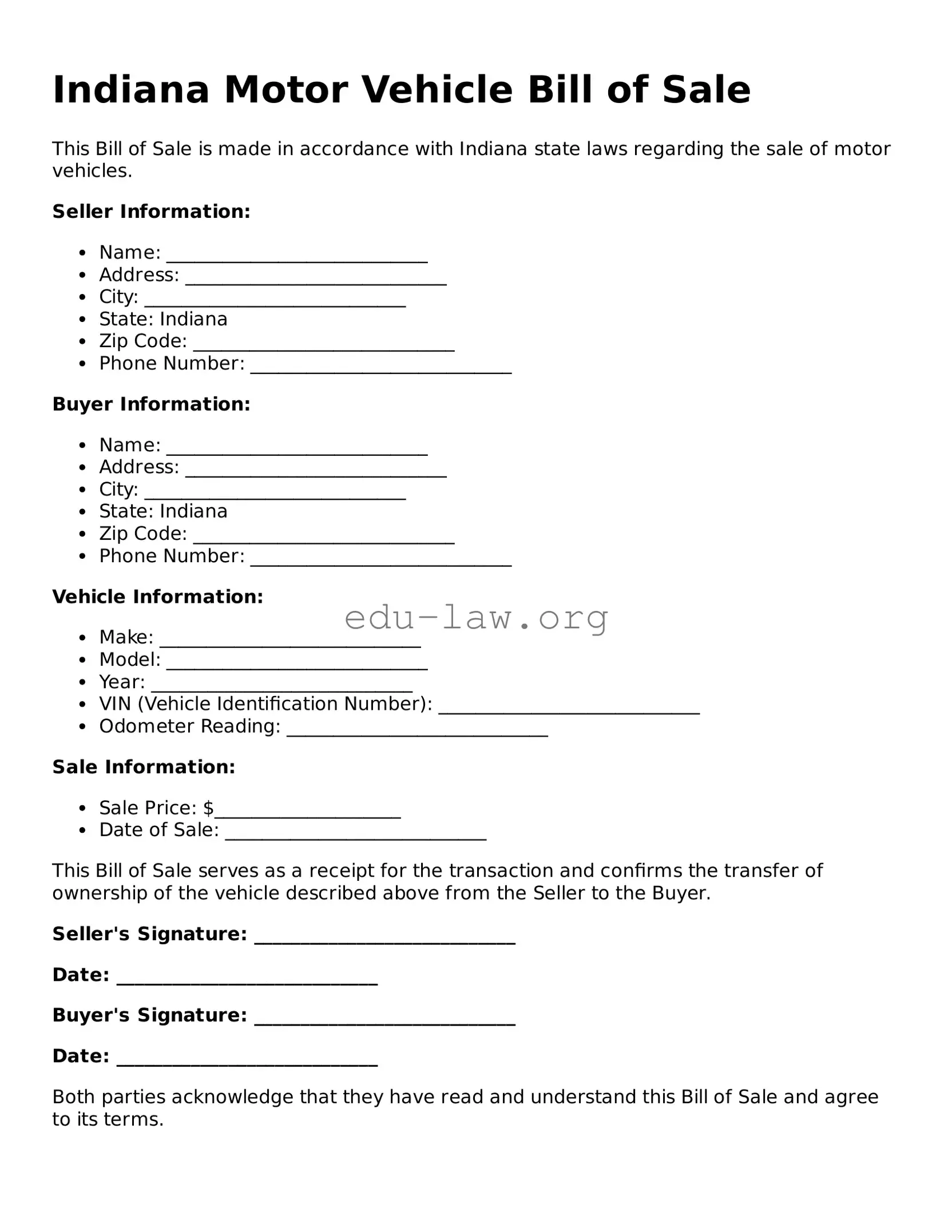
When buying or selling a vehicle in Indiana, having the right documentation is essential to ensure a smooth transaction. One of the most important documents in this process is the Motor Vehicle Bill of Sale form. This form serves as a written record of the transfer of ownership from the seller to the buyer, detailing key information such as the vehicle's make, model, year, and Vehicle Identification Number (VIN). Additionally, it includes the purchase price, the date of sale, and the names and addresses of both parties involved in the transaction. By providing a clear and concise account of the sale, this form not only protects the interests of both the buyer and seller but also aids in future registration and title transfer processes. Understanding the components and significance of the Indiana Motor Vehicle Bill of Sale form is crucial for anyone looking to navigate the vehicle sale process confidently.
Indiana Motor Vehicle Bill of Sale
This Bill of Sale is made in accordance with Indiana state laws regarding the sale of motor vehicles.
Seller Information:
Buyer Information:
Vehicle Information:
Sale Information:
This Bill of Sale serves as a receipt for the transaction and confirms the transfer of ownership of the vehicle described above from the Seller to the Buyer.
Seller's Signature: ____________________________
Date: ____________________________
Buyer's Signature: ____________________________
Date: ____________________________
Both parties acknowledge that they have read and understand this Bill of Sale and agree to its terms.
| Fact Name | Details |
|---|---|
| Purpose | The Indiana Motor Vehicle Bill of Sale form is used to document the sale and transfer of ownership of a motor vehicle between a buyer and a seller. |
| Governing Law | The form is governed by Indiana Code Title 9, Article 17, which outlines the requirements for vehicle transfers in the state. |
| Required Information | The form must include details such as the vehicle identification number (VIN), make, model, year, and the names and addresses of both the buyer and seller. |
| Notarization | While notarization is not mandatory for the Bill of Sale, it is recommended to provide additional legal protection for both parties involved in the transaction. |
Filling out the Indiana Motor Vehicle Bill of Sale form is straightforward. After completing the form, you will need to ensure that both the buyer and seller have signed it. This document will help protect both parties during the sale and is often required for registration purposes.
What is an Indiana Motor Vehicle Bill of Sale?
The Indiana Motor Vehicle Bill of Sale is a legal document used to transfer ownership of a motor vehicle from one party to another. This form includes essential details such as the vehicle's make, model, year, VIN (Vehicle Identification Number), and the sale price. It serves as proof of the transaction for both the buyer and the seller.
Do I need a Bill of Sale to sell my vehicle in Indiana?
While a Bill of Sale is not required by Indiana law for every vehicle sale, it is highly recommended. This document protects both the seller and the buyer by providing a record of the transaction. It can be crucial for tax purposes and for registering the vehicle under the new owner's name.
What information is required on the Bill of Sale?
The Bill of Sale should include the following information: the full names and addresses of both the buyer and seller, the vehicle's make, model, year, and VIN, the sale price, and the date of the transaction. Both parties should also sign the document to validate the sale.
Can I create my own Bill of Sale?
Yes, you can create your own Bill of Sale as long as it contains all the necessary information. However, using a standard form ensures that you include all required details and helps avoid potential legal issues in the future.
Is the Bill of Sale required for vehicle registration in Indiana?
Yes, when registering a vehicle in Indiana, the new owner must provide a Bill of Sale along with other documents, such as the title and proof of identity. This document helps verify the transaction and supports the new owner's claim to the vehicle.
What if the vehicle has a lien on it?
If there is a lien on the vehicle, the seller must disclose this information to the buyer. The Bill of Sale should reflect the lien status, and the seller should ensure that the lien is satisfied before completing the sale. This protects the buyer from potential legal issues later on.
Can I use a Bill of Sale for a vehicle purchased from a dealer?
Typically, when purchasing a vehicle from a dealer, you will receive a sales agreement instead of a Bill of Sale. However, it is still beneficial to have a Bill of Sale for your records, as it documents the transaction details and provides proof of purchase.
How do I complete the Bill of Sale?
To complete the Bill of Sale, fill in all required fields with accurate information. Both the buyer and seller should review the document for accuracy. After ensuring that all details are correct, both parties should sign and date the form. Keep a copy for your records.
What should I do if I lose the Bill of Sale?
If you lose the Bill of Sale, you can create a new one, but both parties must sign it again. It is advisable to keep multiple copies of important documents like the Bill of Sale to avoid complications in the future.
Where can I find an Indiana Motor Vehicle Bill of Sale form?
You can find the Indiana Motor Vehicle Bill of Sale form online through various legal form websites, or you may obtain a copy from the Indiana Bureau of Motor Vehicles (BMV). Ensure that you are using the most current version of the form to meet all legal requirements.
Incomplete Information: Failing to provide all required details can lead to delays or complications. Ensure that the names, addresses, and vehicle information are fully filled out.
Incorrect Vehicle Identification Number (VIN): The VIN must be accurate. Double-check this number, as errors can create issues with registration and ownership transfer.
Not Signing the Document: Both the buyer and seller must sign the Bill of Sale. A missing signature can invalidate the document and complicate the sale.
Failure to Date the Form: The date of the sale is crucial. Omitting this information can lead to disputes about when the transaction occurred.
Neglecting to Keep Copies: Always make copies of the completed Bill of Sale for both parties. This serves as proof of the transaction and can be important for future reference.
The Indiana Motor Vehicle Bill of Sale form serves as a crucial document for individuals engaged in the sale or purchase of a vehicle. However, it is often accompanied by other forms and documents that facilitate the transaction and ensure compliance with state regulations. Below is a list of additional documents that are commonly used in conjunction with the Bill of Sale in Indiana.
Each of these documents plays a significant role in the vehicle transfer process. Ensuring that all necessary paperwork is completed accurately can help prevent future disputes and provide peace of mind for both parties involved in the transaction.
The Indiana Motor Vehicle Bill of Sale form shares similarities with the general Bill of Sale document used across various states. Both forms serve the same primary purpose: to provide a written record of the transfer of ownership of an item, whether it be a vehicle, furniture, or equipment. They typically include essential details such as the names of the buyer and seller, a description of the item, and the sale price. This document acts as a legal safeguard for both parties, ensuring that the transaction is documented and can be referenced in case of disputes.
Another document closely related to the Indiana Motor Vehicle Bill of Sale is the Vehicle Title. While the Bill of Sale serves as proof of the transaction, the Vehicle Title is the official document that proves ownership of the vehicle. When a vehicle is sold, the title must be signed over to the new owner. This process is crucial, as it ensures that the new owner can register the vehicle in their name and obtain the necessary licenses and permits. Both documents work together to establish clear ownership and facilitate the legal transfer of a vehicle.
The odometer disclosure statement is another important document that often accompanies the Bill of Sale. This statement is required by federal law and mandates that sellers disclose the vehicle's mileage at the time of sale. By providing this information, the seller helps protect the buyer from potential fraud, such as rolling back the odometer. The odometer disclosure statement, along with the Bill of Sale, ensures transparency in the transaction and provides a clear record of the vehicle's history.
A purchase agreement is yet another document similar to the Indiana Motor Vehicle Bill of Sale. This agreement outlines the terms and conditions of the sale, including payment details, warranties, and any contingencies that must be met before the sale is finalized. While the Bill of Sale serves as a record of the transaction, the purchase agreement lays out the expectations and responsibilities of both parties. This clarity helps prevent misunderstandings and provides a framework for resolving any potential disputes.
The affidavit of vehicle transfer is a document that may be required in certain situations, particularly when the original title is lost or unavailable. This affidavit serves as a sworn statement by the seller, affirming that they are the rightful owner of the vehicle and have the authority to sell it. By providing this document along with the Bill of Sale, sellers can help ensure a smooth transaction, even in cases where the title cannot be produced.
The release of liability form is another important document that complements the Indiana Motor Vehicle Bill of Sale. This form protects the seller by officially notifying the state that they are no longer responsible for the vehicle once it has been sold. It helps prevent issues related to future traffic violations or accidents involving the vehicle after the sale. By submitting this form, sellers can safeguard themselves from potential legal liabilities, making it an essential part of the transaction process.
The warranty deed is a document often used in real estate transactions, but it shares some similarities with the Bill of Sale in the context of property transfer. Like a Bill of Sale, a warranty deed provides proof of ownership transfer. It assures the buyer that the seller has clear title to the property and that there are no undisclosed claims against it. While the contexts differ, both documents serve to formalize the transfer of ownership and protect the interests of the parties involved.
The lease agreement is another document that, while not directly related to ownership transfer, is similar in that it outlines the terms of a transaction involving a vehicle. A lease agreement specifies the conditions under which a vehicle can be used, detailing responsibilities for maintenance, insurance, and payment terms. Like the Bill of Sale, it serves to clarify the expectations between parties, although it does not transfer ownership in the same way.
Finally, the title application is a document that must be completed when registering a vehicle after purchase. It is similar to the Indiana Motor Vehicle Bill of Sale in that it requires information about the buyer, seller, and vehicle. This application is crucial for obtaining a new title in the buyer's name and ensures that the state has accurate records of vehicle ownership. Together with the Bill of Sale, the title application helps facilitate the legal transfer of the vehicle and its registration with the state.
When filling out the Indiana Motor Vehicle Bill of Sale form, there are important steps to follow. Here’s a list of things you should and shouldn’t do:
Understanding the Indiana Motor Vehicle Bill of Sale form can be challenging. Here are ten common misconceptions that people often have about this document:
Many people believe that a Bill of Sale is optional. However, it serves as important proof of the transaction and can protect both the buyer and seller.
Some assume that notarization is required for the Bill of Sale to be valid. In Indiana, notarization is not necessary, although it can add an extra layer of security.
It is a common misconception that only the seller's signature is required. In reality, both the buyer and seller should sign the document to confirm the transaction.
Many confuse the Bill of Sale with the vehicle title. While the Bill of Sale documents the sale, the title is what officially transfers ownership.
Some people think that the Bill of Sale must follow a strict format. Indiana does not mandate a specific template, but it should include essential details about the transaction.
There is a belief that this document is only necessary for used cars. In fact, it can be used for both new and used vehicle sales.
Some individuals neglect to keep a copy, thinking it is unimportant. However, retaining a copy is crucial for record-keeping and future reference.
Many believe that a Bill of Sale holds no legal weight. In reality, it is a legally binding document that can be used in court if disputes arise.
Some think that they can leave out details. However, including specific information, such as the vehicle's VIN and sale price, is essential for clarity and legality.
There is a misconception that only car dealerships can provide a Bill of Sale. In truth, any individual can create and sign a Bill of Sale for a vehicle transaction.
By understanding these misconceptions, individuals can better navigate the process of buying or selling a vehicle in Indiana.
When filling out and using the Indiana Motor Vehicle Bill of Sale form, consider the following key takeaways:
Following these guidelines will help ensure a smooth transaction and protect the interests of both parties involved.