When couples decide to separate, navigating the complexities of their relationship can be daunting. In Indiana, a Marital Separation Agreement form serves as a vital tool to help spouses outline their rights and responsibilities during this transitional phase. This legally binding document addresses crucial aspects such as property division, child custody arrangements, and financial support obligations. By clearly defining how assets will be divided and what arrangements will be made for any children involved, the agreement aims to minimize conflict and provide clarity for both parties. Additionally, the form can include provisions for spousal support, ensuring that both partners are protected during the separation period. Understanding the importance of this agreement can lead to a more amicable separation process, allowing individuals to focus on their future while ensuring that their current needs are met.
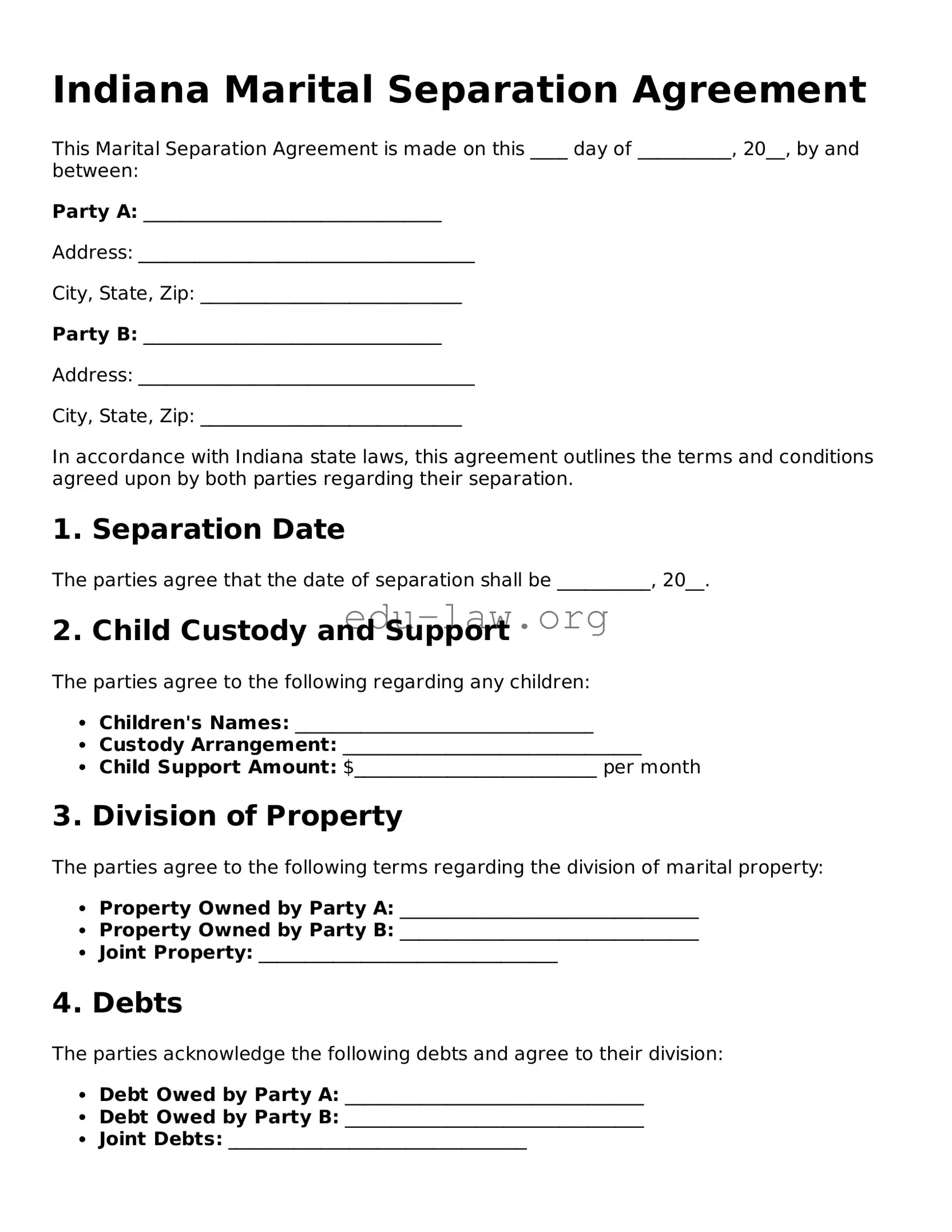
Indiana Marital Separation Agreement
This Marital Separation Agreement is made on this ____ day of __________, 20__, by and between:
Party A: ________________________________
Address: ____________________________________
City, State, Zip: ____________________________
Party B: ________________________________
Address: ____________________________________
City, State, Zip: ____________________________
In accordance with Indiana state laws, this agreement outlines the terms and conditions agreed upon by both parties regarding their separation.
1. Separation Date
The parties agree that the date of separation shall be __________, 20__.
2. Child Custody and Support
The parties agree to the following regarding any children:
3. Division of Property
The parties agree to the following terms regarding the division of marital property:
4. Debts
The parties acknowledge the following debts and agree to their division:
5. Spousal Support
The parties agree on the following terms regarding spousal support:
6. Miscellaneous Provisions
The parties agree to the following additional terms:
7. Governing Law
This agreement shall be governed by the laws of the State of Indiana.
8. Signatures
By signing below, both parties acknowledge that they have read and understood this Marital Separation Agreement and agree to its terms.
Party A Signature: ________________________________ Date: __________, 20__
Party B Signature: ________________________________ Date: __________, 20__
Witness Signature: ________________________________ Date: __________, 20__
| Fact Name | Description |
|---|---|
| Purpose | The Indiana Marital Separation Agreement is used to outline the terms of a couple's separation. |
| Governing Law | This agreement is governed by Indiana state law, specifically under Indiana Code Title 31. |
| Voluntary Agreement | Both parties must voluntarily agree to the terms outlined in the document. |
| Property Division | The agreement typically includes how marital property will be divided between the spouses. |
| Child Custody | It may address child custody arrangements if the couple has children. |
| Spousal Support | The document can specify whether spousal support will be provided and the amount. |
| Legal Binding | Once signed, the agreement is legally binding unless modified by a court. |
| Not a Divorce | Filing this agreement does not finalize a divorce; it is a step in the separation process. |
| Filing Requirement | The agreement may need to be filed with the court in some cases to be enforceable. |
| Modification | Changes to the agreement can be made, but both parties must agree to the modifications. |
After obtaining the Indiana Marital Separation Agreement form, the next step involves accurately filling it out. This process requires careful attention to detail to ensure all necessary information is provided. Once completed, the form will need to be submitted as part of the separation process.
What is a Marital Separation Agreement in Indiana?
A Marital Separation Agreement is a legal document that outlines the terms and conditions agreed upon by spouses who have decided to live apart. This agreement can address various issues such as property division, child custody, visitation rights, and spousal support. While it is not a divorce decree, it serves as a framework for how the couple will manage their responsibilities and rights during the separation period. It can help reduce conflict and provide clarity, which is especially important when children are involved.
Do I need an attorney to create a Marital Separation Agreement?
While it is not legally required to have an attorney draft a Marital Separation Agreement, seeking legal advice is highly recommended. An attorney can help ensure that the agreement complies with Indiana law and adequately protects your rights. They can also assist in negotiating terms that are fair and reasonable. If both parties are in agreement on most issues, they may choose to draft the agreement themselves, but having an attorney review the document can prevent potential misunderstandings or legal issues down the line.
Can a Marital Separation Agreement be modified?
Yes, a Marital Separation Agreement can be modified if both parties agree to the changes. Life circumstances often change, and what may have been suitable at the time of separation might no longer apply. For instance, changes in income, employment status, or the needs of children may necessitate a revision of the agreement. It is important to document any modifications in writing and, ideally, have them reviewed by an attorney to ensure that they are legally enforceable.
Is a Marital Separation Agreement legally binding?
In Indiana, a Marital Separation Agreement is generally considered a legally binding contract, provided that it meets certain criteria. Both parties must enter into the agreement voluntarily and with full disclosure of their financial situations. If the agreement is fair and reasonable, it is likely to be upheld by a court. However, if one party can demonstrate that they were coerced or that the terms are unconscionable, a court may refuse to enforce the agreement. Therefore, clarity and fairness are crucial when drafting this important document.
Failing to include all necessary personal information. It's essential to provide full names, addresses, and contact details for both parties. Omitting this information can lead to complications later.
Not specifying the date of separation. Clearly stating the date helps establish important timelines for legal and financial matters.
Overlooking the division of assets and debts. Both parties should list all assets and debts, detailing who will take responsibility for each. This prevents disputes down the line.
Ignoring spousal support provisions. If applicable, the agreement should outline any spousal support, including the amount and duration. This ensures clarity and reduces future conflicts.
Neglecting to address child custody and support. If children are involved, it's crucial to define custody arrangements and child support obligations to protect their best interests.
Using vague language. Clarity is vital in legal documents. Ambiguous terms can lead to misunderstandings and potential legal challenges.
Failing to have the agreement notarized. A notarized document adds an extra layer of authenticity and can be essential if the agreement is challenged later.
Not seeking legal advice. Many individuals attempt to navigate the process without professional guidance, which can lead to mistakes and unfavorable outcomes.
Forgetting to keep copies of the signed agreement. It's important to retain copies for personal records and future reference, especially if disputes arise.
When navigating a marital separation in Indiana, several forms and documents may accompany the Indiana Marital Separation Agreement. Each of these documents serves a specific purpose and can help clarify the terms of the separation. Below is a list of commonly used forms that may be relevant in this context.
Understanding these documents can streamline the separation process and ensure that all necessary legal aspects are covered. Each form plays a crucial role in protecting the interests of both parties involved, particularly when children are part of the equation.
The Indiana Marital Separation Agreement is often compared to the Divorce Settlement Agreement, which outlines the terms of a divorce. Both documents serve to delineate the rights and responsibilities of each spouse regarding property division, spousal support, and child custody arrangements. While a marital separation agreement may precede a divorce, the divorce settlement agreement is finalized once the divorce is granted, making it a more permanent resolution of the marital issues at hand.
Another similar document is the Property Settlement Agreement. This type of agreement specifically focuses on the division of marital assets and debts. Like the marital separation agreement, it aims to clarify how property will be divided between spouses. However, a property settlement agreement can be part of either a divorce or a separation process, and it typically includes detailed information about individual assets and liabilities.
The Child Custody Agreement is also closely related, particularly when children are involved. This document outlines the arrangements for the care and custody of children post-separation. While the marital separation agreement may touch on custody, the child custody agreement provides a more comprehensive framework, detailing visitation schedules, decision-making authority, and other important aspects of co-parenting.
A similar document is the Spousal Support Agreement, which specifically addresses financial support one spouse may provide to the other after separation. While the marital separation agreement can include provisions for spousal support, this dedicated agreement focuses solely on the financial aspects, including the amount, duration, and conditions of the support.
The Cohabitation Agreement can also be likened to the marital separation agreement, especially in cases where couples choose to live apart but remain legally married. This document outlines the rights and responsibilities of each partner in a cohabiting relationship. Like a separation agreement, it can cover property division and financial responsibilities but is tailored for couples who are not legally separating.
The Prenuptial Agreement, although created before marriage, shares similarities with the marital separation agreement in that it addresses the division of assets and financial responsibilities. Both documents are designed to protect the interests of each spouse, though a prenuptial agreement is established prior to marriage, while a marital separation agreement is created after the marriage has taken place.
The Postnuptial Agreement is another relevant document. This agreement is similar to a prenuptial agreement but is executed after the marriage has occurred. It can address similar issues as a marital separation agreement, such as asset division and support, but it is typically used to clarify or modify existing agreements made during the marriage.
The Mediation Agreement is also relevant in this context. Mediation often serves as a means to resolve disputes amicably, and the resulting agreement can address many of the same issues found in a marital separation agreement. While the separation agreement may be a product of negotiation, a mediation agreement typically arises from facilitated discussions between the parties, aiming for a mutually agreeable resolution.
Lastly, the Legal Separation Agreement is very similar to the marital separation agreement. Both documents serve to formalize the terms of a couple's separation. However, a legal separation agreement may carry additional legal weight, as it is often filed with the court and can be enforced in a similar manner to a divorce decree. It typically addresses issues such as custody, support, and property division, much like the marital separation agreement.
When completing the Indiana Marital Separation Agreement form, it is crucial to approach the process with care. This document is significant, as it outlines the terms of your separation and can impact your future. Here’s a list of what you should and shouldn’t do:
By following these guidelines, you can help ensure that your Marital Separation Agreement is completed correctly and efficiently. This attention to detail can save you from potential complications in the future.
Understanding the Indiana Marital Separation Agreement form is crucial for couples considering separation. However, several misconceptions can lead to confusion. Here are ten common misconceptions:
Many people believe that once a separation agreement is signed, it is immediately enforceable. In reality, it may need to be incorporated into a court order to have legal effect.
Some assume that separation means a 50/50 split of all assets. However, Indiana law allows for an equitable division, which may not always mean equal.
While custody can be addressed in the agreement, it is not final until approved by a court, which considers the best interests of the child.
Separation is a distinct legal status. Couples can remain separated for years without proceeding to divorce.
Couples without children can also benefit from a separation agreement to clarify financial and property arrangements.
Some believe that a verbal agreement is enough. However, written agreements provide clarity and are more enforceable in court.
People often think that a signed agreement is set in stone. In fact, it can be modified if both parties agree and the changes are documented.
While some may choose to proceed without an attorney, having legal representation can help ensure that rights are protected and the agreement is fair.
These two documents serve different purposes. A prenuptial agreement is created before marriage, while a separation agreement is established during or after the marriage.
While there are legal requirements, the process can be straightforward with the right guidance and understanding of the necessary steps.
Being aware of these misconceptions can help individuals make informed decisions about their marital separation and ensure that their rights are protected throughout the process.
When filling out and using the Indiana Marital Separation Agreement form, there are several important points to keep in mind: