In Indiana, the Living Will form serves as a vital tool for individuals wishing to outline their healthcare preferences in the event they become unable to communicate their wishes. This document allows you to specify the types of medical treatment you do or do not wish to receive, particularly in situations involving terminal illness or irreversible conditions. By clearly stating your desires regarding life-sustaining measures, you provide guidance to your healthcare providers and loved ones during difficult times. The form includes sections for you to indicate your preferences about resuscitation, mechanical ventilation, and other critical interventions. Furthermore, it is essential to ensure that the document is signed and witnessed according to Indiana law to be legally valid. Understanding the importance of this form empowers you to take control of your healthcare decisions and ensures that your wishes are respected when you cannot voice them yourself.
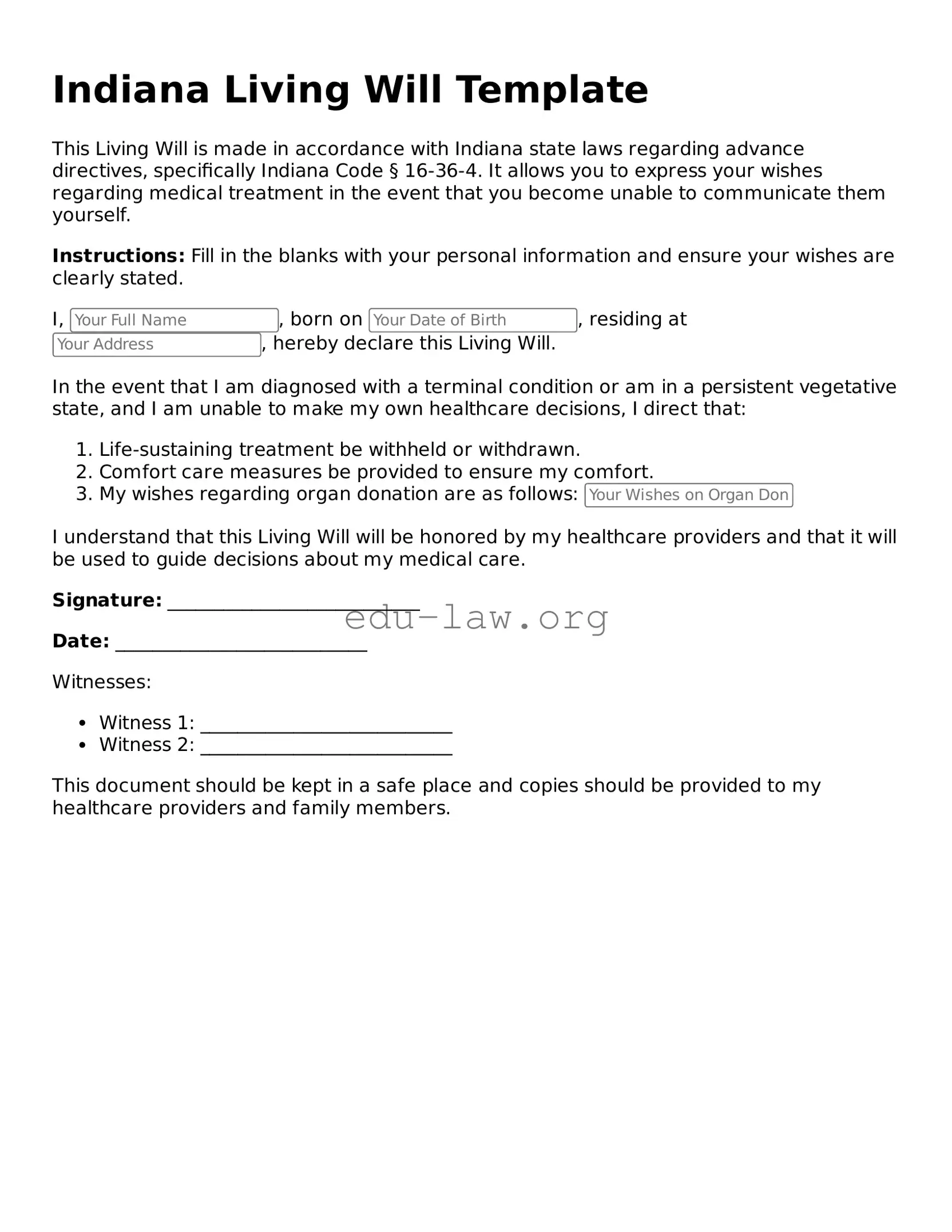
Indiana Living Will Template
This Living Will is made in accordance with Indiana state laws regarding advance directives, specifically Indiana Code § 16-36-4. It allows you to express your wishes regarding medical treatment in the event that you become unable to communicate them yourself.
Instructions: Fill in the blanks with your personal information and ensure your wishes are clearly stated.
I, , born on , residing at , hereby declare this Living Will.
In the event that I am diagnosed with a terminal condition or am in a persistent vegetative state, and I am unable to make my own healthcare decisions, I direct that:
I understand that this Living Will will be honored by my healthcare providers and that it will be used to guide decisions about my medical care.
Signature: ___________________________
Date: ___________________________
Witnesses:
This document should be kept in a safe place and copies should be provided to my healthcare providers and family members.
| Fact Name | Description |
|---|---|
| Governing Law | The Indiana Living Will form is governed by Indiana Code Title 16, Article 36, Chapter 4. |
| Purpose | This form allows individuals to express their wishes regarding medical treatment in the event they become incapacitated. |
| Eligibility | Any adult resident of Indiana can complete a Living Will form. |
| Signature Requirement | The form must be signed by the individual and witnessed by two adults who are not related to the individual. |
| Revocation | An individual can revoke their Living Will at any time, verbally or in writing. |
| Health Care Provider | Health care providers must comply with the directives stated in the Living Will unless they have a valid reason not to. |
| Durable Power of Attorney | The Living Will can be used in conjunction with a Durable Power of Attorney for Health Care. |
| Distribution | It is advisable to provide copies of the Living Will to family members and health care providers to ensure compliance. |
Completing the Indiana Living Will form is an important step in expressing your healthcare preferences. Once you have filled out the form, it should be signed and witnessed according to Indiana law to ensure its validity.
What is a Living Will in Indiana?
A Living Will is a legal document that allows individuals to express their wishes regarding medical treatment in case they become unable to communicate their preferences. This document specifically addresses end-of-life care and can guide healthcare providers and family members in making decisions that align with the individual's desires. In Indiana, it is important for the Living Will to be signed and dated to ensure its validity.
Who should create a Living Will?
Anyone aged 18 or older can create a Living Will in Indiana. It is especially important for individuals with specific health concerns, those undergoing major medical procedures, or anyone who wants to ensure their healthcare wishes are known in the event of a serious illness or injury. Creating a Living Will can provide peace of mind for both the individual and their loved ones.
How do I create a Living Will in Indiana?
To create a Living Will in Indiana, you can use a standard form available online or through legal offices. Fill out the form with your personal information and clearly state your wishes regarding medical treatment. Once completed, you must sign the document in the presence of at least two witnesses who are not related to you or named in the document. Alternatively, you can have the document notarized. Keep copies for yourself and share them with your healthcare provider and family members.
Can I change or revoke my Living Will?
Yes, you can change or revoke your Living Will at any time as long as you are competent to do so. To make changes, you can create a new Living Will or write a statement revoking the previous one. It is crucial to inform your healthcare provider and family members about any changes to ensure they are aware of your current wishes. Destroying the original document is also an effective way to revoke it.
Is a Living Will the same as a Power of Attorney?
No, a Living Will and a Power of Attorney are not the same. A Living Will specifically addresses your wishes regarding medical treatment and end-of-life care. In contrast, a Power of Attorney allows you to appoint someone to make financial or legal decisions on your behalf if you become incapacitated. Both documents are important for comprehensive planning, but they serve different purposes.
Not understanding the purpose of the Living Will: Many individuals fill out the form without fully grasping its intent. A Living Will is designed to outline preferences regarding medical treatment in situations where one cannot communicate their wishes. Failing to understand this can lead to incomplete or inaccurate information.
Inadequate specification of treatment preferences: Some people provide vague instructions about their medical care. It’s crucial to clearly articulate what types of treatments one wants or does not want, such as resuscitation or life support measures. Ambiguity can create confusion for healthcare providers.
Neglecting to update the document: Life circumstances change, and so do preferences regarding medical care. Individuals often forget to revisit and revise their Living Will after significant life events, such as marriage, divorce, or a serious health diagnosis. An outdated document may not reflect current wishes.
Failure to sign and date the form: A common oversight is not signing the Living Will. Without a signature, the document lacks legal validity. Additionally, forgetting to date it can lead to questions about the document's relevance, especially if there are multiple versions.
Not discussing the Living Will with family or healthcare providers: Many individuals complete the form in isolation. Open discussions about one’s wishes can help ensure that family members and healthcare providers understand and respect those wishes. Lack of communication can lead to disputes or confusion during critical moments.
Ignoring state-specific requirements: Each state has its own laws governing Living Wills. Failing to adhere to Indiana's specific requirements, such as witnessing or notarization, can invalidate the document. It’s essential to familiarize oneself with these regulations to ensure compliance.
A Living Will is an important document that outlines your wishes regarding medical treatment in case you become unable to communicate. However, it often works best in conjunction with other forms and documents. Here’s a list of common forms that can complement your Indiana Living Will.
Having these documents in place alongside your Indiana Living Will can help ensure that your medical and personal preferences are respected. It is advisable to discuss these forms with your loved ones and legal advisors to ensure clarity and understanding.
The Indiana Living Will form shares similarities with the Advance Directive, a broader category of documents that includes both living wills and healthcare proxies. An Advance Directive allows individuals to outline their preferences regarding medical treatment in case they become unable to communicate their wishes. Like the Indiana Living Will, it provides guidance to healthcare providers and family members about the individual's desires concerning life-sustaining treatments and end-of-life care.
Another document comparable to the Indiana Living Will is the Durable Power of Attorney for Healthcare. This legal instrument enables individuals to appoint a trusted person to make healthcare decisions on their behalf if they are incapacitated. While the Indiana Living Will specifies treatment preferences, the Durable Power of Attorney empowers a designated agent to interpret those wishes and make decisions in real-time, ensuring that the individual's values and desires are respected.
The Do Not Resuscitate (DNR) order is also similar in purpose to the Indiana Living Will. A DNR order specifically instructs medical personnel not to perform cardiopulmonary resuscitation (CPR) if the individual's heart stops or they stop breathing. While the Indiana Living Will addresses a broader range of medical treatment preferences, a DNR focuses solely on resuscitation efforts, allowing individuals to express their wishes regarding this critical aspect of emergency medical care.
The Physician Orders for Life-Sustaining Treatment (POLST) form is another document that parallels the Indiana Living Will. POLST is designed for individuals with serious illnesses or those nearing the end of life. It translates the individual's treatment preferences into actionable medical orders. Like the Indiana Living Will, POLST ensures that healthcare providers are aware of and adhere to the individual's wishes regarding life-sustaining measures, but it is more specific and often used in conjunction with a living will.
The Health Care Proxy serves as another document similar to the Indiana Living Will. This legal document allows individuals to designate someone to make healthcare decisions on their behalf. While the Indiana Living Will outlines specific medical treatment preferences, the Health Care Proxy focuses on appointing a trusted individual to interpret and execute those preferences. This ensures that a person's values and desires are honored even when they cannot communicate them directly.
Lastly, the Medical Directive is akin to the Indiana Living Will in that it provides instructions about medical care preferences. Medical Directives can encompass a wide range of treatment options, including life-sustaining measures, pain management, and organ donation. Like the Indiana Living Will, it serves as a tool for individuals to communicate their healthcare wishes, thus guiding family members and healthcare providers in making decisions that align with the individual's values and beliefs.
When filling out the Indiana Living Will form, it is important to follow specific guidelines to ensure that your wishes are clearly expressed and legally recognized. Here are four things to do and not do:
When it comes to the Indiana Living Will form, several misconceptions can lead to confusion. Understanding these can help individuals make informed decisions about their end-of-life care. Here are four common misconceptions:
By addressing these misconceptions, individuals can better navigate the important decisions surrounding their healthcare preferences.
When it comes to filling out and using the Indiana Living Will form, here are some key takeaways to keep in mind:
Taking these steps can help ensure that your healthcare preferences are honored when it matters most.