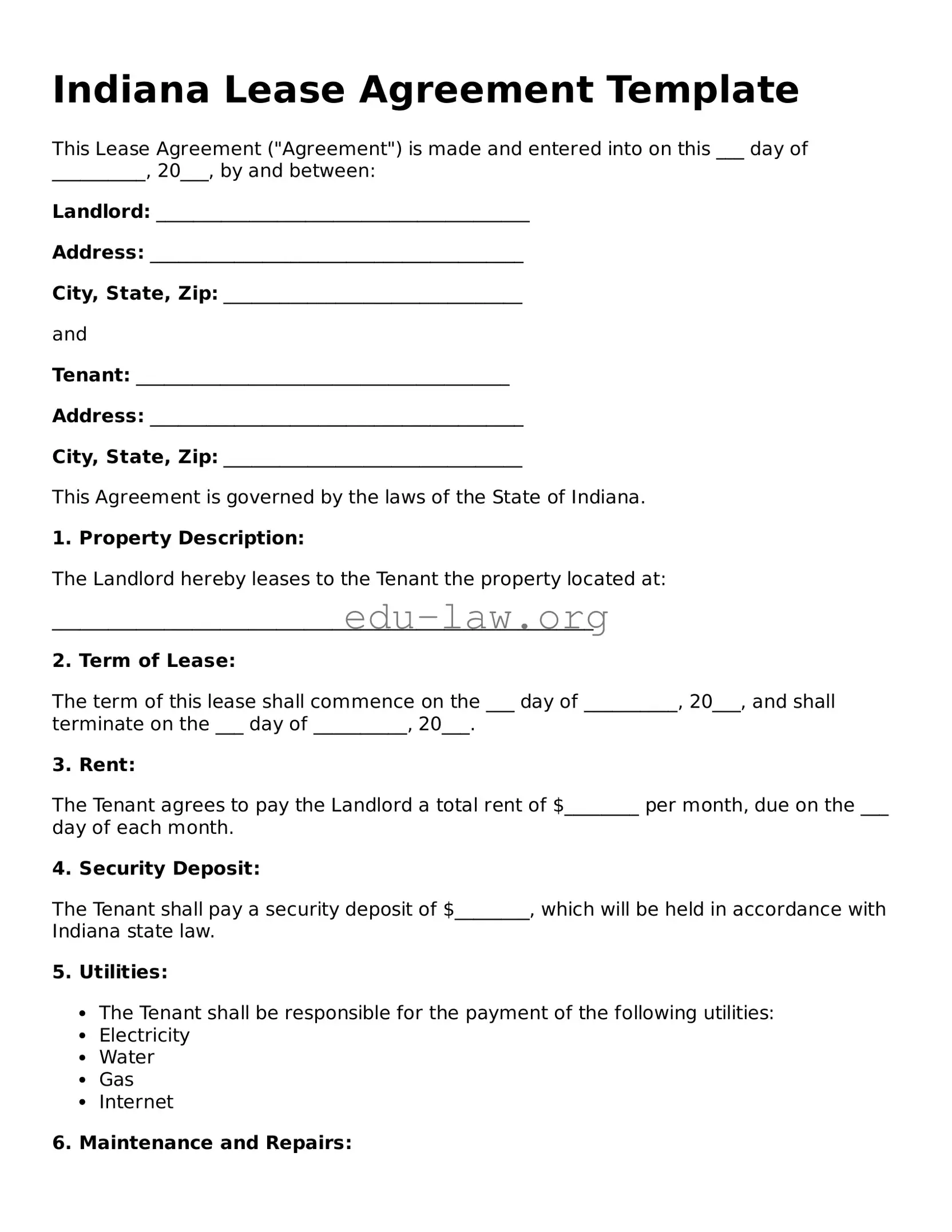
When entering into a rental arrangement in Indiana, understanding the Indiana Lease Agreement form is crucial for both landlords and tenants. This document outlines the terms and conditions of the lease, ensuring that both parties are on the same page regarding their rights and responsibilities. Key components of the form include the rental amount, payment due dates, and the duration of the lease. Additionally, it addresses security deposits, maintenance responsibilities, and rules regarding property use. The agreement also specifies the process for terminating the lease, which is vital for both parties to understand. By clearly delineating expectations, the Indiana Lease Agreement helps to prevent disputes and fosters a more harmonious rental experience.
Indiana Lease Agreement Template
This Lease Agreement ("Agreement") is made and entered into on this ___ day of __________, 20___, by and between:
Landlord: ________________________________________
Address: ________________________________________
City, State, Zip: ________________________________
and
Tenant: ________________________________________
Address: ________________________________________
City, State, Zip: ________________________________
This Agreement is governed by the laws of the State of Indiana.
1. Property Description:
The Landlord hereby leases to the Tenant the property located at:
__________________________________________________________
2. Term of Lease:
The term of this lease shall commence on the ___ day of __________, 20___, and shall terminate on the ___ day of __________, 20___.
3. Rent:
The Tenant agrees to pay the Landlord a total rent of $________ per month, due on the ___ day of each month.
4. Security Deposit:
The Tenant shall pay a security deposit of $________, which will be held in accordance with Indiana state law.
5. Utilities:
6. Maintenance and Repairs:
The Tenant agrees to keep the premises in good condition and to promptly report any maintenance issues to the Landlord.
7. Termination:
This Agreement may be terminated by either party with written notice of ___ days prior to the intended termination date.
8. Governing Law:
This Agreement shall be governed by the laws of the State of Indiana.
IN WITNESS WHEREOF, the parties have executed this Lease Agreement as of the date first above written.
Landlord Signature: ____________________________ Date: ______________
Tenant Signature: _____________________________ Date: ______________
| Fact Name | Description |
|---|---|
| Governing Law | The Indiana Lease Agreement is governed by the Indiana Code Title 32, Article 31, which outlines the rights and responsibilities of landlords and tenants. |
| Written Requirement | In Indiana, lease agreements for a term longer than one year must be in writing to be enforceable. |
| Security Deposit Limits | Indiana law limits security deposits to one month's rent for residential leases, providing protection for tenants. |
| Notice Requirements | Landlords must provide written notice of at least 10 days before initiating eviction proceedings for non-payment of rent. |
| Lease Duration | Leases can be structured as fixed-term (e.g., one year) or month-to-month, depending on the agreement between the parties. |
| Tenant Rights | Tenants in Indiana have the right to habitable living conditions, meaning landlords must maintain the property in a safe and livable state. |
| Landlord Access | Landlords must provide reasonable notice (typically 24 hours) before entering the rental property, except in emergencies. |
| Termination Notice | For month-to-month leases, either party must provide a 30-day written notice to terminate the lease. |
| Discrimination Protections | Indiana law prohibits discrimination in housing based on race, color, religion, sex, national origin, disability, and familial status. |
| Rental Application Fees | Landlords may charge rental application fees, but these must be reasonable and disclosed upfront. |
Filling out the Indiana Lease Agreement form is a straightforward process that requires careful attention to detail. By following the steps outlined below, you can ensure that all necessary information is accurately captured, facilitating a smooth rental experience.
Once the form is completed, both parties should retain a copy for their records. It is advisable to review the agreement together to clarify any questions or concerns before signing. Proper documentation can help prevent misunderstandings in the future.
What is an Indiana Lease Agreement form?
An Indiana Lease Agreement form is a legal document that outlines the terms and conditions under which a landlord rents property to a tenant. This agreement typically includes details such as the duration of the lease, rental amount, security deposit, maintenance responsibilities, and rules for both parties. It serves to protect the rights of both the landlord and tenant, ensuring that everyone understands their obligations and expectations during the rental period.
Who should use the Indiana Lease Agreement form?
This form is designed for landlords and tenants in Indiana. If you are a landlord looking to rent out your property, you will need this document to formalize the agreement with your tenant. Conversely, if you are a tenant seeking to rent a property, you should ensure that a lease agreement is in place to safeguard your rights and clarify your responsibilities. Both parties should review the agreement carefully before signing.
What are the key components of an Indiana Lease Agreement?
Key components of an Indiana Lease Agreement include the names of the landlord and tenant, the property address, the lease term (start and end dates), the rental amount, payment due dates, and details about security deposits. Additionally, it should outline maintenance responsibilities, rules regarding pets, and conditions for terminating the lease. Understanding these elements is crucial for both parties to ensure a smooth rental experience.
Can the Indiana Lease Agreement be modified after signing?
Yes, the Indiana Lease Agreement can be modified after signing, but both parties must agree to any changes. It's important to document any modifications in writing and have both parties sign the updated agreement. This ensures that everyone is on the same page and helps prevent misunderstandings in the future. Always keep a copy of the original agreement and any amendments for your records.
What happens if one party does not follow the lease agreement?
If one party does not follow the lease agreement, it can lead to various consequences. For tenants, failure to pay rent on time could result in eviction proceedings. For landlords, not maintaining the property as agreed may allow tenants to take legal action. It's essential to address any violations promptly and communicate openly to resolve issues before they escalate. Seeking legal advice may also be beneficial if disputes arise.
Not Providing Accurate Information: Many people fail to double-check their personal details. Ensure your name, address, and contact information are correct. Mistakes can lead to confusion or disputes later on.
Overlooking Lease Dates: It's crucial to specify the start and end dates of the lease. Some individuals forget to fill these out or miscalculate the duration. This can create uncertainty about when the lease begins and ends.
Ignoring Terms and Conditions: The lease includes important terms regarding rent, security deposits, and maintenance responsibilities. Failing to read and understand these can result in unexpected obligations.
Missing Signatures: Both parties must sign the lease for it to be valid. Some people neglect this step, thinking the agreement is binding without signatures. This can lead to complications in enforcing the lease.
Not Keeping a Copy: After filling out the lease, it's essential to keep a signed copy for your records. Many forget this step, which can be problematic if disputes arise later.
When entering into a lease agreement in Indiana, several other forms and documents may be necessary to ensure a smooth rental process. These documents help clarify responsibilities and protect the rights of both landlords and tenants. Below is a list of commonly used forms alongside the Indiana Lease Agreement.
These documents play a crucial role in the leasing process. They help both landlords and tenants understand their rights and responsibilities, ensuring a clear and transparent rental experience.
The Indiana Lease Agreement is similar to a Rental Agreement, which outlines the terms under which a landlord allows a tenant to occupy a property. Both documents specify the duration of the tenancy, rental amount, and responsibilities of both parties. While a lease typically covers a longer term, a rental agreement might be more flexible, allowing for month-to-month arrangements. This makes the rental agreement a good option for those seeking shorter commitments.
Another document that shares similarities is the Commercial Lease Agreement. This type of lease is specifically tailored for business properties. Like the Indiana Lease Agreement, it defines the rental terms, including payment schedules and maintenance responsibilities. However, commercial leases often include clauses related to business operations, zoning laws, and property modifications, reflecting the unique needs of commercial tenants.
The Sublease Agreement is also comparable. This document allows a tenant to rent out the property they are leasing to another individual. Similar to the Indiana Lease Agreement, it must detail the rental terms, duration, and responsibilities. However, the original tenant remains liable to the landlord, which adds a layer of complexity not found in standard leases.
A Roommate Agreement is another related document. This agreement is used when multiple tenants share a rental property. It outlines how rent and utilities will be divided, as well as house rules and responsibilities. While the Indiana Lease Agreement is between the landlord and the primary tenant, a roommate agreement focuses on the relationships and obligations among the tenants themselves.
The Lease Option Agreement is also similar but includes an option for the tenant to purchase the property at a later date. This document combines elements of a lease with potential ownership, allowing tenants to build equity while renting. It shares many standard lease provisions but adds clauses regarding the purchase price and timelines, making it distinct yet related.
The Month-to-Month Lease Agreement is another variant that resembles the Indiana Lease Agreement. This document provides flexibility, allowing either party to terminate the lease with short notice. While it covers similar terms such as rent and property maintenance, it does not bind tenants to a long-term commitment, making it suitable for those who may need to relocate quickly.
The Tenancy-at-Will Agreement is also akin to the Indiana Lease Agreement. This document allows either party to terminate the agreement at any time, with proper notice. It provides a basic framework for rental arrangements without the formalities of a traditional lease. While it offers flexibility, it lacks the security and stability typically found in longer-term leases.
Lastly, the Lease Termination Agreement is relevant as it outlines the conditions under which a lease can be ended. This document is crucial for both landlords and tenants, detailing the notice period and any obligations that must be fulfilled before the lease concludes. It parallels the Indiana Lease Agreement in that it addresses the end of the rental relationship, ensuring that both parties understand their rights and responsibilities during the termination process.
When filling out the Indiana Lease Agreement form, it's important to follow certain guidelines to ensure accuracy and legality. Here’s a list of what you should and shouldn’t do:
When it comes to lease agreements in Indiana, many people hold misconceptions that can lead to confusion or even legal issues. Here are nine common misunderstandings about the Indiana Lease Agreement form:
While it is highly recommended to have a written lease for clarity and legal protection, Indiana law does allow for verbal agreements in certain situations. However, proving the terms of a verbal lease can be challenging.
Once a lease is signed, its terms are binding for both parties. Changes can only be made if both the landlord and tenant agree to the modifications in writing.
Indiana law limits security deposits to one month's rent for most residential leases. Landlords cannot demand more than this amount, ensuring tenants are protected.
Landlords must provide reasonable notice before entering a tenant's property, typically 24 hours, unless there is an emergency. This protects the tenant's right to privacy.
While many terms can be negotiated, some aspects, such as compliance with local housing codes, are non-negotiable and must be adhered to by law.
Withholding rent is not a legal remedy in Indiana unless the landlord fails to make necessary repairs after being notified. Tenants should follow proper procedures to avoid eviction.
Unless specified in the lease, agreements do not automatically renew. Tenants should check their lease terms to understand the renewal process and any required notices.
Eviction is a legal process that requires specific steps to be followed. Minor violations often allow for a cure period, giving tenants time to correct the issue before eviction proceedings can begin.
Fees must be reasonable and clearly outlined in the lease agreement. Indiana law protects tenants from excessive or hidden fees that are not disclosed upfront.
Understanding these misconceptions can help both landlords and tenants navigate their lease agreements more effectively and avoid potential disputes.
Ensure that all parties involved in the lease are clearly identified. This includes the landlord and tenant, as well as any additional occupants.
Specify the duration of the lease. Clearly state the start and end dates to avoid any confusion regarding the lease term.
Detail the rental payment terms. Include the amount due, payment method, and due date each month.
Outline the security deposit requirements. Indicate the amount, conditions for its return, and any deductions that may apply.
Include maintenance responsibilities. Clarify who is responsible for repairs and upkeep of the property.
Discuss rules regarding pets. Specify whether pets are allowed, any associated fees, and any restrictions on types or sizes.
Review the termination process. Explain how either party can end the lease, including notice periods and conditions for early termination.