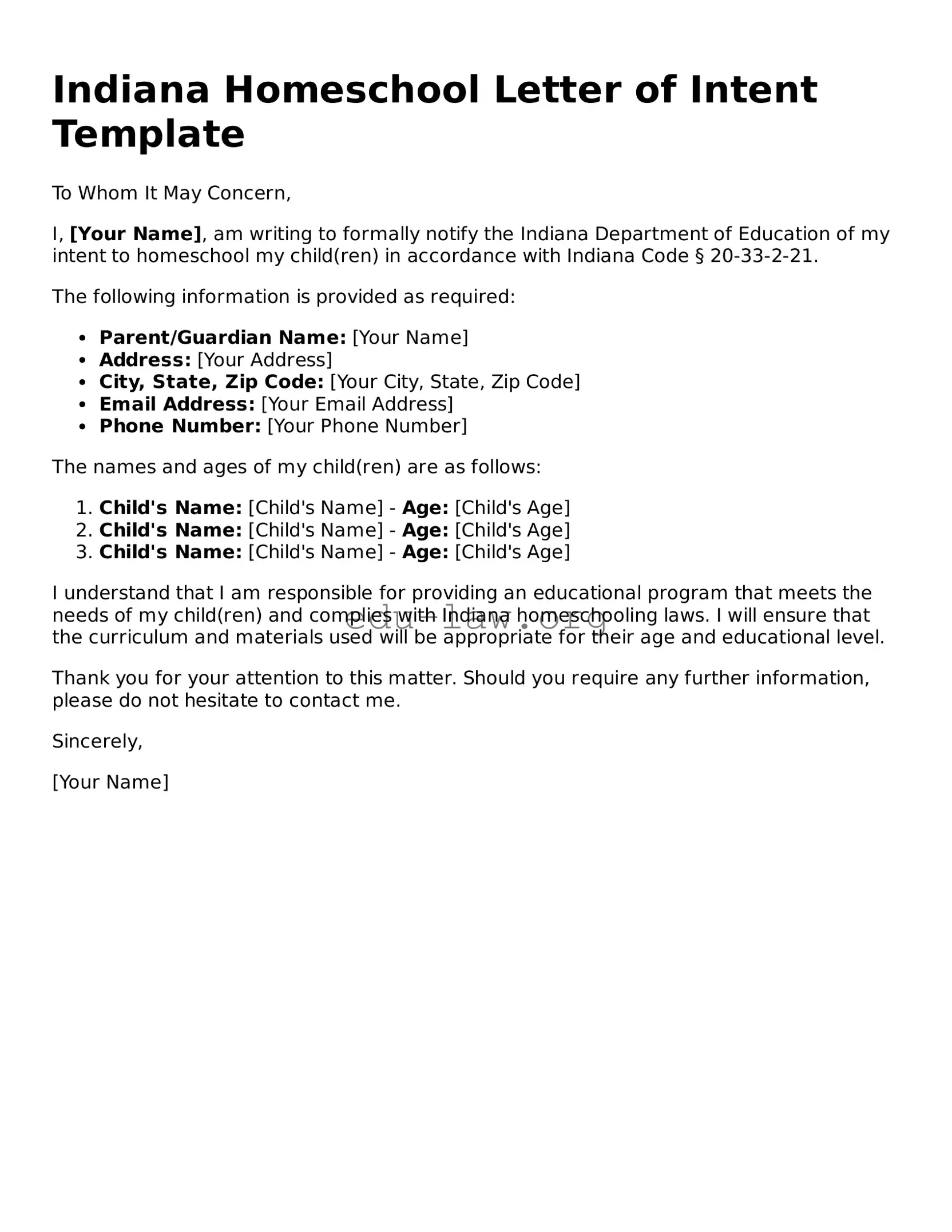
For families considering homeschooling in Indiana, the process begins with a crucial step: submitting a Homeschool Letter of Intent. This form serves as a formal notification to the local school district that parents or guardians have chosen to educate their children at home. It typically requires basic information such as the names and ages of the children being homeschooled, as well as the address of the home where the education will take place. While the form is relatively straightforward, it plays a significant role in establishing the family's commitment to homeschooling. It is important to note that this letter must be submitted within a certain timeframe, usually at the beginning of the school year or when withdrawing a child from public school. Understanding the requirements and ensuring that the letter is completed accurately can help families navigate the initial stages of homeschooling smoothly, allowing them to focus on providing a quality education tailored to their children's needs.
Indiana Homeschool Letter of Intent Template
To Whom It May Concern,
I, [Your Name], am writing to formally notify the Indiana Department of Education of my intent to homeschool my child(ren) in accordance with Indiana Code § 20-33-2-21.
The following information is provided as required:
The names and ages of my child(ren) are as follows:
I understand that I am responsible for providing an educational program that meets the needs of my child(ren) and complies with Indiana homeschooling laws. I will ensure that the curriculum and materials used will be appropriate for their age and educational level.
Thank you for your attention to this matter. Should you require any further information, please do not hesitate to contact me.
Sincerely,
[Your Name]
| Fact Name | Details |
|---|---|
| Purpose | The Indiana Homeschool Letter of Intent form is used to officially notify the state that a parent or guardian intends to homeschool their child. |
| Governing Law | This form is governed by Indiana Code § 20-33-2-28, which outlines the requirements for homeschooling in the state. |
| Submission Deadline | The form must be submitted to the local school corporation at least 10 days before the start of the homeschooling program. |
| Required Information | Parents must provide basic information, including the child's name, age, and the educational plan they intend to follow. |
Once you have decided to homeschool your child in Indiana, the next step is to complete the Homeschool Letter of Intent form. This form notifies the local school district of your intention to provide home education. Follow these steps carefully to ensure that you fill out the form accurately.
After submitting the form, keep a copy for your records. You may receive confirmation from the school district. This acknowledgment will help you stay organized as you embark on your homeschooling journey.
What is the Indiana Homeschool Letter of Intent form?
The Indiana Homeschool Letter of Intent form is a document that parents or guardians must submit to formally notify the state of Indiana that they are choosing to homeschool their children. This letter serves as an official declaration of the intent to educate a child at home rather than in a traditional school setting. By submitting this form, parents fulfill their legal obligation to inform the state about their homeschooling plans.
Who needs to submit the Letter of Intent?
Any parent or guardian who wishes to homeschool their child in Indiana must submit the Letter of Intent. This requirement applies to children who are of compulsory school age, which is generally between the ages of 7 and 18. If a child is being withdrawn from a public or private school to be homeschooled, the form should be submitted to ensure compliance with state laws.
When should the Letter of Intent be submitted?
The Letter of Intent should be submitted at the beginning of the homeschooling period. If a child is transitioning from a traditional school to homeschooling, it is advisable to submit the letter as soon as the decision is made. This helps to ensure that there are no gaps in educational oversight and that the state is aware of the change in the child’s educational setting.
What information is required on the Letter of Intent?
The Letter of Intent typically requires basic information about the child, including their name, age, and grade level. Additionally, the parent or guardian's contact information is needed. Some parents may also choose to include details about their educational plans or curriculum, although this is not always mandatory.
Is there a specific format for the Letter of Intent?
What happens after submitting the Letter of Intent?
Once the Letter of Intent is submitted, the parent or guardian is not required to wait for approval from the state. The homeschooling process can begin immediately. However, it is important to keep a copy of the submitted letter for personal records. Parents should also be aware of any ongoing requirements for homeschooling, such as maintaining educational records or assessments, to ensure compliance with Indiana laws.
Incomplete Information: Failing to provide all required details, such as the names and ages of the children being homeschooled, can lead to delays or complications.
Incorrect Dates: Entering the wrong school year or start date can create confusion. It is important to ensure that the dates align with your homeschooling plans.
Missing Signatures: Not signing the form or having the wrong person sign can invalidate the submission. Ensure that the form is signed by the appropriate guardian.
Not Keeping a Copy: Failing to retain a copy of the submitted form can lead to issues if questions arise later. Always keep a record for your files.
Ignoring Local Requirements: Different counties may have specific requirements beyond the state form. It’s essential to check with local education authorities.
Submitting Late: Each state has deadlines for submitting the Letter of Intent. Missing these deadlines can result in penalties or the inability to homeschool.
Overlooking Contact Information: Not providing a current phone number or email address can hinder communication with the school district.
Using Outdated Forms: Utilizing an old version of the form may lead to issues. Always download the most recent version from the Indiana Department of Education website.
In Indiana, families who choose to homeschool their children must submit a Homeschool Letter of Intent to the local school district. This document serves as a formal notification of the family's decision to educate their children at home. Alongside this letter, several other forms and documents may be relevant to the homeschooling process. Below is a list of commonly used documents that can accompany the Homeschool Letter of Intent.
These documents not only assist in fulfilling legal obligations but also provide a framework for effective homeschooling. They help parents track educational progress and ensure that the child's learning experience is comprehensive and structured.
The Indiana Homeschool Letter of Intent serves as a formal notification to the local school district of a family's intention to homeschool their child. This document bears similarities to the "Notice of Intent" used in various states, which also acts as a declaration to local education authorities. Just like Indiana's form, these notices often require basic information about the child and the educational plan. They ensure that the parents are officially recognized as the primary educators, providing a legal framework for the homeschooling process.
Another document that shares similarities is the "Withdrawal Form" used by parents when removing their child from a public or private school. This form typically includes details about the student and the reason for withdrawal. Like the Indiana Homeschool Letter of Intent, it informs the school of a significant change in the child's educational status. Both documents aim to maintain clear communication between parents and educational institutions, ensuring that the child's educational journey is well-documented.
The "Educational Plan" is another related document. While not always required, it outlines the curriculum and educational goals for the homeschooling year. Similar to the Letter of Intent, this plan helps to establish the family's commitment to providing a structured education. It often includes subjects to be covered, teaching methods, and assessment strategies, reinforcing the idea that homeschooling is a serious and organized educational choice.
In some states, the "Homeschool Registration Form" is used to officially register a homeschooling family with the state education department. This form, like Indiana's Letter of Intent, serves as an official record of the family's decision to homeschool. Both documents require basic information about the student and the parent, ensuring that the state is aware of the homeschooling arrangement and can provide any necessary support or resources.
The "Curriculum Disclosure Form" is another document that may resemble the Indiana Homeschool Letter of Intent. This form is often required by some states to provide details about the educational materials and resources that will be used during the homeschooling process. It aligns with the intent of the Letter of Intent by ensuring that parents are prepared to meet educational standards and that the state is informed about the educational approach being taken.
The "Home Education Affidavit" is a legal document used in certain states to affirm that parents are choosing to homeschool their children. Much like the Indiana Homeschool Letter of Intent, this affidavit serves as a formal declaration of the family's educational choice. It typically requires parents to affirm their commitment to providing a comprehensive education, thereby establishing a legal basis for their homeschooling endeavors.
Lastly, the "Annual Assessment Report" is a document that may be required in some states to demonstrate the educational progress of homeschooled children. This report often includes evaluations or standardized test results, similar to how the Letter of Intent signifies the start of a homeschooling journey. Both documents serve to ensure that families are accountable for their educational choices and that students are receiving a quality education.
When filling out the Indiana Homeschool Letter of Intent form, it's important to follow specific guidelines to ensure a smooth process. Below are six essential dos and don'ts to keep in mind.
Following these guidelines can help ensure that your homeschooling journey begins on the right foot. Properly completing the Letter of Intent is a crucial first step in establishing your educational path.
When it comes to homeschooling in Indiana, there are several misconceptions surrounding the Letter of Intent form. Understanding the facts can help parents navigate the process more smoothly. Here are five common misconceptions:
By dispelling these misconceptions, parents can approach homeschooling with confidence and clarity, ensuring a positive educational experience for their children.
When considering homeschooling in Indiana, filling out the Homeschool Letter of Intent form is a crucial step. Here are some key takeaways to keep in mind:
By following these key points, you can navigate the process of submitting the Indiana Homeschool Letter of Intent with confidence.