In Indiana, the Do Not Resuscitate (DNR) Order form is an essential legal document that allows individuals to express their wishes regarding medical treatment in the event of a life-threatening situation. This form is particularly significant for patients with terminal illnesses or those who wish to avoid aggressive medical interventions that may not align with their values or preferences. The DNR Order clearly indicates that in the case of cardiac arrest or respiratory failure, medical personnel should refrain from performing cardiopulmonary resuscitation (CPR) or other life-saving measures. It is important to note that the form must be signed by a physician and is typically accompanied by the patient's signature or that of a legal representative. Understanding the implications of this document is crucial, as it not only facilitates communication among healthcare providers but also ensures that the patient’s wishes are respected during critical moments. Additionally, the DNR Order can be revisited and updated as needed, reflecting any changes in the patient’s health status or personal preferences. Overall, the Indiana DNR Order serves as a vital tool for individuals seeking to maintain control over their healthcare decisions at the end of life.
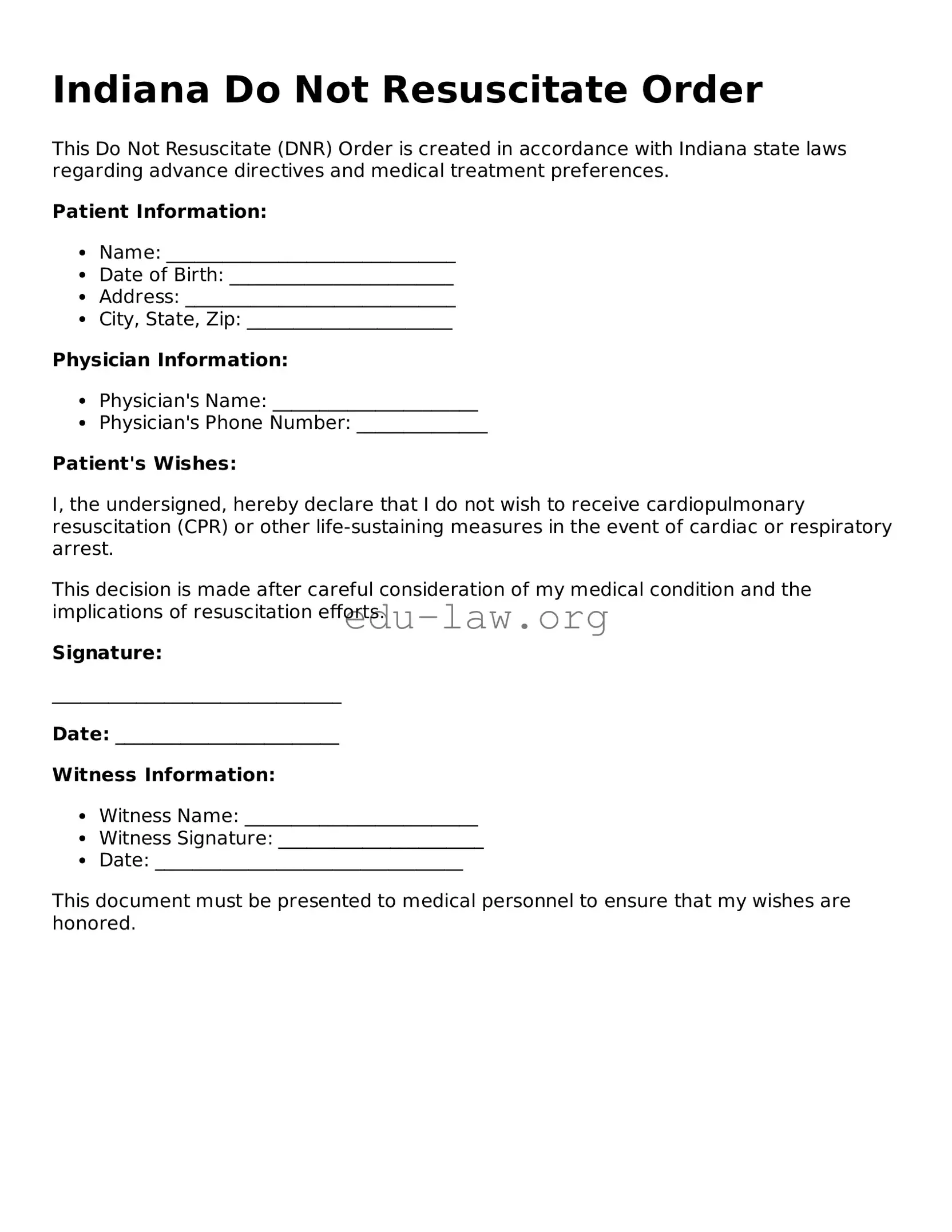
Indiana Do Not Resuscitate Order
This Do Not Resuscitate (DNR) Order is created in accordance with Indiana state laws regarding advance directives and medical treatment preferences.
Patient Information:
Physician Information:
Patient's Wishes:
I, the undersigned, hereby declare that I do not wish to receive cardiopulmonary resuscitation (CPR) or other life-sustaining measures in the event of cardiac or respiratory arrest.
This decision is made after careful consideration of my medical condition and the implications of resuscitation efforts.
Signature:
_______________________________
Date: ________________________
Witness Information:
This document must be presented to medical personnel to ensure that my wishes are honored.
| Fact Name | Description |
|---|---|
| Purpose | The Indiana Do Not Resuscitate (DNR) Order form allows individuals to refuse cardiopulmonary resuscitation (CPR) in the event of cardiac arrest. |
| Eligibility | Any adult who is capable of making informed decisions can complete a DNR order. |
| Governing Law | The Indiana DNR Order is governed by Indiana Code § 16-36-6. |
| Signature Requirement | The form must be signed by the individual or their legal representative to be valid. |
| Health Care Provider Role | Health care providers must honor the DNR order once it is properly executed. |
| Form Availability | The DNR order form is available online through the Indiana State Department of Health. |
| Revocation | Individuals can revoke their DNR order at any time, verbally or in writing. |
| Emergency Medical Services | Emergency medical services personnel are required to follow the DNR order in emergencies. |
Filling out the Indiana Do Not Resuscitate Order form is a critical step in expressing your healthcare preferences. After completing the form, you will need to ensure that it is properly signed and witnessed, and then share copies with your healthcare providers and loved ones.
What is a Do Not Resuscitate (DNR) Order in Indiana?
A Do Not Resuscitate Order is a legal document that allows a person to refuse resuscitation efforts in case of a medical emergency. In Indiana, this order is specifically designed for individuals who do not wish to receive CPR or other life-saving measures if their heart stops or they stop breathing. It reflects the individual's wishes regarding end-of-life care.
Who can create a DNR Order in Indiana?
In Indiana, any adult who is capable of making their own medical decisions can create a DNR Order. This includes individuals who are 18 years or older and can understand the implications of their choices. Additionally, a parent or legal guardian can create a DNR Order for a minor child.
How do I obtain a DNR Order form in Indiana?
You can obtain a DNR Order form from various sources, including hospitals, healthcare providers, or the Indiana State Department of Health website. The form is usually available for free. Make sure to fill it out completely and accurately to ensure it is valid.
What information is required on the DNR Order form?
The DNR Order form will require basic information, such as the patient's name, date of birth, and a statement indicating the desire for a DNR. It also needs to be signed by the patient or their legal representative and must be witnessed or notarized, depending on the specific requirements outlined in Indiana law.
Where should I keep my DNR Order?
It’s essential to keep your DNR Order in a place where it can be easily accessed in an emergency. Many people choose to keep it in their medical records or with their healthcare provider. You can also carry a copy in your wallet or purse. Make sure that family members and caregivers know where to find it.
Can a DNR Order be revoked?
Yes, a DNR Order can be revoked at any time. The individual who created the order can simply destroy the document or inform their healthcare provider that they wish to cancel it. It’s a good idea to communicate any changes to family members and caregivers to ensure everyone is aware of your current wishes.
What should I do if my DNR Order is not being honored?
If you believe your DNR Order is not being honored, it’s important to address the situation immediately. Speak with your healthcare provider or the facility staff to clarify your wishes. If necessary, you may want to consult a legal professional to understand your rights and options regarding the enforcement of your DNR Order.
Not providing a clear signature. A signature is essential to validate the form. Without it, the order may not be honored by medical personnel.
Failing to include the date. The date of signing is crucial. It indicates when the order becomes effective. Without a date, there could be confusion regarding the order's validity.
Omitting the patient's information. Essential details like the patient's name and date of birth should be clearly stated. Missing this information can lead to misunderstandings about who the order applies to.
Not discussing the order with healthcare providers. It's important to communicate the decision with doctors or caregivers. This ensures everyone involved understands the patient's wishes.
In Indiana, individuals may choose to create a Do Not Resuscitate (DNR) Order to express their wishes regarding resuscitation efforts in the event of a medical emergency. This document is often accompanied by several other forms and documents that help clarify a person's healthcare preferences and ensure that their wishes are respected. Below is a list of other important documents that may be used alongside the Indiana DNR Order.
Each of these documents plays a vital role in ensuring that an individual’s healthcare preferences are honored. By preparing and maintaining these forms, individuals can provide clear guidance to their families and healthcare providers, fostering peace of mind in challenging situations.
The Indiana Do Not Resuscitate (DNR) Order form shares similarities with the Advance Directive. An Advance Directive allows individuals to outline their healthcare preferences in case they become unable to communicate their wishes. Both documents empower patients to express their choices about medical treatment, ensuring that their desires are respected during critical moments. While the DNR specifically addresses resuscitation efforts, the Advance Directive encompasses a broader range of medical decisions, including life support and end-of-life care.
Another document akin to the Indiana DNR Order is the Physician Orders for Life-Sustaining Treatment (POLST). The POLST form translates a patient’s wishes regarding life-sustaining treatments into actionable medical orders. Like the DNR, it is designed for individuals with serious health conditions. Both documents aim to communicate patient preferences to healthcare providers, ensuring that treatment aligns with the individual’s values and goals.
The Living Will is also comparable to the DNR Order. A Living Will allows individuals to specify their wishes regarding medical treatment in situations where they are unable to express their preferences. While the DNR focuses specifically on resuscitation, the Living Will covers a wider array of medical interventions. Both documents serve to guide healthcare providers and family members in making decisions that honor the patient’s wishes.
Another similar document is the Healthcare Power of Attorney (HCPA). This legal document designates an individual to make healthcare decisions on behalf of a patient if they are unable to do so. While the DNR Order provides specific instructions about resuscitation, the HCPA allows for broader decision-making authority. Both documents ensure that patient preferences are upheld, but the HCPA is more comprehensive in scope.
The Medical Orders for Scope of Treatment (MOST) form is also related to the DNR Order. Like the POLST, the MOST form is designed for patients with serious illnesses and focuses on their treatment preferences. It includes options for resuscitation, hospitalization, and other critical care decisions. Both forms aim to ensure that medical interventions align with the patient's wishes, providing clarity for healthcare teams.
Another document that shares similarities is the Do Not Intubate (DNI) Order. The DNI specifically instructs healthcare providers not to perform intubation in the event of respiratory failure. While the DNR focuses on resuscitation efforts, the DNI is concerned with airway management. Both documents reflect the patient’s preferences regarding life-sustaining measures and are crucial in emergency situations.
Finally, the Comfort Care Order is relevant in this context. This document outlines a patient’s desire for palliative care rather than aggressive treatment in end-of-life scenarios. While the DNR specifies the refusal of resuscitation, the Comfort Care Order emphasizes comfort and quality of life. Both documents aim to ensure that the patient’s wishes are honored, particularly during critical and sensitive times.
When filling out the Indiana Do Not Resuscitate Order form, it is crucial to approach the process thoughtfully. Here are five important dos and don'ts to consider:
Understanding the Indiana Do Not Resuscitate (DNR) Order form is essential for both patients and healthcare providers. However, several misconceptions can lead to confusion and misinterpretation. Below are five common misconceptions about the Indiana DNR Order form, along with clarifications to promote better understanding.
This is not accurate. A DNR order specifically addresses the use of cardiopulmonary resuscitation (CPR) in the event of cardiac or respiratory arrest. It does not prevent other forms of medical treatment or care from being administered.
This is a common misunderstanding. While many individuals who choose a DNR order may be facing terminal illnesses, anyone can request a DNR order, regardless of their health status. It is a personal decision that reflects individual values and preferences regarding end-of-life care.
This is incorrect. A DNR order can be revoked or modified at any time by the patient or their authorized representative. It is important for individuals to communicate any changes in their wishes to their healthcare providers.
This misconception overlooks the broader applicability of DNR orders. In Indiana, a DNR order is valid in various settings, including at home, in nursing facilities, and during transport to medical facilities, provided it is properly executed and recognized by healthcare personnel.
This is a significant distinction. While both documents are related to end-of-life decisions, a DNR order specifically pertains to resuscitation efforts, whereas a living will outlines a person's preferences regarding a range of medical treatments and interventions. Understanding these differences is crucial for effective planning.
Addressing these misconceptions can help individuals make informed decisions about their healthcare preferences and ensure that their wishes are respected during critical moments.
Filling out the Indiana Do Not Resuscitate Order (DNR) form is an important step in ensuring that your healthcare preferences are respected. Here are some key takeaways to consider:
By keeping these points in mind, you can ensure that your DNR order accurately reflects your wishes and is prepared for any medical situation that may arise.