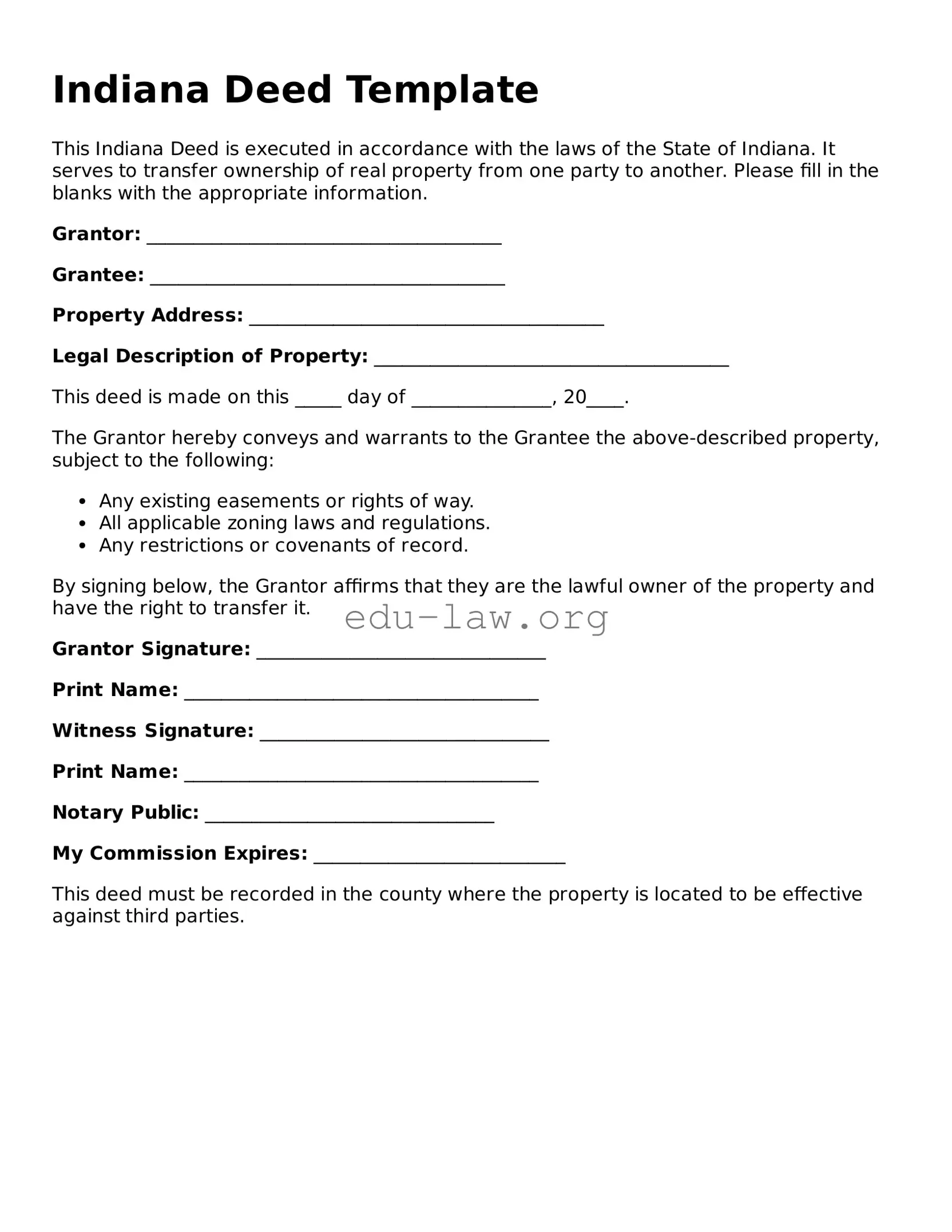
The Indiana Deed form plays a crucial role in real estate transactions within the state, serving as the official document that conveys ownership of property from one party to another. This form encompasses several key elements that ensure clarity and legal validity. It includes the names of the grantor, or seller, and the grantee, or buyer, as well as a clear description of the property being transferred. Additionally, the form outlines any relevant considerations, such as the purchase price or other forms of compensation. Notably, the Indiana Deed form must be executed with the appropriate signatures and notarization to meet state requirements. This ensures that the transfer of ownership is recognized by local authorities and can be properly recorded in public records. Understanding these components is essential for anyone involved in real estate transactions in Indiana, as they help safeguard the interests of both parties and facilitate a smooth transfer process.
Indiana Deed Template
This Indiana Deed is executed in accordance with the laws of the State of Indiana. It serves to transfer ownership of real property from one party to another. Please fill in the blanks with the appropriate information.
Grantor: ______________________________________
Grantee: ______________________________________
Property Address: ______________________________________
Legal Description of Property: ______________________________________
This deed is made on this _____ day of _______________, 20____.
The Grantor hereby conveys and warrants to the Grantee the above-described property, subject to the following:
By signing below, the Grantor affirms that they are the lawful owner of the property and have the right to transfer it.
Grantor Signature: _______________________________
Print Name: ______________________________________
Witness Signature: _______________________________
Print Name: ______________________________________
Notary Public: _______________________________
My Commission Expires: ___________________________
This deed must be recorded in the county where the property is located to be effective against third parties.
| Fact Name | Description |
|---|---|
| Purpose | The Indiana Deed form is used to transfer ownership of real property from one party to another. |
| Types of Deeds | Common types include Warranty Deeds, Quitclaim Deeds, and Special Warranty Deeds. |
| Governing Laws | The Indiana Code Title 32 governs real property transactions and deeds. |
| Notarization | Signatures on the deed must be notarized to be valid and enforceable. |
| Recording | The deed should be recorded with the county recorder's office to provide public notice of the property transfer. |
| Consideration | A nominal consideration must be stated in the deed, even if it is a gift. |
| Legal Description | A detailed legal description of the property must be included to clearly identify the land being transferred. |
After completing the Indiana Deed form, it will need to be submitted to the appropriate county office for recording. Ensure that all required signatures are present, and any necessary fees are prepared for payment.
What is an Indiana Deed form?
An Indiana Deed form is a legal document used to transfer ownership of real estate from one party to another in the state of Indiana. This form outlines the details of the property being transferred, including its legal description, and identifies both the grantor (the person transferring the property) and the grantee (the person receiving the property). Different types of deeds, such as warranty deeds or quitclaim deeds, serve various purposes and offer different levels of protection to the parties involved.
What types of deeds are available in Indiana?
In Indiana, several types of deeds can be used, each serving a specific purpose. The most common types are the warranty deed, which guarantees that the grantor has clear title to the property; the quitclaim deed, which transfers whatever interest the grantor has without any guarantees; and the special warranty deed, which offers limited warranties that apply only to the period the grantor owned the property. Choosing the right type of deed depends on the circumstances of the property transfer and the relationship between the parties.
How do I complete an Indiana Deed form?
Completing an Indiana Deed form requires accurate information about the property and the parties involved. Start by entering the names and addresses of the grantor and grantee. Next, provide a detailed legal description of the property, which can often be found in the property’s current deed or tax records. Ensure that all signatures are notarized to validate the document. After completion, the deed must be filed with the county recorder's office where the property is located to make the transfer official.
Is it necessary to have a lawyer when preparing an Indiana Deed?
While it is not legally required to have a lawyer to prepare an Indiana Deed, consulting with one can be beneficial. A lawyer can help ensure that the deed is filled out correctly and complies with state laws. They can also provide guidance on the implications of the transfer and advise on the best type of deed to use for your situation. If you are unsure about any aspect of the deed or the transfer process, seeking legal advice is a wise choice.
What happens after the Indiana Deed is filed?
Once the Indiana Deed is filed with the county recorder's office, it becomes a public record. This means that anyone can access it, which helps establish the new ownership of the property. The grantee should keep a copy of the deed for their records. Additionally, the transfer may affect property taxes, so it’s important to notify the local tax authority about the change in ownership. The new owner should also consider updating any relevant insurance policies to reflect the change in ownership.
Not including the correct names of the grantor and grantee. Ensure both parties' names are spelled correctly and match their legal identification.
Failing to provide a complete legal description of the property. This description should be precise and can often be found in previous deeds or property records.
Omitting the date of the transaction. The date is important for record-keeping and establishing the timeline of ownership.
Not signing the deed in the presence of a notary. A notary's acknowledgment is often required to validate the document.
Using the wrong type of deed. Different types of deeds serve various purposes, such as warranty deeds or quitclaim deeds. Choose the appropriate one for your situation.
Neglecting to check for any existing liens or encumbrances on the property. This oversight can lead to complications after the deed is recorded.
Forgetting to include any necessary attachments or additional documents. Some transactions may require supporting paperwork, such as a property survey.
Not recording the deed with the county recorder's office after completion. Failing to do so can result in challenges to ownership in the future.
When completing a property transaction in Indiana, several forms and documents may accompany the Indiana Deed form. Each of these documents serves a specific purpose in ensuring a smooth and legally sound transfer of property ownership. Below is a list of commonly used documents.
Understanding these documents is crucial for anyone involved in a property transaction in Indiana. Each plays a vital role in protecting the interests of all parties and ensuring compliance with state laws.
The Indiana Quitclaim Deed is similar to the Indiana Deed form in that both documents transfer property ownership. However, a Quitclaim Deed does not guarantee that the grantor holds clear title to the property. It simply conveys whatever interest the grantor has, if any. This type of deed is often used between family members or in situations where the parties trust each other, as it offers less protection to the grantee compared to a warranty deed.
The Warranty Deed is another document closely related to the Indiana Deed form. Unlike a Quitclaim Deed, a Warranty Deed provides a guarantee that the grantor holds clear title to the property and has the right to sell it. This document protects the buyer from any future claims against the property. It is commonly used in traditional real estate transactions where buyers seek assurance of their ownership rights.
The Special Warranty Deed is similar to a Warranty Deed but with a key difference. It only guarantees that the grantor has not encumbered the property during their ownership. The grantor does not make any promises about the title prior to their ownership. This type of deed is often used in commercial transactions or by banks when selling foreclosed properties.
The Bargain and Sale Deed is another type of deed that conveys property but does not provide any warranties. It implies that the grantor has the right to sell the property but does not guarantee a clear title. This document is often used in real estate transactions where the seller may not have a long history of ownership or where the buyer is willing to accept some risk.
The Grant Deed is similar to the Indiana Deed form in that it transfers ownership of real property. It typically includes implied warranties that the property has not been sold to anyone else and that there are no undisclosed encumbrances. This type of deed is commonly used in some states and provides more assurance than a Quitclaim Deed but less than a full Warranty Deed.
The Life Estate Deed allows a property owner to transfer ownership while retaining the right to live in the property for the rest of their life. This deed is similar to the Indiana Deed form in that it transfers an interest in real estate, but it establishes a life estate, creating a unique arrangement between the grantor and the grantee.
The Trustee’s Deed is used when a property is sold by a trustee, often in the context of a trust or foreclosure. This deed transfers ownership similarly to the Indiana Deed form but involves a fiduciary duty. The trustee acts on behalf of the beneficiaries, and the deed confirms the sale of the property under the terms of the trust.
The Deed of Trust is a security instrument that involves three parties: the borrower, the lender, and the trustee. It is similar to the Indiana Deed form in that it involves real property, but it secures a loan by placing a lien on the property. If the borrower defaults, the lender can foreclose on the property through the trustee.
The Affidavit of Title is not a deed but is often used in conjunction with deeds. It provides a sworn statement about the status of the property title. While it does not transfer ownership, it serves as a supplement to other deeds, offering assurance about the title’s validity, similar to the warranties provided in a Warranty Deed.
When filling out the Indiana Deed form, it's important to follow certain guidelines to ensure accuracy and compliance. Here are some dos and don'ts to keep in mind:
When it comes to the Indiana Deed form, there are several misconceptions that can lead to confusion. Understanding these can help ensure that property transactions go smoothly. Here are four common misunderstandings:
Many people believe that all deeds serve the same purpose. However, there are different types of deeds, such as warranty deeds and quitclaim deeds, each serving a unique function in property transfers.
While notarization is an important step in many transactions, not all deeds in Indiana require notarization to be legally binding. Some deeds may only need to be signed by the parties involved.
Another misconception is that deeds are only needed when property is sold. In reality, deeds can also be used for gifting property, transferring ownership between family members, or even in divorce settlements.
Many believe that once a deed is recorded, it is set in stone. However, deeds can be amended or corrected if there are errors or changes in ownership, provided the proper legal procedures are followed.
By addressing these misconceptions, individuals can navigate the process of property transfer in Indiana with greater confidence and clarity.
Filling out and using the Indiana Deed form requires careful attention to detail. Below are key takeaways that can help ensure a smooth process.
By following these key points, individuals can effectively fill out and utilize the Indiana Deed form to facilitate property transfers.